
- 26,550
- 31,075
Yeseveryone still on about twink blonde ninja, blue majin buu, and gaming keyboard guy?
Follow along with the video below to see how to install our site as a web app on your home screen.
Note: This feature may not be available in some browsers.
Yeseveryone still on about twink blonde ninja, blue majin buu, and gaming keyboard guy?



USklaverei/sandboxFlashyandNinjasfast
vsbattles.fandom.com


The limestone crack speed link doesn't work.USklaverei/sandboxFlashyandNinjasfast

times like this is when i'm really reminded vsdebating fans are wildUSklaverei/sandboxFlashyandNinjasfast


Actually, this link is not working, but I think the brick one should work, since the bridge was that.The limestone crack speed link doesn't work.

The canon width is like crazy as far as I know, and clearly contradicts the shown sizeAlso the calc didn't use the canon width of the cave, but the old out of date fan calc version.
About a third of of calced size.What’s the canon width
The numbers come from ONE. So it's Murata contradicting the author, not the other way around.clearly contradicts the shown size

And for the limestone speed would u use 3500 or 6000?About a third of of calced size.
The numbers come from ONE. So it's Murata contradicting the author, not the other way around.

Normal humans in opm are already superhumans(kid saitama) and by now we already know that ppl in opm who just train become superhumans (a lot of heroes, tank toppers,dk fans...etc) so a very highly trained pilot being a superhuman to a degree wouldnt be suprising reallyHe used superhuman reactions for a regular human ( albeit a jet pilot ) doubt it gets accepted

The canon width of the cave should not be used. It's ridiculous, Brave Giant travelled at least 27 floors by my count before it reached the cavern, and in the very same panel where Brave Giant says that, I count 23 floors between Brave Giant and the water's surface. Are those floors each really about 2 meters on average??Also the calc didn't use the canon width of the cave, but the old out of date fan calc version.
I dont see why they couldn't be in some cases. The entire underground base heavily varies in room sizes. It also was a rewrite ONE more or less forced Murata to do since that was like the 4th version of that encounter. If he didn't want the dialogue in there he wouldn't have included it.Are those floors each really about 2 meters on average??
Was gonna make that point, OPM canon sizes are quite wack.The canon width of the cave should not be used. It's ridiculous, Brave Giant travelled at least 27 floors by my count before it reached the cavern, and in the very same panel where Brave Giant says that, I count 23 floors between Brave Giant and the water's surface. Are those floors each really about 2 meters on average??
Even so, that's very small. The stories in my house are 3 meters from floor to ceiling, and they would struggle to fit the likes of Bug God. 3.5 meters might fit the larger members of the Monster Association, but there's no way Brave Giant could fit in a space of that size, or Overgrown Rover, Great Food Tub, G-5, etc. Those guys are all 5-10 meters tall, so I would think the larger floors would be something like 10 meters to fit larger members and the smaller ones more like 3 meters, enough to comfortably fit creatures about as large as humans.If we use the Brave Giant positioning, it's about 3.5 metres per larger storey if we go half-way through the ceiling and half-way through the floor. The actual spaces in between is something like 2.2-2.6 metres, while the smaller ones are around 1 metre.
But there is the second, where is the shear.Just as I thought. Those are P-Wave velocities. That's not the speed that limestone cracks at, it's the speed of sound in limestone. It's like arguing that diamond cracks at mach 35 because the speed of sound travels at mach 35 in diamond.
Fair enough. I just wish ONE (or Murata or whoever is making these numbers) would stay away from math. About half the time the canon sizes don't line up well with the manga appearances at all. Or even better, they can hire me to pixel scale every character in every single panel they appear in and I will make the canon sizes for them, heheI agree, just mentioning the size in the panel you gave.
It's probably Murata's fault. ONE is the one who does the majority of the dialogue and plotting while Murata does art and a decent chunk of thr character designs. Murata goes for big flashy stuff which doesn't fit with ONE'S ideas.I just wish ONE (or Murata or whoever is making these numbers) would stay away from math
What?But there is the second, where is the shear.

How is he Superhuman exactly?Normal humans in opm are already superhumans(kid saitama)
Because of this? As far as i know there's no Athletic or Peak human that is wall levelHow is he Superhuman exactly?
survived a wall level attack from the piggy monster. i think...How is he Superhuman exactly?


Do itFair enough. I just wish ONE (or Murata or whoever is making these numbers) would stay away from math. About half the time the canon sizes don't line up well with the manga appearances at all. Or even better, they can hire me to pixel scale every character in every single panel they appear in and I will make the canon sizes for them, hehe
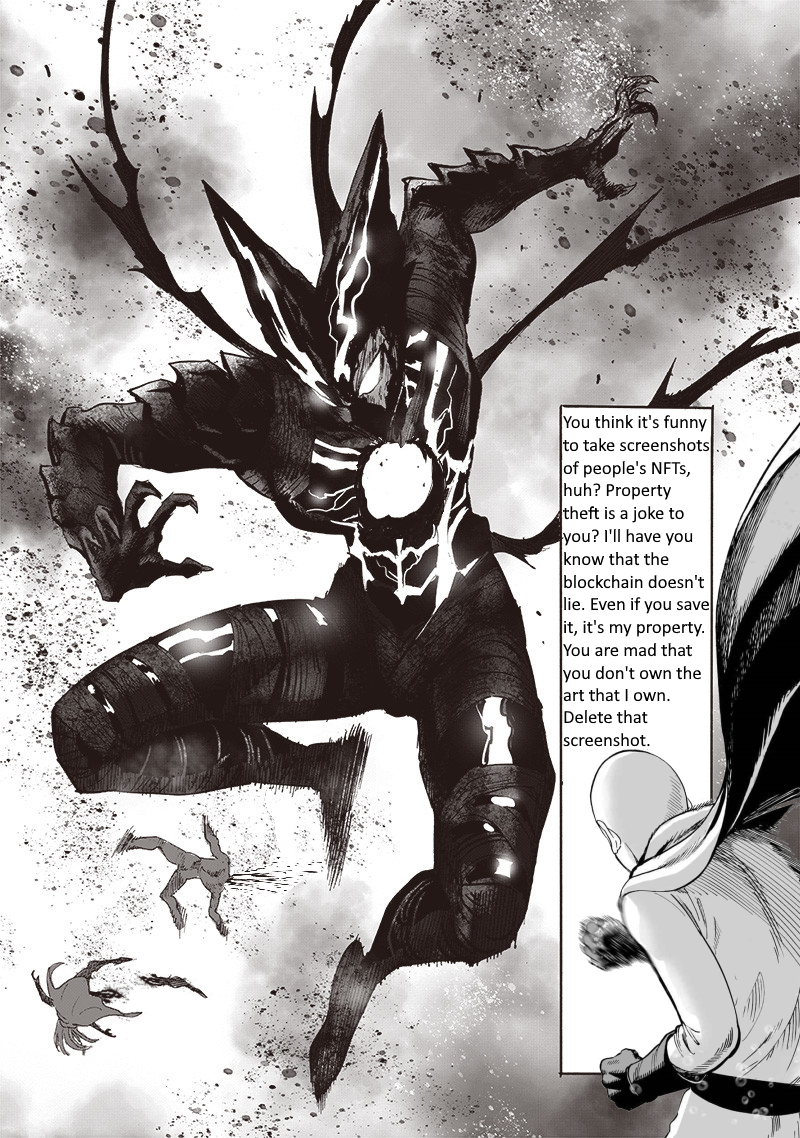

I have an interesting idea. What if instead of counting the number of stones on the GENERAL background (2711), we just find the average number of stones in 100 cubic meters of space? We will take the mass of the largest stones and add to the mass of the lightest and tallest stones and so find the average mass, and then multiply their number in 100 cubic meters of space by the volume of space in which they are located?How are you proposing the calc should be altered?

Yeah, we could do that but I don't know how that'll affect the calc. I say you can use the page right after the stomp as it is easier to see and count the stones that were sent flying. From that we can find rocks of three diff. sizes: Large, Medium and Small and then after finding the mass of one such rock, we can multiply it by the number of rocks in each category.I have an interesting idea. What if instead of counting the number of stones on the GENERAL background (2711), we just find the average number of stones in 100 cubic meters of space? We will take the mass of the largest stones and add to the mass of the lightest and tallest stones and so find the average mass, and then multiply their number in 100 cubic meters of space by the volume of space in which they are located?
Here and here we see their number in space. It's just that 2711 is too little. At an altitude of 100 or a little more meters in a radius of hundreds of meters, there ALREADY more than 100 stones, and we have a huge scale. 2711 is too unrealistic. Otherwise, it would mean that one stone is in every 700 meters of cubic space (According to rough calculations)
The distance they were launched remains the same though.Yeah, we could do that but I don't know how that'll affect the calc. I say you can use the page right after the stomp as it is easier to see and count the stones that were sent flying. From that we can find rocks of three diff. sizes: Large, Medium and Small and then after finding the mass of one such rock, we can multiply it by the number of rocks in each category.


