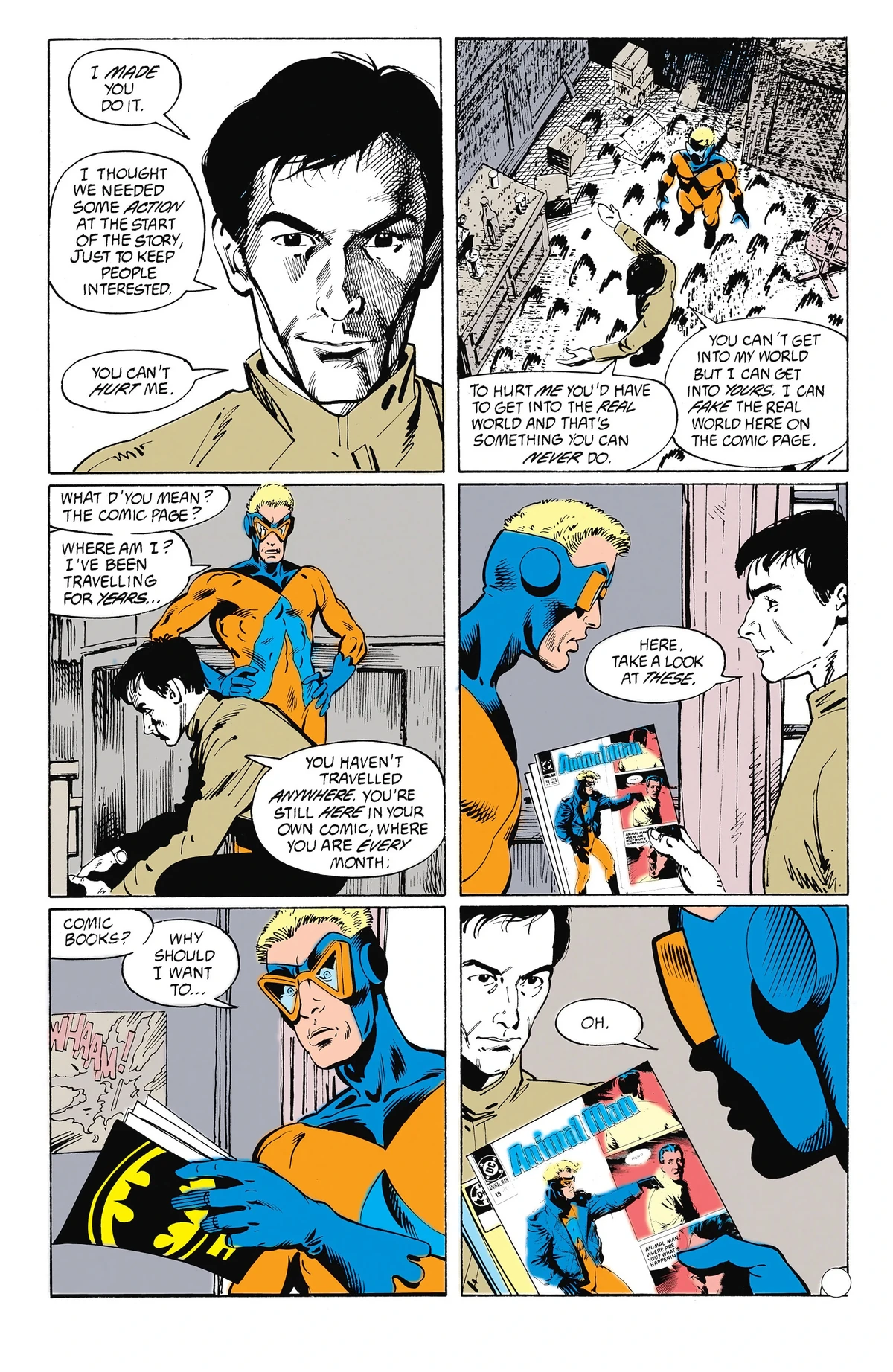
Crawling back from the grave, I guess.
Also valid interpretation of this would be: Undertale is a videogame that has meta elements deeply connected to its narrative and world building, characters and the story telling only consider these elements and mechanics as natural, and this is made so the narrative of the consequences of your actions is much more apparent, as even in this videogame environment, these are "actual people". (As in, your genocidal actions, or someone else's do really affect their lives, and it's not fair for you to just judge them coldly as videogame characters).
I don't see how this serves as a counterargument, really. What you are outlining to me is effectively just a literary analysis of Undertale that, correct or not, ultimately does not in any way undermine the in-universe perspective of the text, in which the game mechanics are very much cosmological elements, as evidenced by the numerous examples I've listed, some of which are undeniably fundamental parts of the story (SAVEs and LOADs, for instance). "These things are just there to help the story convey a specific message or theme" doesn't take away from the fact that said things very much exist and are acknowledged as existent elements of the world.
Furthermore, one thing I was warry to bring up beforehand because of the potentially dubious status of it is the
dirty hacker ending. As CosmicWreck pointed out, if Sans' profile is anything to go by, we consider it to be canon (To my surprise). So, I suppose that's another thing that goes to the list of fourth wall breaks that happen in the game, and which obviously point to Undertale generally treating itself as one.
Continuing into the paragraph below...
Of course the interaction with an actual player is what makes the difference, this is exactly why I addressed my example as "not being perfectly comparable". The narrative of Undertale much more points towards your interpretation than your average Isekai, but naturally, the intent of the examples was not to debunk your arguments in their entirety, but rather address a flaw in its basis.
You say there is a flaw, but as of yet, you haven't really pointed out what, exactly, this flaw is. Or at least you haven't elaborated too much on it: You say that the videogame mechanics and the faked interaction between the game and its audience being integral to the narrative and the setting don't necessarily point to the conclusions drawn by me and the OP, but you haven't explained
why that is the case. In fact, from what I see, you agreed with my assessment that the counterexamples you gave weren't really perfectly comparable to Undertale's case, so given that, your claim of "
Meta Elements or Mechanics can be applied to a narrative without something like what you are implying" still goes unsubstantiated.
Yes. But it actually gives us a reasonable interpretation.
The anomaly very much exists in space-time continuum. It's a fictional force that's very much present inside the universe of Undertale. It's addressed by the narrative directly.
None of this disagrees with Low 1-C, necessarily. Even in a scenario where we accept the existence of a Reality-Fiction Difference here, what we would be rating obviously wouldn't be the actual, real life player, just a fictionalized version of them, for the purposes of the wiki, no different from how other author characters that are indexed here are. Moreover, Sans saying there is
a massive anomaly in the timespace continuum doesn't act as counterevidence for anything, because "anomaly" just means "somehow deviating from the standard scenario." Sans in that monologue is primarily talking about the fact the timeline has been going crazy as of late, so of course that event would be called an anomaly in the spacetime continuum.
So, again, neutral fact that doesn't lend anything to either side of the discussion.
In 1 verse videogame characters from inside a game can be as fictional as in our real world, in another verse they can have many real qualities to them that real people can see, the game characters can think, act, live in the present like real people, and harm real people if they're in the same room, but they're still fictional by the mere fact that "they're videogame characters inside a game", just because that sentence can be said & be correct. In 1 verse comics may be as fictional as in the real world, in another they may lead to their comic universe where they have the same real qualities said before, but they still are fictional characters as from certain perspective they come from a comic, calling them real or fiction in-universe both work just as good.
Elaborating the latter; fictional works can do anything, they can have animals have human or god-like features, laws of physics exaggerated, etc. Among it they can have places being real that we, real people, would see as fiction. Especially if they take inspiration from sources like religions or ideas in psychology that already propose that and have "fictional" things as even with real things (Matter and mind being equal and existing on their own planes, for example, as the latter plane or world can be called imaginary, and imagination is fiction to us in the real world. Similar with dream worlds). As such, to "See/perceive other realities as fiction" is a very vague standard, it can absolutely lead to characters being Low 1-C, sure, but things being fiction to some characters isn't the same as things being fiction to other characters, and based on what we know of the anomaly, they being Low 1-C could not possibly be concluded.
So what you're saying is "There are many ways of seeing something as fiction, and the one that gives Low 1-C shouldn't necessarily be the default"? If so, then I'd say that's not really something that our standards consider to be a thing. To quote the Reality Equalization page:
Additionally, Reality Equalization cannot apply to virtual worlds that exist parallelly to the real world, as those are simply alternate universes, not lower of planes of reality. It also cannot apply to AIs or other electronic entities, as those do not meet the requirements for existing in a lower plane of reality and are instead mere sentient electrical signals.
To elaborate a bit more on cases of this nature: If, for example, there is a parallel universe that just so happens to be one where the events of other universes are stored as works of fiction (In the vein of Earth-33 from DC), then that would be disqualified from any sort of Reality-Fiction Transcendence because the "real world people" there don't actually hold any sort of transcendence over said works. They are as real as the entities they believe to be characters, and the latter are, speaking from an objective, physical standpoint, no more fictional to them than long-gone historical figures whose biographies are chronicled in books are to us. That would be a case where there is not any form of literal reality-fiction interaction at play, regardless of whatever semantics you want to play around with.
As for the examples you brought to the table: Frankly, they seem to be makeshift ones, so I'd rather you bring up some concrete instances of things that happen in named verses. I really don't think discussing potential slippery slopes that don't actually exist is very productive. As far as I see, none of what you keep saying applies to Undertale.
I'm not sure if I was ignored. The world outside the baseline world would not have applied the same generosity the baseline world would to get for match-ups and their calcs validated.
Sword Art Online,
The Matrix and
Yume Nikki are the examples the page gives and all have their real worlds with characters there with regular stats, not Low 1-C, because why would the "equalization" of reality reach there. Nothing would make natural and intuitive for the anomaly to be Low 1-C.
Not particularly familiar with our treatment of those three cases. I could hazard a guess that they either fall under the above clause in the Reality Equalization page, or that the "real" and "fake" worlds are equally prominent, story-wise, in a way that makes it impossible to treat one as transcendent over the other (I know this is the case in Matrix and Yume Nikki, at least, with the aforementioned tidbit in our article for RE applying especially to the former), but I'd be speaking out of turn here.
Since he seems to have written the Reality Equalization page to begin with, I suppose we could ask Saikou about it?
That would be an opinion, and one I easily disagree with. If there is a would-be Low 1-C character due to "the Reality-Fiction difference [being] something literal", and they can be harmed by what they see as fiction, then that's an anti-feat for them, and the Reality-Fiction difference isn't something literal & legit but has other mechanics to it, which would mean that them being Low 1-C is wrong.
That would depend on a lot. It can easily be that the character that is being seen as fiction happens to have Tier 1 AP, for instance. Otherwise, though, this example is phrased very incoherently: "Well, what if the Reality-Fiction Difference between two characters is established as literal, but it also isn't?".
Otherwise: What I am saying is not really a personal opinion, no, those are our standards, and in the context of this thread, your disagreements with them mean nothing, I am sorry to say. If you want to change our rules on how Reality-Fiction Differences are dealt with, then you are welcome to make another thread, but don't try to stall progress in this one solely because of this.
More importantly I feel like most people are ignoring the main problems here. Yes, there is overwhelming evidence that Undertale is a game. The main issue is there is no evidence being brought up that indicates the characters within it, whether The Player or not, are any more or less real or powerful for it
Undertale being perceived as a literal videogame at all while simultaneously being its own, self-contained world would already be taken as evidence of such, so I don't think this is a relevant concern, unless the suggestion is that the Player perhaps just exists in some universe that's disconnected from the gameworld but not transcendent over it (Similar to the scenario I spoke about to Eficiente up there).
You also mentioned the Annoying Dog, but we don't seem to treat him as relevant to the cosmology to begin with, at present, so I don't know how important he is as an example. And even then there's the fact he's just an authorial insertion, and not really Toby Fox "in the flesh" so to speak.