• This forum is strictly intended to be used by members of the VS Battles wiki. Please only register if you have an autoconfirmed account there, as otherwise your registration will be rejected. If you have already registered once, do not do so again, and contact Antvasima if you encounter any problems.

    For instructions regarding the exact procedure to sign up to this forum, please click here.
  • We need Patreon donations for this forum to have all of its running costs financially secured.

    Community members who help us out will receive badges that give them several different benefits, including the removal of all advertisements in this forum, but donations from non-members are also extremely appreciated.

    Please click here for further information, or here to directly visit our Patreon donations page.
  • Please click here for information about a large petition to help children in need.

Dragon Ball Z Multiplier Removal

Status
Not open for further replies.
Got permission from @Nierre

A response to this:
Got perms from KT...
-snip-
Let's gooooo....

First of all, @Chariot190, let me start by doing something called sift gold. You see, I like simple, we love simple, and for some reason you love adding fluff to your arguments, straight up filler, repetitive stuff to reinterate the exact same argument, because breaking down what you're actually trying to argue for would make it more susceptible for proper debunks.

So, first, let me point out all the pointless fluff in your argument to better paint what I mean:

  • “Later feats do not validate the chain”: about 6 times.
  • “Unknown gaps don’t prove anything”: about 11 times.
  • “Frieza/Cell are cherry-picked anchors”: about 9 times.
  • “Conservative scaling is not validation”: about 16 times.
  • “Chain overshoots/undershoots”: about 8 times.
  • “Speed scaling lacks supporting feats”: about 5 times.
  • “The chain is disconnected from actual feats/showings”: about 11 times.
He said the manga overshoots the scaling several times in the span of two paragraphs. He is just repeating the same argument ad infinitum and making it unnecessarily long so no one would actually read it.

A non-exhaustive list:
  • "A later feat does NOT validate the multiplier chain leading up to it"
  • "It only proves Frieza has that feat"
  • "How does that prove Guldo, Jeice, Recoome..."
  • "It doesn't prove a thing"
  • "Neither of those prove every multiplier stack"
  • "A high Frieza feat proves Frieza has a high feat. A high Cell statement proves Cell has a high statement."
  • ...and so on.
This is approximately a 2,000-word argument that could be made in 200 words. The core logic is sound and worth engaging, but the repetition is so heavy that it basically makes the argument a drag to read through because, "hey, you're making the SAME POINT AGAIN, I JUST READ THAT"

So, this is the actual argument being made, without the fluff:
  • A high feat from Frieza or Cell does not retroactively validate every multiplier step leading up to them.
  • Unknown ">>>" gaps between characters are unknowns, not evidence the chain is conservative.
  • The chain undershoots Frieza/Cell but overshoots everything after Cell, proving it isn't consistently grounded in anything.
  • Speed feats especially never catch up to what the multiplier chain implies, making the speed scaling even less defensible.
  • Therefore, multiplier stacking in DBZ is largely disconnected from actual material and shouldn't be treated as precise or validated scaling.
That's it. That's all his points.

THAT'S what I'm going to reply to here:
Chariot, what you're doing here is essentially manufacturing an unreasonable evidentiary standard, one where the only series capable of having their ratings accurately depicted are ones that conveniently pump out a perfectly aligned feat every arc, for every character, at every tier.

That's a standard specifically designed to be impossible to meet, and conveniently, it only ever gets applied when someone wants to dismiss a scaling chain they personally dislike.


Think about what you're actually demanding for a second.
You're asking that a series written weekly over the course of decades, somehow produce a continuous unbroken stream of feats that neatly corroborate every step of a scaling chain. No series does that. Not Naruto, not Bleach, not One Piece, not anything on the wiki. The reason the wiki exists, the reason scaling methodology exists at all, is precisely because fiction doesn't hand you a perfectly calibrated stat sheet. If it did, you wouldn't need a scaling chain. You'd just read the number off the page.

The entire premise of your critique assumes the chain should function like a precise scientific instrument, and then faults it for not doing so, while ignoring that no tool built from the material available could ever meet that bar. You didn't establish a reasonable threshold and find the chain wanting. You established an impossible threshold and then declared victory for finding it unmet.

You don't generate plausible deniability in any meaningful capacity here, because the existence of feats that scale above the chain somehow isn't evidence for you.

"The unknown gaps that aren't accounted for" somehow don't explain the margin between the chain and the feat.

You're demanding a level of mechanical consistency that no narrative work of fiction, let alone a weekly manga written across decades by one man with an admittedly loose relationship to his own numbers, is ever going to produce. And more importantly, no scaling methodology on any major VS wiki actually demands that either. You've invented this requirement from whole cloth and are now using it as your primary metric of validity. That's a goalpost you personally installed.


And the really frustrating part is that this invented standard only flows in one direction. You use it to dismiss the chain when feats overshoot it, but the moment we'd try to use that same logic in reverse, applying the same skepticism to any individual feat that looks suspiciously high or suspiciously low, suddenly the feats are sacrosanct and beyond question. It's the shape of a motivated argument. You've constructed a heads-I-win, tails-you-lose framework where the chain is always suspect for not being 1:! with isolated feats, thus not reliable, and you've dressed it up in the language of rigor to make it look like principled methodology. It isn't. It's selective skepticism applied in exactly the direction needed to reach your preferred conclusion, and if you're going to hold the chain to this standard, you need to hold every individual feat calculation to the same standard, including all thirty-odd interpretations of the Planet Vegeta destruction, or the argument is just nakedly inconsistent.

The chain has never, at any point, been presented as a definitive, precision-mapped declaration of exact AP values.

It has always been a low-end approximation built from the canonical multipliers and power level gaps the story itself provides. I've literally proven it here.

The moment you start critiquing it for failing to be something it never claimed to be, the entire weight of your argument collapses, because you're not actually rebutting the chain on its own terms. You're rebutting a strawman version of it that exists only in the framing of your own post. This distinction matters enormously and I genuinely cannot stress it enough. A low-end, by definition, is expected to come in below the true value. That is the entire function of a low-end. When you construct one, you are consciously and deliberately building something that undershoots, because you are only accounting for what can be directly and conservatively established from the material, and you are leaving out everything that can't be nailed down with precision.

In fact, undershooting is not a problem. It just isn't. That just means the characters that have a canonical gap should be higher than what they're indexed, we've closed the actual threshold of their scaling, before it was "between Planet and Small Star" to "Between Dwarf Brown and Small Star".

So when you look at the output of a low-end and go "this is below the feat," you have identified the low-end functioning exactly as designed and labeled it a failure.

The chain is not trying to nail the exact value. It never was. Critiquing it for not doing so isn't a substantive rebuttal of the methodology. It's a demonstration that you've fundamentally misunderstood, or deliberately misrepresented, what the chain is actually for.


And look, if higher feats don't prove the chain is viable, and the complete absence of AP anti-feats doesn't make it more acceptable, then I genuinely need you to explain what you would accept as evidence. Be specific. Are you asking for a feat that aligns within some acceptable margin every ten chapters? Every twenty? What margin qualifies as close enough? Because you never actually tell us.

You just keep saying things don't line up without establishing what lining up would even look like for you, which means your standard is functionally unfalsifiable. There is no result the chain could produce that you couldn't dismiss under the framework you've built, because if it's "below the feat", the chain is wrong, and if it were somehow exactly at the feat, you'd argue it was cherry-picked to match. An argument with no possible counterexample isn't a rigorous position. And more to the point, if your answer to "what would you accept" is "the feat needs to land close to the chain's result," then you've already conceded the argument, because the chain is a deliberate low-end that doesn't account for arbitrary training gains, rage amplifications, the passive power growth that happens between stated benchmarks, mid-arc power spikes, the effects of zenkai boosts, or any of the numerous unquantified ">>>" gaps you keep citing as problems. Those aren't holes in the chain. Those are documented, narrative-supported reasons why the actual values are higher than the chain suggests.


Let me give you a concrete example of exactly this happening, since apparently it needs spelling out directly:
  • Piccolo Jr. (unweighted) is [several times stronger]() than Piccolo Daimao, Goku (unweighted) is equal to him. "Several times" meaning at low-ball 3x: >9.00938205546 Yottatons (Large Planet level)
  • Goku and Piccolo grow stronger than their 23rd Budokai selves, and are comporable to one another: >9.00938205546 Yottatons (Large Planet level)

That increase is not accounted for in the standard chain. It's just noted as "stronger than before" and left unquantified. And this happens repeatedly, not once, not twice, but multiple times across multiple arcs, at multiple different points in the story's progression. Each one of those unaccounted growth instances pushes the real value further above the chain's conservative floor.

The chain is a FLOOR.

So when you look at the final result and go "wow, the chain undershoots Frieza," you are literally just observing the cumulative effect of all those unaccounted upward deviations stacking on top of each other. You're watching the low-end function correctly and calling it a contradiction.

Beyond just Piccolo and Goku at the Budokai, consider the growth that happens during the journey to Namek, the training in the spaceship, the zenkai boosts from near-death experiences that are narratively significant but never given hard multipliers, the power Goku demonstrates against the Ginyu Force that already exceeds what a strict chain reading would suggest.

Every single one of those moments is the story telling you, in plain terms, that the characters are above where a conservative chain would place them. That's the chain being appropriately humble about what it can prove, and the story filling in the gap above it exactly as you'd expect.

Also, the chain uses the feats. It uses its values and then starts using multipliers again.


Now, on the Cell point specifically, your argument weakens considerably and actually inverts when you look at it closely.

4-B is an extraordinarily large tier.

And this might be news, but THE CALCULATED VALUES ARE NOT CANON! They are not! That means all the scaling chain NEEDS to do is getting in a similar ball park, the actual gap isn't relevant because the author is literally not aware of them.

"He is far above Goku who chains scales as nearly Solar System level, it makes sense he'd produce a 1.053 KiloFoe SS feat."

The chain, using exclusively canonical multipliers and stated power gaps from the story itself, gets close enough to Cell's Solar Kamehameha scaling that the remaining margin is well within what the unaccounted gaps we've already established would cover.

You called the gap "over 1000x" and framed it as damning, as though 1000x is some insurmountable chasm that proves total disconnection. In the context of 4-B, where the tier itself spans values that make 1000x look trivial, it genuinely isn't the devastating indictment you're presenting it as.

And that's before we factor in all the unaccounted growth instances between the 23rd Budokai and the Cell Saga that we've already established aren't captured in the chain. Add those in and the gap closes further.

Beyond that, Gohan's physicals aren't 1000x below the Kamehameha. They're roughly 10x below it, a detail that significantly changes the picture you painted. The reason the Kamehameha scales where it does is a legitimate, canonical one rooted in the story's own stated power relationships. The characters who earn that scaling earn it through the story's own internal logic. That's the chain following the material to its natural conclusion and arriving in the right general neighborhood, which is exactly what it's supposed to do.


And then there's your claim about the chain after Cell overshooting by some incomprehensible degree, which you presented with dramatic rhetoric about millions and billions and total detachment from reality, but conspicuously, devastatingly, without a single actual number or a single actual anti-feat to anchor any of it.

You made this claim with enormous confidence and zero supporting data.

Let's actually run it, since you apparently declined to.

Super Saiyan 3 Goku sits at roughly 5.2650 MegaFoe by standard chain math. Cell is at roughly 1.0530 KiloFoe. That is a gap of approximately 5000x between Cell and SSJ3 Goku, the single most powerful form Goku uses in the entirety of Dragon Ball Z. Not millions. Not billions. Five thousand times. That's the gap you described as the chain shooting off into incoherence.

Now account for the fact that SSJ3's multiplier itself is one of the more conservatively established ones, that the fusion bonuses for Vegito aren't fully quantified in the chain, that Buu Saga power growth follows the same pattern of unaccounted spikes we've documented throughout the series, and suddenly even that 5,000x gap starts looking like exactly what you'd expect from a low-end that's working properly. For the gap to even begin approaching the millions you dramatically invoked, you'd need to push to Vegito at full power using his absolute strongest output under the most aggressive possible reading. And it makes sense for Vegito and him alone to be that much stronger than Cell.

That's the chain arriving at a defensible range that requires cherry-picking the most extreme possible reading of the most powerful character in the verse to even start challenging it meaningfully.


Your only offered anti-feat for the post-Cell era would be Kid Buu destroying a planet. Casually. A feat that is, by the narrative's own framing and context, nowhere near Kid Buu's upper limit, performed in a throwaway moment with zero effort, zero escalation, zero dramatic weight attached to it as a display of power. The arc frames Kid Buu as an existential threat to literally everything, a being so dangerous that the gods themselves were scrambling for solutions, a character explicitly stated to be beyond what even a fully powered Super Saiyan 2 could handle. And a casual, effortless, throwaway planetary destruction from this character doesn't represent his ceiling. One cannot use an effortless low-output moment from a character the story frames as cosmically threatening as a hard cap on that character's capability without simultaneously contradicting everything the narrative is telling you about that character's significance.

If you were to actually commit to that reading and scale everything post-Cell to Kid Buu's casual planet bust as a ceiling, you'd produce results so absurdly low that they'd contradict the story's own internal logic at every level, which is why nobody does that, including you. You don't actually believe that's Kid Buu's limit. No one does. So I ask again.

The chainscaling post-Cell saga is overshooting what, exactly?


You also said yourself, and I want to make absolutely sure this point doesn't get quietly buried, that there are approximately thirty different ways to calculate the Planet Vegeta destruction feat, yielding results that vary enormously across a wide range, some higher than the chain's anchor, some lower, some significantly lower depending on which methodology and which set of assumptions you apply.

You introduced this as a critique of the chain's reliability. But think through what that actually means for your own argument. If the feat itself doesn't produce a single clean authoritative number, if it's a distribution of possible values rather than a fixed point, then the chain isn't undershooting some objectively established value. The chain isn't undershooting anything canonical, it's undershooting ONE version of a feat that could easily be much closer.

It's sitting somewhere within or near the distribution of reasonable interpretations of that feat.

Some calculations of Planet Vegeta probably land much closer to the chain's anchor than the highest-end interpretation you've been implicitly using as your measuring stick. The moment you acknowledge that the feat has a range, you've undermined your own ability to declare definitively that the chain undershoots it, because "undershooting" only means something if there's a fixed target to shoot at. If the target is itself a range, and the chain sits at the lower end of that range or slightly below it. That's the chain being conservative, which is, again, the entire point. You cannot invoke the variability of the feat calculation as evidence of the chain's unreliability and simultaneously use the highest interpretation of that calculation as the benchmark against which the chain is judged. That's having it both ways, and it's one of the more glaring methodological inconsistencies in your entire post.


Your strawman about unknown gaps being used for "precise" determination is also genuinely puzzling, because nobody in this conversation argued that. At no point did anyone claim the gaps tell us exactly how large the jumps are or that they can be used to pin down a specific value.

The argument was always, and only, that the gaps exist, that they are directionally upward based on everything the narrative tells us about how power growth works in this series, and that they provide more than sufficient room to explain why the chain comes in below the feat without that constituting evidence the chain is wrong or disconnected.

The distinction between "this gap explains the margin" and "this gap tells us the precise value of the margin" is not a subtle one.

The chain doesn't need to account for those gaps precisely. It needs to account for them directionally, and it does. It doesn't have to match 1:1. It needs to land in the same ballpark, demonstrate that the floor is correctly placed below the true value, and leave room for the unaccounted growth above it. For AP, across every point we've examined in detail, it demonstrably does exactly that.


The speed discussion, honestly, deserves its own entirely separate treatment and should not be bundled into this conversation as a rhetorical weight to make the AP argument feel more broadly damning.


The bottom line is this, and it's genuinely not complicated once you strip away the volume and look at what's actually being claimed.

The chain is a low-end. It was built as a low-end, it functions as a low-end, and it produces results consistent with a low-end.

The feats being above it is not only expected under that framework, it is the predicted and intended outcome of building something conservative that doesn't account for unquantified upward deviations.

The unaccounted gaps push real values higher, not lower, and they do so repeatedly across the entire chain in ways that are narratively supported and directionally consistent.

The post-Cell inflation is nowhere near the catastrophic, galaxy-brained scale you described, and the actual numbers, when you bother to run them, tell a story dramatically less dramatic than your rhetoric implied.

You have no AP anti-feats.

And you've held the chain to a standard of precision that it was never designed to meet, that no legitimate scaling framework anywhere demands, and that you have never applied with equal rigor to the individual feat calculations you're using as your benchmarks. That's building a maze with no exit, placing the chain inside it, and declaring the methodology broken when it can't find a door that was never there.


And while we're here, let me ask you something that I think cuts straight to the heart of how unreasonable your evidentiary standard actually is in practice.

Why, exactly, do I need to produce a specific independent feat for Burter? For Jeice? For Guldo? What is the actual justification for that requirement?


Because here is what I do have: I have a established lower bound, grounded in a calculable feat, that places characters beneath them at a specific value.
I have an established upper bound, grounded in either a calculable feat or a statement with narrative weight, that places characters above them at a specific value.
And I have canonical, story-endorsed, textually supported multipliers and power gaps that the narrative itself provides to describe the relationships between those characters and the ones bookending them.

That is, by any reasonable definition, a complete and coherent scaling chain. The upper bound exists. The lower bound exists. The canonical gaps between them exist. Burter, Jeice, and Guldo sit somewhere inside that bracket, placed there not by arbitrary guesswork or vibes or wishful thinking, but by the actual stated power relationships the story gave us.

So what is missing? What is the gaping hole in that picture that demands I go find a Burter-specific feat before his placement is considered valid? You haven't answered that, because there is no good answer. The scaling isn't contradictory. It doesn't produce results that conflict with anything the narrative shows us.

It uses the story's own internal logic to arrive at a range that is, in practical terms, entirely defensible: somewhere well above Planet level and well below Small Star level, which is exactly the bracket those characters narratively belong in. That's not a precise number, and it was never meant to be. It's a range established by real bounds with real canonical support, and the burden of proof you're demanding to refine it further, to pin down Jeice specifically rather than acknowledge his bracket, is an extraordinary requirement that you have never, at any point in this conversation, justified. You don't get to demand individual feat verification for every link in a chain that has a valid upper bound, a valid lower bound, and canonical connective tissue between them, and call that a principled methodological objection. That's just asking for more work than the question requires, dressed up as rigor.


This is just me reposting the argument from here, now I sleep.
 
Also, just in case it is needed, I do still hold the same position as before.
 
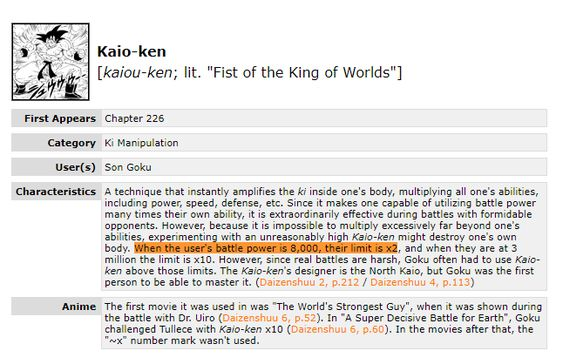
The idea of something like Kaioken being fine for the first few cases, but drop it as a valid scaling chain stacker every where else has been textbook golden egg fallacy. It should be all or nothing that we keep Kaioken valid at all cases or don't use it at all; but it doesn't look like anyone is arguing against that.
"Golden egg fallacy" isn't a thing, are you trying to say "golden mean fallacy"?

If so, it doesn't apply. That fallacy is when someone rejects the possibility that one of two opposing viewpoints is wrong. That's not what's happening with these multipliers. Multipliers in general can be completely wrong, but when they drift too far from the actual concrete feats demonstrated by the characters, they become less and less reliable. That's not a fallacy, at worst, it's just an argument you disagree with.

If you do want some things like that to be done endlessly or not at all, ignoring all risks of reliability and disconnection from source material, why not allow upscaling to automatically be a 1.5x multiplier that can stack indefinitely? And why not allow calc stacking across disconnected scenes (since we already allow it within singular scenes, and across one calculation step with stated speeds).
So, this is the actual argument being made, without the fluff:
  • A high feat from Frieza or Cell does not retroactively validate every multiplier step leading up to them.
  • Unknown ">>>" gaps between characters are unknowns, not evidence the chain is conservative.
  • The chain undershoots Frieza/Cell but overshoots everything after Cell, proving it isn't consistently grounded in anything.
  • Speed feats especially never catch up to what the multiplier chain implies, making the speed scaling even less defensible.
  • Therefore, multiplier stacking in DBZ is largely disconnected from actual material and shouldn't be treated as precise or validated scaling.
That's it. That's all his points.
In his latest post, perhaps, but his earlier posts touched on some other core points that convinced me.

I don't really care about this whole "Does the AP chain undershoot?" stuff, so this post does not change my view.
 
In his latest post, perhaps, but his earlier posts touched on some other core points that convinced me.

I don't really care about this whole "Does the AP chain undershoot?" stuff, so this post does not change my view.
This is my last comment before having to ask for permission again.

My response does not try to change the outcome of this thread, it is just an attempt to stop the OP to also include Attack Potency, which has far lower gaps of multipliers, between 1000x and 5000x between each feat.

I believe this is necessary clarification. I believe a lot of points made by Chariot are valid.

But the deniability of established AP multipliers that rely far more on in-between feats to paint a picture that multipliers are unreliable in all stats no matter what is a way to worsen the conversation. As @Qawsedf234 have stated, the consistency and undershooting of multipliers that apply to all stats is a point of contention he has brought up.

The argumentation against 1:1 multipliers using arguments that have been present in previous threads about the same subject. Using edge cases like Dyspo, Burter, Grade 3, all of these points have been brought up in the past, and the current framing from Chariot does not make them any stronger. The sheer evidence that, outside of these cases that are canonically distinct, the Ki amplification is 1:1 across stats, is still overwhelming.

What I utterly reject in his original argumentation isn't Cell, Buu, Daima, Speed Scaling, it's the use of old arguments under a new coat of paint to discredit the fact multipliers do apply 1:1 to power and speed, and that the AP chainscaling is far more consistent.

With this last post, I will leave the thread until Chariot responds. And while I do believe applying the changes to AP is not valid, the discussion is still important because that is one of the arguments used by opposition. "AP is consistent with multipliers, so that proves they're reliable and fit the standard" is a point made here, not by me, but one that exists, and I don't want to be misrepresented.
 
The argumentation against 1:1 multipliers using arguments that have been present in previous threads about the same subject. Using edge cases like Dyspo, Burter, Grade 3, all of these points have been brought up in the past, and the current framing from Chariot does not make them any stronger. The sheer evidence that, outside of these cases that are canonically distinct, the Ki amplification is 1:1 across stats, is still overwhelming.
Then I would like someone to provide, or direct me towards, that overwhelming evidence.
 
Then I would like someone to provide, or direct me towards, that overwhelming evidence.
As given permission by @Antvasima, I will outlne the arguments.

I will break this down in two main points that will lead to our conclusion. Mind you, I'm only explaining something that's already indexed in the Dragon Ball verse page.

First, the evidence that the source powers everything. If you already accept that, you can move on to the second half.

We are no stranger to this concept, Ki was demostrade on DB, and in early DBZ chapters, such as Chapter 173 and 190, where it is seen that Ki is a technique that channels both physical offense as well as physical defense, meaning the total energy pool of your body is what allows you to exert these superhuman feats in the first place. Ki is the life force of all things, planets, animals, plants, even the air itself, that powers everything you can do with your body.

I'm sure you're familiar with the statement made by Vegeta, where he states that, quoting the original raws:
"戦闘力が あがったと いうことは スピードも あがったと いうことだ"
"Of course, when battle power increased, speed increased as well"

The も particle means "also" or "too." This basically communicates to us that there is a directly correlation between a character's immediate speed and their power level.

This happens all the time through the story, an increase in power directly relates to an increase in speed, even against previously comparable opponents, they're equally helpless in speed and power, just from a general increase in Ki size.

In basic, the amount of stats you will receive in defense, speed, attack, are all related to the size of your ki. If you have a ki of size X, and another character has a ki of size X, both of you are, often times, going to have the same stats in basically everything, as proven by Tenshinham and Goku. Even Toriyama himself admitted that this was one of the best fights to write because they were equal, just by having the same amount of BP, or Ki size.

Akira has stated that Ki is what you need to break the limits of all your physical stats, by emitting Ki at twice the size of your opponent, you can nuliffy their attacks, it's all about size of Ki.

So, from this section we've learned that: Ki fuels all statistics in the body, and amplifying its size will increase all stats. Just by having a higher amount of Ki, you're likely to be better in every conceivable way.


Second, proving it's proportional, twice the size, twice the everything.

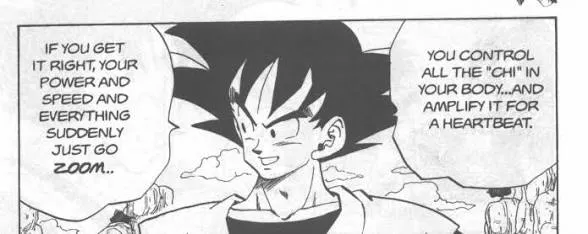
This is where techniques like the Kaio-Ken comes to play. An increase in Battle Power, is an increase of Ki size. If you have twice as much Ki, you have twice as much BP.

The more simplistic explanation of the technique is that, it's a technique that temporarily doubles your stats. That by itself doesn't prove anything about the nature of ki, as that would be a quirk particular to the technique itself. But the question is, how exactly does the Kaioken achieve this multiplication.

The Kaioken does not individually multiply each stat of your body, to achieve this effect, it simply amplifies the size of the user's Ki temporarily, and in a heart beat, all statistics multiply by the same amount. It doesn't amplify one area of Ki that handles physical defense more, or less. That means the size of one's ki is directly proportional to one's stats.

Size of Ki controls all stats, and we have a canonical evidence that size of ki is directly proportional to your current, natural stats. Of course, we have far more evidence than that.

Take Frieza for example, Frieza in his final form uses 50% of his battle power, aka, his ki size, to fight Goku, he is keeping up with a Goku that's multiplied his speed by 20 times. Mind you, the thing about Frieza is obvious. If you're using half of the source that fuels your speed, you're operating at half speed, half power, half durability. That much is obvious, as when Frieza is extremely casual and using a much lower amount of his Ki pool to guard and move, he is harmed by Base Goku's kick, as where he's fighting at 50% of his ki pool, he is harmed far less by Kaioken x20.
Still, after reaching 100% power, Frieza can give a good fight to Goku Super Saiyan, a 50x multiplier in his ki size, meaning a 50x increase in speed.

All of the things above, percentages, kaioken, super saiyan, are both a ki size multiplier and a BP multiplier, meaning that for this era, BP was proportional to Ki size as well.

Needless to say, using Kaio-Ken, a technique that has already proven that Ki Size = Proportional stats. And percentages, which is just common sense, we have two obvious situations where it proves that multiplying BP means multiplying all stats.

And as it turns out, Battle Power is a reliable way to read an opponent's strength (meaning all ability), as Akira Toriyama, the man himself, has stated that because people WERE ABLE TO READ the opponent's strength, battles became too predictable. Akira straight up admits the BP system is far too reliable to read one's strength that it needed to change, and to change BP, he says characters will use Ki control to lower or raise their power levels, meaning, AGAIN, Ki is directly related to the number systems that place all stats into one absolute number.

But we have evidence of this even as back as early Dragon Ball, in the 23rd Martial Arts Tournament, in Goku vs Tenshinhan, Tien uses a technique where he splits into four fighters. It's not a division of mass, because Tien is not just as agile as he was before (which would happen if he had proportionally the same strength/speed but 1/4 of the mass).

In this technique, Goku immediately blitzes Tien and tells him that, because he deposited his power from one person into four bodies, each body had 1/4th of power, speed and durability of the original.

That proves dividing, as well as multiplying the total amount of ki in your body will split your statistics equally across the board.

Allow me to address some of the edge cases brought up by Chariot.

Oozaru

This form multiplies Ki size by 10, but it doesn't multiply speed by ten.

I mean, this one is a bit obvious. Take your current strength, your current weight. Multiply your strength by only 10, and your mass by 20 million. Is the multiplication of 10x to your current power enough to compensate for your new mass? Obviously not. In fact, that's the canon reason why the form is slow according to Paragus.

Burter

What gives one the impression that Burter is faster than his power level suggests? We don't know his power level.
Is it because he said he was the fastest in the universe?

Brother in christ, he was lying. Here is him losing to a casual Goku.
Here's the same Goku fighting evenly with Ginyu.

Burter wasn't the fastest on his team, let alone the universe? Also there's Frieza. That's. literally. just. their. branding.

Grade 3

This is literally another Oozaru situation.


So all edge cases have an in-universe explanation as to why they are edge cases.

The mere act of removing weights to allow oneself to move freely increases Power level by a significant amount.
 
While that explanation is helpful on some points, I think it's insufficient for me.

Ultimately, if a verse has a UES that applies to speed, would I be willing to assume that every multiplier applies to speed as well, even without the multiplier saying so? I don't think so. I don't even think the DB profiles as-is properly think of these sorts of consequences, since it looks like LS isn't given a multiplier, despite that presumably also being Ki-dependent.

Plus, even if the multiplier itself is well-founded, we require supporting feats or significant plot support for it to stack as high as DB's does. And I'm not willing to endorse AP evidence counting as support for the speed stacking due to the UES, based on the current unclear rules on Multipliers (I could quickly type up a thread to clarify this if people want). At best, I'd vote neutral if that's the key deciding factor.

So I think I would need more evidence on the other points in order to be convinced.
 
Last edited:
Ultimately, if a verse has a UES that applies to speed, would I be willing to assume that every multiplier applies to speed as well, even without the multiplier saying so?
Sorry for being dumb but wdym? You means that the multiplier in the verse must say "oh hey it is x20 power so it is also x20 speed as well" kind of statement or something else?. The verse already clear that Ki influence all physical stats includes speed as well, so increases in Ki will also increases your speed

I don't even think the DB profiles as-is properly think of these sorts of consequences, since it looks like LS isn't given a multiplier, despite that presumably also being Ki-dependent.
We actually scales LS to Ki as well, but many profiles still have Unknown LS and we have yet to touch LS. Profile that already have LS have higher rating via multiplier such as Kaioken or Super Saiyan
 
Sorry for being dumb but wdym? You means that the multiplier in the verse must say "oh hey it is x20 power so it is also x20 speed as well" kind of statement or something else?. The verse already clear that Ki influence all physical stats includes speed as well, so increases in Ki will also increases your speed
Well yeah, if there's just a statement saying "This makes them 20x more powerful!" I wouldn't automatically assume that applies to speed too.

If it was "Unlocks 20x more ki" or something I could see it, tho.
We actually scales LS to Ki as well, but many profiles still have Unknown LS and we have yet to touch LS. Profile that already have LS have higher rating via multiplier such as Kaioken or Super Saiyan
If their LS got the same multiplier as their speed, then they should be at least Pre-Stellar, instead of just being Class M/G.
 
While that explanation is helpful on some points, I think it's insufficient for me.

Ultimately, if a verse has a UES that applies to speed, would I be willing to assume that every multiplier applies to speed as well, even without the multiplier saying so? I don't think so. I don't even think the DB profiles as-is properly think of these sorts of consequences, since it looks like LS isn't given a multiplier, despite that presumably also being Ki-dependent.

Plus, even if the multiplier itself is well-founded, we require supporting feats or significant plot support for it to stack as high as DB's does. And I'm not willing to endorse AP evidence counting as support for the speed stacking due to the UES, based on the current unclear rules on Multipliers (I could quickly type up a thread to clarify this if people want). At best, I'd vote neutral if that's the key deciding factor.

So I think I would need more evidence on the other points in order to be convinced.

To use the last of my permission to add something to this conversation, and also to illustrate @Qawsedf234's previous point in a more elaborate way.

I think what you're asking for is basically impossible.

The current standards we have only require me to prove the multipliers themselves are reliable, or important to the story. For example, Android 17 has to be more than twice as strong and fast as Mecha Frieza, and so on, so forth until we reach early Z. These are necessities presented in the story at the time of their occurance. If a multiplier applies to multiple statistics, there is not a requirement for me to prove that the multiplier is reliable for every one of them, just that the multiplier is reliable at all.

The standards also mention the lack of contradictions. It is imperative to notice that the current values for travel speed and LS are essentially placeholders for the lack of feats on that department, and Toriyama's sheer lack of understanding of LS, that contradicts not the chain-scale, but even previous legitimate feats in his own story. That is not to disrespect him, he has no obligation to know these things, nor does he has any obligation to know that pushing a stone as big as Early DB Goku did was already far beyond mere 40 tons.

By our current standards, we do accept that the reliability of multipliers for AP is evidence for speed, since it's the same multiplier. It generally feels like UES is being treated as a background premise from which we're inferring speed multiplication. The argument is that we have direct, explicit statements that speed is multiplied.

Here's what the standards cite:
"For higher multipliers...the multipliers importance to the plot of the story...becomes increasingly necessary."

In this post here, I outline why every multiplication step is load-bearing to the narrative. For the Goku vs Frieza fight to make any sense, he has to be stronger than his Kaioken x10 self. For Super Saiyan to make sense, it has to be better than a 40x Kaioken Base Goku, etc etc. Why wouldn't these qualify as story-relevant multipliers and scaling?


If it was "Unlocks 20x more ki" or something I could see it, tho.
If ki is the source of power, and any alteration to ki causes an equal proportional alteration to strength, why wouldn't "20x more powerful" translate to 20x ki size, if the association of BP was connected to ki?


You may remove this comment if it's deemed unproductive to the discussion.
 
To use the last of my permission to add something to this conversation, and also to illustrate @Qawsedf234's previous point in a more elaborate way.

I think what you're asking for is basically impossible.

The current standards we have only require me to prove the multipliers themselves are reliable, or important to the story. For example, Android 17 has to be more than twice as strong and fast as Mecha Frieza, and so on, so forth until we reach early Z. These are necessities presented in the story at the time of their occurance. If a multiplier applies to multiple statistics, there is not a requirement for me to prove that the multiplier is reliable for every one of them, just that the multiplier is reliable at all.
By our current standards, we do accept that the reliability of multipliers for AP is evidence for speed, since it's the same multiplier.
The current standards don't say that, and I would argue against those who tried to write that into our standards.

It essentially reduces the burden of evidence the more stats that a multiplier applies to, which seems completely backwards to me.
It generally feels like UES is being treated as a background premise from which we're inferring speed multiplication. The argument is that we have direct, explicit statements that speed is multiplied.
Do you have this for every multiplier going all the way up to trillions of times? If so, please direct me towards that wellspring of evidence.
In this post here, I outline why every multiplication step is load-bearing to the narrative. For the Goku vs Frieza fight to make any sense, he has to be stronger than his Kaioken x10 self. For Super Saiyan to make sense, it has to be better than a 40x Kaioken Base Goku, etc etc. Why wouldn't these qualify as story-relevant multipliers and scaling?
"The multiplier makes a character stronger" cannot be what's meant by plot-relevance, as discussed earlier in the thread, since "it actually makes a character stronger" is described in a separate part of the Multipliers page as being valid support for lower jumps:
However, a good statement alone is not enough to get a high multiplier accepted. The amount of extra evidence one has to provide to get larger multipliers accepted is proportional to the size of the multiplier. For lower multipliers, like things much less than times 100, evidence can take the form of a clear increase in combat strength against priorly equal or superior opponents. For higher multipliers, like times 100 and above, the importance of stronger evidence, such as feats displaying power of a similar magnitude as the value the multiplier points to or the multipliers importance to the plot of the story, and a higher amount of evidence becomes increasingly necessary.
While it's not particularly clear what "importance to the plot of the story" means, it cannot mean "the character got it and then they were stronger".

But hey, even being generous, let's go through your post and see what multiplier is supported by the values you espouse:
  • The first stated multiplier you bring up is Goku getting 20x more powerful after training. You did not provide any plot support for this.
  • You said that Qawsedf234 established that the Kaioken is narratively relevant to the story, but just linked to his profile. You presumably meant this post where the relevance to the story is that Kaio-Ken x20 let Goku be comparable to 50% Frieza. Well, this scan doesn't actually show that, but I'm pretty sure that's shown in other scenes anyway.
  • You provided this guidebook statement (that's in Chinese for some reason!?!?!? DB wiki shows that this guidebook is Japanese), saying that Goku got 10x more powerful after training under high gravity. Again, without providing plot support for this.
  • You provided this statement that Goku can withstand kaioken x10. Not super useful since it's a temporary boost, I'm not sure why you're treating this as Goku's base state.
  • Next you gave this statement that each Frieza form becomes multiple times more powerful each transformation. Works for me, 3x for second, 9x for third, I suppose? There's probably plot support for each of these being faster, but you didn't provide that.
  • Then you showed Goku using Kaio-Ken x20 to hit Frieza. You didn't actually show that there was a speed issue with hitting him before, but that probably exists.
  • You then asserted that Frieza using 50% of his power means he's using 50% of his speed as well. You linked this non-translated databook scan for some reason. And you didn't actually show anything indicating that him using less power means he's using less of his speed. In fact, solely based on the information provided, where the 50% stuff is Frieza's estimate of how much energy he'd need to annihilate Goku, it sounds like this could be an exception.
  • You posted this non-translated scan for Super Saiyan being a 50x multiplier (although that's cited so often enough I'll take it on faith), and for some reason posted Goku getting wailed on by Frieza as evidence that Goku's faster than him? This doesn't really seem to be story support.
  • You show that Future Gohan isn't as strong as that Goku we're talking about, but you do show that he's stronger than Future Trunks, who could destroy Mecha Frieza. You didn't actually show this step, but I think there's some stuff about Mecha Frieza being stronger than 100% Third Form Frieza? I'll assume that exists, and you meant to include it.
  • You then provide this scan of Future 17 saying he wasn't using even half of his power last time. You say this shows Future 17 blitzing Gohan with half power, but this doesn't actually show that. Let's assume that exists.
  • You then pretend that a blitz is a valid multiplier.
So, with all of those relevant multipliers put together (20x from training, 10x from high gravity, 9x from two Frieza transformations, 50x for Super Saiyan, 2x for Future 17), we get 180,000x

This thread's talking about an 86 trillion times multiplier. You did not outline why every multiplication step is load-bearing to the narrative. You're missing about 480 million times of multiplication steps, and even for the ones you did include, you did not show how many of them were load-bearing to the narrative.


Maybe that evidence does exist, GodlyCharmander failing to explain all of it in one post does not mean that it's false. But I want someone here to point to the actual comprehensive information on this, along with indicators of plot importance.

You can't expect staff to accept something by explaining 5% of it and then relying on vibes for the rest. And any staff members who do know the other 95% should actually ******* explain it, instead of just voting and leaving that for others.
If ki is the source of power, and any alteration to ki causes an equal proportional alteration to strength, why wouldn't "20x more powerful" translate to 20x ki size, if the association of BP was connected to ki?
For some of these statements, because it's not "Even if my ki reserves were halved, I could still demolish you!" It's stuff like "Yeah, I would only need to use 50% of my power to destroy you". Different techniques require different amounts of ki, the difference deploying attacks that require 5% of ki, and ones that require 50%, involves how much ki was charged into that attack, which I wouldn't expect to change the speed of the attacker in general. It's not like Goku becomes 5x faster every time he charges a kamehameha.

And in general, if we are to believe it's an energy system where characters can channel that fundamental energy into whatever they wish, further concerns pop up:
  • From my point of view, it's not exactly unfeasible that a character could train for strength in particular. Getting more ki, and assigning that ki towards their strength, rather than their speed.
  • Similarly, it doesn't seem out of question that characters could get more proficient about deploying ki to their strength, getting stronger without requiring more of the fundamental energy source.
  • Is it actually justified to believe that something like Super Saiyan results in a character spontaneously, and temporarily, getting 50x more ki? I don't see a great link between that and the form being achievable through extreme anger/sadness, or by focusing their energy into their back. Why would such techniques (until the Perfect Cell saga) cause wear on the body and (iirc) a larger stamina drain? If it's something like their bodies not being prepared for the ki, does that really jive with saiyans quickly gaining power after near-death experiences?
  • And of course, there's the concern of how Stamina is also provided through ki, but becoming more powerful doesn't have these characters able to fight nonstop for decades by the time of the Androids saga.
 
Last edited:
But hey, even being generous, let's go through your post and see what multiplier is supported by the values you espouse
The post was made for someone who I assumed has read the story in the past, so it unfortunately doesn't explain what would be a natural conclusion to them, thus, causing for a lack of general scans that I presumed one would know by heart. This is my mistake, but I can easily provide them for you.

Once again, you may remove this comment if you think it goes past @Antvasima's permission to respond to your requests, but I personally believe the permission extended to things I could add on.

The first stated multiplier you bring up is Goku getting 20x more powerful after training. You did not provide any plot support for this.
I apologize for this, but it is imperative to the narrative that Goku got especifically a 20x boost to his strength.

On top of the statement, we have the fact that Goku trained and acquired the equivalent of thousands of years of training on Earth by training with King Kai, something cited as an absolute necessity to defeat these new saiyans. That training is the only reason why Goku is able to contend with Nappa in the first place, as his power is stated to be increasing "exponentially", and the numerical value of the series itself supports the necessity for Goku to be that strong, as his original BP of 416 transforms into a value of "over 8000", which covers the "nearly 20x" statement perfectly, aligning the statement to the story, and creating a necessity in the narrative for Goku to be that strong.

In fact, if Goku was any weaker than 20x, his Kaioken x2 wouldn't the only thing King Kai thought Goku needed, despite being ultimately wrong, as his power level would be far below Vegeta's 18000. Goku's at 16000 thanks to the Kaioken, of course.

I believe this is plot support.

You provided this guidebook statement (that's in Chinese for some reason!?!?!? DB wiki shows that this guidebook is Japanese), saying that Goku got 10x more powerful after training under high gravity. Again, without providing plot support for this.

The fact Goku got ten times stronger is proven to be relevant to the plot similarly to the previous point, that tenfold value aligns with the increase of Goku's "beyond 8000" Battle Power to his approximate 90000 units in the arc, that being the only reason why a Kaioken x2 surpasses Captain Ginyu, forcing him to switch bodies, the only reason why he can stomp the Ginyu Force, and why Vegeta is impressed by the sheer amount of power Goku holds, since he believes that its impossible for someone to grow so much stronger in such a short amount of time to the point of believing Goku is a Super Saiyan. The amount that Goku grows is directly tied to the events of the story.

You provided this statement that Goku can withstand kaioken x10. Not super useful since it's a temporary boost, I'm not sure why you're treating this as Goku's base state.

The reasoning is obvious, Kaio-Ken's multiplication is imperative to the story, if Goku can use it to x10, that means at his peak Goku is 10x stronger than Base, and any version of himself that is above that x10 Kaioken, would be as well. I don't need to prove the Kaioken is narratively plausible twice, right? Or every time it's used? That's unreasonably strict.

There's probably plot support for each of these being faster, but you didn't provide that.

Did you read my post or not?

You then asserted that Frieza using 50% of his power means he's using 50% of his speed as well. You linked this non-translated databook scan for some reason. And you didn't actually show anything indicating that him using less power means he's using less of his speed. In fact, solely based on the information provided, where the 50% stuff is Frieza's estimate of how much energy he'd need to annihilate Goku, it sounds like this could be an exception.

You conceded to the fact there was a problem with speed with 50% Frieza, and that his speed was increasing along with his use of power. "It sounds like this could be an exception" because...?

You can see Frieza's "60 million BP", and the guide scan was only to prove this further.

Agnaa, I have to be honest with you, you're not retaining previously established information given in this very thread, I've provided you with plenty evidence that Ki is the source and what fuels speed in previous post. The evidence that Frieza is using half his speed is because he's using half his power. That's it.

If Ki equally fuels all your statistics, and you're using half of it, that means you're operating at half power.

The first thing Frieza does after establishing how much energy he needs to beat Goku is speedblitzing him to oblivion, and Goku realizes he might not be bluffing.

In the scan above Piccolo also credits Frieza's speedblitz to the gap in their power, and it also shows Kaioken x10 not being able to negate the blitz.

I ask again, an exception because?????

Goku getting wailed on by Frieza as evidence that Goku's faster than him? This doesn't really seem to be story support.

This is what my post states:

  • [...] he wasn't exactly blitzing FP Frieza [...]
I do admit that I posted the wrong scan. Here's some moments where Goku shows superiority in speed. But the fact they were close, despite Frieza being twice as fast as Kaioken x20 Goku, is story support for a 50x multiplier.

who could destroy Mecha Frieza. You didn't actually show this step, but I think there's some stuff about Mecha Frieza being stronger than 100% Third Form Frieza?

Again, I assumed the one I responded to had watched or read Dragon Ball. Yes, Mecha Frieza scales above Namek Frieza.

You say this shows Future 17 blitzing Gohan with half power, but this doesn't actually show that. Let's assume that exists.

I don't have to, the fact 50% Future 17 could contend with Future Gohan works for the purposes of this.

You then pretend that a blitz is a valid multiplier.

Pretend? I provided a reason for it.

Accept that: The story has established that a gap in power level as little as 18000 to 24000, a gap that's canonically linear thanks to the Kaioken, is enough for a blitz to occur. This is also proven true when Frieza, having almost twice his power in his second form, was able to blitz Vegeta, whom he was able to contend with in his first form. So it is narratively sound to claim a gap between 1.33x to 2x canonically allows for a speed blitz. This is even consistent in the Cell Saga, where Gohan was on par with Perfect Cell in terms of speed, but turned a stomp around with a 2x multiplier. We will use 1.33x so you have better odds, okay?


You're missing about 480 million times of multiplication steps, and even for the ones you did include, you did not show how many of them were load-bearing to the narrative.

We're not, everything is in the speed blog people neglect to check.

Yeah, I would only need to use 50% of my power to destroy you

It's a literal plot point that Frieza has to power up to 100% and it takes an extreme amount of concentration, and you're acting like I haven't provided a scan that proves Frieza was operating at half his battle power? In fact, it literally states that the act of using higher percentages makes the ki shoot up. It's literally about operating at Ki percentages.

Frieza was operating at half stats, that much has been agreed upon for more than a decade on the site.

Do you have this for every multiplier going all the way up to trillions of times? If so, please direct me towards that wellspring of evidence.

That's an impossible standard to meet, and unique to Dragon Ball scaling. But, again, we do. Every gap is explained with evidence for it in the narrative.
 
I apologize for this, but it is imperative to the narrative that Goku got especifically a 20x boost to his strength.

On top of the statement, we have the fact that Goku trained and acquired the equivalent of thousands of years of training on Earth by training with King Kai, something cited as an absolute necessity to defeat these new saiyans. That training is the only reason why Goku is able to contend with Nappa in the first place, as his power is stated to be increasing "exponentially", and the numerical value of the series itself supports the necessity for Goku to be that strong, as his original BP of 416 transforms into a value of "over 8000", which covers the "nearly 20x" statement perfectly, aligning the statement to the story, and creating a necessity in the narrative for Goku to be that strong.

In fact, if Goku was any weaker than 20x, his Kaioken x2 wouldn't the only thing King Kai thought Goku needed, despite being ultimately wrong, as his power level would be far below Vegeta's 18000. Goku's at 16000 thanks to the Kaioken, of course.

I believe this is plot support.
The fact Goku got ten times stronger is proven to be relevant to the plot similarly to the previous point, that tenfold value aligns with the increase of Goku's "beyond 8000" Battle Power to his approximate 90000 units in the arc, that being the only reason why a Kaioken x2 surpasses Captain Ginyu, forcing him to switch bodies, the only reason why he can stomp the Ginyu Force, and why Vegeta is impressed by the sheer amount of power Goku holds, since he believes that its impossible for someone to grow so much stronger in such a short amount of time to the point of believing Goku is a Super Saiyan. The amount that Goku grows is directly tied to the events of the story.
I don't think we take power levels seriously enough for them to be that relevant.

While I'm sympathetic to the idea that characters going out of the way to train, or to develop a new technique, to beat others fulfills the criteria of story importance, I'm not sure how far to stretch that.
Ah yeah, my bad.
You can see Frieza's "60 million BP", and the guide scan was only to prove this further.
Ah okay, makes sense.
The first thing Frieza does after establishing how much energy he needs to beat Goku is speedblitzing him to oblivion, and Goku realizes he might not be bluffing.
I'm not really seeing those scenes that way? That could very well be the intention, with Frieza kinda just ******* around, but based on the concrete actions, he seems to modestly outspeed Goku, while noticeably overpowering him. There's nothing actually done there that would entail being 40x faster. I could almost see it with the way Frieza got underneath Goku, before the tail-neck-grab, but Goku seemed able to react to that at least.
You conceded to the fact there was a problem with speed with 50% Frieza, and that his speed was increasing along with his use of power. "It sounds like this could be an exception" because...?
Agnaa, I have to be honest with you, you're not retaining previously established information given in this very thread, I've provided you with plenty evidence that Ki is the source and what fuels speed in previous post. The evidence that Frieza is using half his speed is because he's using half his power. That's it.

If Ki equally fuels all your statistics, and you're using half of it, that means you're operating at half power.
In the scan above Piccolo also credits Frieza's speedblitz to the gap in their power, and it also shows Kaioken x10 not being able to negate the blitz.

I ask again, an exception because?????
That was more fully explained in the last part of my post.
This is what my post states:

  • [...] he wasn't exactly blitzing FP Frieza [...]
I do admit that I posted the wrong scan. Here's some moments where Goku shows superiority in speed. But the fact they were close, despite Frieza being twice as fast as Kaioken x20 Goku, is story support for a 50x multiplier.
Nice!
Again, I assumed the one I responded to had watched or read Dragon Ball. Yes, Mecha Frieza scales above Namek Frieza.
It's been over a decade, for me.

And, yeah, if it's something that other supporters are arguing with you over, you should explain it as if the staff are unfamiliar with the details.
Pretend? I provided a reason for it.
That doesn't actually fly, our Multipliers standards require actual ones to be stated; we don't just pick a number out of thin air to apply to every blitz/stomp/one-shot.
We're not, everything is in the speed blog people neglect to check.
If you just want me to look at that with the same lenses, I can.

I'm not trying to make you type shit out again for no reason, if there's other resources you think are good enough I can go off that.

Its justification for Frieza second form is incoherent, some justifications don't link all the relevant evidence, Base Gotenks Post-RoSaT (at least in the scans provided) doesn't provide evidence that Piccolo was talking about SS before, and base afterwards, the Super Saiyan 3 Gotenks multiplier is incorrect based on previous logic (it should be 1,440,000,000,000c; 8x above SS1, not 4.8x above as it is now).
It's a literal plot point that Frieza has to power up to 100% and it takes an extreme amount of concentration, and you're acting like I haven't provided a scan that proves Frieza was operating at half his battle power? In fact, it literally states that the act of using higher percentages makes the ki shoot up. It's literally about operating at Ki percentages.

Frieza was operating at half stats, that much has been agreed upon for more than a decade on the site.
Ah okay, fair enough.
 
Still got dem perms... Being told to post this now, for reference I'm obviously working on something with a bit more substance and scans finding the guide raws have been difficult though, but that might be best saved for the next thread I'm told, anyway.
A response to this:

Let's gooooo....

First of all, @Chariot190, let me start by doing something called sift gold. You see, I like simple, we love simple, and for some reason you love adding fluff to your arguments, straight up filler, repetitive stuff to reinterate the exact same argument, because breaking down what you're actually trying to argue for would make it more susceptible for proper debunks.

So, first, let me point out all the pointless fluff in your argument to better paint what I mean:

  • “Later feats do not validate the chain”: about 6 times.
  • “Unknown gaps don’t prove anything”: about 11 times.
  • “Frieza/Cell are cherry-picked anchors”: about 9 times.
  • “Conservative scaling is not validation”: about 16 times.
  • “Chain overshoots/undershoots”: about 8 times.
  • “Speed scaling lacks supporting feats”: about 5 times.
  • “The chain is disconnected from actual feats/showings”: about 11 times.
He said the manga overshoots the scaling several times in the span of two paragraphs. He is just repeating the same argument ad infinitum and making it unnecessarily long so no one would actually read it.

A non-exhaustive list:
  • "A later feat does NOT validate the multiplier chain leading up to it"
  • "It only proves Frieza has that feat"
  • "How does that prove Guldo, Jeice, Recoome..."
  • "It doesn't prove a thing"
  • "Neither of those prove every multiplier stack"
  • "A high Frieza feat proves Frieza has a high feat. A high Cell statement proves Cell has a high statement."
  • ...and so on.
This is approximately a 2,000-word argument that could be made in 200 words. The core logic is sound and worth engaging, but the repetition is so heavy that it basically makes the argument a drag to read through because, "hey, you're making the SAME POINT AGAIN, I JUST READ THAT"

So, this is the actual argument being made, without the fluff:
  • A high feat from Frieza or Cell does not retroactively validate every multiplier step leading up to them.
  • Unknown ">>>" gaps between characters are unknowns, not evidence the chain is conservative.
  • The chain undershoots Frieza/Cell but overshoots everything after Cell, proving it isn't consistently grounded in anything.
  • Speed feats especially never catch up to what the multiplier chain implies, making the speed scaling even less defensible.
  • Therefore, multiplier stacking in DBZ is largely disconnected from actual material and shouldn't be treated as precise or validated scaling.
That's it. That's all his points.
Why you felt the need to complain about repetition, claim you like nice simple stuff, but then proceed to do the same but far worse is confusing, no? It's mostly the same handful of points repeated over and over with different wording? Why open your post with thinly veiled attempts to turn your alleged rebuke into "woe is me, it's long", instead of just arguing properly? And then do it anyway? Anyone can do that too, ain't special, hey watch this:
"You're demanding an impossible/unreasonable standard".
Which, you repeated through:
"unreasonable evidentiary standard"
"perfectly aligned feat every arc"
"continuous unbroken stream of feats"
"precise scientific instrument"
"impossible threshold"
"mechanical consistency"
"invented requirement"
"goalpost"
"standard of precision"
"maze with no exit"

That's what? The same point said about 10 different ways?

"The chain is a low-end / floor / conservative"
Said via:
"low-end"
"floor"
"conservative"
"undershooting is not a problem"
"below the true value"
"below the feat"
"the chain is a FLOOR"
"low-end functioning correctly"
"built as a low-end"
"functions as a low-end"
"produces results consistent with a low-end"
Etc.
You bring up this general idea almost 40 times.

"Unknown gaps/unaccounted growth explain the difference":
by means of
"unaccounted gaps"
"arbitrary training gains"
"rage amplifications"
"passive power growth"
"mid-arc power spikes"
"zenkai boosts"
"unaccounted upward deviations"
"growth during the journey to Namek"
"training in the spaceship"
"Buu Saga power growth"
"directionally upward gaps"

Now this gets repeated over 20 times in different wording.

"4-B is big / Cell is close enough / 1000x isn't that bad".
"4-B is an extraordinarily large tier"
"calculated values are not canon"
"similar ballpark"
"1000x isn't insurmountable"
"Gohan's physicals are only roughly 10x below"
"right general neighborhood"
Same Cell stuff repeated multiple times.

"Post-Cell isn't as bad as you say":
Said by
"not millions or billions"
"SSJ3 Goku is only 5000x"
"Vegito is the only way to reach millions"
"makes sense for Vegito"
"post-Cell inflation is nowhere near catastrophic"
Same point, several times.

"Why do I need a Burter/Jeice/Guldo feat?"
Again, via:
"Why do I need to produce a specific independent feat?"
"I have a lower bound"
"I have an upper bound"
"canonical gaps"
"complete and coherent scaling chain"
"somewhere inside that bracket"
"not arbitrary guesswork"
"well above Planet level and well below Small Star level"
"you don't get to demand individual feat verification"

Again, same thing, over and over.

If repetition is so bad that you feel the need to open up complaining about it and point out how you don't do that yourself, then why in the world are you complaining that my argument was "2,000 words that could be made in 200", then wrote a roughly 3,700-word response to it which could also be reduced to about 30 words?

"I feel the chain is a conservative floor, unknown upward gaps explain why feats sit above it, 1000x isn't a big deal in 4-B, post-Cell isn't as bad as claimed, and you don't need individual feats for every character because upper/lower bounds and canonical gaps I think are enough".

That's it. That's your whole post.

Could we not pretend the issue is repetition or length? We both know that isn't actually what you don't like, you just proceeded to prove that yourself yet opted to attempt to attack that anyway. The issue is whether the repeated point is correct, ignoring the reason why repetition is sometimes needed, that being that the same point can be misconstrued multiple ways, so it's important to tackle the various angles and arguments against it, in said multiple ways, or that multiple arguments sometimes have the same answer which leads to repeating the same point because failure to do so just results in "you didn't tackle my point, you dodged it", or whatnot.

And you literally summarized my argument, admitted the core logic was sound and worth engaging, anyway?
Regardless, that's derailing, clutters the thread, whatever.
Now given the post below is run on, I'm gonna do us all a solid and put the tldr at the top:
My position is not "nobody scales unless they have their own feat".

My position, at least to the argument just made is:
A broad chain can support broad upscaling.
A lower and upper bound can support a bracket.
A direct feat can support the character tied to that feat.
But none of that proves exact multiplier-derived AP and speed values for every link between those points.

So if the chain is only a conservative low-end, then use it as a rough floor/bracket. Don't use it as exact profile values.
Chariot, what you're doing here is essentially manufacturing an unreasonable evidentiary standard, one where the only series capable of having their ratings accurately depicted are ones that conveniently pump out a perfectly aligned feat every arc, for every character, at every tier.

That's a standard specifically designed to be impossible to meet, and conveniently, it only ever gets applied when someone wants to dismiss a scaling chain they personally dislike.
Ignoring the fact that there's nothing wrong with disliking bad scaling. Like yeah, I don't like the scaling. I don't like it because I think it's wrong. Why try to frame that as "you only reject this because you personally dislike it"? That's just dodging the actual reasons being given as to why it's disliked, of which there was many.

Imagine that: someone dislikes a method because they think the method is faulty?
But no, this twists what I actually said.

I'm not asking for "a perfectly aligned feat every arc, for every character, at every tier". That's not even remotely what I said. What I was saying is extremely basic: if you're going to claim the multiplier chain is supported by the feats, then the feats should actually support the chain.

The chain misses the next major feat by 823x, misses the next one by 1,061x, then later far above the last actual thing with nothing backing it, that is, by definition, not "the feats supporting the stacking".

I ain't demanding perfection, but missing by hundreds or thousands of times isn't validation either.

A broad scaling chain is fine. A rough range is fine. A conservative floor is fine.
What isn't fine is taking that rough chain, treating it like precise indexing, applying it to AP and speed (but not the parts that are impossible to ignore get contradicted excessively), stacking it across dozens of things, and then saying "the feats validate it lol", when the actual feats aren't even within orders of magnitude.

And keep in mind, this is only one part of my issue with DBZ multiplier abuse. I'm not saying "this one AP point is the entire problem". I'm saying, even the AP, which people keep acting like they're fine and line up nicely, still doesn't actually line up. Speed is obviously worse, LS and movement is so impossible we hide the issue.
But given you ask this like 5 times, I may as well put some here as I know full most won't actually read this all, so what would is my oh-so-rigid support?
Not a feat for every character.
Not a feat every ten chapters.
Not even perfect 1:1 alignment.

Feats or statements that actually land in the same rough ballpark as the chain once in a while would be support though. Or at least a steady progression of feats/statements moving in the same general direction and at the same general scale the excessive chain implies.

If, for example, the multiplier chain says someone should be 10 yottatons and the feat/statement comes out to 1.7 yottatons, fine, close enough. That can be chalked up to calc method, fiction being loose, different assumptions, whatever.

But if the chain says 12,000x above Roshi and the next major feat is 9,872,819x above Roshi, that isn't close enough. If the chain says 1,600x above Frieza and the next used statement is 1,697,664x above Frieza, that is not the same ballpark either.

And then after Cell, when the chain starts going thousands, millions, or worse, above the last actual thing without anything ever coming close, calling it "low-ending" is absurd, it's just the exact same problem continuing as before without even the Frieza/Cell excuse.
There's also a massive difference between broad upscaling and exact chained indexing.
"Character A is stronger than Character B, so they upscale" is normal scaling.
"Character A has this exact value because we stacked a long chain of vague gaps, power jumps, form amps, superiority statements, and later anchors that still don't line up" is a vastly stronger claim that's being actively contested.

The first one can be supported by broad story context yeah.
The second one needs actual support for the exact placement.

And the unknown gaps make it worse.

Unquantified bridges can show characters got stronger, but unless those gaps are quantified, they can't prove the chain's exact values. Since they're unknown, you don't actually know if they fill the gap, overshoot it, undershoot it, or even apply to every in-between character being scaled.

A documented zenkai without a number is still not a number.
A documented training gain without a number is still not a number.
A documented ">>>" gap without a number is still not a number.
"Stronger than before" is not a multiplier.

Those things support general upscaling yeah. They sure as hell don't justify "this exact stacked value is correct".

And no, this standard ain't unfalsifiable, don't wanna hear that. It would be falsified very easily if the chain repeatedly landed near independent feats/statements, at least within a magnitude or two, or if the series consistently showed outputs in the rough range the chain implies, or hell, even just having ANY feats here or there that, while a bit lower, still show progression in statistical values that help corroborate "yeah at least they're making ludicrous jumps".
It doesn't.

Out of thousands of feats, statements, attacks, showings, anti-feats, travel feats, beam feats, etc., the chain gets "saved" by two big AP anchors, Frieza and Cell, and even, they fail to align and just get used as the new foundation after the fact.
That isn't multiplier support chat.

And the "if it landed exactly on the feat, you would call it cherry-picked" point below, is just putting words in my mouth. If an independently built chain landed near an independent feat, that would be support. Obviously.

It becomes cherry-picking when you ignore everything that doesn't line up, proceed to pick the only two times something breaks past the bare minimum, skip to them, and then act like every in-between placement got validated by them and the astronomical stacking in-between has any semblance of consistency with the actual material.

So what would be needed for me to accept it?
Actual repeated "ballpark" support.
Actual showings indicating huge progression more often than once every 1000 examples where the 999 others fail to do anything or even act as scrutiny.
Not "perfect" support.
Not a feat constantly.
Not a feat for every single character either.

Just actual support that the chain is being backed by the material instead of spiraling off and being used as a substitute for feats and showings because there isn't any.
Think about what you're actually demanding for a second.
You're asking that a series written weekly over the course of decades, somehow produce a continuous unbroken stream of feats that neatly corroborate every step of a scaling chain. No series does that. Not Naruto, not Bleach, not One Piece, not anything on the wiki. The reason the wiki exists, the reason scaling methodology exists at all, is precisely because fiction doesn't hand you a perfectly calibrated stat sheet. If it did, you wouldn't need a scaling chain. You'd just read the number off the page.

The entire premise of your critique assumes the chain should function like a precise scientific instrument, and then faults it for not doing so, while ignoring that no tool built from the material available could ever meet that bar. You didn't establish a reasonable threshold and find the chain wanting. You established an impossible threshold and then declared victory for finding it unmet.

You don't generate plausible deniability in any meaningful capacity here, because the existence of feats that scale above the chain somehow isn't evidence for you.

"The unknown gaps that aren't accounted for" somehow don't explain the margin between the chain and the feat.

You're demanding a level of mechanical consistency that no narrative work of fiction, let alone a weekly manga written across decades by one man with an admittedly loose relationship to his own numbers, is ever going to produce. And more importantly, no scaling methodology on any major VS wiki actually demands that either. You've invented this requirement from whole cloth and are now using it as your primary metric of validity. That's a goalpost you personally installed.
And yet, no series gets to rely almost entirely on stacking multipliers for decades of scaling without feats corroborating the end result either, yet here we are, no?

Though, quite a few series do have better feat progression than this, or at least don't contradict themselves this hard. But ignoring that.

This "impossible standard" framing is still just a strawman, and even if it wasn't, the only reason it'd be impossible is simply because you lack the proof actually needed. If you lack the proper evidence for even the most baseline claim, it being impossible isn't unfair, kind of the point of needing evidence to begin with.

Anyway, who exactly asked for every character to have their own independent calc? It sure wasn't M3X, and it sure wasn't me.

"Burter needs his own planet-busting feat".
"Jeice needs his own calc".
"Guldo scales nowhere unless he has a direct showing".

That wasn't the argument, it wasn't "every character needs a personal feat".

The issue is claiming the chain is validated by feats that the chain doesn't remotely align with.

If the chain gets to 12,000x above Roshi, and then Frieza's feat is 9,872,819x above Roshi, that feat isn't proof the chain was accurate. It's a new completely detached anchor almost 1,000x away from where the chain ended up, while the material in-between failed to corroborate the chain at any point.

Now if the next chain gets 1,600x above Frieza, and then Cell's statement is 1,697,664x above Frieza, that statement also doesn't prove the second chain was accurate. It's another new anchor that the chain failed to reach while everything in-between once again failed to support it.

That isn't demanding a feat for every tiny gap. It's me saying a later feat being hundreds or thousands of times above the stack doesn't retroactively prove the stack leading up to it was valid.

That was my point, and it's still true.

And this "weekly manga written over decades" thing I'm not even sure why you'd admit that?

If your argument is that the story is loose, written weekly, not calibrated to precise degree, and activelt not designed like this, then congrats, that's a very blatant reason to be more careful with exact multiplier stacking, not less.

"Toriyama had a loose relationship with numbers, fiction is not precise, no story gives perfect stat sheets"
then you turn around and go:
"Anyway, let's stack dozens of multipliers, vague gaps, superiority chains, power level jumps, forms, training boosts, rage amps, absorptions, and later anchors into exact AP and speed values without any real support".

Dude wtf?
If the source is loose with numbers, the conclusion should be less exact, not more.

And your "no major VS wiki demands this" complaint is just whataboutism.
Even if other verses or other sites get away with sloppy, flimsy, absurd scaling, that doesn't make this method good. And funny you say this because it is literally part of our rules.

"Other places also do bad thing" isn't evidence or an excuse that this is reliable.
Two wrongs don't make a right, or in this case, a methodology.

Though, I'm not even asking for a perfectly calibrated exact proven chain at every minor point.

I'm asking for the thing being used as exact AP/speed math to have actual support as exact AP/speed math.

A broad chain can support broad upscaling.
A lower and upper bound can support a bracket.
A direct feat can support the character tied to the feat.
Unknown gaps can support unknown upward movement.

None of that proves exact multiplier-derived values for every link between those points.

Impossible standard? I think the standard is actually quite simple:
If you say the feats validate the chain, the feats should actually validate the chain.
If you say the chain is only a rough low-end, then keep it that way.
If you say the gaps are unknown, then stop using them as if they implicate known values.

Asking the exact scaling method being abused to justify the exact values it's producing is basically the most universal fair standard possible.
And the really frustrating part is that this invented standard only flows in one direction. You use it to dismiss the chain when feats overshoot it, but the moment we'd try to use that same logic in reverse, applying the same skepticism to any individual feat that looks suspiciously high or suspiciously low, suddenly the feats are sacrosanct and beyond question. It's the shape of a motivated argument. You've constructed a heads-I-win, tails-you-lose framework where the chain is always suspect for not being 1:! with isolated feats, thus not reliable, and you've dressed it up in the language of rigor to make it look like principled methodology. It isn't. It's selective skepticism applied in exactly the direction needed to reach your preferred conclusion, and if you're going to hold the chain to this standard, you need to hold every individual feat calculation to the same standard, including all thirty-odd interpretations of the Planet Vegeta destruction, or the argument is just nakedly inconsistent.
Dude can you have the decency to reply to me without using AI, it's kind of obvious...
But either way, no? This whole chunk is trying to make my point sound way more extreme compared to how it actually is, then throwing buzzwords on top of that to detract from the fact you didn't even prove anything.

"Invented standard".
"Selective skepticism".
"Motivated argument".
"Heads-I-win, tails-you-lose".
"Nakedly inconsistent".
Now prove it.

Why do you think a fallacy is a good argument? A lil fancy phrase isn't evidence. You still have to show where my standard changed, where the skepticism is actually selective, or where the inconsistency is on my end, and the hypocrisy is absurd, do I need to start pointing out every fallacious argument made? Because we'd be here for weeks if I were to. But all the same, you don't.

I ain't treating feats as the only thing that matters, and I'm sure as hell not saying calcs can't be questioned either.

Feats can be questioned.
Calcs can be questioned.
Methods can be questioned.

I literally noted Planet Vegeta has a bunch of possible ends, which you yourself opted to cling to, and I've said Cell's statement has its own issues too. So the whole "feats are sacrosanct when convenient" framing is just blatant disingenuity.

Fact is, you're skipping over a wee lil actual distinction:

A direct feat supports the character tied to that feat.
A chain is an extrapolation built from assumptions, multipliers, superiority gaps, power level jumps, training gains, later anchors, and missing values.

Not all evidence is equal, and here they're not equally direct forms of evidence.

Questioning a fifty-step extrapolated chain more heavily compared to a direct feat isn't "selective skepticism". It's common sense, or I guess given we want to slap big boy words onto everything to make it sound stronger, it's "basic evidentiary hierarchy". A dude doing a feat and a microsoft excelsheet extrapolating fifty steps from that feat are not the same thing.

Frieza's feat supports Frieza. Cell's statement supports Cell.

They don't prove every multiplier step before them was secretly accurate, reliable, or consistent.

Like yeah, if you want to dispute the Planet Vegeta calc, dispute it. If you want to use a lower accepted value, do that. If you want to revise the anchor, revise the anchor.

But if the current chain uses one accepted value as its anchor, then that is the value the current chain is relying on.
Ya'll don't get to use the accepted high value when it inflates ratings, then hide behind "well, other calcs exist bro" when that same accepted value exposes the chain as detached from the actual material.

Now THAT is the actual inconsistency.
Not me pointing it out.

Why are you utilizing the feat as a hard anchor when it helps, but then treating it like a loose, optional, vague value when that same exact anchor exposes the chain as being off by orders of magnitude?

That's the "heads-I-win" move.
Not me saying "damn, use the accepted value consistently".

If the chain gets to ~12,000x above Roshi, but Frieza's accepted feat is ~9,872,819x above Roshi, then Frieza's feat simply isn't proof the chain was accurate. It's a new anchor detached from the spiraling extrapolation. Same shit with Cell.

You think that's selective? Well we can talk about selective later but no, that's me not letting a later feat support or justify things it has absolutely nothing to do with.

And despite your claim, this applies forward or backward.
A later anchor don't magically validate everything before it.
An earlier floor won't magically validate everything after it.
A calc being aight in one spot doesn't mean every chain built around it is now confirmed.

The direction doesn't matter. The issue is whether the chain is actually supported.

And the "plausible deniability" line is just more fake-smart framing, like be real now, I could create plausible deniability if that's what you want, but all the same, what I'm actually doing is making a direct distinction:

A feat being above the chain can prove the character with the feat is higher than the chain.
It does not prove the chain leading up to that feat was accurate/reliable/whatever.

That isn't even slightly comparable of a claim.
Frieza/Cell's feat being above the chain is evidence for them and above, not evidence that every stacked step before them was correct or remained indicative.

Despite the buzzwords at play here, I'm simply saying a feat proves itself. It doesn't prove every random detached extrapolation leading up to it.

And the "thirty Planet Vegeta calcs" point actually makes the exact-chain issue worse.
If the accepted blog/profile uses one specific value, then that's the value the chain is currently relying on.

If you think a lower Planet Vegeta calc is better, then revise Planet Vegeta to a lower calc and argue from there, yet as it stands, the accepted value is the benchmark being used.

Using an accepted value when it benefits the ratings, then backpedaling to "other calcs exist" when that same value makes the multiplier chain look bad is absurd.

And if the feat's value is genuinely too unstable to judge the chain against, then the chain built from that feat is even more unstable.

So either:
1. The anchor is stable enough to use, in which case the chain can be factchecked.
or
2. The anchor is too unstable to use that precisely, in which case exact chain indexing gets less reliable, not more.
You gotta pick one.

You can't just say the feat is too variable to criticize the chain, but the chain is somehow precise enough to keep assigning exact AP and speed values.

Me being inconsistent? That's your rebuttal falling into "the value is exact when I need it and vague when I don't", i.e. being inconsistent.

And the "motivated argument" accusation is insulting, motivated by what exactly? Indexing things properly? Not letting a chain pretend to be exact when the support for it is vague or incoherent?

If anything looks motivated, it's the way the excuses change depending on where the chain fails.

If below, it's "conservative".
Zero backing? It's "no anti-feats".
When nothing lines, suddenly "calcs are not canon".
When the gaps unknown, "unknown growth fills them".
When speed, movement, travel, or LS expose the issue, oops we gotta ignore those now, different issue (even though his CRT is about the multipliers in general).
When the accepted anchor creates scrutiny, "other calcs exist".

Consistent methodology? That's a different excuse depending on the failure. I'd even call it a naked inconsistency, if you would.

Also, calling something a "goalpost" doesn't make it one. A goalpost shift would've required me to change my standard after the fact. I didn't.

Been the same the whole time:
If people say the feats validate the chain, then the feats should actually validate the chain.
If say the chain is only a rough floor, then stop using it as exact.
If one claims the gaps are unknown, then stop using them as if they produce known values.
That isn't moving a goalpost. That's applying the same standard to every version of the same excuse.

And the "nakedly inconsistent" is baffling, because the actual inconsistency is wanting the chain to be precise or vague depending on what excuse is needed.

Precise enough to assign values.
Vague enough to avoid being checked.
Precise enough to index profiles.
Vague enough to ignore missing the anchors.
Precise enough to drag AP and speed upward.
Vague enough to split facets off when applying the same logic becomes inconvenient.

That's what inconsistency looks like.

Slinging around shit like "selective skepticism", "heads-I-win", "goalpost shifting", or "naked inconsistency" doesn't prove, nor answer any of that you needed to.

A feat can be valid.
A chain can still fail to line up with that feat.
And the valid feat does not retroactively prove the chain leading into it.

A later anchor can replace the old floor.
It dsn't prove the old floor was accurate.
A broad bracket can be used as a broad bracket.
It doesn't become exact profile math.
Unknown upward gaps can support upward movement.
It doesn't become known multipliers.

The chain either has enough precision to assign exact values, or it doesn't.
If it does, then checking whether it lines up with the feats is fair.
If it don't, then stop using it as exact profile math.

And for all those accusations, you still didn't actually prove the chain is consistent, reliable, or worth using.
The chain has never, at any point, been presented as a definitive, precision-mapped declaration of exact AP values.

It has always been a low-end approximation built from the canonical multipliers and power level gaps the story itself provides. I've literally proven it here.

The moment you start critiquing it for failing to be something it never claimed to be, the entire weight of your argument collapses, because you're not actually rebutting the chain on its own terms. You're rebutting a strawman version of it that exists only in the framing of your own post. This distinction matters enormously and I genuinely cannot stress it enough. A low-end, by definition, is expected to come in below the true value. That is the entire function of a low-end. When you construct one, you are consciously and deliberately building something that undershoots, because you are only accounting for what can be directly and conservatively established from the material, and you are leaving out everything that can't be nailed down with precision.

In fact, undershooting is not a problem. It just isn't. That just means the characters that have a canonical gap should be higher than what they're indexed, we've closed the actual threshold of their scaling, before it was "between Planet and Small Star" to "Between Dwarf Brown and Small Star".

So when you look at the output of a low-end and go "this is below the feat," you have identified the low-end functioning exactly as designed and labeled it a failure.

The chain is not trying to nail the exact value. It never was. Critiquing it for not doing so isn't a substantive rebuttal of the methodology. It's a demonstration that you've fundamentally misunderstood, or deliberately misrepresented, what the chain is actually for.

This is doing the exact thing I LITERALLY just pointed out.

You're trying to have the chain be both "not exact", yet somehow still good enough to give exact values.

No my dude, if the chain was "never been presented as a definitive, precision-mapped declaration of exact AP values", then why are we using it as one?

There's literally a blog giving exact values. Those values get linked. Those values get used on profiles. Those values are being treated as precise indexing right now.

"It was never trying to nail the exact value" doesn't work when the chain is quite literally being used to assign exact values in real time.

If it's not exact, don't give everyone exact values from it.
If it's not precise, don't apply it as precise scaling.
If it's only a rough low-end, don't act like the AP feats line up with it.
If it's only a vague bracket, then admit the in-between placements are vague too.

There's no way we use the chain like exact scaling when it benefits the ratings, then backpedal to "it's just a low-end lol" when fact checking if the numbers are actually backed.
Calling it a low-end isn't validation.

A low-end can still be too disconnected to be useful. A floor still has to be meaningful, connected, backed, corroborated and not used beyond what it proves.

A direct feat is a hard floor for the character tied to it. A long multiplier chain is an extrapolated floor built from assumptions, stated multipliers, vague gaps, power level jumps, superiority chains, and missing values.

That isn't even remotely comparable.
Thus, if the extrapolated floor is hundreds or thousands of times away from the later anchor, and spirals into thousands, millions, billions, and above, and the only thing you can say is "unknown gaps happened somewhere idk", then the chain nor the anchor corroborated each other. It merely got replaced.

"Below a feat" and "validated by the feat" aren't even adjacent.

As above, if I say someone is at least 1 kiloton, and then their next actual feat is 1 yottaton, sure, my old floor was technically below the true value. But that doesn't mean every stacked step between those two points was accurate, useful, or validated. It just means my floor was way too detached from the actual later level to be informative.

And "undershooting is not a problem" is only actually true if you're not then using the higher feat to say the chain is supported.

If the argument was simply just "the chain gives a rough floor, and Frieza/Cell are higher than it", that would be fine. Obviously not what I'm arguing against.

But people keep saying the AP feats support the multiplier chain, so the chain should be kept, and by proxy the stacked chain is valid enough to use, yet they objectively don't support it.

The chain is off ~823x/~1,061x, then ad infinitum. Calling that "a low-end working as intended" only works because you're trying to argue the chain itself is one linear hyper consistent reliable string while arguing it's also "a vague floor" to get around the blatant problems with that notion. But if it's a vague floor, then it can't be used as an exact process, which it is.

The unknown gaps point just admits the chain is incomplete too. If you need missing differences from unquantified training gains, then the multiplier chain itself isn't what reached the feat. Those gaps support general upscaling, sure, but do they tell us Jeice, Recoome, Ginyu, Saiyan Saga Goku, etc., are exactly where the chain puts them?

Your "Dwarf Brown-to-Small Star" point also falls into the same lil trick your later "4-B is big" thing attempts to do. A narrower bracket is still a bracket. "They somewhere in this range" is evidently ok. But that isn't actually proving exact values inside that still very much obscene range, and it definitely doesn' prove exact speed scaling.

So either the chain is a rough bracket, or it's exact enough to assign profile values.

If it's imprecise or rough, stop treating it like exact AP/speed progression.
If it's exact enough to assign values, then it's beyond fair to check whether it lines up with the feats.
And it does not.
And look, if higher feats don't prove the chain is viable, and the complete absence of AP anti-feats doesn't make it more acceptable, then I genuinely need you to explain what you would accept as evidence. Be specific. Are you asking for a feat that aligns within some acceptable margin every ten chapters? Every twenty? What margin qualifies as close enough? Because you never actually tell us.

You just keep saying things don't line up without establishing what lining up would even look like for you, which means your standard is functionally unfalsifiable. There is no result the chain could produce that you couldn't dismiss under the framework you've built, because if it's "below the feat", the chain is wrong, and if it were somehow exactly at the feat, you'd argue it was cherry-picked to match. An argument with no possible counterexample isn't a rigorous position. And more to the point, if your answer to "what would you accept" is "the feat needs to land close to the chain's result," then you've already conceded the argument, because the chain is a deliberate low-end that doesn't account for arbitrary training gains, rage amplifications, the passive power growth that happens between stated benchmarks, mid-arc power spikes, the effects of zenkai boosts, or any of the numerous unquantified ">>>" gaps you keep citing as problems. Those aren't holes in the chain. Those are documented, narrative-supported reasons why the actual values are higher than the chain suggests.
I already answered this above.
My standard would not be some perfect 1:1 alignment or a feat for every character. It's simply actual support within the alleged ballpark: independent feats/statements, or at least a consistent progression of showings on the general scale the chain implies.

The examples being used here do not provide that.
Let me give you a concrete example of exactly this happening, since apparently it needs spelling out directly:
  • Piccolo Jr. (unweighted) is [several times stronger]() than Piccolo Daimao, Goku (unweighted) is equal to him. "Several times" meaning at low-ball 3x: >9.00938205546 Yottatons (Large Planet level)
  • Goku and Piccolo grow stronger than their 23rd Budokai selves, and are comporable to one another: >9.00938205546 Yottatons (Large Planet level)

That increase is not accounted for in the standard chain. It's just noted as "stronger than before" and left unquantified. And this happens repeatedly, not once, not twice, but multiple times across multiple arcs, at multiple different points in the story's progression. Each one of those unaccounted growth instances pushes the real value further above the chain's conservative floor.

The chain is a FLOOR.

So when you look at the final result and go "wow, the chain undershoots Frieza," you are literally just observing the cumulative effect of all those unaccounted upward deviations stacking on top of each other. You're watching the low-end function correctly and calling it a contradiction.

Beyond just Piccolo and Goku at the Budokai, consider the growth that happens during the journey to Namek, the training in the spaceship, the zenkai boosts from near-death experiences that are narratively significant but never given hard multipliers, the power Goku demonstrates against the Ginyu Force that already exceeds what a strict chain reading would suggest.

Every single one of those moments is the story telling you, in plain terms, that the characters are above where a conservative chain would place them. That's the chain being appropriately humble about what it can prove, and the story filling in the gap above it exactly as you'd expect.

Also, the chain uses the feats. It uses its values and then starts using multipliers again.

You're unironically attempting to use a tiny early-chain example that sounds reasonable, but only in isolation, in a vacuum, by itself, ignoring the actual issue, everything that it spirals into, then acting like it justifies everything stacked after it.

Piccolo being "several times stronger" than DK not the cool DK tho isn't the issue by itself. Goku and Piccolo getting stronger later is not much issue either. Sure, that supports upscaling. Obviously. What did you expect?

The conveniently skipped issue is taking things like that, turning "several times" into a hard 3x, turning "stronger than before" into another usable step, then doing that again and again across dozens of gaps before acting like the final result is reliable, consistent, coherent, all because twice total, in a process of thousands of steps, something of note happens regardless of it's involvement with the stacking.

That doesnt prove the chain. That's the chain failing in real time, then jumping ship to said anchor.

A small early gap doesn't validate the fifty steps stacked afterward? It doesn't prove the Saiyan Saga values line up for example, It don't prove the Namek intermediate characters line up too. It doesn't prove Jeice, Recoome, Ginyu, Zarbon, Nappa, Raditz, Saiyan Saga Goku, etc., whoever else, land exactly where the chain claims they are.
It only proves an exceedingly basic broad point:
Piccolo Jr. was above Daimao.
Goku and Piccolo later got stronger.
Other characters later scale above them.
Damn, that be normal upscaling.

But normal upscaling isn't what ya'll keep arguing for.
Which is also where your "canonical gaps" wording becomes misleading. Some of these gaps are canonical in the broad sense. Piccolo Jr. is above Daimao. Goku and Piccolo got stronger. Goku trained on the spaceship. Zenkais happened. Yuh huh.

But the exact values are not canon. You argued that directly yourself.

So the most this example proves is dudes got stronger than the bare minimum.
Which obviously is not the same thing as proving the exact multiplier chain is valid or that it stays consistent after you do what you just did 1000 times in a row.
Now, on the Cell point specifically, your argument weakens considerably and actually inverts when you look at it closely.

4-B is an extraordinarily large tier.

And this might be news, but THE CALCULATED VALUES ARE NOT CANON! They are not! That means all the scaling chain NEEDS to do is getting in a similar ball park, the actual gap isn't relevant because the author is literally not aware of them.

"He is far above Goku who chains scales as nearly Solar System level, it makes sense he'd produce a 1.053 KiloFoe SS feat."

The chain, using exclusively canonical multipliers and stated power gaps from the story itself, gets close enough to Cell's Solar Kamehameha scaling that the remaining margin is well within what the unaccounted gaps we've already established would cover.

You called the gap "over 1000x" and framed it as damning, as though 1000x is some insurmountable chasm that proves total disconnection. In the context of 4-B, where the tier itself spans values that make 1000x look trivial, it genuinely isn't the devastating indictment you're presenting it as.

And that's before we factor in all the unaccounted growth instances between the 23rd Budokai and the Cell Saga that we've already established aren't captured in the chain. Add those in and the gap closes further.

Beyond that, Gohan's physicals aren't 1000x below the Kamehameha. They're roughly 10x below it, a detail that significantly changes the picture you painted. The reason the Kamehameha scales where it does is a legitimate, canonical one rooted in the story's own stated power relationships. The characters who earn that scaling earn it through the story's own internal logic. That's the chain following the material to its natural conclusion and arriving in the right general neighborhood, which is exactly what it's supposed to do.
"4-B is a large tier" isn't a rebuttal.

If the chain is ~1,061x below Cell's statement, then it is ~1,061x below Cell's statement. Calling both values 4-B doesn't magically make that gap vanish, you know damn well the wiki doesn't only index by tier names. It uses calculated values.

And "calculated values are not canon" applies to the multiplier slop values too.

Toriyama wasn't writing Cell's Kamehameha as exactly 1.053 KiloFoe, and he also wasn't writing 50% SSJ Goku as some exact chain-derived KiloFoe value either. Again, not saying it pretend it's unquantifiable (in fact the fact it's quantifiable and provable is a good thing).

But, that's to say, the question here ain't "is the calc canon?" Obviously not (not to say it's unusable though, it obviously is as it's own benchmark), The question is whether the extrapolation is reliable enough to justify exact ratings.

If being over a thousand times off still counts as "similar ballpark", well goddamn, "ballpark" really needs a limit.

Is 1,061x close?
Is 5,000x close?
Is 1,000,000x close?
Is 1,000,000,000,000,000 close? (lower than some of the stacks btw).
At what point does "same ballpark" stop meaning anything?

Not to mention the most blatant issue is this part of your reply is:
"He is far above Goku who chain scales as nearly Solar System level, it makes sense he'd produce a 1.053 KiloFoe SS feat".

That's exactly where the stacking jumps ship my dude.
Frieza feat > Android/Cell arc scaling > 50% SSJ Goku > Cell slop.
On that front, Cell's statement is still ~1,061x off.

It only starts looking close when you shift to the later Gohan/backscale route.

Cell being roughly 8-10x above Gohan is a completely different method of caling.
Cell being ~1,061x above 50% SSJ Goku is missing, even more if we factor in your own argument Frieza may be way off. Again going "well 4-B is huge", means nothing as we both know that, "solar system" in the context of the statement is only as high as it is, because we treat it a specific way, unless you want to downgrade it?

Regardless, using the Gohan route don't prove the original chain was accurate. It just shows Cell can be made to look closer once you stop relying on the very thing you're trying to justify.

And if that kind of patching/backscaling is acceptable here, then it needs to be acceptable consistently.

You can't just allow it only when it makes Cell look "fine", then reject the same logic when others try to backscale from Frieza, Cell, or later anchors in ways that would obviously break the actual placements. Or even earlier thinking on it.

For example, reverse-scaling/backscaling from later anchors exposes how absurdly asinine this method gets when treated like gospel.
If we can just pick a later accepted anchor, grab the exact same multipliers, and start working backward and stacking them the same way we do forward, we get absurd results.

Do to much backwards from Cell or Frieza through the same kind of stacked gaps, and you can end up forcing early characters into absurdly high spots, even up to straight up stupid values like planet busting human tier characters depending on how far you do it for.

Do the same thing with LS too for example, from later anchors, and you can get the opposite kind of nonsense: characters like Vegeta or Frieza being dragged into hilariously low physical strength results, even below what the most downplayed portrayal would suggest.

Do it from some later Super manga physical effort showing, and you can force massive parts of the cast into "few ton" type LS ranges despite the same characters being treated as physically monstrous by the story like Cell himself.

And no, before this gets twisted and strawmanned to hell, I'm not saying those reverse results are correct.

Which is my point. They're obviously not correct.

But they're produced by the same kind of logic and the exact same multipliers: pick an anchor, assume the chain is precise, then propagate it through a bunch of gaps as if the result is meaningful. And in many, many of the cases, the anchor wouldn't be "a low-end casual feat", it'd be the best damn thing they have that took all their effort and power yet still would spiral into nonsense when applied backwards.

Everyone here knows the reverse results are bullshit because they produce stuff like planet busting goons on one end or absurdly low LS for characters who obviously shouldn't be that low on the other, or everything else in-between, movement speed, LS, combat speed, AP, it doesn't matter, pick a random arbitrary point and start doing it and it quickly breaks no matter what you use or where you start.

So why is the exact same thing but the other way fine? The direction isn't the issue.

Forward-stacking vague gaps into exact ratings is the exact same problem as backward-stacking into absurd lows or highs. One just looks more convenient because it gets bailed out by Frieza and Cell a couple times.
But being bailed out twice does not make the method reliable.

If the same multiplier logic produces obvious nonsense the moment you reverse it, shift the starting point, or apply it consistently to AP, speed, movement, travel, or LS, then the problem is the logic itself, evidently they were never intended or meant to be reliable enough to stack into infinity and used as a exact means to gather values.

It's simply a general idea at best.

That's but another of many issues.

Per this argument, either later anchors can retroactively multiply backwards to smooth over massive discrepancies, in which case the method becomes super dangerous fast, slippery slope and all that, or they can't, in which case Cell doesn't validate any of the stacking leading up to him.

And the unknown-gap answer? Unquantified gaps can support "higher than before". They can't prove "this exact stacked number is correct".

"4-B is wide" is just hiding behind an arbitrary tier label to make the actual discrepancy look minor.
"Calculated values are not canon" applies to the multiplier chain too.
"Unknown gaps cover it" is unquantified.
"Gohan is only 10x below" relies on just ditching the very chain itself.
And selective backscaling only works by using hypocritical double standards to avoid accidentally revealing even more issues.

None of this proves the multiplier chain leading into Cell was accurate.
And then there's your claim about the chain after Cell overshooting by some incomprehensible degree, which you presented with dramatic rhetoric about millions and billions and total detachment from reality, but conspicuously, devastatingly, without a single actual number or a single actual anti-feat to anchor any of it.

You made this claim with enormous confidence and zero supporting data.

Let's actually run it, since you apparently declined to.

Super Saiyan 3 Goku sits at roughly 5.2650 MegaFoe by standard chain math. Cell is at roughly 1.0530 KiloFoe. That is a gap of approximately 5000x between Cell and SSJ3 Goku, the single most powerful form Goku uses in the entirety of Dragon Ball Z. Not millions. Not billions. Five thousand times. That's the gap you described as the chain shooting off into incoherence.

Now account for the fact that SSJ3's multiplier itself is one of the more conservatively established ones, that the fusion bonuses for Vegito aren't fully quantified in the chain, that Buu Saga power growth follows the same pattern of unaccounted spikes we've documented throughout the series, and suddenly even that 5,000x gap starts looking like exactly what you'd expect from a low-end that's working properly. For the gap to even begin approaching the millions you dramatically invoked, you'd need to push to Vegito at full power using his absolute strongest output under the most aggressive possible reading. And it makes sense for Vegito and him alone to be that much stronger than Cell.

That's the chain arriving at a defensible range that requires cherry-picking the most extreme possible reading of the most powerful character in the verse to even start challenging it meaningfully.
This is just narrowing the example until it sounds less bad? While ignoring even your "minor" example is still drastic. I did give numbers before, multiple times in fact, not sure why we just pretending I didn't, a undermine tactic I suppose idk, but sure, let's run them again.

The post-Cell problem isn't made up despite your insistence it is. The values being used literally create it.

Cell:
1.053 KiloFoe
SSJ3 Goku:
5.265 MegaFoe = ~5,000x Cell

SSJ Vegito Kamehameha:
1.053 GigaFoe = 1,000,000x Cell

Later manga chain:
33.696 GigaFoe = 32,000,000x Cell

So no, the "millions" claim wasn't just "rhetoric". It's quite literally in the values being used.

You picked Buu Saga SSJ3 Goku because that's the smallest version of the issue, then acted like it solves, justifies, or excuses the rest.

Even the smallest gap is still ~5,000x above the last tangible benchmark. That shit ain't a small gap. It's still the chain inflating thousands of times above the last concrete value without any new feat or statement validating that even just slightly.

And Vegito doesn't just vanish because he makes the issue exponentially worse. Vegito is part of the chain. If the blog gives SSJ Vegito's Kamehameha as 1.053 GigaFoe, then that is still 1,000,000x above Cell.

Same with the later, it reaches 33.696 GigaFoe, damn, so then that's 32,000,000x above Cell.

Kind of the problem here, after Cell, the chain keeps inflating, and this time you don't even have anything to use as an excuse like Frieza or something.

"Vegito should be much stronger than Cell" is obviously true. Vegito would shove Cell's head so far that I'd say he'd choke on it but the very act of shoving it up there would unravel his body at the cellular level.

Despite that, "much stronger than Cell" and "exactly 1,000,000x Cell through stacked chain math", isn't even slightly comparable.

That is the same exact distinction as before:
Broad upscaling is fine.
Exact chained values need actual support.

SSJ3's multiplier being accepted also doesn't help anyone or anything as even if that one form amp is fine in a specific vacuum, how does validate every unquantified Buu Saga growth step, fusion gap, absorption jump, and chain extension or stack used to climb thousands or millions of times above Cell? That's the exact point of the OP is it not?

One part of the chain being acceptable in isolation (keyword there), doesn't indicate the whole stacked result ends up reliable.

And the "no anti-feat" thing?
The burden isn't on me, or anyone for that matter, to find one single hard cap that disproves every inflated value. The burden is on the chain to justify why those exact inflated values should be used in the first place.

"Higher than Cell" yeah, sure.
"Thousands or millions of times above Cell" needs a wee bit more.

Thus the question remains?
Where is the next AP feat or statement after Cell that validates SSJ3 Goku being ~5,000x Cell, SSJ Vegito being 1,000,000x Cell, or later manga scaling reaching 32,000,000x Cell? Or anything that even slightly indicates these values as precise, consistent, or some stuff in there to help bridge it?

Rhetorical: there isn't such an anchor, in which case, post-Cell scaling isn't being corroborated. It's just exploiting stacks in absence of actual evidence; the stacks exploding into absurdity, not the chain being corroborated.
Your only offered anti-feat for the post-Cell era would be Kid Buu destroying a planet. Casually. A feat that is, by the narrative's own framing and context, nowhere near Kid Buu's upper limit, performed in a throwaway moment with zero effort, zero escalation, zero dramatic weight attached to it as a display of power. The arc frames Kid Buu as an existential threat to literally everything, a being so dangerous that the gods themselves were scrambling for solutions, a character explicitly stated to be beyond what even a fully powered Super Saiyan 2 could handle. And a casual, effortless, throwaway planetary destruction from this character doesn't represent his ceiling. One cannot use an effortless low-output moment from a character the story frames as cosmically threatening as a hard cap on that character's capability without simultaneously contradicting everything the narrative is telling you about that character's significance.

If you were to actually commit to that reading and scale everything post-Cell to Kid Buu's casual planet bust as a ceiling, you'd produce results so absurdly low that they'd contradict the story's own internal logic at every level, which is why nobody does that, including you. You don't actually believe that's Kid Buu's limit. No one does. So I ask again.

The chainscaling post-Cell saga is overshooting what, exactly?
Strawmanning the point there much? I never said Kid Buu's planet bust is his absolute ceiling.
I didn't say Kid Buu is only planet level.
I didn't say post-Cell characters are capped by that feat.
I didn't say Kid Buu is not massively above Cell.
Obviously Kid Buu is above Cell? Obviously he is a massive threat. Obviously he isn't capped at planet destruction?
Despite the strawman, the issue was never about if "Kid Buu destroyed a planet, so Kid Buu can only destroy planets".

It's how after Cell, the chain starts climbing thousands, to millions of times, and in some cases even further, above the last tangible benchmark, while the actual concrete feats/statements never once corroborate those exact values, or even the rough values.

That lad, is what we call drastically overshooting because there's literally nothing else there. As in, overshooting the actual support.

Cell gives us a solar statement. Neat. After that, where is the next finite AP feat or statement that validates SSJ3 Goku being ~5,000x Cell, SSJ Vegito being 1,000,000x Cell, or later finite manga scaling reaching 32,000,000x Cell?
Point to that if you would please.

"Kid Buu is scawy" doesn't validate nor prove a 5,000x gap is reliable.
"Kid Buu is above SSJ2" don't prove a 5,000x gap too.
"Vegito is much stronger than Cell" ain't proving a 1,000,000x gap.
"Existential threat" is not a calc, feat, or anything of actual value.
"Threat to the universe" is not an exact multiplier.
All of those things merely support upscaling, not validate the actual stacked values.

And no, saying this doesm't mean I think Kid Buu's planet bust is his maximum output. The planet bust is simply one of the few concrete post-Cell AP showings, and it does not corroborate the multiplier chain. "Well, he is obviously much stronger than that" isn't a showing, is it?

Also, calling the Earth destruction a throwaway moment with zero dramatic weight, regardless of its relevance to the argument, is just weird? They fail to stop it, they have to escape, everyone else dies, Vegeta is pissed, the cast panics, and it directly shapes every single following decision they make till he's dead within the final climax. The planet gets destroyed and the cast dies. How is that some random background ki blast?

But even then, again, I don't gotta pretend that feat is Kid Buu's limit when the point isn't "planet bust = ceiling", but rather "the actual post-Cell material doesn't support or validate the stacking even slightly".

And the universe-threat stuff?

The old Buu rampage had Bibidi sealing Buu and moving him around instead of Buu personally crossing the universe through raw speed or output.
Kid Buu's clearest universe-destruction threat yap comes after he gets Instant Movement, so it can't be used as proof of raw travel/combat speed scaling across the universe.
Buutenks' is just "eventually", with like 7 caveats.
Buu is immortal, does not age, can absorb people, can keep causing damage over time, and can remain a threat indefinitely and even worse his old "universal threat" was working under those exact same conditions too.

And Universe 7 only having 28 mortal-life planets means "wiping out all life" isn't the same thing as proving some clean AP/speed feat across every cosmic distance, though I suppose you're ignoring all the other issues and attempting to limit this to just a "AP issue", but same thing applies, he don't gotta be a million times 4-B to do any of this.

Meaning, those statements imply Buu is a huge threat if left alone.
Literally, they don't justify the inflation.
They don't prove the exact multiplier chain.

They don't prove SSJ3 Goku is ~5,000x Cell.
They don't prove Vegito is 1,000,000x Cell.
They don't prove later finite manga scaling at 32,000,000x Cell.
They don't prove the speed chain either.

You asked "overshooting what?", how about the actual support.

Then it just keeps extending far beyond without validating that extension atop that.
You also said yourself, and I want to make absolutely sure this point doesn't get quietly buried, that there are approximately thirty different ways to calculate the Planet Vegeta destruction feat, yielding results that vary enormously across a wide range, some higher than the chain's anchor, some lower, some significantly lower depending on which methodology and which set of assumptions you apply.

You introduced this as a critique of the chain's reliability. But think through what that actually means for your own argument. If the feat itself doesn't produce a single clean authoritative number, if it's a distribution of possible values rather than a fixed point, then the chain isn't undershooting some objectively established value. The chain isn't undershooting anything canonical, it's undershooting ONE version of a feat that could easily be much closer.

It's sitting somewhere within or near the distribution of reasonable interpretations of that feat.

Some calculations of Planet Vegeta probably land much closer to the chain's anchor than the highest-end interpretation you've been implicitly using as your measuring stick. The moment you acknowledge that the feat has a range, you've undermined your own ability to declare definitively that the chain undershoots it, because "undershooting" only means something if there's a fixed target to shoot at. If the target is itself a range, and the chain sits at the lower end of that range or slightly below it. That's the chain being conservative, which is, again, the entire point. You cannot invoke the variability of the feat calculation as evidence of the chain's unreliability and simultaneously use the highest interpretation of that calculation as the benchmark against which the chain is judged. That's having it both ways, and it's one of the more glaring methodological inconsistencies in your entire post.
You realize that makes the chain look worse, right?
If Planet Vegeta has thirty different possible calcs with a huge range, then congrats dude, you've just admitted the anchor itself is unstable.

That does the exact opposite of what you want, it doesn't make it reliable. It makes the whole thing less precise.
And that would be why the "calculated values aren't canon" point was made, and ironically why you're trying to double down on it.

Yeah sure, obviously the exact Planet Vegeta value ain't canon. Cell's exact KiloFoe value isn't canon either. And the giant multiplier chain assigning precise values to every character sure as hell isn't canon either.

Upon which, the question is no longer "is this exact number canon?"
Obviously not.

The real question would be whether the extrapolation is reliable or consistent enough to assign exact ratings.

And yet all you've argued is:
"The feat has a huge calc range",
"the author was not aware of the exact value",
"the chain is only a low-end",
"the gaps are unquantified",
"the values don't need to line up",
"maybe some lower Planet Vegeta interpretation would make the chain look closer",
well, all you've done is basically argue my own issue.

How does that support exact multiplier stacking? It supports broad progression at best.

Frieza is way above Roshi.
Ginyu is way above Saiyan Saga characters.
Cell is way above Frieza.
Yep, epic, not the problem.
What is, is taking that broad progression and arguing it's secretly:
"this character is exactly this many times above Roshi's moon feat, so he gets this exact AP value and this exact speed value".

Shouldn't have to say this but that's what's being argued. Also, I'm judging the chain against the value literally being used.

If the accepted blog/profile is using one specific Planet Vegeta value, then THAT is the value the chain is relying on right now.

If you think a lower Planet Vegeta calc is better, then go revise the anchor first and then we can argue from that new value.

But you can't use the high accepted Planet Vegeta value to justify inflated ratings, then when the chain gets called out for not lining up with that value, hide behind "well uhm, other lower calcs exist too?".

Yeah they do, sucks we ain't using those though. That doesn't justify or excuse the chain. It's backpedaling to a different possible calc as what's accepted one doesn't do anything for you.

And worse, if the feat's value is so flexible that you can pick a lower interpretation to make one comparison "look" less awful, that still doesn't validate the chain. It just means the anchor has uncertainty and thus the conclusion from an such an uncertain anchor should be less precision, not more.

As in:
"Frieza has a feat with a range of possible values, and characters below him broadly downscale/upscale in that context".
Not:
"This exact multiplier chain correctly places every character leading up to Frieza at this exact value".

And this guts the exact-values usage too no less as if Planet Vegeta's calculated value isn't actually an authoritative number, then why are we pretending a long multiplier chain built from it and leading up to it can somehow assign exact values to Jeice, Recoome, Ginyu, Saiyan Saga Goku, 17, Cell, Trunks, etc.?

Meaning, if the anchor itself is uncertain, the chain built from that anchor is even more uncertain.
Like my dude, that isn't an excuse for indexing. That in itself is a reason to toss it and just do general upscaling.
And that's one of many contradictions here, you keep saying the feat is too variable to judge the excessive stacking, but the chain is somehow precise enough to justify continued usage, yet if the anchor's value is flexible enough to dodge any burden, then the chain itself built from that anchor can't possibly be reliable enough to extrapolate to this degree.

And then once you factor in how that flexibility would indicate there's interpretations where the multiplier chain implies a character is stronger than what the actual feat interpretation would support. So, evidently, it's not a conservative floor. Sometimes, the real supported value could be lower than what the chain is claiming.

And it gets even worse, because the range excuse applies to both; if there are lower interpretations of the same exact anchor, then there can be even cases where the multiplier chain overshoots it too.

Meaning, "it's conservative because it undershoots Frieza" only works if you cling to the high anchor when convenient, yet here you are the moment you appeal to a wider calc range, the chain stops being some stable conservative floor and becomes even less definite.

You've effectively conceded it's fundamentally inconsistent, and yet if said chain is below the feat, you call it "conservative".
If the chain is above what some feat interpretations support, suddenly the feat is flexible?
If the exact values don't line up, "calcs aren't canon".
If unknown gaps are needed, "the story supports upscaling".

All of those excuses lead to the same exact result, that being the chain is not precise enough to be used the way it is being used.
It can maybe support broad upscaling.
It can maybe support a rough floor.
It can maybe support a bracket.
It does not prove exact AP values.
It does not prove exact speed values.
It does not prove every in-between placement.

And it definitely does not justify stacking a bafflingly large amount of disconnected assumptions together until some dude lands at a hyper-specific value like "this character is exactly THIS many times that feat".

Finding one possible lower interpretation of Planet Vegeta that makes one comparison look less bad isn't support. It's a concession that the anchor is too variable for the exact chain to be treated as precise in the first place.
Atop that issue is whether the chain consistently follows the material.
And it never does.

The intermediate feats don't back it.
The gaps being invoked are unquantified.
The anchor being variable means less precision, not more.
And the exact multiplier stack is still being treated as reliable anyway.

All you've done is admit the chain shouldn't be treated as precise in the first place, and your "Somewhere within or near the distribution" still doesn't prove anything important, we already know from above that "thousands of times" is "close enough" for you so really it could be any value, above or below and you'd still argue it anyway...
Your strawman about unknown gaps being used for "precise" determination is also genuinely puzzling, because nobody in this conversation argued that. At no point did anyone claim the gaps tell us exactly how large the jumps are or that they can be used to pin down a specific value.

The argument was always, and only, that the gaps exist, that they are directionally upward based on everything the narrative tells us about how power growth works in this series, and that they provide more than sufficient room to explain why the chain comes in below the feat without that constituting evidence the chain is wrong or disconnected.

The distinction between "this gap explains the margin" and "this gap tells us the precise value of the margin" is not a subtle one.

The chain doesn't need to account for those gaps precisely. It needs to account for them directionally, and it does. It doesn't have to match 1:1. It needs to land in the same ballpark, demonstrate that the floor is correctly placed below the true value, and leave room for the unaccounted growth above it. For AP, across every point we've examined in detail, it demonstrably does exactly that.
"NOBODY argued that" is outright false.

My post wasn't written only at you. You weren't even in the thread when a lot of the points I was answering were made, nor were you in the like 5 random chats complaining about this thread or misconstruing my points looking at you JJK chat. I was responding to multiple arguments from multiple people across multiple places, including people absolutely treating unknown gaps like they could validate the chain, and ironic as it might be, you're doing it too.

Like why do you get to jump in after the fact and say "nobody argued that" as if every line was aimed solely at you? Neither the OP nor thread revolves around the few stray points you personally want to argue. But even taking your "version" at face value, the argument still doesn't work. Being a tad concise here given I said a more detailed version towards the start of this but...

You say the gaps don't need to tell us the precise value, only that they exist and point "upward".
Okay. Then they support basic upscaling.
That's all.

They'd support "higher than before". They don't support exact AP values, exact speed values, or exact placements for every in-between character. If the chain only accounts for these gaps directionally, then it should be treated as mere directionality.

Do not use it to assign exact values to intermediate stacking points.
Do not use it to drag speed along as if it exact literal scaling.
Do not say the feats corroborate it when the feats are hundreds or thousands of times away.
Do not call absurd orders of magnitude differences the "same ballpark".

"Upward" is not "more than sufficient."

How do you know the unknown gaps are sufficient?
How do you know they aren't too small?
How do you know they don't overshoot?
How do you know they apply reliably and consistently to every in-between placement?
How do you know they don't break the chain somewhere else or at specific points?
You don't, because they are unknown.

Obviously, that's why they can't be used as a lil patch for exact stacking values and supporting vague broad superiority, and a rough imprecise floor isn't evidence of reliable stacking of chains.

Your argument amounts to "treat it directionally", so actually do so.
Use basic upscaling.
Use brackets.
Use "at least" where supported, maybe "far higher" at times.

But you need to stop arguing to allow it for exact profile indexing while defending it as a vague directional floor.

That is not the story filling in the gap.
That is YOU filling in the gap.
The speed discussion, honestly, deserves its own entirely separate treatment and should not be bundled into this conversation as a rhetorical weight to make the AP argument feel more broadly damning.
Nice try, speed doesn't get to be separated off now.
This thread started because multiplier stacking is being used to make characters absurdly faster without direct speed feats anywhere near that level. Other people brought in AP and UES to defend that by arguing, basically, "the AP multipliers work, and power/speed scale together, so the speed multipliers should work too".
So now that AP itself is being questioned, you come in here, ignore the very reason why it was being argued and discussed to begin with and then suddenly act like speed is a separate topic which is baffling given you're replying to MY arguments yet you're acting like the thread revolves around what you in particular feel like discussing.

Speed isn't some unrelated "rhetorical" extra. Speed is one of the main things the multiplier chain is being used to justify as it is.

And that very fact exposes an absurd selective application problem that you're not dodging.

If the multiplier chain is actually a general stat chain through UES or "power and speed scale together", and all this other stuff, allegedly, why is it only allowed to inflate AP and according to others, combat/reaction speed too?

Why not movement speed?
Why not travel speed?
Why not lifting strength?
Why not every other stat people claim rises with power?

It's obvious why: because the instant it's actually applied consistently, it EXPLODES.

Movement speed doesn't get the full multiplier chain because the showings contradict it.
Travel speed doesn't get the full multiplier chain because the showings contradict it.
Lifting strength doesn't get the full multiplier chain because the showings contradict it.

But combat speed gets to keep it because the contradictions can be hidden behind "combat speed =/= travel speed" and vague UES arguments.

Nothing but selective application going on there.

And mind you, I'm not saying combat speed and travel speed have to be identical. Obviously they not. The problem is that the unironic same exact literal multiplier logic/chain is being used to inflate combat speed or even AP, would also imply absurd results elsewhere if applied consistently. So people just stop applying it wherever it becomes outright impossible to hide the contradictions to it and pray nobody picks up on it.
Which would be speed, and even LS and movement matter here.

They're not random side issues. They expose the multiplier method, so much so the very reason people brought them up in the first place was because of the multipliers "should" effect "everything the same".

If the multiplier chain is valid as exact stat scaling as currently used, then LS, movement speed, combat speed, and travel speed would all allegedly get extrapolated along too, because the series clearly treats power-ups as affecting physical performance in all these categories in general per your own arguments. That's literally the whole reason people keep going on about UES and "power = speed" arguments.

Yet the wiki doesn't let that happen.
Why?

Because applying the exact multiplier chain to movement speed, for example, makes the chain drop dead.
Applying the exact multiplier chain to travel speed makes the travel showings collapse.
Applying the exact multiplier chain to lifting strength honestly just leads to hilarity.

The chain is only being allowed to apply where the contradictions are less difficult to hide, in which case...

AP gets exact multiplier stacking because Frieza and Cell give it two big anchors to hide behind.
Combat speed gets exact multiplier stacking because people can handwave the lack of any support whatsoever with UES and "combat speed =/= travel speed".
Movement speed doesn't get exact multiplier stacking because the anti-feats are too blatant and impossible to pretend don't exist.
Travel speed doesn't get it because exact multiplier can't be reconciled with the blatant anti-feats.
Lifting strength don't get exact multiplier stacking because it would make the verse collapse into absurd nonsense like below average human LS for Saiyan Saga or whatnot, or anywhere really, just depends at what arbitrary point you start doing it from, can even get insect level Cell according to multipliers if you really wanted.

That's blatant selective application, cherry-picking what to slap it on because doing it consistently just reveals they spiral into absurdity.

Meaning, if the multiplier chain is good methodology, apply it consistently.
But if applying it consistently breaks the verse, showings, and is so contradicted it's bordering on being a meme, then the very method itself isn't reliable enough to be used as exact scaling.

For example; Saiyan Saga Goku has a Mach 20-ish movement feat. If the same multiplier stack were applied to movement speed, later movement should explode into absurd MFTL+ values. But that's obviously not accepted as the movement showings not only don't support it, they contradict it.

Same with lifting strength. The verse clearly treats forms and power-ups as increasing physical strength to some degree. SSJ1 amps lifting strength. Kaioken amps physical output. We have things like Kid Trunks in the gravity chamber, Goku's funny heaven training, Kaioken during the trip to Namek, and more showing that LS is increased.

Yet who actually lets the full millions, billions, and more multiplier chain run through LS? The instant you do, it collapses into absurd nonsense and dozens of anti-feats. You get later characters struggling with weights that would make earlier scaling absurd, and in reverse you can end up with obviously stupid implications for weaker characters.

So LS, instead, simply gets treated as general upscaling instead of exact multiplier scaling.
Movement speed gets treated as general upscaling instead of exact multiplier scaling.
Travel speed gets treated as general upscaling instead of exact multiplier scaling.

But combat speed somehow gets to keep the exact chain?
And AP is somehow "consistent" and "conservative" when it's literally the exact same thing, just less obviously so because by miracle it got bailed out twice, and only twice.

Massive problem don't you think?
Even in Super it's made clear with Gas. Gas is explicitly treated as the strongest/fastest in the universe at that point due to the funny wish, yet when raw movement/travel is relevant, forced to be even, his actual showing still does not remotely match what the multiplier chain would claims he's at. It undersells it by
In fact let's talk about that, even the universal interpretation of that is absurdly generous framing of what actually happened.

The actual scene has Goku abusing Instant Transmission routing. He's baiting Gas away from Planet Cereal, but not in one straight universal line from one edge of Universe 7 to the other. Most of the warp points are visibly tied to the same sector space: Jaco, the Galactic King, the Galactic Patrol Prison, and other Galactic Patrol/Saiyan/Freeza-related points. Planet Cereal itself is tied to Freeza's operations and the sector where the Saiyans were used, so all of this is in the same general quadrant of the universe, so acting like the whole route spans the entire universe is pushing it, it's all within the North Galaxy,, with the only real stray point being Whis.

But even with Whis doesn't make the feat "full universe". Whis could be anywhere in Universe 7, sure, so using a full observable-universe-scale distance is, quite literally, the absolute most generous possible assumption. It's basically saying, "let's pretend the Whis planet was maximally far away", and that's ignoring Planet Cereal isn't at the edge of the universe anyway so no matter the case it wouldn't be the full thing.

On top of that, the "20 minutes" line isn't at the beginning of his feat. By the time that statement is said, there's already been dialogue, confusion, more talking, and the characters beginning to move away in a normal vehicle no less. So even the timeframe of 20 minutes it's a high-end, def a handful extra slapped on there.

And that's already the inflated high-end. It ignores the fact that most of Goku's route ain't universal in scope, ignores that the route is built around known teleport markers mostly tied to the same broad sector, ignores that Whis being "somewhere else" proves nothing for an edge-to-edge universal feat, and ignores the extra delay before the 20-minute figure is even said after he already began his feat.

And even after all that generosity, this is still nowhere near 282.22911 quadrillion c, at the speed the multipliers have him at, he should have been able to cross the entire universe in like 10 seconds, let alone an unknown yet likely far smaller distance in over 20 minutes.

So the absolute best speed feat in the entire mana canon, by the strongest character in the entire universe, is magnitudes below what the "conservative" chains would dictate, all using an outright wanked version of the feat and ignoring the explicit caveats that would gut it drastically. And that's ignoring how apparently the chain is supposed to be even higher due to "unknown gaps".

That should be the example that confirms and overshoots the multiplier stacking, not proving them inconsistent with the actual media, and that's just one of many.

But ignoring that, trying to stack a bunch of vague "unknown but notable upscaling" on top of these chains isn't solid. You'd be taking an already inflated interpretation, then adding unquantified scaling gaps between various forms, arcs, and characters, without any fixed multiplier. So using the Gas example given I just outlined that, you can maybe justify saying Gas is far above older characters, but it doesn't justify pretending the scene directly proves some exact hundreds-of-quadrillions-c speed. The feat itself, even at its most generous, fails to corroborate.

But again, I'm not saying movement speed equals combat speed.

My point is that if the multiplier chain were actually a consistent general speed chain, then even general movement showings wouldn't be struggling so far below what the stacking of chain implies, because the multipliers effect that too per the current standards, like based on actual feats and caps, throughout just DBZ they only actually grow a few hundred times in travel speed at peak, yet the multipliers would suggest they'd have grown millions to trillions.

The same issue appears across the speed evidence in general.
Beam feats don't match the multiplier chains.
Travel feats don't match up to the multiplier chain.
Movement feats don't catch up to the multiplier chain.
LS feats may as well not even exist in accordance to the multiplier chain.
Or Genki Dama gathering speed which doesn't scale to Goku or Buu.
Cell's universe-destruction material has lifespan, 28-planets, and no-timeframe issues.
Buu's old rampage involved Bibidi moving him around, so not raw speed.
Kid Buu's come after Instant Movement.
Buutenks is all over the place.
Beerus doesn't backscale to Z and in the case of the manga most of his don't even exist.
Piccolo's Super manga ship feat belongs to a later, vastly stronger Piccolo and is only around 50,000c anyway so it's missing the mark by millions of times.
Daima feels like a personal attack by Toei themselves.

So even if AP got lucky with Frieza and Cell as anchors, speed doesn't.

The speed chain gets early Rel/low FTL material and anti-feats to the higher ends, and stacks it incomprehensibly high, or worse, while nothing ever provides validation, support, or even a hint. You might, maybe, occasionally get a vague feat that is ok but still magnitudes off speed here and there if squint too I suppose. And again, not saying "combat speed must equal travel speed".

Meaning, if AP multipliers and UES are being used to justify speed multipliers, then speed needs its own support, and if the multipliers apply to all stats, then movement speed, travel speed, and lifting strength become huge problems not just for speed, but for everything they're used for, and just the very concept of stacking them in general.

But, if the multipliers do not broadly apply to stats, then combat speed doesn't get validated even if in some world AP might.

Either way, the current speed scaling is fried and going "AP works", does nothing for anything except put it under scrutiny too.

Tldr:
It does not prove exact AP values.
It does not prove exact combat speed values.
It does not prove movement speed should be ignored when inconvenient.
It does not prove travel speed should be ignored when inconvenient.
It does not prove LS should be ignored when inconvenient.
And it definitely does not prove "somewhere between two anchors" validates "this exact multiplier chain is reliable or consistent".

AP doesn't even work truly. AP only looks better because Frieza and Cell give it two big anchors to jump ship to, even though those anchors fail to validate the steps leading up to them.

So no, sucks, but speed isn't being tacked on to make AP look worse.
Speed was the original issue. AP was brought in to justify the speed.

And if AP itself turning out to be suspect while speed is far worse, and every single notion the multipliers would apply to just exacerbate how unreliable they are then pretending it's secretly ok for on aspect out of like a dozen is asinine.
The bottom line is this, and it's genuinely not complicated once you strip away the volume and look at what's actually being claimed.

The chain is a low-end. It was built as a low-end, it functions as a low-end, and it produces results consistent with a low-end.

The feats being above it is not only expected under that framework, it is the predicted and intended outcome of building something conservative that doesn't account for unquantified upward deviations.

The unaccounted gaps push real values higher, not lower, and they do so repeatedly across the entire chain in ways that are narratively supported and directionally consistent.

The post-Cell inflation is nowhere near the catastrophic, galaxy-brained scale you described, and the actual numbers, when you bother to run them, tell a story dramatically less dramatic than your rhetoric implied.

You have no AP anti-feats.

And you've held the chain to a standard of precision that it was never designed to meet, that no legitimate scaling framework anywhere demands, and that you have never applied with equal rigor to the individual feat calculations you're using as your benchmarks. That's building a maze with no exit, placing the chain inside it, and declaring the methodology broken when it can't find a door that was never there.
Brother, your "bottom line" is just repeating the exact same thing you've stated literally 40 times now while hiding the parts that show just how bad it truly is and and then acting like "it ain't so bad".
This "bottom line" isn't a new argument nor even a finisher. It's just the same excuses bundled together as if summarizing it again strengthens it.

"The chain is a low-end" was already answered in the initial post.
A low-end being below a later feat doesn't mean the chain was validated by said feat. If the chain is only a rough floor, then use it as a rough floor. Don't extrapolate excessively and use it as exact math.

"Unaccounted gaps push the real values higher" was already answered too, bit ironic given you just finished saying you weren't arguing that but eh.

Unquantified upscaling supports unquantified upscaling. It doesn't actually tell us the exact value of Jeice, 17 or Enraged Vegeta, or anyone else inside the chain.

"Post-Cell inflation is not that bad"...
Even the narrowed SSJ3 Goku example is ~5,000x above Cell. Vegito is 1,000,000x above Cell. Later manga value reaches 32,000,000x above Cell, and to even discuss the anime canon (not Toei they aight), is mortifying. Unfortunately no, the issue wasn't dramatic rhetoric with no numbers. The numbers are literally the values being used.

And "you have no AP anti-feats" isn't support.
That's you trying to shift the burden because you're incapable of proving it. The burden isn't mine to prove every exact chain value impossible. The burden is on the chain to prove those exact values are actually supported.

Also, it's telling that you have to specify AP, because movement speed, travel speed, combat speed, and LS expose the selective application problem and how the multipliers chains in general spirals into nonsensical values. Ergo the chain is treated as exact where it can get away with things or as exact when it's useful, yet then treated as broad or irrelevant where applying it consistently reveals the issue.

Ain't consistent methodology.
What's happening is pretty obvious:

When the chain is below Frieza/Cell, it's "conservative".
When the chain rockets up above after Cell, its "no anti-feats".
When values don't line up, it's "calcs aren't canon".
When the gaps are missing, it's "unknown growth fills it".
When speed, movement, travel, or LS cripple this, they get split off as separate issues or ignored.

Just a brand new different excuse depending on how the stacking fails time and time again. And the "standard of precision it was never designed to meet" point is basically an accidental concession.

If the chain was never designed to meet that standard of precision, then stop using it for precise values.

It ain't exact, so stop assigning exact values from it, it's merely a broad bracket per your own words, so then use broad ratings, brackets, or "at least" ratings where appropriate.

But that isn't what's happening, and your argument that it somehow is the case, is being used to somehow justify the opposite of what you kept admitting.

The values are written out.
The values are linked.
The values are used on profiles.
Whole blogs exist to produce and justify those exact values and they're linked right on the verse page itself and the exact values even get noted on the profiles.

So yes, if the chain is being used as exact AP and speed scaling, then damn right it's going to be judged as exact AP and speed scaling that's built on stacks.

A later high feat, broad floors, vague gaps, two bounds before there's none, and burden shifting, none of that justifies continued use of these chains.

A "maze with no exit"? The exit is simple, people just don't like it.

Stop treating a vague floor precisely using stacks that aren't corroborated, contradicted, and expecting them to stay reliable or consistent, and in order to do so, post real support, prove the other damning facets somehow don't count without mental gymnastics, and only then could maybe there be a point to be had.
And while we're here, let me ask you something that I think cuts straight to the heart of how unreasonable your evidentiary standard actually is in practice.

Why, exactly, do I need to produce a specific independent feat for Burter? For Jeice? For Guldo? What is the actual justification for that requirement?


Because here is what I do have: I have a established lower bound, grounded in a calculable feat, that places characters beneath them at a specific value.
I have an established upper bound, grounded in either a calculable feat or a statement with narrative weight, that places characters above them at a specific value.
And I have canonical, story-endorsed, textually supported multipliers and power gaps that the narrative itself provides to describe the relationships between those characters and the ones bookending them.

That is, by any reasonable definition, a complete and coherent scaling chain. The upper bound exists. The lower bound exists. The canonical gaps between them exist. Burter, Jeice, and Guldo sit somewhere inside that bracket, placed there not by arbitrary guesswork or vibes or wishful thinking, but by the actual stated power relationships the story gave us.

So what is missing? What is the gaping hole in that picture that demands I go find a Burter-specific feat before his placement is considered valid? You haven't answered that, because there is no good answer. The scaling isn't contradictory. It doesn't produce results that conflict with anything the narrative shows us.

It uses the story's own internal logic to arrive at a range that is, in practical terms, entirely defensible: somewhere well above Planet level and well below Small Star level, which is exactly the bracket those characters narratively belong in. That's not a precise number, and it was never meant to be. It's a range established by real bounds with real canonical support, and the burden of proof you're demanding to refine it further, to pin down Jeice specifically rather than acknowledge his bracket, is an extraordinary requirement that you have never, at any point in this conversation, justified. You don't get to demand individual feat verification for every link in a chain that has a valid upper bound, a valid lower bound, and canonical connective tissue between them, and call that a principled methodological objection. That's just asking for more work than the question requires, dressed up as rigor.


This is just me reposting the argument from here, now I sleep.
Huh, this is a super weird pivot.

When did I say Burter, Jeice, or Guldo need their own personal feat before they can scale anywhere?

That ain't my argument, and you know that's not what I was saying too.

"Burter needs a Burter-specific planet-busting feat".
"Jeice needs a Jeice-specific calc"
"Guldo needs his own independent AP showing".
Yet another strawman.

A lower bound and an upper bound can absolutely establish a bracket, that's true.
If you have a lower anchor below the Ginyu Force and an upper anchor above them, then sure, they can sit somewhere between those points. That's normal scaling. Who gives a damn about that? That's not contested.

The issue is what you do after that.
A bracket is not an exact value.

"Somewhere above Saiyan Saga Vegeta and below Frieza" isn't the same thing as "Burter is exactly here, Jeice is exactly here, Recoome is exactly here, and Ginyu is exactly here because the multiplier chain says so".

That's not even similar?
Like there's a massive difference between:

"Recoome is stronger than planet busting Vegeta, so he should upscale".
and:
"Recoome is exactly here because we stacked this gap, this multiplier, this Kaioken value, this power level jump, this superiority chain, this form amp, this 50x, then this other thing, did a flip, and then 20 steps later a feat happens that is still hundreds or thousands of times off anyway, all while nothing between the foundation and this rating occurs at any point".

The first one is normal scaling that every verse does.
The second one is excessive extrapolation pretending to be exact indexing.

If you were actually saying:
"The Ginyu Force should be somewhere well above Planet level and below Frieza's higher anchor, with broad upscaling/downscaling inside that range"

Damn cool, me agree (y)
Now that's fine.

But as stated, not how the chain is actually being used.
The chain isn't stopping at "somewhere in this range", a range of thousands to millions of times and sometimes more by the way. It's spitting out exact AP values and exact speed ratings, then those values get linked, listed, and treated as real consistently reliable proof.

And your "canonical connective tissue" thing is trying to do a whole lot relative to what it's even capable of.

A > B is not a multiplier.
"Stronger than before" is not a multiplier.
">>>" is not a multiplier.
Training happened is not a multiplier.
A zenkai without a number is not a multiplier, and even if it were that's LITERALLY the problem.
A character being somewhere below Frieza is not proof they land at one exact value inside that range.

Those things support basic upscaling.
They can't prove a specific chain-derived number.
They can't prove every in-between placement.
They can't prove exact speed scaling.
They can't turn a bracket into precise indexing.

So when you ask "why do I need to produce a Burter feat?":
You don't need a Burter-specific feat to say Burter scales somewhere above a lower feat.

What you do need is actual support if you want to say the exact chain value assigned to Burter is reliable.

And yet you spent your whole post dodging that very basic distinction.

A lower bound and upper bound tell us the outside limits, not the position of every character inside those limits.

If I know someone is somewhere between 1 and 1,000,000,000, that doesn't mean I can assign them 384,726 because I stacked a bunch of vague superiority statements and multipliers, and assumed it stayed consistent and coherent enough to give a precise result and called that "coherent".

The range can be real while the exact placement is incoherent regardless.
And the fact that the bracket is "well above Planet level and well below Small Star level" is still massive.

If that is the rating being proposed, then use that kind of wording?

Use "at least".
Use "possibly".
Use "likely higher".
Use a broad range.
Use basic upscaling.

But don't use the existence of the very reason not to use multipliers into infinity to justify using said multiplication repeatedly, as once exact values are being assigned, the burden once again becomes yours.

You now have to show why that specific value is supported, or the chain method stayed fine, not merely why the character "is around here".

And this matters a hell of lot more than being argued because the chain is not just being used for AP.
Speed needs its own support.
The same exact chain being used for speed is precisely why the issue gets worse, not better.

Also, "the scaling isn't contradictory" is just false once you stop hiding behind AP only.

Speed original issue.
AP and UES were brought in as excuse.
Movement speed, travel speed, and LS expose the multiplier chain as functionally incoherent.
I already elaborated enough above, so ain't doing it again here.

But no, nobody gets to call the scaling "non-contradictory" by ignoring the very contradictions themselves, let alone the parts where the exact same multiplier logic is disproven,

That's basically admitting the problem is impossible to reconcile so "just ignore it".

And this is especially bad because you've already conceded half the reasons the chain should absolutely not be used:
calcs are not canon,
the chain is not precise,
the gaps are not quantified,
the author was not working with these calc values,
the author was not writing everything with exact numerical intent,
Planet Vegeta itself has a wide calc range,
and the chain keeps escalating beyond the last finite anchor anyway...

Those concessions actively support not using the stacking.

They don't support exact AP values.
They definitely don't support exact speed values.
And they don't validate every in-between placement.

Like the hell you mean I'm demanding "individual feat verification for every link"?

Saying exact placements require more than:
"they are somewhere between these two anchors".

Isn't some super duper extraordinary unfair standard.
It's the absolute minimum expected of anything.
Was also asked to point out what this would effect too.
The answer? Everything, and everyone.
Outside of specifically the Frieza chain featuring Kaioken and SSJ1, there is no more of this stacking 100 different multipliers.
Characters just now scale off the actual showings, or to be more precise the actual tangible and usable anchors like Frieza destroying Planet Vegeta, Cell's statement, Roshi, and whatever the general best feat a group of characters scale off of that's consistent.
Obviously things like "at least", "likely higher", "likely far higher", and more can be used in full, but none of this "he's 89,364,973x higher than this feat, so he's this value, tier, and exact rating", like nah, just treat it like every other verse does.
Obviously if new feats and calcs get accepted, applied, check out, consistent, not-contradicted, anchors, ratings, and more can change, but that's obvious, that's how it works for everything.

Speaking strictly for speed right now, that would mean everyone scales off Piccolo's 0.54c feat, KK20x and SSJ1 bolster SSJ1 Goku to 27c (50% Frieza at 10.8c), or maybe if we want to be really generous, including the Saiyan Saga Kaioken's, in which case, 1080c and everything else accordingly (such as FTL Vegeta, FTL+ Ginyu, etc.), which ironically is what the rule used to be. Either way, get calcing boys, at the very least this will likely change, a few backup feats re being discussed but that's not relevant to the current stuff.
 
I think that an extrapolated scaling chain being lower than eventual feats is fine support, actually.

Characters are at least 10,000x stronger, until they run into a feat that's 1,000,000x stronger; then I suppose, the "at least" must cover 100x. That's fine. All this proves is that such reasoning through multipliers didn't get a value that was high enough, which is a problem that would only be made worse by rejecting those multipliers.

ofc, I'm not willing to give infinite deference to that. I'd want the supportive feats to be somewhat regular.

And, if travel speed & LS aren't being given a multiplier due to contradictions, then that should heavily weigh against using the multiplier for combat speed. You don't get to have your cake (combat speed gets justified due to AP) and eat it too (travel speed & LS contradictions being treated as independent).
 
Spoiler: Speed/UES, and other stuff (this one relevant)
This portion is probably the most convincing part of the support for the OP.

I've always noticed that we utilized these multipliers for AP and Speed yet we don't for other factors such as LS and travel speed, and I had already known why for a while, because LS and Travel speed are much, much easier to debunk due to much more blatant anti feats within the series compared to AP and Speed. As Agnaa said you can't both have your cake and eat it too.

(This thread definitely opened my eyes to how many verses [even ones that I support] get away with "shoddy" multiplier use that go against the rules in place, although not nearly to the same degree.)
 
Perms from Ant are permanent according to @Qawsedf234. Also got permission from @Nierre
Dude can you have the decency to reply to me without using AI, it's kind of obvious...
There's also a literal typo in the thing you quoted.

Either way, get calcing boys, at the very least this will likely change, a few backup feats re being discussed but that's not relevant to the current stuff.

Stop treating your own posts like they're final on the thread, this is such a detrimental way to try and settle victory because you believe no one will read and find holes in your arguments. Look at this, immediate support in 11 minutes, from people who definitively have not read through your entire comment, and are just supporting this because it's you.

Regardless, that's derailing, clutters the thread, whatever.

You think you can make an entire section dedicated to a part of the argument you consider to be cluttering, derailing, by responding to it by a verifiably false analogy, and then you go and say that so I would be discouraged from responding to you and proving you're misrepresenting my point? Absolutely not. It doesn't clutter anything, I will put it under a spoiler. You're getting replied to, Chariot. I'm tired of you thinking your word is final in this wiki, it's not.

Why you felt the need to complain about repetition, claim you like nice simple stuff, but then proceed to do the same but far worse is confusing, no? It's mostly the same handful of points repeated over and over with different wording? Why open your post with thinly veiled attempts to turn your alleged rebuke into "woe is me, it's long", instead of just arguing properly? And then do it anyway?

Because the standard of debating you set is honestly excruciating, and your constant need to overly explain points that can be simplified to a tenth of their original length is either a practice to intimidate and dissuade opposition, or just plain inability to condense your thoughts into consumable sizes. Either way, your own way of debating also provides a false sense of subjulgation, because most people who support your points simply do so because of the length of your posts. It's literally why people are supporting you, and treating you like some sort of final boss that you are not.

You made a post with 194 thousand characters to debate YAMCHA VS OMNIMAN, all of that to say 5 points and ask for 2 arguments. I don't care how much you believe in a position, you did not have 20 thousand words of content for a vs thread, and you certaintly don't have it here. You're literally just wordy.

The same point said about 10 different ways?
You bring up this general idea almost 40 times.
Now this gets repeated over 20 times in different wording.
Same point, several times.

None of these are the same point. Some of them aren't even the same phrase or refer to the same phrase. Stating a point, and elaborating on it is not the same as repeating it, which is what you have done.

You genuinely tried to paint: "This chian is a low-end", and "undershooting is not a problem" as the same point, despite them being completely different.

What I can conclude is that you disliked that I pointed out the nature of your argumentation, and tried to apply the same back to me. Which is hilarious, because anyone with eyes and who can read back, know that you're either mistaken, or being disingenious about them.

ALSO:
"much stronger than Cell" and "exactly 1,000,000x Cell through stacked chain math", isn't even slightly comparable.
"Higher than Cell" yeah, sure.
"Thousands or millions of times above Cell" needs a wee bit more.
If the blog gives SSJ Vegito's Kamehameha as 1.053 GigaFoe, then that is still 1,000,000x above Cell.

Like come on.

For the sake of argument, and that alone, I will prove each point refers to a completely different argument, and each citation is necessary:

Let's start this by saying you're, likely intentionally, missing a distinction here. And mind you, it's a critical one.

The difference is between a theme and an argument. Yes, multiple paragraphs share a thematic through-line. That's how structured argumentation works.

And don't even pretend for a SECOND that's the same thing you do.

But cataloguing instances where the same thematic idea appears and labeling them repetition fundamentally confuses repetition of a conclusion with repetition of an argument.

Those are not the same thing, and conflating them is how you make a 3,700-word response look like padding when it isn't.

Take your first list:
"Unreasonable evidentiary standard,"
"continuous unbroken stream of feats,"
"precise scientific instrument,"
"maze with no exit."

You've listed these as though they're the same point said ten different ways. They aren't. Each one is addressing a different application of the same underlying flaw in your methodology. I will literally break them down for you, and while I do so, I'm also claiming you're entirely incapable of doing so with the same repetition I've pointed out in my initial post. Because they are not the same, you're repeating arguments there.

"Continuous unbroken stream of feats" is specifically responding to the implication that every arc needs feat coverage for every character.
"Precise scientific instrument" is responding to the critique that the chain fails because it doesn't produce exact values.
"Maze with no exit" is responding to the unfalsifiability of your standard, the fact that no result the chain could produce would satisfy you.
"Goalpost" is responding to the asymmetric application of skepticism.

These aren't the same argument.

They're the same diagnosis applied to four structurally different symptoms. A doctor who tells you that your fever, your fatigue, your sore throat, and your congestion are all caused by the same virus isn't repeating himself.

The repetition of the conclusion is doing real argumentative work each time it appears, because each instance is closing off a different escape route you might use to avoid accepting it.


The "chain is a low-end / floor / conservative" list is even more telling, because you've essentially proven the point against yourself by how you compiled it.

You counted nearly forty instances across an entire multi-paragraph response. HA!

What you didn't note is that each of those instances appears in a paragraph addressing a different specific claim you made.

The chain being a floor is relevant when addressing why feats overshoot it.

It's relevant again, differently, when addressing why the post-Cell values are defensible.

It's relevant again when addressing why the Burter bracket doesn't need independent feat verification.

It's relevant again when addressing why "1000x below Cell" isn't damning.

Saying "the chain is a low-end" in the context of the Frieza discussion is not the same argumentative move as saying it in the context of the Buu Saga discussion, even though the words are similar, because the claim being rebutted is different each time.

If the response had said "the chain is a low-end" once and then simply gestured at every other paragraph with "same reason," you would, correctly, have accused it of not engaging with your specific points.
You would have said it dodged.
You even preemptively acknowledged this yourself at the end of your own post, noting that repetition is sometimes necessary because "failure to do so just results in 'you didn't tackle my point, you dodged it.'"
You made the argument for us. You just didn't apply it to your own critique.

The "unknown gaps explain the difference" list follows the same pattern.
Yes, zenkai boosts, rage amplifications, training during the Namek journey, and mid-arc power spikes all belong to the same category of "unaccounted upward growth." But they are not the same citation.
Each one is a specific, distinct narrative mechanism that independently contributes to the gap between the chain and the feat.

Listing them separately isn't saying the same thing multiple times. I don't know how you got that conclusion, Chariot. What they do is building a cumulative case that the unaccounted growth is not one isolated anomaly but a recurring feature of how Dragon Ball handles power progression throughout the entire series.
If only one such mechanism existed, you could dismiss it as a convenient excuse.

The point of enumerating them is to demonstrate that this is a pattern, not a patch.
Collapsing all of them into one bullet point labeled "unknown gaps" would actually weaken the argument, because it would let you respond "well that's just one factor, that's not enough to close a 1000x gap." The enumeration is the argument. Calling it repetition misunderstands why it's there.

As for your closing point about the response being reducible to thirty words, yes, any argument can be reduced to a thesis statement. That's true of every argument ever made, including yours. "The chain doesn't line up with feats, so it's invalid" is your entire post in eleven words. But the reduction isn't the argument. The argument is the demonstration, the working through of specific cases, the closing of specific objections, the application of the general principle to each particular claim. If thesis-statement length were sufficient, nobody would ever need to write more than a sentence.

The reason responses are longer than their thesis is that the opposition has made multiple specific claims that each require specific engagement. You made claims about Frieza, about Cell, about post-Cell inflation, about Burter and Jeice, about speed, about gaps, about cherry-picking.

Each of those required a separate response.

That they all arrive at conclusions that share thematic overlap isn't redundancy. It's coherence. An argument where every paragraph reaches a completely unrelated conclusion isn't thorough. The fact that the response maintained a unified logical throughline while addressing over a dozen distinct sub-claims is a feature, not a flaw, and the fact that you could reduce it to a single thesis afterward is proof it was well-structured, not proof it was bloated.

You, on the other hand, does NONE of that. The claim about undershooting was repeated several times after the argument that introduces the feats was presented, for no REASON.

Never compare our level of integrity again.

Ignoring the fact that there's nothing wrong with disliking bad scaling
You're immediately poisoning the well by claiming with objectivity that what we're arguing for is bad scaling.
And you're being obtuse by saying the critique is that you "dislike the scaling", and not that you're making requirements that are impossible to meet, thus making said requirement absurd and unproductive.

That's something you do often, you portray your position as "it's just disliking what's bad, and you're saying it's wrong", when there's so much more nuance that you refuse to engage with. That's funny, immediately.

Now, let's get into the actual substance, because there's a significant strawman sitting right at the center of your response that needs to be pulled out and examined directly before anything else, because it's quietly doing enormous amounts of work in your argument and it doesn't survive contact with what was actually claimed.

Chariot, I'll hold your hand when I say this, in fact, I'll even make the text bigger so you can see:

Nobody said unquantifiable gaps prove the chain's exact values.

That was never the argument. Not once. Go back and read what was written.

The argument was that unquantifiable gaps exist, that they are directionally upward based on everything the narrative tells us about how power growth functions in this series, and that their existence means the chain's output is a floor, not a ceiling.

NO, ACTUALLY? Like, what values is the "stronger than before" trying to prove? The AP they scale to BEFORE the "stronger than before" statement? Obviously not. That AP was reached using narrative LOGIC.

That is a fundamentally different claim from "these gaps prove the exact value is X."

You have responded to the second claim at length, with considerable confidence, one that I never made, while the first claim, the one actually made, about growth in power existing and not being indexed for the sake of conservatism, sits entirely unaddressed.

This is LITERALLY just "man makes up fictional scenario in his head and gets angry about it", instead, you're not angry, you're just replying to this manufactured argument you made up and ignored mine.

A documented zenkai without a number still tells you the character is stronger than before.
A documented training arc without a hard multiplier still tells you the character grew.
"Stronger than before" doesn't need to be a number to perform the function it's being asked to perform here, which is not to establish a precise value, but to establish that the true value sits above the chain's conservative output.

You're demanding that directional evidence function as precise evidence before you'll accept it as directional evidence, which is a category error dressed up as a methodological objection. The gaps don't need to be quantified to justify the chain being a low-end. The chain produces a range.

The gaps push the real value above that range's floor. That's the entire argument, and your rebuttal never touches it because you replaced it with a version that's easier to knock down.


Now, on your actual stated standard, you've clarified it here and it's worth engaging with directly and honestly.

You want feats or statements that land within a rough ballpark, within an order of magnitude or two, reasonably often, to corroborate that the chain is tracking the material's progression.

That's a fair standard in isolation.

But here's the problem: you're applying it to a chain that was never designed to produce exact values in the first place, and then measuring the gap between the chain's conservative floor output and the feat's value as though the chain were claiming to be the feat's precise predictor When you factor in the unquantified growth instances we've documented, the zenkai boosts, the training arcs, the rage amplifications, the mid-arc power spikes, the "several times stronger" statements that don't get hard multipliers, those gaps close considerably. You don't know by how much, because they're unquantified.

But "I don't know the exact amount" and "therefore they contribute nothing" are not the same statement, and treating them as equivalent is the core of the strawman you've been running throughout this entire exchange.

ALSO, And there's another dimension to the ballpark argument that exposes just how unreasonable the "within an order of magnitude or two" standard becomes once you actually think about the scale involved.

You're operating in 4-B.
Do you have any genuine appreciation for what that means in terms of raw energy values?

The difference between the low end of 4-B and the high end of 4-B is an astronomically vast range of values that dwarfs anything an author is consciously tracking when they write a story.

Toriyama was not consulting astrophysics textbooks when he decided Cell could threaten the solar system. He knew it was bigger than a planet. He knew it was impressively large. He did not know, and could not have known, that the difference in binding energy between a large planet and a solar system spans many, many orders of magnitude in ways that make even seemingly "close" narrative descriptions wildly divergent in calculated terms.

This matters enormously for your ballpark standard, because two characters whom an author genuinely writes as being in the same "ball park", close enough that one could reasonably challenge the other, might still sit 100x, 500x, or even 1000x apart in calculated energy output simply because of how nonlinear the scaling within 4-B actually is.

An author can write a character as "a few times below Cell" while being Large Star level or something, while the actual energy differential calculated from their respective feats comes out to several orders of magnitude, because human intuition about "close" and "far" does not map onto exponential energy scales in any reliable way, not because the author contradicted themselves.

So when you demand that the chain land within a magnitude or two of the feat as your threshold for validity, you're imposing a standard of numerical precision onto a creative work whose author had no access to or awareness of the numbers involved, and then treating the gap between the chain and the feat as evidence of methodological failure rather than as the inevitable consequence of translating narrative proximity into calculated energy values across a tier where narrative proximity and mathematical proximity are almost entirely decoupled.

A 1000x gap in 4-B between a conservative chain floor and a feat is the chain being written by someone who understood the story's internal logic and the feat being calculated by someone who understands it, and those two frameworks not aligning perfectly at the boundaries of human comprehension. That's not a flaw in the methodology.

For example, Goku being at least x1600 times stronger than First Form Frieza's IS A NARRATIVE NECESSITY birthed from several canonical sources. Yet he lands at Large Star level against a Solar System level villain who scales above him. A gap of 1000x. Should that be discarded because it's not REALISTIC?

The standards should be relative to the tier.

Your distinction between broad upscaling and exact chained indexing is actually a reasonable one, and we'll grant you that freely. "Character A upscales from Character B" is a weaker claim than "Character A is at this precise value via a chain of specific multipliers." You're right that the second claim requires more support than the first. But here's what you're missing: the chain is not actually making the second kind of claim either. It's producing a range, built from canonical gaps and multipliers, that establishes a bracket.

Burter is somewhere above the lower bound and somewhere below the upper bound, placed there by the story's own stated power relationships. He is necessarily at least 480x stronger than Roshi by the story's own logic.


And your falsifiability criteria, since you pushed back on that, let's look at it carefully.

You said the standard would be falsified if the chain repeatedly landed near independent feats within a magnitude or two. Fine. But you've also acknowledged that the two biggest AP anchors in the series, Frieza and Cell, both overshoot the chain rather than undershoot it.

Which means every character who scales beneath those anchors has a true value above the chain's floor, confirmed by the anchor feat itself.

That's two independent confirmations that the chain's floor is correctly placed below the true values, which is exactly what a low-end is supposed to produce.

Your counter to this is that the gaps are too large to count as "ballpark." But you've set that threshold yourself without justification. Why is 823x outside the ballpark for a chain that explicitly doesn't account for dozens of upward growth instances? You haven't established that the unaccounted growth couldn't plausibly close that gap. You've asserted it. Asserting that the unaccounted factors couldn't bridge several hundred times worth of growth in a series where a single zenkai or rage amp has been shown to multiply power by enormous factors isn't an argument.


On the post-Cell issue, you've now specified the gaps you're concerned about: the chain going 1,600x above Frieza while Cell's statement puts the relevant scaling at 1,697,664x above Frieza.

Super Perfect Cell fodderizes Goku, the only one who scales 1600x above Frieza. Only Super Cell and Gohan scale to the statement, lmao. There isn't a measurable relationship between the 1600x chain above frieza, and the statement. SO THEY CAN'T CONTRADICT ONE ANOTHER. Lol.

What's the contradiction again? Goku scales to 1600x First Form Friezas, and the guy who outscales him to oblivion scales to far more Friezas?

Now, that's a real number worth engaging with, and we're not going to dodge it.

But notice what you've just described. Between the Cell Saga and the Buu Saga, the series introduces Super Saiyan 2, Super Saiyan 3, fusion via both Potara and Fusion Dance, Gohan's Ultimate form, and multiple characters undergoing transformative power-ups that the narrative frames as categorically beyond anything that came before.
These are story-defining escalations that the arc treats as qualitative jumps, not incremental growth. And you want to know something interesting about all of those? They're either unquantified entirely, given multipliers that the chain uses conservatively, or attached to statements the narrative presents as approximate rather than precise.

The gap between Cell and the upper end of Buu Saga power is evidence that the Buu Saga introduced multiple stacked escalations that the chain, being conservative, handles with the minimum defensible multipliers. If anything, that gap being as large as it is while the chain still produces values below it is entirely consistent.

The bottom line here is that your refined standard, ballpark support within a magnitude or two reasonably often, is one the chain actually meets once you stop measuring it against the highest possible interpretation of each feat and start measuring it against the range of reasonable interpretations, accounting for the unaccounted upward growth that you yourself have acknowledged exists but dismissed as unquantified. "Unquantified" means we don't know the number. It does not mean the number is zero, it does not mean it's negligible, and it does not mean it can be excluded from consideration when evaluating whether a low-end floor is correctly positioned. You've been treating absence of a hard number as absence of contribution, and that's the methodological move that's been quietly running your entire argument. Fix that assumption, and the evidentiary picture looks substantially different from the one you've been drawing.

ALSO, the gap isn't 823x, it could be WAY WAAAAAAAY shorter with another method of calculating the feat. So, no.


I won't give the time of the day to argue about the AI accusation beyond my first post. Address the arguments.

The "loose source means less exact conclusions" point sounds compelling on the surface. If Toriyama was loose with numbers, shouldn't the chain be more conservative, not less? Here's the problem: that's exactly what the chain is. The chain is not claiming to be Toriyama's intended stat sheet.

Lmao. We're indexing canonical relationships of power. Because you're judging the collective.

Go multiplier by multiplier.

Is Zenkai Goku not faster than Kaioken x10 Namek Goku? Of course he was. So it's valid.

And then you go one by one and they're all perfectly sound and reasonable. Why is the collection of them inaccurate?

We're using the minimum defensible values extracted from what he actually wrote and multiplying them conservatively. The looseness of the source is precisely why the chain is built as a floor rather than an exact value. You've constructed an argument that sounds like it's attacking the chain's precision, but what it's actually describing is the justification for why the chain is presented as a low-end in the first place. The conclusion you think undermines the methodology is the conclusion the methodology already incorporated. Toriyama being loose with numbers means exact values aren't claimable. Correct. That's why the chain produces a floor.

Burter is AT LEAST 480x above Buff Roshi. But FAR below Frieza. So he's at minimum, "Large Planet level". How is that unrealiable?

If the gap is proven to be accurate?


On the anchor consistency argument, if the argument were purely "the calc is variable so you can't criticize us," it would be inconsistent.

But that's not what was argued. The point about multiple calc methods was deployed to challenge the specific framing of 823x as though it were an authoritative gap rather than the product of one specific set of methodological choices applied to both the chain and the feat simultaneously.

If you use the highest interpretation of the feat and the most conservative interpretation of the chain and measure the distance between them, you get the maximum possible gap. Is that not true? Pointing that out isn't inconsistency

And your either/or at the end, either the anchor is stable enough to use or it isn't, is a false dilemma, because "stable enough to use as a general anchor" and "stable enough to produce a single authoritative number that the chain must match exactly" are different thresholds. Also, the calc will be downgraded. The new formula uses 1/20 KE, not 1/2, so the new result is 10x lower. So the gap is 83x

Wow, that's less than two orders of magnitude. Can we keep it now?! Ridiculous.

The evidentiary hierarchy point. Sure. A direct feat for Frieza supports Frieza. The chain supports a bracket. And the relationships between chars support the Frieza feat as a ceiling.

The argument is that the chain produces a defensible range, and that characters within the chain sit somewhere inside that range by the story's own logic. Burter is necessarily somewhere above the lower bound and below the upper bound. That's not an exact placement.


Then you list the changing excuses, where things get slippery.

Are you saying I'm being opportunistic for bringing up facts about our scaling?

Look at what they actually are. They're different responses to different specific objections, because the objections are structurally different from each other.

"The chain is below the feat" is a different problem from "the chain has no support" which is a different problem from "the chain overshoots showings." Different problems require different answers.

Yes the chain has support, the canonical gap between characters. Also Burter is scaling off SAIYAN SAGA GOKU X4 KAIOKEN, and not a super specific chain that leads up to him and EXACTLY places him 823x below Frieza. He is already MASSIVELY UPSCALING.

"precise when convenient, vague when not"

Oh please. The chain is used as a floor for AP profiles. It is explicitly labeled a low-end. What do you think the '>' means?

They claim values at least as high as the chain suggests, with the understanding that the true value sits somewhere above it. That's consistent application of a single methodology across every profile. There's no moment where the chain is treated as exact for upscaling and then vague for criticism, because the chain is never treated as exact in the first place.


You're trying to have the chain be both "not exact", yet somehow still good enough to give exact values.

Are you genuinely unfamiliar with the concept of lowballing, or are you choosing to engage with a version of this argument that nobody actually made? Because this needs to be spelled out with complete clarity, apparently.

"if we ignore the unquantiable gaps that would make it higher, Burter is at least 480x stronger than Roshi (with this evidence here)"

Now compare that to the alternative you're implicitly advocating for by rejecting this methodology. If the chain can't say "at least 480x above Roshi" because that number is too precise for your comfort, what replaces it? "Burter is really, really stronger than Roshi, we don't know by how much."
That's it. That's the only other option. And I need you to think seriously about which of those two statements is more useful, more honest, and more grounded in the actual material.

Because that's what you're arguing for.

then why are we using it as one?

We don't, you're making up a fake scenario in your head. We explicitly rate Burter "At least Floor Value".

Did you think the "at least' was decoration, perhaps?

"At least 480x above Roshi" is not a claim that Burter is exactly 480x above Roshi. It's a claim that he is no lower than that, derived from the minimum conservative reading of canonical relationships the story itself provides.


There's literally a blog giving exact values. Those values get linked. Those values get used on profiles. Those values are being treated as precise indexing right now.

"It was never trying to nail the exact value" doesn't work when the chain is quite literally being used to assign exact values in real time.

If it's not exact, don't give everyone exact values from it.
If it's not precise, don't apply it as precise scaling.
If it's only a rough low-end, don't act like the AP feats line up with it.
If it's only a vague bracket, then admit the in-between placements are vague too.

Oh my God, you're going on about a completely fake scenario.

The blog doesn't give exact values, the feats they scale off gives out exact values, and we just correlate them with the minimum possible canonical gap between the feats and characters who scale above it.

The blog doesn't conjure values from nowhere. The feats produce exact values through calculation. The chain then does one specific, limited, defensible thing: it identifies the minimum canonical relationship between the character and that calculated value. If a character is canonically stated to be twice as strong as someone who calculates to 1.5 Yottatons, indexing them at 3 Yottatons isn't claiming a precise independent measurement of their strength. It's expressing how they relate to a known data point through a documented canonical gap. That's relational scaling. That's all it ever was. The number on the profile isn't "Burter is exactly this strong." It's "Burter is at least this strong relative to this feat via these canonical relationships."

Chains give up values, but they're not exact values, they're minimum values.

The moment you understand the "at least" as functional rather than cosmetic, your entire objection to the chain's precision dissolves, because the chain was never claiming exactness.


You're unironically attempting to use a tiny early-chain example that sounds reasonable, but only in isolation, in a vacuum, by itself, ignoring the actual issue, everything that it spirals into, then acting like it justifies everything stacked after it.

Oh heeeey, you're misrepresenting my argument again!

Let's circle back:
That increase is not accounted for in the standard chain. It's just noted as "stronger than before" and left unquantified. And this happens repeatedly, not once, not twice, but multiple times across multiple arcs, at multiple different points in the story's progression. Each one of those unaccounted growth instances pushes the real value further above the chain's conservative floor.

Apparently you're also unfamiliar with the concept of examples. You can check the chainscaling yourself, it has far more gaps like this which we can't measure.

The conveniently skipped issue is taking things like that, turning "several times" into a hard 3x, turning "stronger than before" into another usable step, then doing that again and again across dozens of gaps before acting like the final result is reliable, consistent, coherent, all because twice total, in a process of thousands of steps, something of note happens regardless of it's involvement with the stacking.

And why wouldn't they be? Clearly they are far below the feats characters stronger than them scale to anyway?

Oh but noooo, the feats outscaling the chain is just us being lucky, right? What a way to try and shove the evidence under the carpet, Chariot.

That's the chain failing in real time
What is it failing at? The anchor would push the chainscaling higher.

A small early gap doesn't validate the fifty steps stacked afterward? It doesn't prove the Saiyan Saga values line up for example, It don't prove the Namek intermediate characters line up too. It doesn't prove Jeice, Recoome, Ginyu, Zarbon, Nappa, Raditz, Saiyan Saga Goku, etc., whoever else, land exactly where the chain claims they are.
It only proves an exceedingly basic broad point:
Piccolo Jr. was above Daimao.
Goku and Piccolo later got stronger.
Other characters later scale above them.
Damn, that be normal upscaling.

So you're actually saying everyone should just be

"REAAAAAALLY REALLY above Planet level"?

Lmao, sorry. The normal upscaling is acknowledging the canonical multipliers. We KNOW by how much they upscale, why would we pretend undermining that would be more accurate?

But the exact values are not canon. You argued that directly yourself.

The values from the feats, yeah.

Burter being at least 480x Roshi is absolutely canon. That's what we're indexing.

You did not cook.


"4-B is a large tier" isn't a rebuttal.

If the chain is ~1,061x below Cell's statement, then it is ~1,061x below Cell's statement. Calling both values 4-B doesn't magically make that gap vanish, you know damn well the wiki doesn't only index by tier names. It uses calculated values.

And "calculated values are not canon" applies to the multiplier slop values too.

Toriyama wasn't writing Cell's Kamehameha as exactly 1.053 KiloFoe, and he also wasn't writing 50% SSJ Goku as some exact chain-derived KiloFoe value either. Again, not saying it pretend it's unquantifiable (in fact the fact it's quantifiable and provable is a good thing).

But, that's to say, the question here ain't "is the calc canon?" Obviously not (not to say it's unusable though, it obviously is as it's own benchmark), The question is whether the extrapolation is reliable enough to justify exact ratings.

If being over a thousand times off still counts as "similar ballpark", well goddamn, "ballpark" really needs a limit.

I mean, it is, but:
Is 1,061x close?

Why should Goku, who is stomped by SPCell, be close to him?

In fact, there's no relationship between Cell's statement and Goku's scaling, which is a lowball since we're assuming he's just twice as strong as Vegeta. He could simply downscale from Cell and scale to 526.5 Foe, while everyone else who is fodderized by Goku scales off the chain much lower than him. There wouldn't be any relations between the two values there, so, again, where's the problem?

That's exactly where the stacking jumps ship my dude.
Frieza feat > Android/Cell arc scaling > 50% SSJ Goku > Cell slop.
On that front, Cell's statement is still ~1,061x off.

It only starts looking close when you shift to the later Gohan/backscale route.

Cell being roughly 8-10x above Gohan is a completely different method of caling.
Cell being ~1,061x above 50% SSJ Goku is missing, even more if we factor in your own argument Frieza may be way off. Again going "well 4-B is huge", means nothing as we both know that, "solar system" in the context of the statement is only as high as it is, because we treat it a specific way, unless you want to downgrade it?

Regardless, using the Gohan route don't prove the original chain was accurate. It just shows Cell can be made to look closer once you stop relying on the very thing you're trying to justify.

And if that kind of patching/backscaling is acceptable here, then it needs to be acceptable consistently.

You can't just allow it only when it makes Cell look "fine", then reject the same logic when others try to backscale from Frieza, Cell, or later anchors in ways that would obviously break the actual placements. Or even earlier thinking on it.

For example, reverse-scaling/backscaling from later anchors exposes how absurdly asinine this method gets when treated like gospel.
If we can just pick a later accepted anchor, grab the exact same multipliers, and start working backward and stacking them the same way we do forward, we get absurd results.

Do to much backwards from Cell or Frieza through the same kind of stacked gaps, and you can end up forcing early characters into absurdly high spots, even up to straight up stupid values like planet busting human tier characters depending on how far you do it for.

Do the same thing with LS too for example, from later anchors, and you can get the opposite kind of nonsense: characters like Vegeta or Frieza being dragged into hilariously low physical strength results, even below what the most downplayed portrayal would suggest.

Do it from some later Super manga physical effort showing, and you can force massive parts of the cast into "few ton" type LS ranges despite the same characters being treated as physically monstrous by the story like Cell himself.

And no, before this gets twisted and strawmanned to hell, I'm not saying those reverse results are correct.

Which is my point. They're obviously not correct.

But they're produced by the same kind of logic and the exact same multipliers: pick an anchor, assume the chain is precise, then propagate it through a bunch of gaps as if the result is meaningful. And in many, many of the cases, the anchor wouldn't be "a low-end casual feat", it'd be the best damn thing they have that took all their effort and power yet still would spiral into nonsense when applied backwards.

Everyone here knows the reverse results are bullshit because they produce stuff like planet busting goons on one end or absurdly low LS for characters who obviously shouldn't be that low on the other, or everything else in-between, movement speed, LS, combat speed, AP, it doesn't matter, pick a random arbitrary point and start doing it and it quickly breaks no matter what you use or where you start.

So why is the exact same thing but the other way fine? The direction isn't the issue.

Forward-stacking vague gaps into exact ratings is the exact same problem as backward-stacking into absurd lows or highs. One just looks more convenient because it gets bailed out by Frieza and Cell a couple times.
But being bailed out twice does not make the method reliable.

If the same multiplier logic produces obvious nonsense the moment you reverse it, shift the starting point, or apply it consistently to AP, speed, movement, travel, or LS, then the problem is the logic itself, evidently they were never intended or meant to be reliable enough to stack into infinity and used as a exact means to gather values.

It's simply a general idea at best.

That's but another of many issues.

Per this argument, either later anchors can retroactively multiply backwards to smooth over massive discrepancies, in which case the method becomes super dangerous fast, slippery slope and all that, or they can't, in which case Cell doesn't validate any of the stacking leading up to him.

And the unknown-gap answer? Unquantified gaps can support "higher than before". They can't prove "this exact stacked number is correct".

"4-B is wide" is just hiding behind an arbitrary tier label to make the actual discrepancy look minor.
"Calculated values are not canon" applies to the multiplier chain too.
"Unknown gaps cover it" is unquantified.
"Gohan is only 10x below" relies on just ditching the very chain itself.
And selective backscaling only works by using hypocritical double standards to avoid accidentally revealing even more issues.
The reverse-scaling argument contains a foundational error, as always. The argument collapses entirely and actually ends up supporting the methodology it was designed to attack.

The reason the chain is built as a low-end floor going forward is precisely because the unaccounted gaps are directionally upward.

Why does that matter? What does that mean? Simple. It means that whatever the chain claims is canonically below what the value is.

The chain is conservative in a specific direction because the evidence supports growth in a specific direction. It is baked into the methodology by the nature of how power progression works in the source material. Characters get stronger over time. The story repeatedly and explicitly confirms this.

None of this proves the multiplier chain leading into Cell was accurate.

What proves it is the evidence in those blogs. I'm sick of saying this. 17 is objectively at least twice as strong as Frieza. Semi-Perfect Cell is objectively as strong as 17+Imperfect Cell, and Goku is at least twice as strong as Semi-Perfect Cell. This is all TRUE, and ACCURATE.

And that's all the stacks done here btw. A mere 8x above Super Saiyan Goku from Namek, then we go to a feat.

The post-Cell problem isn't made up despite your insistence it is. The values being used literally create it.

Cell:
1.053 KiloFoe
SSJ3 Goku:
5.265 MegaFoe = ~5,000x Cell

SSJ Vegito Kamehameha:
1.053 GigaFoe = 1,000,000x Cell
The literal strongest being in the verse to even touch the "million", and with evidence, too, yikes. Kid Buu needed energy from multiple places in the universe, including multiple "beyond Cell" characters, what's the contradiction for SSJ3 Goku? Explain.

Later manga chain:
33.696 GigaFoe = 32,000,000x Cell

That's DRAGON BALL SUPER, which HAS its own feats.

So no, the "millions" claim wasn't just "rhetoric". It's quite literally in the values being used
That's you using a completely different manga, actually.

You picked Buu Saga SSJ3 Goku because that's the smallest version of the issue, then acted like it solves, justifies, or excuses the rest

I picked him because he's the strongest non-fusion character on the list and literally scales that high because of canonical absorbtions to characters who scale above the Cell feat.

Even the smallest gap is still ~5,000x above the last tangible benchmark
Which is a fine gap.

It is. Because the series doesn't have AP feats anymore, and the last Spirit Bomb uses an ambiguously high amount of energy. Also if Kid Buu was gonna destroy the universe, wouldn't he have to destroy some neutron stars? Some black holes? He could definitely justify that gap via narrative alone lmao.

And Vegito doesn't just vanish because he makes the issue exponentially worse. Vegito is part of the chain. If the blog gives SSJ Vegito's Kamehameha as 1.053 GigaFoe, then that is still 1,000,000x above Cell.

And?... How is that inflated, at WHICH point did we falsify a gap or wank anything? If anything, based on the last points, Vegito is "far above x1,000,000 Cell" and we're just being safe.

Same with the later, it reaches 33.696 GigaFoe, damn, so then that's 32,000,000x above Cell.

This is DBS. DBS has speed feats, wanna talk about that?

Kind of the problem here, after Cell, the chain keeps inflating, and this time you don't even have anything to use as an excuse like Frieza or something.

"Vegito should be much stronger than Cell" is obviously true. Vegito would shove Cell's head so far that I'd say he'd choke on it but the very act of shoving it up there would unravel his body at the cellular level.

Despite that, "much stronger than Cell" and "exactly 1,000,000x Cell through stacked chain math", isn't even slightly comparable.

And why not? Did we falsify the evidence to reach this conclusion? Obviously not. For the value to be inflated, you need to be able to claim the true value is much lower. You can't.
That is the same exact distinction as before:
Broad upscaling is fine.
Exact chained values need actual support.

SSJ3's multiplier being accepted also doesn't help anyone or anything as even if that one form amp is fine in a specific vacuum, how does validate every unquantified Buu Saga growth step, fusion gap, absorption jump, and chain extension or stack used to climb thousands or millions of times above Cell? That's the exact point of the OP is it not?

And are the presences of these objective gaps not "actual support"

Should we NOT qualify Buutenks as being Buu + Gotenks SSJ3? Should we settle for lower? What's actual support if the manga itself is not support in your opinion?

One part of the chain being acceptable in isolation (keyword there), doesn't indicate the whole stacked result ends up reliable.

And the "no anti-feat" thing?
The burden isn't on me, or anyone for that matter, to find one single hard cap that disproves every inflated value. The burden is on the chain to justify why those exact inflated values should be used in the first place.

Because individually every multiplier is canonical in the story. Every SSJ3 is 400x Base, and every relationship between their strength is canonical.

That's it
"Higher than Cell" yeah, sure.
"Thousands or millions of times above Cell" needs a wee bit more.

You said this three times. See what I mean?

Thus the question remains?
Where is the next AP feat or statement after Cell that validates SSJ3 Goku being ~5,000x Cell, SSJ Vegito being 1,000,000x Cell, or later manga scaling reaching 32,000,000x Cell? Or anything that even slightly indicates these values as precise, consistent, or some stuff in there to help bridge it?

There isn't a need to be one, that's just a false requirement, you're forcing a series to have a feat. Lmao.

Also technically, Kid Buu mirking all the things in the universe, and the Spirit Bomb.

Rhetorical: there isn't such an anchor, in which case, post-Cell scaling isn't being corroborated.

It's corroborated by relational scaling and a lack of contradictions.


I never said Kid Buu's planet bust is his absolute ceiling.

I never said you did:
Your only offered anti-feat for the post-Cell era would be Kid Buu destroying a planet.

"Would be", this is literally just be replying to a possible counter, not claiming you said it. You wasted half your post

concrete feats/statements never once corroborate those exact values, or even the rough values.

The statements definitely do, lmfao. Kid Buu was stated to make the whole universe go 'poof'

There is no feat at all. The scaling is corroborated by statements and relations of power.

"Threat to the universe" is not an exact multiplier.
It is definitive proof Buu can destroy things that would outscale the feat but aight.

wiping out all life
"life", no one used ts.

They fail to stop it
I'm talking about this random ass ki blast.

They don't prove SSJ3 Goku is ~5,000x Cell.
They don't prove Vegito is 1,000,000x Cell.
They don't prove later finite manga scaling at 32,000,000x Cell.
They don't prove the speed chain either.

You asked "overshooting what?", how about the actual support.
The support doesn't suggest any lower, it's not overshooting anything.

I'M REPEATING MYSELF NOW: Check every multiplier gap individually, and find out they're all valid.

Then come here and answer what exactly is it overshooting? What support? Are the multipliers being canon not support?


You realize that makes the chain look worse, right?
If Planet Vegeta has thirty different possible calcs with a huge range, then congrats dude, you've just admitted the anchor itself is unstable.
...

Brother, the anchor having a range doesn't make it unstable. It makes it a bounded range, and there is an enormous difference between those two things that your entire latest response has been quietly erasing.

Let me walk you through this carefully:

The Planet Vegeta feat does not produce a single authoritative number, correct, we've acknowledged that openly. But it doesn't produce an infinite smear of possible values either.

It produces a range with a floor and a ceiling. You cannot calculate it above Star level. You cannot calculate it below Large Planet level.

Those bounds exist, they're real, they're derived from the same physics and methodology you'd apply to any other feat, and they mean something.

If the chain's output for characters scaling to Frieza sits within that bounded range, then the chain is not disconnected from the feat. It is inside the feat's own distribution of legitimate values. That is not "thousands of times away and getting lucky."


How does that support exact multiplier stacking? It supports broad progression at best.
The broad progession has stated values and multipliers, Chariot.

If a gap is stated to be a x2 multiplier, why would I index it as just "far higher"?

You keep making the same fundamental error no matter how many times the distinction gets drawn.

When the story provides a stated multiplier, a hard canonical gap, a documented power level differential, you don't discard that information in favor of vague gestures at "higher than before." You use it.

If the narrative explicitly establishes that Character A is twice as strong as Character B, and Character B sits at a calculable value, then indexing Character A at twice that value isn't pretending to have precision the material doesn't provide.

The canonical multiplier is real data. Ignoring it in favor of "somewhere in a broad range" doesn't make the methodology more honest.

You're arguing that using available evidence is overclaiming, and that discarding available evidence is rigor. That's completely backwards.

Frieza is way above Roshi.
Ginyu is way above Saiyan Saga characters.
Cell is way above Frieza.
Yep, epic, not the problem.
What is, is taking that broad progression and arguing it's secretly:
"this character is exactly this many times above Roshi's moon feat, so he gets this exact AP value and this exact speed value".

Shouldn't have to say this but that's what's being argued. Also, I'm judging the chain against the value literally being used.

If the accepted blog/profile is using one specific Planet Vegeta value, then THAT is the value the chain is relying on right now.

If you think a lower Planet Vegeta calc is better, then go revise the anchor first and then we can argue from that new value.

But you can't use the high accepted Planet Vegeta value to justify inflated ratings, then when the chain gets called out for not lining up with that value, hide behind "well uhm, other lower calcs exist too?".

Yeah they do, sucks we ain't using those though. That doesn't justify or excuse the chain. It's backpedaling to a different possible calc as what's accepted one doesn't do anything for you.

And worse, if the feat's value is so flexible that you can pick a lower interpretation to make one comparison "look" less awful, that still doesn't validate the chain. It just means the anchor has uncertainty and thus the conclusion from an such an uncertain anchor should be less precision, not more.

As in:
"Frieza has a feat with a range of possible values, and characters below him broadly downscale/upscale in that context".
Not:
"This exact multiplier chain correctly places every character leading up to Frieza at this exact value".

And this guts the exact-values usage too no less as if Planet Vegeta's calculated value isn't actually an authoritative number, then why are we pretending a long multiplier chain built from it and leading up to it can somehow assign exact values to Jeice, Recoome, Ginyu, Saiyan Saga Goku, 17, Cell, Trunks, etc.?

Meaning, if the anchor itself is uncertain, the chain built from that anchor is even more uncertain.
Like my dude, that isn't an excuse for indexing. That in itself is a reason to toss it and just do general upscaling.
And that's one of many contradictions here, you keep saying the feat is too variable to judge the excessive stacking, but the chain is somehow precise enough to justify continued usage, yet if the anchor's value is flexible enough to dodge any burden, then the chain itself built from that anchor can't possibly be reliable enough to extrapolate to this degree.

And then once you factor in how that flexibility would indicate there's interpretations where the multiplier chain implies a character is stronger than what the actual feat interpretation would support. So, evidently, it's not a conservative floor. Sometimes, the real supported value could be lower than what the chain is claiming.

And it gets even worse, because the range excuse applies to both; if there are lower interpretations of the same exact anchor, then there can be even cases where the multiplier chain overshoots it too.

Meaning, "it's conservative because it undershoots Frieza" only works if you cling to the high anchor when convenient, yet here you are the moment you appeal to a wider calc range, the chain stops being some stable conservative floor and becomes even less definite.

You've effectively conceded it's fundamentally inconsistent, and yet if said chain is below the feat, you call it "conservative".
If the chain is above what some feat interpretations support, suddenly the feat is flexible?
If the exact values don't line up, "calcs aren't canon".
If unknown gaps are needed, "the story supports upscaling".

All of those excuses lead to the same exact result, that being the chain is not precise enough to be used the way it is being used.
It can maybe support broad upscaling.
It can maybe support a rough floor.
It can maybe support a bracket.
It does not prove exact AP values.
It does not prove exact speed values.
It does not prove every in-between placement.

And it definitely does not justify stacking a bafflingly large amount of disconnected assumptions together until some dude lands at a hyper-specific value like "this character is exactly THIS many times that feat".

Finding one possible lower interpretation of Planet Vegeta that makes one comparison look less bad isn't support. It's a concession that the anchor is too variable for the exact chain to be treated as precise in the first place.
Atop that issue is whether the chain consistently follows the material.
And it never does.

The intermediate feats don't back it.
The gaps being invoked are unquantified.
The anchor being variable means less precision, not more.
And the exact multiplier stack is still being treated as reliable anyway.

The "at least" framing handles the uncertainty you're describing exactly as it should.

Characters are indexed at a minimum value derived from the most conservative reading of the canonical relationships the story provides, within the established bounds of the anchor feat's calculable range.

"At least Large Planet level" for a character below Frieza is a claim that given the lower bound of the anchor and the canonical gaps between them, they cannot be below this value. That's not exact stacking treated as gospel. That's bounded reasoning applied conservatively, which is the only kind of reasoning available when your source material is a weekly manga rather than a physics textbook.

The alternative you keep gesturing toward, just saying "stronger than Roshi, weaker than Frieza, tier unknown," is not more accurate. It is less useful, less falsifiable, and less honest about what the material actually tells us, because the material tells us more than that, and pretending otherwise is willful ignorance of available evidence.

All you've done is admit the chain shouldn't be treated as precise in the first place, and your "Somewhere within or near the distribution" still doesn't prove anything important, we already know from above that "thousands of times" is "close enough" for you so really it could be any value, above or below and you'd still argue it anyway...

Corny, coming from the guy saying "the evidence doesn't prove anything" It's objectively somewhere near the distribution, each gap has logic and evidence to support it.


"NOBODY argued that" is outright false.

My post wasn't written only at you. You weren't even in the thread when a lot of the points I was answering were made, nor were you in the like 5 random chats complaining about this thread or misconstruing my points looking at you JJK chat. I was responding to multiple arguments from multiple people across multiple places, including people absolutely treating unknown gaps like they could validate the chain, and ironic as it might be, you're doing it too.

Nobody argued for unquantifiable gaps being specific values. Everyone argued for unknown gaps being a thing, and making the chain a low-end. You only responded to the former.

You say the gaps don't need to tell us the precise value, only that they exist and point "upward".
Okay. Then they support basic upscaling.
That's all.

They'd support "higher than before". They don't support exact AP values, exact speed values, or exact placements for every in-between character. If the chain only accounts for these gaps directionally, then it should be treated as mere directionality.

Do not use it to assign exact values to intermediate stacking points.
Do not use it to drag speed along as if it exact literal scaling.
Do not say the feats corroborate it when the feats are hundreds or thousands of times away.
Do not call absurd orders of magnitude differences the "same ballpark".

"Upward" is not "more than sufficient."

How do you know the unknown gaps are sufficient?
How do you know they aren't too small?
How do you know they don't overshoot?
How do you know they apply reliably and consistently to every in-between placement?
How do you know they don't break the chain somewhere else or at specific points?
You don't, because they are unknown.

Obviously, that's why they can't be used as a lil patch for exact stacking values and supporting vague broad superiority, and a rough imprecise floor isn't evidence of reliable stacking of chains.

Your argument amounts to "treat it directionally", so actually do so.
Use basic upscaling.
Use brackets.
Use "at least" where supported, maybe "far higher" at times.

But you need to stop arguing to allow it for exact profile indexing while defending it as a vague directional floor.

That is not the story filling in the gap.
That is YOU filling in the gap.

Yeah? They are basic upscaling with no clear value, so when we place multipliers on these upscaled values that are actually higher than they present, we are undermining the true gap.

Overshoot what?²
Sufficient for what?
Too small for what?

I just know the current scaling chian is below the true values, that's all. So using the x823 gap with Frieza's feat is not fair, because it's a smaller gap than that. That's it.

We literally already use "at least" for that very reason.

Nice try, speed doesn't get to be separated off now
On God...

Fine.

you're acting like the thread revolves around what you in particular feel like discussing.

Aren't you the guy who makes an argument and calls the thread to be concluded like you're some sort of guide of wisdom?

Why not movement speed?
Why not travel speed?
Why not lifting strength?
Why not every other stat people claim rises with power?

It's obvious why: because the instant it's actually applied consistently, it EXPLODES.

Movement speed doesn't get the full multiplier chain because the showings contradict it.
Travel speed doesn't get the full multiplier chain because the showings contradict it.
Lifting strength doesn't get the full multiplier chain because the showings contradict it.

But combat speed gets to keep it because the contradictions can be hidden behind "combat speed =/= travel speed"


OH YOU THINK COMBAT SPEED SCALES WITH TRAVEL SPEED?

L. M. F. A. O.

Let's discuss that then?


Okay.

What is the difference between movement speed and travel speed here? Both refer to travel speed. Stop trying to be coy

You CANNOT in GOOD FAITH use the Lifting Strength contradictions as a point of content here.

The reason being, we, as a collective, already decided to disconsider them as blatant outliers even against the very feats characters perform.

So LS, instead, simply gets treated as general upscaling instead of exact multiplier scaling.
Movement speed gets treated as general upscaling instead of exact multiplier scaling.
Travel speed gets treated as general upscaling instead of exact multiplier scaling.

Lifting Stretch's anti-feats can't be used because they contradict even the feats, so they're outliers. Unless you plan to actively downgrade Dragon Ball to 40 tons LS, they are irrelevant.

Massive problem don't you think?
Even in Super it's made clear with Gas. Gas is explicitly treated as the strongest/fastest in the universe at that point due to the funny wish, yet when raw movement/travel is relevant, forced to be even, his actual showing still does not remotely match what the multiplier chain would claims he's at. It undersells it by
In fact let's talk about that, even the universal interpretation of that is absurdly generous framing of what actually happened.

The actual scene has Goku abusing Instant Transmission routing. He's baiting Gas away from Planet Cereal, but not in one straight universal line from one edge of Universe 7 to the other. Most of the warp points are visibly tied to the same sector space: Jaco, the Galactic King, the Galactic Patrol Prison, and other Galactic Patrol/Saiyan/Freeza-related points. Planet Cereal itself is tied to Freeza's operations and the sector where the Saiyans were used, so all of this is in the same general quadrant of the universe, so acting like the whole route spans the entire universe is pushing it, it's all within the North Galaxy,, with the only real stray point being Whis.

But even with Whis doesn't make the feat "full universe". Whis could be anywhere in Universe 7, sure, so using a full observable-universe-scale distance is, quite literally, the absolute most generous possible assumption. It's basically saying, "let's pretend the Whis planet was maximally far away", and that's ignoring Planet Cereal isn't at the edge of the universe anyway so no matter the case it wouldn't be the full thing.

On top of that, the "20 minutes" line isn't at the beginning of his feat. By the time that statement is said, there's already been dialogue, confusion, more talking, and the characters beginning to move away in a normal vehicle no less. So even the timeframe of 20 minutes it's a high-end, def a handful extra slapped on there.

And that's already the inflated high-end. It ignores the fact that most of Goku's route ain't universal in scope, ignores that the route is built around known teleport markers mostly tied to the same broad sector, ignores that Whis being "somewhere else" proves nothing for an edge-to-edge universal feat, and ignores the extra delay before the 20-minute figure is even said after he already began his feat.

And even after all that generosity, this is still nowhere near 282.22911 quadrillion c, at the speed the multipliers have him at, he should have been able to cross the entire universe in like 10 seconds, let alone an unknown yet likely far smaller distance in over 20 minutes.

So the absolute best speed feat in the entire mana canon, by the strongest character in the entire universe, is magnitudes below what the "conservative" chains would dictate, all using an outright wanked version of the feat and ignoring the explicit caveats that would gut it drastically. And that's ignoring how apparently the chain is supposed to be even higher due to "unknown gaps".

That should be the example that confirms and overshoots the multiplier stacking, not proving them inconsistent with the actual media, and that's just one of many.

You're lying btw. Gas is 282.2 Quadrillion times in COMBAT SPEED, not travel speed.

Let me paint this.

Accept: Travel Speed =/= Combat Speed; Saiyan Saga Goku's travel speed is Mach 1.9; The gap between this Goku and Gas is 2.61323251e16x.

Gas's Travel Speed: 681.6x2.61323251e16 = 1.78117928e19m/s or 59,413,745,491.9 (59 billion times faster than light)

In 20 minutes, that would cover 2,259,249;.58 Light-Years, or a few galaxies. Not outside of the scope you've set. It proves what again? You had to assume those two speeds correlate, they don't.

Also the gap between Gas and Planet Cereal was too large for a teleportation, that could go to New Namek on another quadrant and Other World.

Realistically the distance was larger than 2 million light years :)

But ignoring that, trying to stack a bunch of vague "unknown but notable upscaling" on top of these chains isn't solid. You'd be taking an already inflated interpretation, then adding unquantified scaling gaps between various forms, arcs, and characters, without any fixed multiplier. So using the Gas example given I just outlined that, you can maybe justify saying Gas is far above older characters, but it doesn't justify pretending the scene directly proves some exact hundreds-of-quadrillions-c speed. The feat itself, even at its most generous, fails to corroborate.

But again, I'm not saying movement speed equals combat speed.

Then your Gas point is even worse. Use the movement speed they actually scale to.

My point is that if the multiplier chain were actually a consistent general speed chain, then even general movement showings wouldn't be struggling so far below what the stacking of chain implies

That's because you lied about what they imply. They just imply on how fast these characters can fight and move in SHORT BURSTS, not space travel.

Gas' travel speed is not 282 quadrillion times light.

because the multipliers effect that too per the current standards, like based on actual feats and caps, throughout just DBZ they only actually grow a few hundred times in travel speed at peak, yet the multipliers would suggest they'd have grown millions to trillions.

The same issue appears across the speed evidence in general.
Beam feats don't match the multiplier chains.
Beam feats rely on anime showings, which are secondary, and can't be used to contradict anything from the manga.

Travel feats don't match up to the multiplier chain.
There aren't many travel feats in the first place.

Outside Namek, we have one from Gotenks that was done casually as a joke, same situation as Kid Buu.

Movement feats don't catch up to the multiplier chain.
Why are you separating movement and travel.

LS feats may as well not even exist in accordance to the multiplier chain.

LS anti-feats are outliers that contradict the show itself.

SSJ Vegeta couldn't lift 1000 Tons in the same ******* manga that had Goku lifting this in 10x gravity. We're not using them.

So even if AP got lucky with Frieza and Cell as anchors, speed doesn't.

The speed chain gets early Rel/low FTL material and anti-feats to the higher ends, and stacks it incomprehensibly high, or worse, while nothing ever provides validation, support, or even a hint. You might, maybe, occasionally get a vague feat that is ok but still magnitudes off speed here and there if squint too I suppose. And again, not saying "combat speed must equal travel speed".

Then why did you act like it using Gas' combat speed?

Meaning, if AP multipliers and UES are being used to justify speed multipliers, then speed needs its own support, and if the multipliers apply to all stats, then movement speed, travel speed, and lifting strength become huge problems not just for speed, but for everything they're used for, and just the very concept of stacking them in general.

They are not nearly as much of a problem as you're making them out to be. I basically refuted the Gas point, and the Lifting Strength anti-feats are contradicting even the same manga without the scaling chain, it's a plot-induced stupidity, and for that reason it should be excluded.
But, if the multipliers do not broadly apply to stats, then combat speed doesn't get validated even if in some world AP might.

Either way, the current speed scaling is fried and going "AP works", does nothing for anything except put it under scrutiny too.


The entirety of the bottom line section was "this isn't X, this is Y", that AI loves to do. I'll be skipping this one, you're repeating yourself.


Huh, this is a super weird pivot.

When did I say Burter, Jeice, or Guldo need their own personal feat before they can scale anywhere?

That ain't my argument, and you know that's not what I was saying too.

"Burter needs a Burter-specific planet-busting feat".
"Jeice needs a Jeice-specific calc"
"Guldo needs his own independent AP showing".
Yet another strawman.

Huh.

Frieza's feat is insanely high. Neat.
How does that prove Guldo, Jeice, Recoome, Saiyan Saga Goku, Raditz, or anyone else is exactly where the chain places them? Or the upscaling chain for that matter?
Either or. Either way. The problem stays the same.
It doesn't prove a thing.

You can stack 50 multipliers backward from Frieza if you want, or 50 forward from Roshi, but that doesn't mean the result is actually corroborated by the material. It just means ya'll took one exceptional anchor and wormed a bunch of characters into positions beneath it or above it, and then acting like it's all valid and true instead of just excessive extrapolation stretched far beyond what the material actually indicated.

And this gets even worse, just look at the actual feats those characters are doing around those points. They're not consistently whipping out shit that lines up with Frieza's feat or Cell's statement (or to be more exact, around the level that the multipliers off said feats would suggest they'd be). A lot of their actual feats are way, way below that too.

^

Sounds to be like you're expecting them to produce feats constantly to justify the multiplier chain to me, bro.

They don't. And the "feats" they produce wouldn't even be building level if we were to take them at face value, did we forget about Ki Control all of a sudden?

A lower bound and an upper bound can absolutely establish a bracket, that's true.
If you have a lower anchor below the Ginyu Force and an upper anchor above them, then sure, they can sit somewhere between those points. That's normal scaling. Who gives a damn about that? That's not contested.

The issue is what you do after that.
A bracket is not an exact value.

"Somewhere above Saiyan Saga Vegeta and below Frieza" isn't the same thing as "Burter is exactly here, Jeice is exactly here, Recoome is exactly here, and Ginyu is exactly here because the multiplier chain says so".

That's not even similar?
Like there's a massive difference between:

"Recoome is stronger than planet busting Vegeta, so he should upscale".
and:
"Recoome is exactly here because we stacked this gap, this multiplier, this Kaioken value, this power level jump, this superiority chain, this form amp, this 50x, then this other thing, did a flip, and then 20 steps later a feat happens that is still hundreds or thousands of times off anyway, all while nothing between the foundation and this rating occurs at any point".

The first one is normal scaling that every verse does.
The second one is excessive extrapolation pretending to be exact indexing.

If you were actually saying:
"The Ginyu Force should be somewhere well above Planet level and below Frieza's higher anchor, with broad upscaling/downscaling inside that range"

Damn cool, me agree (y)
Now that's fine.

But as stated, not how the chain is actually being used.
The chain isn't stopping at "somewhere in this range", a range of thousands to millions of times and sometimes more by the way. It's spitting out exact AP values and exact speed ratings, then those values get linked, listed, and treated as real consistently reliable proof.

And your "canonical connective tissue" thing is trying to do a whole lot relative to what it's even capable of.

A > B is not a multiplier.
"Stronger than before" is not a multiplier.
">>>" is not a multiplier.
Training happened is not a multiplier.
A zenkai without a number is not a multiplier, and even if it were that's LITERALLY the problem.
A character being somewhere below Frieza is not proof they land at one exact value inside that range.

Those things support basic upscaling.
They can't prove a specific chain-derived number.
They can't prove every in-between placement.
They can't prove exact speed scaling.
They can't turn a bracket into precise indexing.

So when you ask "why do I need to produce a Burter feat?":
You don't need a Burter-specific feat to say Burter scales somewhere above a lower feat.

What you do need is actual support if you want to say the exact chain value assigned to Burter is reliable.

And yet you spent your whole post dodging that very basic distinction.

A lower bound and upper bound tell us the outside limits, not the position of every character inside those limits.

If I know someone is somewhere between 1 and 1,000,000,000, that doesn't mean I can assign them 384,726 because I stacked a bunch of vague superiority statements and multipliers, and assumed it stayed consistent and coherent enough to give a precise result and called that "coherent".

The range can be real while the exact placement is incoherent regardless.
And the fact that the bracket is "well above Planet level and well below Small Star level" is still massive.

If that is the rating being proposed, then use that kind of wording?

Use "at least".
Use "possibly".
Use "likely higher".
Use a broad range.
Use basic upscaling.

But don't use the existence of the very reason not to use multipliers into infinity to justify using said multiplication repeatedly, as once exact values are being assigned, the burden once again becomes yours.

You now have to show why that specific value is supported, or the chain method stayed fine, not merely why the character "is around here".

And this matters a hell of lot more than being argued because the chain is not just being used for AP.
Speed needs its own support.
The same exact chain being used for speed is precisely why the issue gets worse, not better.

Also, "the scaling isn't contradictory" is just false once you stop hiding behind AP only.

Speed original issue.
AP and UES were brought in as excuse.
Movement speed, travel speed, and LS expose the multiplier chain as functionally incoherent.
I already elaborated enough above, so ain't doing it again here.

But no, nobody gets to call the scaling "non-contradictory" by ignoring the very contradictions themselves, let alone the parts where the exact same multiplier logic is disproven,

That's basically admitting the problem is impossible to reconcile so "just ignore it".

And this is especially bad because you've already conceded half the reasons the chain should absolutely not be used:
calcs are not canon,
the chain is not precise,
the gaps are not quantified,
the author was not working with these calc values,
the author was not writing everything with exact numerical intent,
Planet Vegeta itself has a wide calc range,
and the chain keeps escalating beyond the last finite anchor anyway...

Those concessions actively support not using the stacking.

They don't support exact AP values.
They definitely don't support exact speed values.
And they don't validate every in-between placement.

Like the hell you mean I'm demanding "individual feat verification for every link"?

Saying exact placements require more than:
"they are somewhere between these two anchors".

Isn't some super duper extraordinary unfair standard.
It's the absolute minimum expected of anything.

You've spent this entire post arguing against exact value assignment. The issue is that you keep asserting the chain produces exact values while the profiles literally say "at least." You have been shadow-boxing a phantom this entire exchange lmfaoooooo.

Go look at Burter's profile. It does not say "Burter is precisely this number." It says "at least" a floor value.

That language is doing exactly what you're demanding.

It's expressing a bracket minimum, not a pinned coordinate.

And if your entire argument is that exact values are unjustified while bracket minimums are fine, then you have been arguing for the last several exchanges against a methodology that already does what you're asking and you simply haven't noticed. Like BRO. Each gap is the minimum it could be with internal logic from the series, IT NARROWS DOWN THE LOWER BOUND.

Now, on your distinction between "A is stronger than B so he upscales" and "A is exactly here because of fifty stacked steps," you're presenting these as the only two options available. They aren't. There is a third option sitting right between them that the chain actually occupies, and you've been refusing to acknowledge it exists throughout this entire debate. That option is: "A is at least here because of a stated canonical multiplier applied to a known data point, producing a floor, not an exact value."

When the story gives you a hard power level ratio, a stated form multiplier, a documented Kaioken value, those are not ">>>". Or whatever the f, they are canonical quantitative relationships that the narrative itself provides, and using them to narrow a bracket is not excessive extrapolation.


NOW LISTEN TO ME

Can't I, just by accepting Kaioken, let's just accept it--

Can't I claim, just by the fact Burter is stronger than Kaioken x4 Goku, claim with certainty, that he is, at the very least, 4x Higher than Roshi, too?

Because the scaling chain just does that. But with a much larger line-up.
It is the responsible application of available evidence. You've been collapsing all forms of canonical gap evidence into the same category of "vague and unquantifiable" when they are demonstrably not all the same. A stated 50x multiplier is not the same kind of evidence as a training montage. Treating them identically isn't rigor. It's erasure of a real and meaningful distinction.

Your point that "A greater than B is not a multiplier" is correct in isolation, and nobody is disputing it.

But bruh, I didn't claim that shi.

The chain isn't built exclusively from bare superiority statements. It incorporates documented power level differentials where available, stated form multipliers that the narrative explicitly provides, and canonical statements about relative strength that go beyond mere "A beats B."

When those exist, using them to establish a floor is not pretending to have precision that isn't there. It's using the precision that actually is there. And when they don't exist, when all you have is a bare superiority statement, the chain doesn't produce a precise number from that gap. It produces an inequality. "At least as strong as the character below them." That's it. The whole architecture is designed around exactly the epistemic humility you're demanding, and the reason you keep missing this is that you've decided the conclusion must be wrong and are working backward from there.

On the speed issue, you're right that speed scaling has more problems than AP scaling, and this has been acknowledged before.

But you're using that as a cudgel to invalidate AP scaling methodology by association, and that argumentative move doesn't work. The AP chain having defensible canonical support doesn't require the speed chain to be equally supported. These are independent questions. Saying "speed is broken therefore AP is broken" is guilt by proximity. Speed ain't even broken, you just dislike how high it scales with no proper comeback ngl.

And the concessions you're listing at the end,, none of these support your conclusion that the chain shouldn't be used.

They support the conclusion that the chain should be used as a floor expressed with "at least" language rather than as an exact value. Which is precisely how it is used. You've listed a series of reasons why exact precision is unwarranted and then declared that those reasons invalidate the floor, when all they actually do is explain why the floor is expressed as "at least" rather than as "exactly."


At least, I'm also against removing the multipliers for AP for the reasons presented by Chariot. I'm utterly against it. The OP is about speed, and even then I think the reasoning is iffy based on current standards, so unless those changes, I don't think speed should be removed too, each multiplier is backed up by evidence, and this alone should prompt anti-feats for that particular statistic.
 
Charmander, dude, I'm sorry, but I'm not going to read a 7,300 word post, almost the entirety of which is talking about AP stuff which isn't actually being tackled right now, pointless mocking, or belaboring the point.

The post(s) of Chariot's you're responding to also contained these issues. His latest post was an even worse, even more repetitive 13,000 word slugfest, with many obvious wastes of time. But that at least had some markers saying "You should read this" or "You can ignore this".

Basically, you don't need to make your posts as long as the ones you're responding to. And if you do, please better highlight parts that you want me to read, due to being cogent responses to actually relevant points.

(I almost wanna demand any post over 2k words gets a quality check - sending it back to be rewritten if it includes any obvious fluff - to clamp down on stonewalling, but I don't think we have any rules that'd let me do that)
 
Charmander, dude, I'm sorry, but I'm not going to read a 7,300 word post, almost the entirety of which is talking about AP stuff which isn't actually being tackled right now, pointless mocking, or belaboring the point.

The post(s) of Chariot's you're responding to also contained these issues. His latest post was an even worse, even more repetitive 13,000 word slugfest, with many obvious wastes of time. But that at least had some markers saying "You should read this" or "You can ignore this".

Basically, you don't need to make your posts as long as the ones you're responding to. And if you do, please better highlight parts that you want me to read, due to being cogent responses to actually relevant points.

(I almost wanna demand any post over 2k words gets a quality check - sending it back to be rewritten if it includes any obvious fluff - to clamp down on stonewalling, but I don't think we have any rules that'd let me do that)

Great, we agree. Make a rule to make a post limit, I legitimately despise wordy responses that are just wordy for no reason, and that's Chariot's entire brand, so please make a rule.

You can also make a fair guess and only read the response to points Chariot considered relevant

Like UES is valid? Then read the response to UES.

The argument that links justification of multipliers being consistent to AP being consistent is also pretty much there.

I spent 4 hours writing this. I do not wish to do it ever again.
 
Basically, you don't need to make your posts as long as the ones you're responding to.
Charmander is responding to Chariot's points. If you want the responses to be shorter, tell Chariot to keep his word count under 5,000 characters as they're presenting the argument. For the opposition to properly debate they will need to respond to most, if not all, of the claims Chariot puts forth.

EDIT: Came off as hostile to Chariot here when that was not the intention. Making a detailed post is perfectly acceptable, even if it is lengthy. But making a lengthy posts means whoever you're debating against will also need to make a lengthy post to address every argument. If the pro-DBZ just ignores points, people reading will just consider it a loss by not addressing it, which is not fair to their side.

If you want smaller word counts that's fine, but it has to be applied to all parties from this point on. Focusing on Charmander alone does not fix the issue.
Yall have a lot of free time
Really? Come on KT.

(I almost wanna demand any post over 2k words gets a quality check - sending it back to be rewritten if it includes any obvious fluff - to clamp down on stonewalling, but I don't think we have any rules that'd let me do that)
The only character limit is that posts can't be more than 150,000 characters long. If you want to enforce post size limits, you'd need to make another staff thread that limits the number of words people are allowed to write with.
 
Last edited:
After going through some of the major comments I find myself Neutral leaning on disagreement.

I personally think more important than just the statements and feats themselves is the context of said statements and feats.

DB establishes and demonstrates that outside of special mechanics like Grade 3 SSJ which increases mass along with power, speed grows when power grows (people question whether than means 1 to 1 power to speed conversion but that’s probably impossible to prove on either side for most verses unless their author is like Gege or Togashi and willing to spoon feed you exact measures, if you ask me Toriyama has always been a very simple and straightforward author, if he writes someone getting twice as strong he’s definitely thinking they’re also getting twice as fast.)

As far as a lack of MFTL and beyond feats, it’s also important to note that DB for whatever reason is one of the rare verses where characters can canonically destroy solar systems and move significantly faster than light yet 90% of the verse can’t physiologically survive in space to be able to demonstrate those kind of feats regularly.

Yet despite that we know that between the original series and Super characters have gone from being able to destroy moons and dodge lightning to destroying universes and traveling them or Ki that can send ripples through the Universe.

There’s a very intentional progression of speed and power that parallel each other in every step of DB that I don’t feel like should be ignored. With the original Super Saiyan and Kaioken multipliers being Toriyamas way of quantifying that progression.

Whether or not those multipliers are only being used where it actually makes sense to apply them is a different matter and probably one that should be looked into.

If it wouldn’t look absolutely disgusting on the profiles I would have suggest a likely rating here.
 
Last edited:
After talking with @Qawsedf234 and reading both Chariot and Chamander's responses, I believe this topic has been throughly and completely discussed. I view that additionally comments will ultimately not be adding anything to the discussion.

I would ask all moderators to confirm their votes and then based on that response we can apply or dismiss the changes:
@KingTempest @Dalesean027 @LephyrTheRevanchist @SomebodyData @Planck69 @Damage3245 @Qawsedf234 @Vietthai96 @Reiner04 and @DarkDragonMedeus

@Antvasima I did what you requested, Charmdander got plenty of responses but his last one was very aggressive and has a bunch of report worthy parts, like genuinely insulting Chariot and other who agreed with him. I’m doing this against Chariot’s will even cause he wanted to reply but I don’t want the thread to keep going despite the problem being obvious, and how majority of the staff already approved the thread and it passed like 2 days ago.
 
Charmdander got plenty of responses but his last one was very aggressive and has a bunch of report worthy parts

Apologies for the extra comment, but this comes off as slandering.

At worse, I reacted to Chariot's own provocativeness towards me with the same energy, he literally accuses me of using AI, and depositing 4 hours into a response, that's not exactly a nice thing to say... If saying "lmfao" and using caps lock counts as aggressive, half the site would be banned. Perhaps it didn't come off as the most professional of responses, and I do apologize to Chariot, but at the same time, you need to be consistent and treat both parties in the same way.

I don’t want the thread to keep going despite the problem being obvious, and how majority of the staff already approved the thread and it passed like 2 days ago.

On that front, I do agree. And I appreciate your willingness to leave this thread open so the debate could take place. I will be removing myself from this thread and let it reach its natural conclusion.
 
At worse, I reacted to Chariot's own provocativeness towards me with the same energy, he literally accuses me of using AI, and depositing 4 hours into a response, that's not exactly a nice thing to say... If saying "lmfao" and using caps lock counts as aggressive, half the site would be banned. Perhaps it didn't come off as the most professional of responses, and I do apologize to Chariot, but at the same time, you need to be consistent and treat both parties in the same way.
Chariot gives me all his posts prior so I can read and say if he should tone it down (or even be a bit more aggressive if the situtation asks for it), and I don't remember Chariot insulting or mocking you in any of his replies, and believe me, I've read his replies here a couple of times, more than double checked. And your original post opened with this:
First of all, @Chariot190, let me start by doing something called sift gold. You see, I like simple, we love simple, and for some reason you love adding fluff to your arguments, straight up filler, repetitive stuff to reinterate the exact same argument, because breaking down what you're actually trying to argue for would make it more susceptible for proper debunks.
This is completely false and more importantly, uncalled for, given his first message was not aimed at anyone, he was just addressing general points without mentioning names, and he was chill during the entirety of his message. And I'm not so sure if he was being provocative, considering in your last screenshot, he quoted your comment word for word:
the feats are sacrosanct and beyond question.
A bunch of times he just quoted your own comment word for word. And the other stuff is just what anyone would say: "That's what? The same point said about 10 different ways" is completely normal, "you didn't even prove anything" can be interpreted as toxic but in the context of this thread, it's completely normal. Really, man, the thread was chill until your first and second reply to him, where you said what I quoted already, and more:
Stop treating your own posts like they're final on the thread, this is such a detrimental way to try and settle victory because you believe no one will read and find holes in your arguments. Look at this, immediate support in 11 minutes, from people who definitively have not read through your entire comment, and are just supporting this because it's you.
You think you can make an entire section dedicated to a part of the argument you consider to be cluttering, derailing, by responding to it by a verifiably false analogy, and then you go and say that so I would be discouraged from responding to you and proving you're misrepresenting my point? Absolutely not. It doesn't clutter anything, I will put it under a spoiler. You're getting replied to, Chariot. I'm tired of you thinking your word is final in this wiki, it's not.
Because the standard of debating you set is honestly excruciating, and your constant need to overly explain points that can be simplified to a tenth of their original length is either a practice to intimidate and dissuade opposition, or just plain inability to condense your thoughts into consumable sizes. Either way, your own way of debating also provides a false sense of subjulgation, because most people who support your points simply do so because of the length of your posts. It's literally why people are supporting you, and treating you like some sort of final boss that you are not.

You made a post with 194 thousand characters to debate YAMCHA VS OMNIMAN, all of that to say 5 points and ask for 2 arguments. I don't care how much you believe in a position, you did not have 20 thousand words of content for a vs thread, and you certaintly don't have it here. You're literally just wordy.
None of these are the same point. Some of them aren't even the same phrase or refer to the same phrase. Stating a point, and elaborating on it is not the same as repeating it, which is what you have done.

You genuinely tried to paint: "This chian is a low-end", and "undershooting is not a problem" as the same point, despite them being completely different.

What I can conclude is that you disliked that I pointed out the nature of your argumentation, and tried to apply the same back to me. Which is hilarious, because anyone with eyes and who can read back, know that you're either mistaken, or being disingenious about them.
These are all uncalled for, completely irrelevant and you could've toned down a lot. I can't find a single reply like this in Chariot's first reply, so there is no reason for you to start the back and forth and then try to blame him after you started all of this. Believe me, I know how heated this site can be, I've been reported, warned and banned for the exact same stuff you're doing, but there gotta be some limits to that.
On that front, I do agree. And I appreciate your willingness to leave this thread open so the debate could take place. I will be removing myself from this thread and let it reach its natural conclusion.
And no problem. I told staff I didn't want to bullshit my way through the thread with votes and call it a day, but given it's getting heated, and staff aren't getting moved with the arguments, neither sides will change their votes, the agree side thinks a speed gap of 43 trillion is obviously wrong, the disagree side doesn't think so despite being the rules, how are yall disagreeing with applying the rules, so there is no point anyway.
 
And no problem. I told staff I didn't want to bullshit my way through the thread with votes and call it a day, but given it's getting heated, and staff aren't getting moved with the arguments, neither sides will change their votes, the agree side thinks a speed gap of 43 trillion is obviously wrong, the disagree side doesn't think so despite being the rules, how are yall disagreeing with applying the rules, so there is no point anyway.

You're absolutely right. I apologize for my behavior. You've been a good sport about this. While I see these as confrontational rather than straight up toxic, it's not my place to decide how the receiving end perceives them, and it's my responsibility to make sure my replies are toned down. I apologize to @Chariot190 profusely for the provocative nature of my own comments and the overall misunderstanding of his initial post which I replied to.

Thank you for understanding, M3X.
 
I'm not really sold with Charmander's response to the LS and travel speed stuff.

If any anti-feats are irrelevant due to being below the actual feats, then they should already be multiplied upwards trillions of times by the end of DBZ.

I'd think that the situation has to be more complicated. Since neither party's actually supplied a decently comprehensive list of feats and anti-feats (I've done some of these so I can tell a comprehensive one for DBZ would be a stupid amount of work), I kinda have to go off the vibes of what's already been used.


While there are routes to me being convinced, quite a few different points would need to be overturned. With Charmander dipping (and my vote probably not mattering regardless), I guess I should give my verdict.

Unless some solid supportive speed feats are found (presumably this will be discussed in another thread, before anything gets applied? The alt speed feats weren't investigated too well here) I'd want scaling to stop at 10.8c.
 
Last edited:
My vote remain the same, at worst it should be a likely rating due to the verse context but well, if the thread get accepted, i wouldn't mind, it is what it is
 
Why would it stop at Goku's KKx20? The max would be either SS1 or 54c when they reach the 100x multiplier cap.
That's not how our standards on Multipliers are structured:
However, a good statement alone is not enough to get a high multiplier accepted. The amount of extra evidence one has to provide to get larger multipliers accepted is proportional to the size of the multiplier. For lower multipliers, like things much less than times 100, evidence can take the form of a clear increase in combat strength against priorly equal or superior opponents. For higher multipliers, like times 100 and above, the importance of stronger evidence, such as feats displaying power of a similar magnitude as the value the multiplier points to or the multipliers importance to the plot of the story, and a higher amount of evidence becomes increasingly necessary.
It's not like 100x is the exact last value where you can upscale values based on that weak evidence.


But, most importantly, I did simply misread Chariot's post:
Speaking strictly for speed right now, that would mean everyone scales off Piccolo's 0.54c feat, KK20x and SSJ1 bolster SSJ1 Goku to 27c (50% Frieza at 10.8c)
My mind cut out "to 27c (50% frieza"; I thought he said SSJ1 was 10.8c

So yeah, I'd want speed scaling to stop with SSJ1, at 27c
 
I have been given at least 4 instance/scans basically reminding the context of the Kaioken multiplier itself.
n8n6q0.webp

jat7r9.webp

2iynam.webp
rjmkxm.webp

So Kaioken x2 would double the AP, Speed, Durability equally. And while flight speed and lifting strength are indeed effected, the doubts come from how effected as they're quite inconsistent. Technically, there are plenty of decent flight speed feats, but it's only in short bursts like going from Point A to Point B to dodge an attack or to perform a flying kick technique is when they're within ball park of flight. And technically, there are things that would argue Steller Class or higher LS, but we usually treat feats like that as Calc Stacking given the rules for blocking a punch or giant Ki Blast and not even budging, but I those seem like topics that are really a bit complicated to navigate. The stuff about pure AP, Durability and Combat speed are too in our faces to ignore. But I have used a scan from the original manga, scans from secondary canon sources talking about the general terminology rather than centering it on any specific continuity; manga, Anime adaptations, films, ect.

And about what I said here
The idea of something like Kaioken being fine for the first few cases, but drop it as a valid scaling chain stacker every where else has been textbook golden egg fallacy. It should be all or nothing that we keep Kaioken valid at all cases or don't use it at all; but it doesn't look like anyone is arguing against that.
Some people say "Golden Egg" as opposed to "Golden Mean." I'm not sure why, maybe the former is what it used to be called and/or that's just what it roughly translates to in different languages other than English. But lots of people on social media and even various formers staff members here have said Golden Egg instead of Golden Mean in the past. But still, it's a double standard to treat Kaioken as a legit canon multiplier in older arcs but treat it as not a valid and/or noncanon multiplier in later arcs when Goku's base stats upscale from how strong he used to be. Either Kaioken should be treated as a canon multiplier (Which means it remains the same type of buff in every use) or don't use it at all (Though the latter seems too extreme for many even for those who are on board with being stricter, but I'd rather just make another staff thread to propose changing the cap rule). I'll simply recap the scaling up till the SSJ1 Frieza saga using the official scaling chains.
  • The initial 0.54c was done by Raditz era Piccolo and when AP/speed was slightly restricted due to weighted clothes
    • Goku and Piccolo are both slightly faster without them
    • Raditz is more than capable of blitzing both of them at the same time
  • Fast forward to Nappa/Vegeta saga
    • 6 Saibamen are equal to Raditz Individually
    • All 6 Z Fighters, Piccolo, Gohan, Krillin, Tien, Yamcha, and Chiaoutzu are even stronger/faster than them because they trained and all got much stronger/faster than they were in Raditz saga
      • Krillin vaporized 3 of them with a single attack using an attack split into 6 projectiles; other three missed the 4th one
    • Nappa was too much for the fighters even when fighting 5 on 1; too strong and fast
    • Goku blitzed Nappa without even trying when he came back from King Kai training without Kaioken
    • Goku even with Kaioken x2, 1.08cand couldn't even keep up with Vegeta's power or speed.
      • Despite King Kai claiming x2 was his limit, he was able to go up to 4x. 3x turned the tables in hand to hand power/speed.
      • Using Kaioken x3, Kamehameha matched Vegeta's Galick Gun, while Kaioken x4 overwhelmed it; though Vegeta still tanked it
  • Fast forward to Namek saga
    • Vegeta got stronger/faster due to a Zenkai boost he got from his injuries on earth, a jump from a stated 18K to 24K PL
    • He perception blitzed and vaporized Cui which exceeds what Kaioken x3 or x4 did to Vegeta
      • Cui was equal to Vegeta during the battle against Goku on Earth, 1.12c
      • Vegeta would be at least 1.62c to 2.16c minimum
    • Later Vegeta blitzed and oneshotted Dodoria who is easily stronger/faster than Cui
    • Later fought Zarbon who is stronger/faster than Dodoria even in base.
      • He initially was blitzing base Zarbon
      • Tables were turned against transformed Zarbon
      • Vegeta later turned tables again after another Zenkai he got from recovering from transformed Zarbon's attacks
    • Vegeta alongside Krillin and Gohan were getting blitzed and bodied by Recoome, who is obviously much faster than the 2.16c at that point
    • Goku comes back after the 100 G training and became so fast, none of the Ginyu force members; Recoome, Burter, or Jeice could see him move. And he also oneshots Recoome and Burter while still holding back. Far faster than he was back in Saiyan saga even with Kaioken x4. And this is all his new stats even without Kaioken.
    • Goku still was weaker than Captain Ginyu in base form, but Kaioken x2 would have made it a stomp, but confirmed he could've when Kaioken x10 given Goku's "Nothing compared to what he's capable of.
  • Fast forward to the battle with Frieza
    • Senzu Bean Goku gave Vegeta made him much stronger/faster than Ginyu and equal to Frieza's 1st form
    • Frieza's 2nd form is 2x stronger/faster than 1st form, and said to be above Goku's 10x Kaioken at the time, who'd be much faster than the 21.6c going off pattern
    • Frieza's 3rd form is once against double the power/speed of 2nd form, 43.2c
      • Which turned the tables of Piccolo (Nail absorbed being a bit stronger than 2nd form
      • Vegeta also surpassed Frieza's 3rd form after another Zenkai, but obviously stood no chance against Final Form
      • Goku also surpassed Vegeta and by extension 3rd form Frieza
    • Against Final Form Frieza
      • Couldn't even keep up with Frieza using Kaioken x10 432c
      • Barely matched 50% Frieza even with Kaioken x20 864c
      • Super Saiyan form stomps Frieza being so fast Frieza couldn't see him move + was 100% invulnerable to everything 50% Frieza threw at him
      • Was holding back but still more than a match for 100% Frieza 1728c
      • The 50x statement would still make it 2160c
Problems with forcing 27c to be the cap results in.
  • Fallacious headcanons that Base Namek saga Goku is somehow slower than Vegeta during Saiyan saga
    • Despite Goku blitzing 3 characters who were more than capable blitzing a stronger/faster version of Vegeta
    • Goku also keeping up with yet another instance of Vegeta getting blitzed
  • And/or fallacious headcanons that Vegeta somehow got slower than he was in Saiyan saga despite obviously growing much faster/stronger
I'm still in the mentality that my middle ground proposal might be the best. Even that might technically still be lowballing since it excludes power jumps between Raditz saga and Nappa/Vegeta saga and assumes same base speed stats. And it also assumes Ginyu Force members and Goku at beginning of Namek are simply equal to Kaioken Goku was. And everyone stronger than Frieza saga SSJ1 Goku and beyond, including the fact that Goku, Vegeta, and Gohan eventually grew exceeding those levels in base forms. They'd all still be Massively FTL+
 
Last edited:
Status
Not open for further replies.
Back
Top