- 4,089
- 4,777
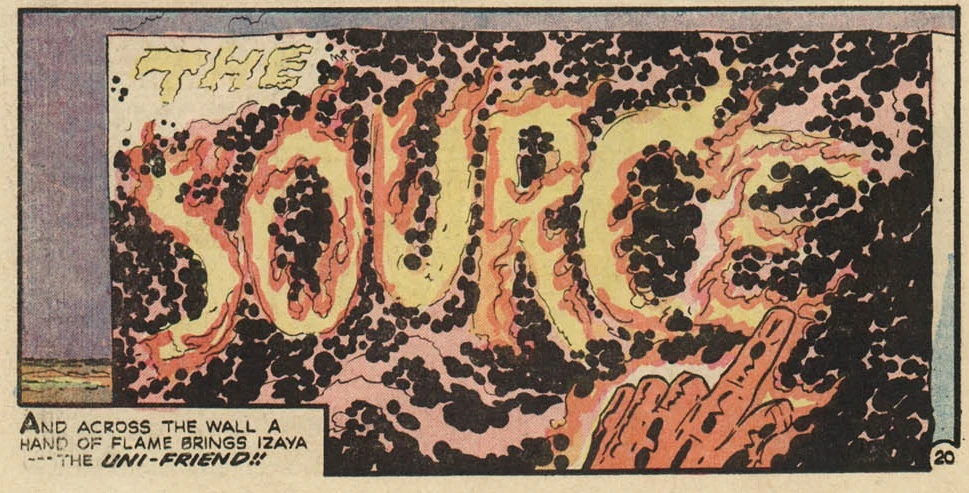
This topic has been covered in previous threads, so I thought it would be helpful to discuss it clearly. The Source and the Overvoid are often thought to be the same thing, but they are actually different. This thread aims to clarify this distinction.
The Source, long thought to be entirely identical to the Overvoid, was first described as a product of a self-referential void in The New Gods #1 (2025). This void, often mistaken for the Great Darkness, is self-referential by definition, it refers to itself.
By contrast, the Great Darkness cannot define or become aware of itself without the presence of another; its awareness depends on the Source. This means, strictly speaking, the Great Darkness is not self-referential, whereas the void that produced the Source is. The Overvoid, on the other hand, perfectly exemplifies self-referentiality. It is described as a non-dual omni-awareness and a transparent and eternal void. Its non-duality means that there is no "other" outside of it, so all consciousness is directed toward itself. Its transparency and eternity emphasize its fullness and independence. Together, these characteristics strongly support the idea that the Overvoid functions as a self-referential void.
In an interview, Grant Morrison identified the Overvoid and the Source as God, but the same writer also associated the Source with the Ain Soph Aurr, the “Infinite Light” of Kabbalah, the radiant emanation of the unknowable divine source. This interpretation aligns with more recent portrayals of the Source, particularly in The Flash and The New Gods, which describe it as the Light, while earlier materials depicted it as a manifestation of the Creator’s power. The Light is also a creation of God.
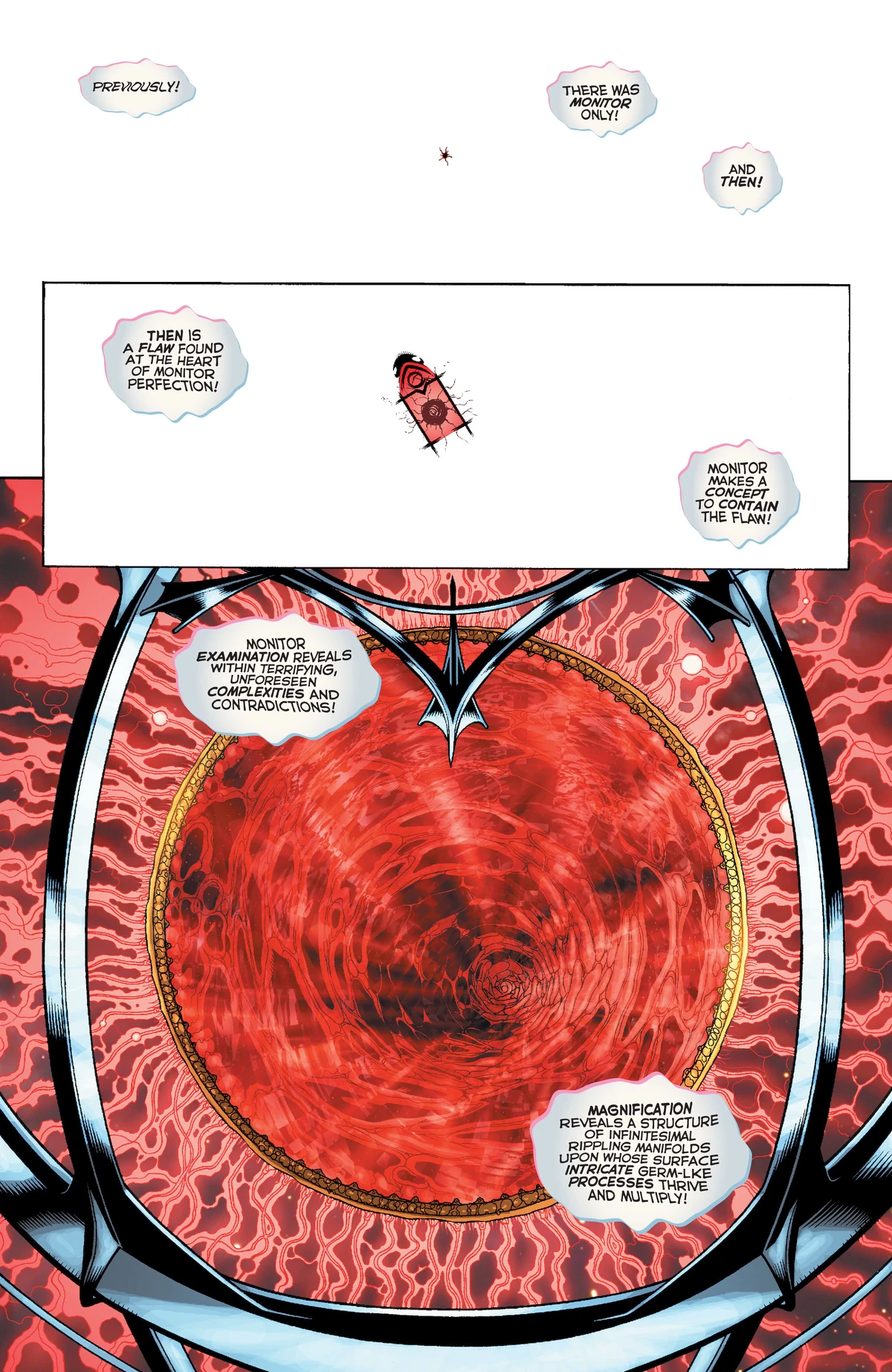
Another point I’d like to address is the famous scan from Justice League Incarnate #4, which is often cited as “confirmation” that the Overvoid is the Light. This topic has already been discussed in previous threads, and I maintain the same position. The story begins with a recap of the origins of creation, narrated by Doctor Multiverse, and uses lines and art styles that closely mirror those of Multiversity.
The issue with that recap is that it identifies the Great Darkness as the instigator of crises, which isn’t the case. The Great Darkness merely observes, unconcerned with the Multiverse, as noted in Dark Crisis: The Deadly Green #1 and Dark Crisis on Infinite Earths #7. Now, you might ask, “Does being wrong about the Great Darkness disprove that the Overvoid is the Light?” Not necessarily. In her recap, Doctor Multiverse states that the Great Darkness has constantly tried to destroy the Multiverse through various aspects or avatars, while the Light created counterforces to protect it. However, if her claim about the Great Darkness is inaccurate, it calls into question the overall reliability of Doctor Multiverse’s statements and cannot be used as evidence to equate the Overvoid with the Light/Source.
Conclusion: The Source is not the Overvoid, but rather a product of it.
Agrees: @Antvasima, @Setsuna_tenma, @Re5yh, @ProfectusInfinity, @Xearesay, @Vasco, @Firestorm808
Disagree: @Weaver261
Neutral:
The Source, long thought to be entirely identical to the Overvoid, was first described as a product of a self-referential void in The New Gods #1 (2025). This void, often mistaken for the Great Darkness, is self-referential by definition, it refers to itself.
"The Great Darkness could only define to itself through the presence of another. For total darkness can only be defined as an absence of light."
By contrast, the Great Darkness cannot define or become aware of itself without the presence of another; its awareness depends on the Source. This means, strictly speaking, the Great Darkness is not self-referential, whereas the void that produced the Source is. The Overvoid, on the other hand, perfectly exemplifies self-referentiality. It is described as a non-dual omni-awareness and a transparent and eternal void. Its non-duality means that there is no "other" outside of it, so all consciousness is directed toward itself. Its transparency and eternity emphasize its fullness and independence. Together, these characteristics strongly support the idea that the Overvoid functions as a self-referential void.
In an interview, Grant Morrison identified the Overvoid and the Source as God, but the same writer also associated the Source with the Ain Soph Aurr, the “Infinite Light” of Kabbalah, the radiant emanation of the unknowable divine source. This interpretation aligns with more recent portrayals of the Source, particularly in The Flash and The New Gods, which describe it as the Light, while earlier materials depicted it as a manifestation of the Creator’s power. The Light is also a creation of God.
Another point I’d like to address is the famous scan from Justice League Incarnate #4, which is often cited as “confirmation” that the Overvoid is the Light. This topic has already been discussed in previous threads, and I maintain the same position. The story begins with a recap of the origins of creation, narrated by Doctor Multiverse, and uses lines and art styles that closely mirror those of Multiversity.
"This caused an imperceptible flaw in what was once the immaculate perfection of the Light."
The issue with that recap is that it identifies the Great Darkness as the instigator of crises, which isn’t the case. The Great Darkness merely observes, unconcerned with the Multiverse, as noted in Dark Crisis: The Deadly Green #1 and Dark Crisis on Infinite Earths #7. Now, you might ask, “Does being wrong about the Great Darkness disprove that the Overvoid is the Light?” Not necessarily. In her recap, Doctor Multiverse states that the Great Darkness has constantly tried to destroy the Multiverse through various aspects or avatars, while the Light created counterforces to protect it. However, if her claim about the Great Darkness is inaccurate, it calls into question the overall reliability of Doctor Multiverse’s statements and cannot be used as evidence to equate the Overvoid with the Light/Source.
Conclusion: The Source is not the Overvoid, but rather a product of it.
Agrees: @Antvasima, @Setsuna_tenma, @Re5yh, @ProfectusInfinity, @Xearesay, @Vasco, @Firestorm808
Disagree: @Weaver261
Neutral:
Last edited: