This forum is strictly intended to be used by members of the VS Battles wiki. Please only register if you have an autoconfirmed account there, as otherwise your registration will be rejected. If you have already registered once, do not do so again, and contact Antvasima if you encounter any problems.
For instructions regarding the exact procedure to sign up to this forum, please click here.
We need Patreon donations for this forum to have all of its running costs financially secured.
Community members who help us out will receive badges that give them several different benefits, including the removal of all advertisements in this forum, but donations from non-members are also extremely appreciated.
Please click here for further information, or here to directly visit our Patreon donations page.
Please click here for information about a large petition to help children in need.
I accepted this but I realised how lowballed it is.
Just because we see large slices of concrete at the deepest point of the volume, doesn't lead to the conclusion that the whole thing was fragmented with fragments that size, hell, it's contradicted by the fact we see pebbles and pulverised bits coming out of the crater.
What we see is that 99 percent of the volume has disappeared, therefore pulverisation should be the route here.
We've had this discussion about you pushing for pulverisation for these sorts of feats back here. You were widely disagreed with, and I still disagree for those same reasons.
You have not provided enough details for the "sends people flying" thing for me to evaluate it. "It's a shockwave, 239 m/s" does not logically follow. And yes, non-natural gusts of air at slower speeds than 239 m/s could send people flying.
You have not provided enough details for the kicking speed feat, I have no idea what you're talking about there.
Similarly, I'm not sure what you're talking about with the last feat.
You've listed four values at the bottom, but suggested 5 calculations to change.
We've had this discussion about you pushing for pulverisation for these sorts of feats back here. You were widely disagreed with, and I still disagree for those same reasons.
You have not provided enough details for the "sends people flying" thing for me to evaluate it. "It's a shockwave, 239 m/s" does not logically follow. And yes, non-natural gusts of air at slower speeds than 239 m/s could send people flying.
The anime doesn't consistently portray real life physics there. The distance that dude moves spontaneously changes on a frame-by-frame basis, making it a bad measuring stick for timeframes, unless we are to believe that time is inexplicably speeding up and slowing down from frame to frame.
Okay I'm beginning to get tired. I'm just gonna write a long paragraph.
Izana Saves Kakucho
The Distances:
Dale Uses These Scans To "Debunk" The Distance Between Kisaki And Kakucho Being 40 Cm.
First I'm Going To Establish The Distance Between Kisaki And Kakucho After Kisaki Puts His Gun Down. Even Though Dales Arguments Are Fallacious (Argument From Incrudelity)
Dale Uses This To "Debunk" The Distance Between Kisaki And Kakucho, However He's Wrong.
Kakucho's Height = 1.79 Metres Or 222 Pixels So
1 Pixel = 0.8063063063063063 Cm
Distance Between Izana And The End Of The Panel = 100 Pixels Or 0.8 Metres
The Distance Between Izana And The Gun Tip After Kisaki Puts The Gun Down = 0.79 + 0.3325 = 0.9675 Metres
The Panel He Uses To "Debunk" The Distance Between The Gun Tip And Kakucho Doesn't Take Into Account The Facts That Kisaki's Arm Is Down Meaning The Distance Between Them Is Much Higher.
And Pixel Scaling To Kakucho Is Inaccurate As Izana Pushed Him Behind Him Meaning He's Further Then He Was In The AngSized Panel
Distance To The End Of The Panel = 219 Pixels Or 1.5056 Metres
You May Now Think. Oh Wow, Dale Was Right !! But You Would Be Thinking Wrong, Here's Why:
When AngSizing The Distance To Kakucho, Kisaki's Back Is In Frame, After The Shooting, Kisaki Straightens His Back, Which Means He's Further After The Shooting. How Much Further? Well He's About The Distance Of His Back Further Which Is 0.383 Metres. Meaning The Distance Between Izana And Kisaki Is Actually 1.683 Metres. It All Makes Sense, Especially Considering The Fact Kisaki Fell Back And He Moved After The Fact. So I Declare This Scan Debunked.
Also, Kisaki Clearly Moved. For Scans, Look Below. All Of This Pixel Scaling Doesn't Actually Matter.
This Scan Is Directly Contradicted By, 1, 2, 3, 4 scans before the feat. Which proves Kisaki HAD to of moved after the shooting. Kisaki's arm was clearly pointing forward. Not to the side. There Are More Photos Contradicting It In The Manga If You Want, I Found Well Over 5.
A Scream Reaches 125 DB, If Kakucho's Scream Couldn't Even Knock Izana Out Of His Broken Mental State, Would Normal Talking Break Him Out ? No, And There Is No Amount Of Evidence That Proves It Can, You'd Just Be Lying.
Also, If You Still Think Izana Was Somehow Running Behind Kakucho, The Anime Says You're Wrong. Listen Closely. We Only Hear One Pair Of Footsteps Which Matches With The Frames Of Kakucho's Stomps. Even During Kisaki Saying "Die" We Hear The Same Consistent Stomps As Before Proving Izana Was Standing Still (Obviously).
I don't have the time to grapple with the rest of your post right now, but it reads like a worrying reversion to your behaviour from 3 years ago.
In fact, this argument you're drawing out is one of the ones which lead to one of Tokyo Revengers' Discussion Rules against arguing for characters being above Supersonic.
These arguments you're providing don't smell substantively new, so I'm going to reject them without consideration.
I don't have the time to grapple with the rest of your post right now, but it reads like a worrying reversion to your behaviour from 3 years ago.
In fact, this argument you're drawing out is one of the ones which lead to one of Tokyo Revengers' Discussion Rules against arguing for characters being above Supersonic.
These arguments you're providing don't smell substantively new, so I'm going to reject them without consideration.
It's theexactsame feat we have discussed ad nauseum.
I'm not entertaining another relitigation after we have already done so 3+ times, with far more extensive detail than I could bring to the table right now.
If you can't see the resemblance, then that is quite unfortunate indeed.
It's theexactsame feat we have discussed ad nauseum.
I'm not entertaining another relitigation after we have already done so 3+ times, with far more extensive detail than I could bring to the table right now.
If you can't see the resemblance, then that is quite unfortunate indeed.
We made a discussion rule for a reason. You have not gone through any legitimate process to have this be considered an exception, so I will not tolerate an attempt to re-litigate it.
For every single discussion rule, people can constantly come around and say "But my argument's different!" if we let that slide simply based on the OP's claim, discussion rules would be pointless.
I got perms to post
First feat.
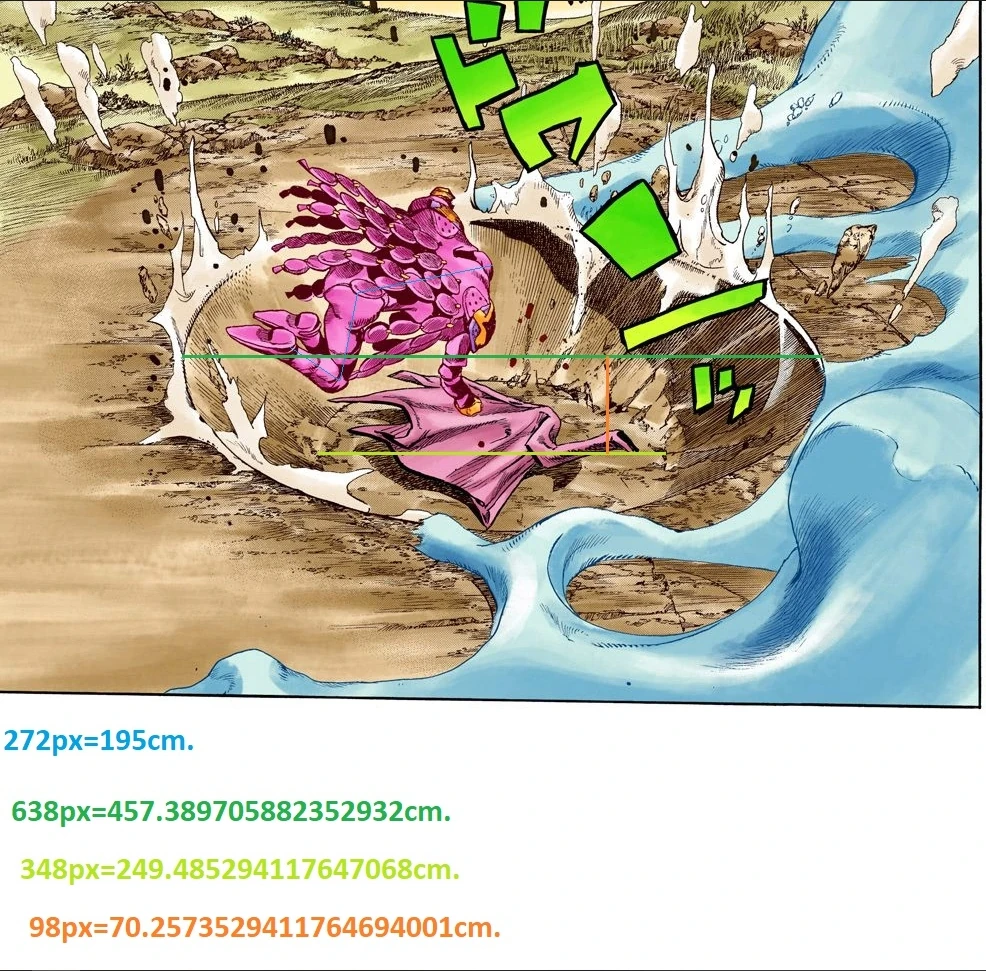
I'm going to say straight up. It's compression. It just is. It's a crater, there's basically zero debris, it's straight up the most basic compression I've ever seen, the dude gets slammed into the wall and pushes it in as it deforms, that's the exact type of interaction our concrete pulv is obtained from, that being 40Mpa~ on average.
And while I do get it, I don't exactly like the arguments against it.
There's cracks so it's frag?
There being extra cracks would just add to the feat, the volume of the crater is still compressed, if you factored in the cracks it would simply buff the feat up higher a negligible degree, not detract from the fact the material was pushed in and compressed.
Authors don't intend/mean that.
How would anyone know? How do we know what they do or do not know? Why are we assuming the author doesn't know what a crater entails? Why are we acting like an author thinks a solid concrete wall behaves like drywall? This isn't an argument unless we have substantial evidence and it'd only apply to that specific author in question.
And in the end, it doesn't matter what they think, if they drew that, that's the feat, it is what it is.
There's cracks next to it isn't overly realistic.
Yes. There is. This doesn't change the fact the volume itself was compressed though. Which is what's being calced. The compression should taper off more evenly being real, but, in the end, it's still a crater, it got compressed, the volume calculated is "pulved". If we want to throw feats out for stuff like that we may as well throw out every single physical feat on this forum because none create an impact, hole, crater, etc that would be 100% accurate to the impact in question. Obviously we don't do that and just calc the destruction as it is.
Or even just "the volume being gone doesn't mean it's pulv".
Ignoring the fact our pulverization values stem from compressive strength values, as in, literally the type of thing that's happening in this feat, which is to say that the 40J/cc value comes from compressive strength, aka, "the resistance of a material to breaking under compression." or to be more exact, "the ability of a material to resist being crushed, squashed, or shortened when a load presses down on it".
Which is to say, by literal definition, it straight up is the type of mechanical interaction where concrete "pulv" applies to.
Plus, even if we want to be roundabout by our standards, we, as a wiki, use pulv precisely in instances like this, that being Pulverization: Applied when the matter that was destroyed was turned to dust. We usually use this value when we see no remains of the matter that was destroyed in the aftermath of the attack. The value is 214 (J/cc). - Our calc page.
Which, is also the case here. So not only by our own standards does this qualify for pulv, but the fact it's a compression feat, and our pulv value comes from compression values anyway, just makes the unfair amount of scrutiny here confusing? Plus why would we ever default to frag for "zero debris, 99% of the volume is gone now due to the impact", over pulv? It's backwards, you'd run with whatever it's closest to, not the opposite extreme.
I could go on, but I shouldn't have to.
Like I get it, this verse is bad, it's been hyperinflated constantly, and everyone wants to avoid letting wank slip through, I get it, it's basically a case of trust being broken so everything is met with extreme scrutiny but this ain't helping it.
It's pulv, or to be more exact, it's compression, it is what it is, let's treat it properly instead of acting like frag fits better when it most certainly doesn't.
Of course, just because I agree with that doesn't mean there's some other stuff about it I don't disagree with.
Why reinforced concrete? Like we don't see any metal, rebar, etc in the feat at all, and it definitely isn't deep enough to assume it'd be taking out the metal framing by default like it would if it was blowing out the whole wall or floor or something.
Which is to say, it's only affecting the "concrete" part of "reinforced concrete". So just use standard concrete values, not reinforced.
Also, the depth seems a bit inflated (Not that I don't understand, I've spent months trying to figure out the depth of a crater feat, straight views make getting a depth extremely difficult), but why 25cm?
Like average male chest depth is one thing, I could get behind that in most cases, but global adult male average isn't that of a young japanese dude who's already kind of small?
Not exactly the average, it's probably more like 20cm at best, given how small the dude is tho, it could be legit as low as about 14cm~ based on random pediatric scales I skimmed over for japanese youths.
For reference, using your width/length of the hole, with normal concrete pulv and a more contextually accurate depth of about 16cm for a japanese teen twink, would be 3374210 Joules, so like 3 megajoules, 9-B, an upgrade but like nothing game changing, don't even think it upgrades the verse in the end. Then again if the dude is that small, his face might be 1cm~ lower too, so even those might need to be trimmed by a few percent. At this point I'd just redo it entirely, feat might not even change values in the end.
As for the other calcs and feats here, idk I kind of agree with Agnaa, like I get using compression for a compression feat, but stuff like shockwaves? Kicks? The arguments to change it are very flimsy or unsubstantiated imo.
Tbh I don't even think that one feat counts as LS to begin with, and more, just don't really hold up in my view, they're either fine or close enough as it is, or bordering on shouldn't even be used so pushing for more is asking for it to get tossed as we're being generous as it is.
First feat.
I'm going to say straight up. It's compression. It just is. It's a crater, there's basically zero debris, it's straight up the most basic compression I've ever seen, the dude gets slammed into the wall and pushes it in as it deforms, that's the exact type of interaction our concrete pulv is obtained from, that being 40Mpa~ on average.
And while I do get it, I don't exactly like the arguments against it.
There's cracks so it's frag?
There being extra cracks would just add to the feat, the volume of the crater is still compressed, if you factored in the cracks it would simply buff the feat up higher a negligible degree, not detract from the fact the material was pushed in and compressed.
Authors don't intend/mean that.
How would anyone know? How do we know what they do or do not know? Why are we assuming the author doesn't know what a crater entails? Why are we acting like an author thinks a solid concrete wall behaves like drywall? This isn't an argument unless we have substantial evidence and it'd only apply to that specific author in question.
And in the end, it doesn't matter what they think, if they drew that, that's the feat, it is what it is.
There's cracks next to it isn't overly realistic.
Yes. There is. This doesn't change the fact the volume itself was compressed though. Which is what's being calced. The compression should taper off more evenly being real, but, in the end, it's still a crater, it got compressed, the volume calculated is "pulved". If we want to throw feats out for stuff like that we may as well throw out every single physical feat on this forum because none create an impact, hole, crater, etc that would be 100% accurate to the impact in question. Obviously we don't do that and just calc the destruction as it is.
Or even just "the volume being gone doesn't mean it's pulv".
Ignoring the fact our pulverization values stem from compressive strength values, as in, literally the type of thing that's happening in this feat, which is to say that the 40J/cc value comes from compressive strength, aka, "the resistance of a material to breaking under compression." or to be more exact, "the ability of a material to resist being crushed, squashed, or shortened when a load presses down on it".
Which is to say, by literal definition, it straight up is the type of mechanical interaction where concrete "pulv" applies to.
Plus, even if we want to be roundabout by our standards, we, as a wiki, use pulv precisely in instances like this, that being Pulverization: Applied when the matter that was destroyed was turned to dust. We usually use this value when we see no remains of the matter that was destroyed in the aftermath of the attack. The value is 214 (J/cc). - Our calc page.
Which, is also the case here. So not only by our own standards does this qualify for pulv, but the fact it's a compression feat, and our pulv value comes from compression values anyway, just makes the unfair amount of scrutiny here confusing? Plus why would we ever default to frag for "zero debris, 99% of the volume is gone now due to the impact", over pulv? It's backwards, you'd run with whatever it's closest to, not the opposite extreme.
I could go on, but I shouldn't have to.
Like I get it, this verse is bad, it's been hyperinflated constantly, and everyone wants to avoid letting wank slip through, I get it, it's basically a case of trust being broken so everything is met with extreme scrutiny but this ain't helping it.
It's pulv, or to be more exact, it's compression, it is what it is, let's treat it properly instead of acting like frag fits better when it most certainly doesn't.
Of course, just because I agree with that doesn't mean there's some other stuff about it I don't disagree with.
Why reinforced concrete? Like we don't see any metal, rebar, etc in the feat at all, and it definitely isn't deep enough to assume it'd be taking out the metal framing by default like it would if it was blowing out the whole wall or floor or something.
Which is to say, it's only affecting the "concrete" part of "reinforced concrete". So just use standard concrete values, not reinforced.
Also, the depth seems a bit inflated (Not that I don't understand, I've spent months trying to figure out the depth of a crater feat, straight views make getting a depth extremely difficult), but why 25cm?
Like average male chest depth is one thing, I could get behind that in most cases, but global adult male average isn't that of a young japanese dude who's already kind of small?
Not exactly the average, it's probably more like 20cm at best, given how small the dude is tho, it could be legit as low as about 14cm~ based on random pediatric scales I skimmed over for japanese youths.
For reference, using your width/length of the hole, with normal concrete pulv and a more contextually accurate depth of about 16cm for a japanese teen twink, would be 3374210 Joules, so like 3 megajoules, 9-B, an upgrade but like nothing game changing, don't even think it upgrades the verse in the end. Then again if the dude is that small, his face might be 1cm~ lower too, so even those might need to be trimmed by a few percent. At this point I'd just redo it entirely, feat might not even change values in the end.
As for the other calcs and feats here, idk I kind of agree with Agnaa, like I get using compression for a compression feat, but stuff like shockwaves? Kicks? The arguments to change it are very flimsy or unsubstantiated imo.
Tbh I don't even think that one feat counts as LS to begin with, and more, just don't really hold up in my view, they're either fine or close enough as it is, or bordering on shouldn't even be used so pushing for more is asking for it to get tossed as we're being generous as it is.
I got perms to post
First feat.
I'm going to say straight up. It's compression. It just is. It's a crater, there's basically zero debris, it's straight up the most basic compression I've ever seen, the dude gets slammed into the wall and pushes it in as it deforms, that's the exact type of interaction our concrete pulv is obtained from, that being 40Mpa~ on average.
And while I do get it, I don't exactly like the arguments against it.
There's cracks so it's frag?
There being extra cracks would just add to the feat, the volume of the crater is still compressed, if you factored in the cracks it would simply buff the feat up higher a negligible degree, not detract from the fact the material was pushed in and compressed.
Authors don't intend/mean that.
How would anyone know? How do we know what they do or do not know? Why are we assuming the author doesn't know what a crater entails? Why are we acting like an author thinks a solid concrete wall behaves like drywall? This isn't an argument unless we have substantial evidence and it'd only apply to that specific author in question.
And in the end, it doesn't matter what they think, if they drew that, that's the feat, it is what it is.
There's cracks next to it isn't overly realistic.
Yes. There is. This doesn't change the fact the volume itself was compressed though. Which is what's being calced. The compression should taper off more evenly being real, but, in the end, it's still a crater, it got compressed, the volume calculated is "pulved". If we want to throw feats out for stuff like that we may as well throw out every single physical feat on this forum because none create an impact, hole, crater, etc that would be 100% accurate to the impact in question. Obviously we don't do that and just calc the destruction as it is.
Or even just "the volume being gone doesn't mean it's pulv".
Ignoring the fact our pulverization values stem from compressive strength values, as in, literally the type of thing that's happening in this feat, which is to say that the 40J/cc value comes from compressive strength, aka, "the resistance of a material to breaking under compression." or to be more exact, "the ability of a material to resist being crushed, squashed, or shortened when a load presses down on it".
Which is to say, by literal definition, it straight up is the type of mechanical interaction where concrete "pulv" applies to.
Plus, even if we want to be roundabout by our standards, we, as a wiki, use pulv precisely in instances like this, that being Pulverization: Applied when the matter that was destroyed was turned to dust. We usually use this value when we see no remains of the matter that was destroyed in the aftermath of the attack. The value is 214 (J/cc). - Our calc page.
Which, is also the case here. So not only by our own standards does this qualify for pulv, but the fact it's a compression feat, and our pulv value comes from compression values anyway, just makes the unfair amount of scrutiny here confusing? Plus why would we ever default to frag for "zero debris, 99% of the volume is gone now due to the impact", over pulv? It's backwards, you'd run with whatever it's closest to, not the opposite extreme.
I could go on, but I shouldn't have to.
Like I get it, this verse is bad, it's been hyperinflated constantly, and everyone wants to avoid letting wank slip through, I get it, it's basically a case of trust being broken so everything is met with extreme scrutiny but this ain't helping it.
It's pulv, or to be more exact, it's compression, it is what it is, let's treat it properly instead of acting like frag fits better when it most certainly doesn't.
Of course, just because I agree with that doesn't mean there's some other stuff about it I don't disagree with.
Why reinforced concrete? Like we don't see any metal, rebar, etc in the feat at all, and it definitely isn't deep enough to assume it'd be taking out the metal framing by default like it would if it was blowing out the whole wall or floor or something.
Which is to say, it's only affecting the "concrete" part of "reinforced concrete". So just use standard concrete values, not reinforced.
Also, the depth seems a bit inflated (Not that I don't understand, I've spent months trying to figure out the depth of a crater feat, straight views make getting a depth extremely difficult), but why 25cm?
Like average male chest depth is one thing, I could get behind that in most cases, but global adult male average isn't that of a young japanese dude who's already kind of small?
Not exactly the average, it's probably more like 20cm at best, given how small the dude is tho, it could be legit as low as about 14cm~ based on random pediatric scales I skimmed over for japanese youths.
For reference, using your width/length of the hole, with normal concrete pulv and a more contextually accurate depth of about 16cm for a japanese teen twink, would be 3374210 Joules, so like 3 megajoules, 9-B, an upgrade but like nothing game changing, don't even think it upgrades the verse in the end. Then again if the dude is that small, his face might be 1cm~ lower too, so even those might need to be trimmed by a few percent. At this point I'd just redo it entirely, feat might not even change values in the end.
Regardless, if you want it changed, it deserves its own dedicated, general thread, rather than trying to make two feats on the site far higher than the thousands of other similar feats.
Regardless, if you want it changed, it deserves its own dedicated, general thread, rather than trying to make two feats on the site far higher than the thousands of other similar feats.
What? We do that for countless crater feats, which is precisely why I'm wondering why we're acting like we don't do this when we do, we almost never pretend it's basic frag, and for the few calcs that ultimately do, they're wrong and actually go against our established standards, not the other way around.
It's legit standard protocol, says so right there on the calc page when to use it even.
Most craters are almost always pulv/compression and calced as such from what I've seen, based on the fact they're pulv/compression, and numerous verses treat feats as such, whether it's random Batman wall craters using compression, or huge city wide craters from random mid manhua.
Like what exactly am I supposed to get changed? This is already how we calc these.
What? We do that for countless crater feats, which is precisely why I'm wondering why we're acting like we don't do this when we do, we almost never pretend it's basic frag, and for the few calcs that ultimately do, they're wrong and actually go against our established standards, not the other way around.
It's legit standard protocol, says so right there on the calc page when to use it even.
Most craters are almost always pulv/compression and calced as such from what I've seen, based on the fact they're pulv/compression, and numerous verses treat feats as such, whether it's random Batman wall craters using compression, or huge city wide craters from random mid manhua.
Like what exactly am I supposed to get changed? This is already how we calc these.
Not sure where you're getting this from. Closest I can find is the Calculations page saying:
Pulverization: Applied when the matter that was destroyed was turned to dust. We usually use this value when we see no remains of the matter that was destroyed in the aftermath of the attack. The value is 214 (J/cc).
But in this case there are the remains of the matter, we see pebbles and mostly-cracked pieces, not a bare crater.
And looking at the "few calcs" thing, here are the first 8 accepted calcs I find when searching for "crater" that are related to this sorta situation (not using ones with vaporisation, or that have bare craters that I already believe are pulv):
I stopped looking after 8 since I'd spent an hour looking through 10 pages of search results and only got those.
Funnily enough while looking for those I found this calc, where the aftermath looks quite barren and similar to the other calcs, but the video clearly shows massive fragments that just inexplicably disappear when it cuts away.
Anyway, looks like kind of a 50/50 split over which one we go with, I don't think it's just a few going that way with the vast majority sticking with pulv. And going away from that random selection, I've got this accepted calc of mine which merely used frag.
Not sure where you're getting this from. Closest I can find is the Calculations page saying:
But in this case there are the remains of the matter, we see pebbles and mostly-cracked pieces, not a bare crater.
And looking at the "few calcs" thing, here are the first 8 accepted calcs I find when searching for "crater" that are related to this sorta situation (not using ones with vaporisation, or that have bare craters that I already believe are pulv):
I stopped looking after 8 since I'd spent an hour looking through 10 pages of search results and only got those.
Funnily enough while looking for those I found this calc, where the aftermath looks quite barren and similar to the other calcs, but the video clearly shows massive fragments that just inexplicably disappear when it cuts away.
Anyway, looks like kind of a 50/50 split over which one we go with, I don't think it's just a few going that way with the vast majority sticking with pulv. And going away from that random selection, I've got this accepted calc of mine which merely used frag.
On a side note. My theory makes more sense because there isn't a crater out there with cracks like that at the bottom. they would only happen if continued force was applied.
Yes, exactly, we do not see any relevant volume leftover.
No joke think we only see one or two pebbles, for all intents and purposes we see nothing of the crater's volume.
Actually, it doesn't, it compresses it. We just happen to use compression for pulverization for dusting too because it's the most comparable mechanical interaction, in some cases dusting could be higher or lower depending on the material tbh.
But a crater, and where we get our pulv value from anyway, is for pushing and compressing a material inward, which is what happens in this feat, or any feat like it.
But, what? Are you saying because we don't see any residue (which by our standards is exactly when we use pulv, so DT is just wrong on that front, you'd need to make a CRT to rewrite the calc page to remove the second line, given no remains would encompass dust), that it's somehow more accurate to assume the opposite end of the extreme and use basic frag?
That makes no sense. That's like saying on a scale between 95 to 100, a feat has a destruction value of 100 instead of 95, thus we should use 1 instead of 95.
Yes it does?
A bunch of material just got compressed inward, of course the area around it will fracture on top of it, honestly it wouldn't make sense if it didn't, there should be huge cracks extending outward from the edges, and there should be cracks along the inner crater too. This doesn't detract from the pulv, it adds to it.
It's directly related to the calc at hand no? In fact the entire topic is if pulv should be used or not.
If need be I will make a CRT for it, in general, for craters as a whole, I really shouldn't have to by our very standards, how it's written on the page, and hundreds of calcs and verses already follow that route, on top the very pulv values we use being derived from compression values and articles, but if it would appease you, I will do so.
We don't? Unless they just cut out a scan from the imgur album, in which case that's more on them removing extra context from the feat, as opposed to if a basic crater slam should use pulv, if there's missing context then yeah ignore this whole convo.
But based on what I've been shown, we see a single maybe half cm pebble. And that's it. If it's such a big deal, he can subtract 2 or 3 cubic cm from the end volume.
Also we don't see cracked pieces? Unless you're referring to the bottom of the crater? Of course it'd be cracked, it just got compressed inward in less than a second.
The area around it should be cracked too to some degree. But he isn't calcing the cracks, he's calculating the compressed volume, aka, the crater? If he wants to add the cracks, it'd only push the feat higher, probably be best to use tensile or shear strength depending on the angle of the cracks. Maybe use a magic wand tool to get the area of the cracks and figure out the depth of the splits, then apply the aforementioned tensile or shear values along the cross sections idk.
And looking at the "few calcs" thing, here are the first 8 accepted calcs I find when searching for "crater" that are related to this sorta situation (not using ones with vaporisation, or that have bare craters that I already believe are pulv):
snip
I stopped looking after 8 since I'd spent an hour looking through 10 pages of search results and only got those.
Funnily enough while looking for those I found this calc, where the aftermath looks quite barren and similar to the other calcs, but the video clearly shows massive fragments that just inexplicably disappear when it cuts away.
Ok? Obviously if we see a billion chunks of debris, we wouldn't use pulv, because we know the mass wasn't compressed, it was just shattered and fell or launched out of the "crater".
That isn't the case in 99% of crater feats tho and isn't the case here.
Anyway, looks like kind of a 50/50 split over which one we go with, I don't think it's just a few going that way with the vast majority sticking with pulv. And going away from that random selection, I've got this accepted calc of mine which merely used frag.
I can grab a dozen or more accepted blogs from CGM's that use pulv for basic crater wall feats. Hell I have accepted crater wall feats that use pulv due to compression.
Just because you have a calc that uses frag, doesn't mean that's the standard or how it should have been done or what everyone else does for the most part or how it's written to be used.
In fact looking at your calc and the feat mp4, your calc SHOULD be pulv no questions asked, it's a basic crater performed by a punch on a instant impact, there's no solid debris beyond maybe a few slivers of shrapnel, and there's even a big plume of dust. Go upgrade it tbh.
Mind you, there's legit hundreds of calcs that use pulv for craters by default, even some popular verses hinge on assuming pulv for craters for their key ratings, or compression, such as Chainsaw Man, Marvel Comics and other Comic street goons, JJK, etc.
Which is why I'm sitting here wondering why I'm being asked to "change" this, when there's nothing to actually change? And over Tokyo Revengers of all verses? Like I know we don't want to inflate or wank it, but going the opposite extreme doesn't help either.
I'm aware, I made sure to read it before commenting to see if maybe I was missing something, like maybe there was big chunks afterward that would make up a majority of the destroyed volume, proving it wasn't pulv or something and that's why it got rejected. But that wasn't the case, the majority of the thread was just unwarranted scrutiny and unfair standards for literally no reason.
I'm contesting that verdict evidently, don't really want to given this verse mid af but our job is to be fair and index properly which we aren't doing atm.
Case and point, are we really saying we won't use pulv for a compression feat because MAYBE the author imagined concrete like drywall? How do we know? Why is that even a legitimate point brought forth?
In fact that has just as much backing as saying the author actually spent hours looking into material interactions and mechanics and knew exactly what they were drawing. Which is to say it's baseless conjecture and ultimately doesn't matter because it isn't drywall, it's concrete.
We can't say it's secretly frag or the author didn't mean to have it be that strong when that's not what's drawn or shown.
Same goes for the other arguments, none of them add up or go against what we've been doing for like a decade now.
Is that not what this thread is for? To change it? Or do you mean in general? Because if so, as said I am willing to make a thread to get it ironed out if this is actually some sort of issue in regards to clarity. In fact **** it, maybe I'll start writing it up now just to avoid a back and forth here, save us both time that way.
Actually, it doesn't, it compresses it. We just happen to use compression for pulverization for dusting too because it's the most comparable mechanical interaction, in some cases dusting could be higher or lower depending on the material tbh.
But a crater, and where we get our pulv value from anyway, is for pushing and compressing a material inward, which is what happens in this feat, or any feat like it.
Compression causing cracks is related to the physical roots of our destruction values, yeah, but our destruction values kind of mangle that sort of thing, such that I think it's only reasonable to apply to a volume that is turned into dust.
Our destruction values are in j/cc, not in Pa. I don't think applying force to a wall such that it creates a crack like that, is equivalent to applying our destruction values over the volume that was displaced to the other side. As I mentioned at the start of the original thread, I think the best argument for these craters being pulv is when they're in the ground, but for wall-based feats like this there's room on the other side for the vacant matter to displace into.
But, what? Are you saying because we don't see any residue (which by our standards is exactly when we use pulv, so DT is just wrong on that front, you'd need to make a CRT to rewrite the calc page to remove the second line, given no remains would encompass dust), that it's somehow more accurate to assume the opposite end of the extreme and use basic frag?
That makes no sense. That's like saying on a scale between 95 to 100, a feat has a destruction value of 100 instead of 95, thus we should use 1 instead of 95.
I was extending it from the argument in the previous thread, where Vzearr was arguing from physical realism; that if the matter is not visible, that it must have turned into dust and blown away.
I am not arguing against using pulv for situations with bare craters and no notable amount of material left. I'm saying that such an idea is ultimately unrealistic; not all of these scenes have the wind necessary to blow all that dust into nonexistence in a quarter of a second. And so, "the dust blew away" is not a noticeably more realistic alternative to "the fragments disappeared somehow", and so we should use other indicators (like the destruction at the frontier, and any rubble that is present, even if it doesn't compose the entire volume) to figure out the appropriate destruction value.
Yes it does?
A bunch of material just got compressed inward, of course the area around it will fracture on top of it, honestly it wouldn't make sense if it didn't, there should be huge cracks extending outward from the edges, and there should be cracks along the inner crater too. This doesn't detract from the pulv, it adds to it.
Welp, idk enough about the material science at play, but I'd expect the change to be more gradual, than to go from "crushing into dust" into "can't even break off large fragments" in 0.1 mm.
A lot of those are ones I already saw, and didn't include since they're bare craters without meaningful cracking on the edge (which is the qualifier I look for).
But ye, there are new relevant pulvs there. I just tried pulling from literally every calc, both pulv and non-pulv, instead of just searching for pulv ones.
Yeah I'm not so sure about that last thread either since most crater of a similar nature use pulverization, I could also pull a few dozen who have also done the same exact thing across many other verses so I am inclined to lean more to chariot here but I'll wait for both of you to do big post.
A lot of those are ones I already saw, and didn't include since they're bare craters without meaningful cracking on the edge (which is the qualifier I look for).
Compression causing cracks is related to the physical roots of our destruction values, yeah, but our destruction values kind of mangle that sort of thing, such that I think it's only reasonable to apply to a volume that is turned into dust.
Cracks being caused is 100% to be expected.
There doesn't need to be dust, most crater feats we accept on wiki don't even have much dust, if any, and they really don't need to, the crater is still there, the volume is still gone. I might be misreading you, but you're basically saying because we don't see dust, we should use frag, even though logically, we should probably be using something stronger than pulv given the lack of even dust.
Yes, but where did we get those values from? If you want to be extreme, every single destruction value we have on wiki, is more or less wrong.
They stem from MPA values, we just apply them to cubic material because shrug.
There's been many threads on this in the past, nobody wants to fix it, we use a simplified approach.
But all the same, our destruction values for pulv is compression strength, to not apply that to compression feats is baffling.
I don't think applying force to a wall such that it creates a crack like that, is equivalent to applying our destruction values over the volume that was displaced to the other side.
Two of your points have been prefaced with "I think/I don't think", and while this hobby is ultimately a matter of opinion, we still have established precedent and some stuff isn't exactly that subjective.
This is how we treat it, this is where the values come from, it's compression, we use pulv for compression, craters, etc.
Why would you assume it was displaced on the other side?
You don't add extra assumptions like that, and it isn't even true because if it was, it wouldn't be just cracked, there'd be a whole extra rim around the edge of the crater that's evidently disconnected from the wall because that area, let's treat it as a cylinder in this context, would have been sheared off the insides of the wall and pushed backwards, that isn't what happened. Thinking on it further, we see the edges of the crater line up evenly with the wall edges right? But if it was dislodged and pushed backwards, why is it concave yet lines up still? If we treat it like a cylinder, that means the wall would have had to of had a chunk jutting out to start with that got pushed back so the rim now lins up with the edge of the wall around it, while the center is still compressed inwards anyway?
As I mentioned at the start of the original thread, I think the best argument for these craters being pulv is when they're in the ground, but for wall-based feats like this there's room on the other side for the vacant matter to displace into.
Unless you see actually displacement around the edges, because if you're arguing the indentation is actually just the wall being pushed back, that would mean the edges of the affected area would have needed to be sheared off from the wall's cross section to dislodge it back further and everything behind that point would have had to be broken apart too.
Also literally nobody treats these feats that way.
Occam's Razor, we see a crater, and you're instead assuming all this extra stuff that tbh doesn't even make sense logistically or visually, when it was never shown or implied, instead of just treating the crater like a crater?
I was extending it from the argument in the previous thread, where Vzearr was arguing from physical realism; that if the matter is not visible, that it must have turned into dust and blown away.
It very well could of given the force that causes these craters to begin with, would cause an instant plume of dust to be launched at high velocity, but that may or may not be the case, and ultimately doesn't matter.
The dude got slammed into a wall, it compressed the wall, it made a crater, we use pulv for those types of feats, always have.
I'm saying that such an idea is ultimately unrealistic;not all of these scenes have the wind necessary to blow all that dust into nonexistence in a quarter of a second.
If you want to argue strict realism, every single one would, the very impacts that cause these things would generate enough pressure wind to blow dust away at insane speeds proportionate to the amount of volume and energy exerted.
Technically speaking the ejection speed for a 3 megajoule impact that, hypothetically, converts the effected volume into dust, would have something ridiculous like a ejection speed of dust in the range of hundreds to low thousands of mps.
And so, "the dust blew away" is not a noticeably more realistic alternative to "the fragments disappeared somehow", and so we should use other indicators (like the destruction at the frontier, and any rubble that is present, even if it doesn't compose the entire volume) to figure out the appropriate destruction value.
Yes, we should, obviously if there's a lots of debris you wouldn't use pulv, because the feta wouldn't be compression or pulv but simply an impact that broke material and then the broken material was just launched or fell out afterward, but that isn't the case for 99% of crater feats where debris tend to just be a few stray bits around the edges, or nothing at all
Welp, idk enough about the material science at play, but I'd expect the change to be more gradual, than to go from "crushing into dust" into "can't even break off large fragments" in 0.1 mm.
You're right, mostly, it SHOULD taper a bit more, but it also depends on how fast the strike and impact is.
Like those quick compressive testers that strike within a fraction of a second very often simply compress the area they strike as designed, leaving a nice hole. But a more slow or gradual compress would create more faultlines, splits and whatever, it just kind of depends on the speed, the material in question, and even the area of the thing doing the strike, but that's beside the point.
That doesn't change the feat being discussed, or the hundreds of others.
I mean, is it? Everyone on this wiki more or less, follows what I'm saying here, from CGM's, mods, basically every relevant verse.
If anything I should be asking you to make a thread because your stance on this topic is the exception, not mine, hell even some of the mods you have listed as disagreeing, have a bunch of crater calcs, some against walls even, some with even more lil stray chunks, that use pulv because that is simply what we do so idk what's going on with them.
A lot of those are ones I already saw, and didn't include since they're bare craters without meaningful cracking on the edge (which is the qualifier I look for).
Almost every single one I linked has some semblance of cracking or isn't completely smooth. I think maybe 4 are completely smooth? If need be I can grab a dozen more that are jagged, ununiform, etc.
Your qualifier isn't even real..... You're taking something that would add to the calc to discredit it...
But ye, there are new relevant pulvs there. I just tried pulling from literally every calc, both pulv and non-pulv, instead of just searching for pulv ones. Sounds good.
I mean it's gonna take me awhile given you're basically making me dig through decades old archived files and find a shit ton of research papers to explain basic compression i might even have to whip out the old narutoforums account to look at the source of our values if I want to be extra detailed but my point still stands, this is unwarranted scrutiny for a basic feat that fits both our accepted standards, and fits the literal premise of where we even obtained the pulv value to begin with, with the only argumentation against it being essentially guesswork or assumptions when that's the exact type of thing we want to avoid.
Why? What's the scientific backing behind this? Even if a material has high af compression (like high-psi concrete), the impacts would stil create tensile wave reflections that cause spall (chips popping off), radial and concentric cracks (this should be more concentrated towards the lip), and delamination under the crater too. And it depends on material too, concrete, stone, or ceramics are brittle. They'd fail by cracking once local tensile stress exceeds their (much lower, usually anyway) tensile strength or fracture toughness, which is to say, by overcoming the compressive strength, you, by default, will always create cracks by default at the edges of the affected compressed area, plus not to mention the dynamic strength rises at high strain rate, but that still isnt enough to stop cracking around a strong central crush zone, resulting ina crater with cracks, chips, and roughness. Of course, it also depends on the material, this is for rock, concrete, etc, but something like rubber, most metals, and other ductile stuff, etc, actually shouldnt have a bunch of cracks or jaggeds, they should be nice and smooth due their inherent elasticity and malleability, they'd deform a lot more evenly. Inversely something like glass or ice should be utterly ****** and shatter far beyond the compressed area due to how they interact and fractures propagates in them.
Cracks being caused is 100% to be expected.
There doesn't need to be dust, most crater feats we accept on wiki don't even have much dust, if any, and they really don't need to, the crater is still there, the volume is still gone. I might be misreading you, but you're basically saying because we don't see dust, we should use frag, even though logically, we should probably be using something stronger than pulv given the lack of even dust.
Yes, but where did we get those values from? If you want to be extreme, every single destruction value we have on wiki, is more or less wrong.
They stem from MPA values, we just apply them to cubic material because shrug.
There's been many threads on this in the past, nobody wants to fix it, we use a simplified approach.
But all the same, our destruction values for pulv is compression strength, to not apply that to compression feats is baffling.
We have to be very careful about the volumes we choose for these feats because of that simplification. Even if a force was working against the compressive strength of a material, that doesn't mean that it did so to the extent of entailing the use of the pulv destruction value over that whole volume.
Ultimately those forces are a way of interacting with the material. You could apply 1/100th of the force, and you would still be interacting with the material in that same way, yet you would be using less force (and presumably less energy) to do so. So these destruction values should only apply past a certain level of destruction, in this case, greater than breaking them apart into tiny fragments.
There are degrees of failure, and pulv is a high bar.
Two of your points have been prefaced with "I think/I don't think", and while this hobby is ultimately a matter of opinion, we still have established precedent and some stuff isn't exactly that subjective.
This is how we treat it, this is where the values come from, it's compression, we use pulv for compression, craters, etc.
Why would you assume it was displaced on the other side?
You don't add extra assumptions like that, and it isn't even true because if it was, it wouldn't be just cracked, there'd be a whole extra rim around the edge of the crater that's evidently disconnected from the wall because that area, let's treat it as a cylinder in this context, would have been sheared off the insides of the wall and pushed backwards, that isn't what happened. Thinking on it further, we see the edges of the crater line up evenly with the wall edges right? But if it was dislodged and pushed backwards, why is it concave yet lines up still? If we treat it like a cylinder, that means the wall would have had to of had a chunk jutting out to start with that got pushed back so the rim now lins up with the edge of the wall around it, while the center is still compressed inwards anyway?
That doesn't sound right to me, if I push my finger into a tissue, it gets displaced backwards, without having an "extra rim" around the edge of the depression created. It doesn't need to be a cylinder, or have any harsh discontinuity. With more rigid materials, bits would get broken off, but I don't think it'd need to be harsh enough to be visible in the feats we're talking about.
It very well could of given the force that causes these craters to begin with, would cause an instant plume of dust to be launched at high velocity, but that may or may not be the case, and ultimately doesn't matter.
The dude got slammed into a wall, it compressed the wall, it made a crater, we use pulv for those types of feats, always have.
If you want to argue strict realism, every single one would, the very impacts that cause these things would generate enough pressure wind to blow dust away at insane speeds proportionate to the amount of volume and energy exerted.
Technically speaking the ejection speed for a 3 megajoule impact that, hypothetically, converts the effected volume into dust, would have something ridiculous like a ejection speed of dust in the range of hundreds to low thousands of mps.
No shot, being thrown in the wall in that direction would not result in that volume of dust disappearing from where is visible in a short amount of time, it would've been largely omnidirectional/random, at best, going back towards the person throwing him into the wall, coating them in dust.
You're right, mostly, it SHOULD taper a bit more, but it also depends on how fast the strike and impact is.
Like those quick compressive testers that strike within a fraction of a second very often simply compress the area they strike as designed, leaving a nice hole. But a more slow or gradual compress would create more faultlines, splits and whatever, it just kind of depends on the speed, the material in question, and even the area of the thing doing the strike, but that's beside the point.
Why? What's the scientific backing behind this? Even if a material has high af compression (like high-psi concrete), the impacts would stil create tensile wave reflections that cause spall (chips popping off), radial and concentric cracks (this should be more concentrated towards the lip), and delamination under the crater too. And it depends on material too, concrete, stone, or ceramics are brittle. They'd fail by cracking once local tensile stress exceeds their (much lower, usually anyway) tensile strength or fracture toughness, which is to say, by overcoming the compressive strength, you, by default, will always create cracks by default at the edges of the affected compressed area, plus not to mention the dynamic strength rises at high strain rate, but that still isnt enough to stop cracking around a strong central crush zone, resulting ina crater with cracks, chips, and roughness. Of course, it also depends on the material, this is for rock, concrete, etc, but something like rubber, most metals, and other ductile stuff, etc, actually shouldnt have a bunch of cracks or jaggeds, they should be nice and smooth due their inherent elasticity and malleability, they'd deform a lot more evenly. Inversely something like glass or ice should be utterly ****** and shatter far beyond the compressed area due to how they interact and fractures propagates in them.
I mean it's gonna take me awhile given you're basically making me dig through decades old archived files and find a shit ton of research papers to explain basic compression i might even have to whip out the old narutoforums account to look at the source of our values if I want to be extra detailed but my point still stands, this is unwarranted scrutiny for a basic feat that fits both our accepted standards, and fits the literal premise of where we even obtained the pulv value to begin with, with the only argumentation against it being essentially guesswork or assumptions when that's the exact type of thing we want to avoid.
Kind of a case-by-case basis concern in all honesty. Sometimes if the crater isn't overtly smooth or spherical in nature or if it genuinely shoots up large debris instead of it being smooth compression, we chalk it up to being frag, though the line becomes significantly murky even then. Not something you can make a "one size fits all" rule for, just gotta play it close to the chest.
If you punch and pulp like 100m3 of solid rock in the face of a 10000m3 cube, there should be hundreds of fault lines, cracks, splits and all that fun stuff spread across the surface of the concaved material and even outside of it extending from the rim of the impact. But you wouldn't ignore the 100m3 of solid rock being pulved even if the cracks and whatnot covered a total 100m2 of the cube in question, would you?
I would understand if it was fragmentation, but as outlined below, compression or complete visible removal/destruction is the exact opposite, technically lowballing it.
You're arguing against the very source of when pulv should be used and where we even got these values from, based on how it's an area thing, not cubic, but that applies to every single value for everything, we as a wiki just treat the Mpa as J/cc as a shortcut. Yes, it is indeed more complex than that, but there's been so many threads on that and it's been rejected every time that this isn't an argument to be made here. Yeah it's not perfect, but if you want to be real, in the case of compression and pulv, the Mpa value is actually underselling it by quite a bit, contrary to our basic frag values which are technically inflated by magnitudes due to not actually encompassing the entire 3D space/cubic cm volume yet applying the joule energy over every cubic cm, especially for big chunky feats, so that "careful point" doesn't actually make much sense here, it's other types of destruction that should be scrutinized a bit more.
Even if a force was working against the compressive strength of a material, that doesn't mean that it did so to the extent of entailing the use of the pulv destruction value over that whole volume.
That is literally where our pulv value comes from.
I can't even reply to this because it's just how it is. If we follow this logic we would need to literally throw out every single pulv calc and value on this wiki.
As it stands, we use pulv, which is actually compression, for feats where a volume of material is compressed, turned to dust, or otherwise destroyed down to a degree that is no longer visible. This is the standard, this feat is no different, we shouldn't treat it differently, it isn't special, it has no special caveats, this is what we do and have done for over a decade.
This is legitimately not something I need to argue against, you would need to completely overhaul how we use pulv in calcs for this to be a point.
Ultimately those forces are a way of interacting with the material. You could apply 1/100th of the force, and you would still be interacting with the material in that same way, yet you would be using less force (and presumably less energy) to do so.
Other way around. If you're interacting with a material, and the end result is crater, "that force" is a baseline, it only goes up from there, not down as we know the cubic material in question has been reduced or effected in such a way to comply with both our rules, and compression as a mechanical property, unless it crosses into a threshold like extra chunks, or leftover debris, or whatnot, but that's why we have benchmarks of multiple values to use for what's fit best. And yeah, if something has big chunks leftover or spilled out, we don't use pulv, but unless you can point out where in this case those chunks exist, this isn't relevant.
Yeah? Which is what this is? That's what every single calc I linked is.
It's literally why our calc page says if ya don't see remains, use pulv.
Obviously, if there's a bunch of fragments, or big chunks, or this, or that, you wouldn't use pulv, but that goes without saying and isn't what's happening here or any of the calcs mentioned (bar a few, but they subtract those debris from the cratered area).
If there is little, if any, remains of the volume in question, it's pulv.
If reduced to dust or a level below that, it is pulv (Up to sub-atomic destruction, in which case that value takes over, obviously).
If compressed, well at that point it's just compression which is where we get our pulv value to begin with, which, mind you, we do in fact use pulv based solely on the fact a material was compressed or even just pushed (See several of the accepted blogs I linked), but 99% of those still fall under the prior two points so semantics don't matter.
In fact you just answered your prior point, there are degrees of failure, yet you're taking what amounts to a lower degree of failure at the edges, which is completely realistic, arguing it isn't realistic, and furthermore ignoring the actual compression of the majority of mass due to that extra additional lower-end failure, and using that to discredit the majority, when in actuality they co-exist and if you wanted to be real precise, you'd account for both at the same time which would simply buff all these feats by a lil bit.
That doesn't sound right to me, if I push my finger into a tissue, it gets displaced backwards, without having an "extra rim" around the edge of the depression created.
A tissue? A very soft, malleable, substance, of course it's not going to do that?
This doesn't work here, we're talking about concrete, and moreover you're arguing this because you see cracks, and because you see those cracks, you think it's actually fragmented, dislodged, and displaced. Yet we see the edges of what you're claiming to be actually displaced pushed mass, line up with the edge of untouched wall, still connected, yet it's concaved and sloped? That doesn't make sense, it just isn't possible, it should be completely disconnected in order for the material behind it to be pushed.
Like yeah I can put my finger in water and the water displaces perfectly, different substances behave differently. If this was metal
In fact
Here's a shitty ms paint side cross section diagram that I drew at 5am
This is what would need to happen. For the crater we see to be "just pushed in material that gets pushed out the other side", everything behind it would need to be dislodged from the surrounding wall, sheared off, in order for the concrete in front of it (the being the crater you're claiming is just fragged and is sunk into the wall) to sink deeper into the wall, and push the material behind it further.
This isn't what happens, it isn't how it's drawn. If this was metal or elastic sure, but this is LITERALLY impossible, and I'll explain why in detail too.
Concrete cant actually bulge or bend much before it breaks, and we straight up know how much on average, and we know this for basically every material ever.
We use Strain (ε) = Stress (σ) / Stiffness (E) to calculate this usually.
For concrete, its young’s modulus (E), the stiffness, is about 20 to 40gpa.
Its tensile strength on the other hand, is pissweak, only around 2 to 6mpa or so, so in tension it cracks almost immediately, at a strain (ε = stress/E). That’s about a tenth of a millimeter stretch per meter length using standard values.
In compression, the strength is higher, 20 to 40 Mpa for normal concrete (which we use 40, obviously, on wiki), and strain at peak is about 0.001, or 0.1%, give or take. Concrete can keep going a little into the post peak "crush" zone or whatever you want to call it, and construction codes often assume a maximum usable compressive strain of about 0.003 (0.3%) apparently, so, ya know.
tldr, a 1m thick concrete block for example would only expand sideways by about half a millimeter before shattering, and that's 1m, I doubt this wall is that thick (Unless it is, correct me if I'm wrong).
The depth of the crater in this feat is like 20cm based on bro's pixel scaling, trusting him on that front. Assuming the wall is only 30cm thick total which aligns with a lot of post 1980s japanese standards. It literally isn't possible. Concrete don't be like that.
If you need to know what half the other values mean, and in fact let's calculate it for this specific feat.
The 0.03mm (tension cracking) number comes from calculating how much a concrete beam stretches before it cracks, which is obtained by strain (ε) = Change in Length (ΔL) / Original Length (L₀), so:
(L₀) 300mm (The 30cm wall in this context).
Then the tensile strain, let's be super generous to your point here, let's use the highest tensile value (6 out of 2-6mpa) and the lowest modulus of 20gpa, and then use Hook's law, which is the aforementioned Strain (ε) = Stress (σ) / Stiffness (E). So ε = 6 / 20000 = 0.0003.
Then we just use this formula, ΔL = ε * L₀. Or; 0.0003 * 300mm (30cm thickness) = 0.09mm.
Ie, a 30cm concrete wall, can only push, indent, whatever, stretch by 0.09mm at BEST before it cracks and breaks at the point being stretched. This tiny number shows why concrete is brittle in tension, and also why your argument is strictly impossible (and also kind of why all those cracks is completely fine for concrete craters).
And idk while I'm here, may as well do the rest. So, the other part of this shit is when you squeeze most materials (like a rubber eraser), they expand sideways yeah? Well this is quantified by Poisson's Ratio (the funny greek ν) where ν - (Lateral Strain) / (Axial Strain).
So how much does it bulge sideways when ya'll shorten it by 0.9mm? We got math for that too, which is εlateral = ν * εaxial = 0.2 (value for concrete) * 0.003 = 0.0006. Then we do the bulge which is ΔLlat = lateral * L₀ = 0.0006 * 300mm = 0.18mm.
It gets worse tho, building codes (like ACI 318, as in the first thing I found off google...) define the ultimate compressive strain for unconfined concrete as 0.003, based on thousands of tests showing that when you compress a plain concrete cylinder, it will crush and fail at a strain at about that. Basically goons design concrete structures so that a 30cm piece shouldn't shorten by more than nine tenths of a millimeter. If it does, it's at risk of crushing, as in, compressing, as in this feat.
And given you're arguing a displacement of it being pushed 20cm into the wall is just it being pushed back and out the other end, and it isn't gonna shear or whatever because something like a kleenex can deform, on every single possible manner, it is factually impossible and this alone should show you why cracks makes sense too, if it so much as gets displaced by 0.1mm it's snapping.
I should mention this isn't exactly some secret obscure formula either, it's one of the most basic mechanical formulas for any material.
It doesn't need to be a cylinder, or have any harsh discontinuity. With more rigid materials, bits would get broken off, but I don't think it'd need to be harsh enough to be visible in the feats we're talking about.
It does need to be a cylinder because the area affected is circular and the depth is straight.
The indent in the wall is concaved over a circular area, and you argued the material was pushed back out the other side of the wall, meaning the footprint of the effected area was pushed through the entire wall's depth, as such the sides of that volume/mass would have been sheared off the wall's innards, and volume equal to the concaved volume being dislodged out the back would have been ejected, but in order for that to happen, the entire depth of that wall over the concaved zone's area would need to be "pushed" into the wall, sheared, pushed back, yadda yadda, as that's the only way for it to be indented like that and create a concave section into the wall, without that part being compressed/pulved, while arguing mass was ejected in the back. as everything between the back of the wall and front would need to be ripped off from the section around it and pushed forward.
Technically not a cylinder, it'd be an elliptical cylinder, but you know what I mean.
And bits would be broken off, bits would also crack and more, but that isn't what you argued there, you said it's concaved, because it was pushed in and the volume is just pushed out the other side of the wall. That isn't remotely the same thing.
No shot, being thrown in the wall in that direction would not result in that volume of dust disappearing from where is visible in a short amount of time, it would've been largely omnidirectional/random, at best, going back towards the person throwing him into the wall, coating them in dust.
It'd be launched at subsonic speeds if we're treating it at over a megajoule in energy, yes.
It wouldn't be launched back at the dude swinging because that other dude's body acts an obstruction and as he's pushed against the wall the resulting "dust" would be pushed and spread apart of omnidirectionally from under his back and eject at a sloped angle due to said back obstruction and the sloped angle of the crater itself. And this would all occur well below a second timeframe due to the low individual mass of grains, energy applied and all that fun stuff. Now, it wouldn't stay at those speeds, the drop off in velocity would be asinine, but within a few meters it'd be launched at subsonic speeds. Upper limit being 182.6mps btw based on a perfect transfer of the obtained energy, but even dubiously low values like a strength-limited energy balance formula gives like 90mps+, a contact-area based ejecta formula gave like 170mps (I kind of just treated the contact zone as a square for his back, I don't care enough to be to exact), there was the Housen Holsapple ejecta velocity law which I figured might have been aight given it's used for everything from meteors to bullets (so kinetic impacts) but it needs an impact velocity value which we can't really do without working backwards via the impact energy which is against calc rules (But assuming we did for proof of concept, it'd be about 210ms at point of contact, and gradually decrease to the edge of the calc's rim at about 30ms, which is to say being hyper realistic, you'd have like 80% of the volume ejected at 100-200ms, with the rest tapering off and just a lil bit at the edges moving at superhuman to low subsonic), I could go on, but if you want to overanalyze it or argue that it's impossible, it objectively isn't.
Needless to say in actuality, I don't think there was any dust intended or stuff got ejected at extreme speeds, I just think bro got slammed, and the wall got compressed, and that's it, because that's what we see and led to believe but, given your argument, going by strict realism, due to said realism, it's well within reason for whatever imaginary mass to be blown away in a fraction of a second given the energy's involved, how fast depends on whatever arbitrary formula you wanna whip out but most would eject stuff like dust at subsonic speeds within a few megajoule range.
Whether or not this is true, doesn't alter if the feat is a crater and had been compressed though, like dude could have atomically obliterated every dust molecule, or the dust doesn't exist, or maybe it was launched away, or maybe the artist just drew a basic crater to convey "hey this dude slams dude, it made a crater".
None of this changes that we see a compressed crater due to a compression action, so we should just calc it as we see it if we don't have any other info.
I mean if it needs to be done, it should be done well.
Like man you got me reading NASA docs on meteors somehow and papers on tensile waves and mechanical properties of concrete, over the funny verse we like to bully in chat, because we don't want to call a spade a spade.
I'd be miffed if it didn't lead me to finding a formula that is gonna help calc a feat I've been sitting on for a year
Regardless, the whole push displacement argument is straight up impossible due to the properties of concrete, which leaves just "we don't see a bunch of dust" as the main hit against this feat, which somehow makes frag more reliable instead of the very value that stems from this type feat? Idk man I really don't wanna die on the hill that is this mid verse but goddamn.
This thread is not limited to staff or calculation mods, normal user's can contribute here too as long as they provide useful information in thread. But yeah I get your point.
Also I saw @Vzearr & @KLOL506 being a lil bit hostile towards each other, which I don't think is good for both of you.
If you punch and pulp like 100m3 of solid rock in the face of a 10000m3 cube, there should be hundreds of fault lines, cracks, splits and all that fun stuff spread across the surface of the concaved material and even outside of it extending from the rim of the impact. But you wouldn't ignore the 100m3 of solid rock being pulved even if the cracks and whatnot covered a total 100m2 of the cube in question, would you?
I would understand if it was fragmentation, but as outlined below, compression or complete visible removal/destruction is the exact opposite, technically lowballing it.
You're arguing against the very source of when pulv should be used and where we even got these values from, based on how it's an area thing, not cubic, but that applies to every single value for everything, we as a wiki just treat the Mpa as J/cc as a shortcut. Yes, it is indeed more complex than that, but there's been so many threads on that and it's been rejected every time that this isn't an argument to be made here. Yeah it's not perfect, but if you want to be real, in the case of compression and pulv, the Mpa value is actually underselling it by quite a bit, contrary to our basic frag values which are technically inflated by magnitudes due to not actually encompassing the entire 3D space/cubic cm volume yet applying the joule energy over every cubic cm, especially for big chunky feats, so that "careful point" doesn't actually make much sense here, it's other types of destruction that should be scrutinized a bit more.
That is literally where our pulv value comes from.
I can't even reply to this because it's just how it is. If we follow this logic we would need to literally throw out every single pulv calc and value on this wiki.
As it stands, we use pulv, which is actually compression, for feats where a volume of material is compressed, turned to dust, or otherwise destroyed down to a degree that is no longer visible. This is the standard, this feat is no different, we shouldn't treat it differently, it isn't special, it has no special caveats, this is what we do and have done for over a decade.
This is legitimately not something I need to argue against, you would need to completely overhaul how we use pulv in calcs for this to be a point.
Other way around. If you're interacting with a material, and the end result is crater, "that force" is a baseline, it only goes up from there, not down as we know the cubic material in question has been reduced or effected in such a way to comply with both our rules, and compression as a mechanical property, unless it crosses into a threshold like extra chunks, or leftover debris, or whatnot, but that's why we have benchmarks of multiple values to use for what's fit best. And yeah, if something has big chunks leftover or spilled out, we don't use pulv, but unless you can point out where in this case those chunks exist, this isn't relevant.
Yeah? Which is what this is? That's what every single calc I linked is.
It's literally why our calc page says if ya don't see remains, use pulv.
Obviously, if there's a bunch of fragments, or big chunks, or this, or that, you wouldn't use pulv, but that goes without saying and isn't what's happening here or any of the calcs mentioned (bar a few, but they subtract those debris from the cratered area).
And the bar has been met?
If there is little, if any, remains of the volume in question, it's pulv.
If reduced to dust or a level below that, it is pulv (Up to sub-atomic destruction, in which case that value takes over, obviously).
If compressed, well at that point it's just compression which is where we get our pulv value to begin with, which, mind you, we do in fact use pulv based solely on the fact a material was compressed or even just pushed (See several of the accepted blogs I linked), but 99% of those still fall under the prior two points so semantics don't matter.
In fact you just answered your prior point, there are degrees of failure, yet you're taking what amounts to a lower degree of failure at the edges, which is completely realistic, arguing it isn't realistic, and furthermore ignoring the actual compression of the majority of mass due to that extra additional lower-end failure, and using that to discredit the majority, when in actuality they co-exist and if you wanted to be real precise, you'd account for both at the same time which would simply buff all these feats by a lil bit.
I think a lot of this is a misunderstanding. The concern I was getting at is that just because a compressive force is applied, doesn't mean that the material failed in a way that would entail pulverisation. Originating from your post saying that this destruction value should be used because it's a crater made by pushing and compressing a material inward. If one millionth of the force applied in this feat was applied, that would still be a compressive force being applied, but it wouldn't cause the failure we need to call it pulverisation.
I may be misunderstanding you by bringing up this concern in the first place. But the argument chain was:
Here's a shitty ms paint side cross section diagram that I drew at 5am
This is what would need to happen. For the crater we see to be "just pushed in material that gets pushed out the other side", everything behind it would need to be dislodged from the surrounding wall, sheared off, in order for the concrete in front of it (the being the crater you're claiming is just fragged and is sunk into the wall) to sink deeper into the wall, and push the material behind it further.
This isn't what happens, it isn't how it's drawn. If this was metal or elastic sure, but this is LITERALLY impossible, and I'll explain why in detail too.
This doesn't actually look inconsistent with the feat, to me. From someone looking at that from the right side, it would look like a spherical cap being taken out of the wall, which is what we see in the feat.
I thought you were implying that the feat would have to look like this (ignore the zero effort protrusion in the other side of the wall). Which would indeed not reflect the feat, but which also looks physically unlikely to me.
I agree that Dark's posts do not constitute "providing information" or being "otherwise useful for a discussion", so I'm going to delete them and posts responding to them.
Honestly, just close this, it's not worth ruining your entire reputation after coming back just to upgrade a verse that is hated by all staff. (And likely will be closed or dleeted)
I respect the hustle tbh. I'm just here because of the implications and the fact we should be fair and consistent, I haven't even read this shit, I'm just calling a spade a spade.
I think a lot of this is a misunderstanding. The concern I was getting at is that just because a compressive force is applied, doesn't mean that the material failed in a way that would entail pulverisation.
My brother, compression is pulverization as the wiki defines it.
Actual pulverization is in actuality, astronomically higher, dusting is just thrown in there along with compression for lack of better options.
But as shown, there's many, many calcs that use pulv simply due to it being compressed, and have been accepted.
Originating from your post saying that this destruction value should be used because it's a crater made by pushing and compressing a material inward. If one millionth of the force applied in this feat was applied, that would still be a compressive force being applied, but it wouldn't cause the failure we need to call it pulverisation.
It also wouldn't do a single thing to the wall? Am I missing something here? Obviously I'm arguing compression to the degree of our stand-in pulverization value based on the effect that occured within the feat in question and how and the context in which it was performed and not simply because an act of pushing at all was applied to a material.
The fact of the matter is, the wall is compressed inward, it doesn't do what you think it does if only because it quite literally can't, it's impossible.
1/10000000000th of the force wouldn't pulv it either, it also wouldn't crack it or do anything at all, what matters is the end result we see and the context in which that result is obtained for us to decide on the method of calculation? In this case it's just dude gets planted in a wall, it gets compressed inward and leaves a crater with no debris of note.
That was less my original point, but more so a later point when contested given by wii definition and standards, that is exactly when we use pulv, especially for craters, and has been the case for hundreds of accepted calcs.
Acting otherwise is double standards tbh.
Which isn't an issue? It's simply compressed material?
There's no debris, no chunks, nothing. You're arguing stuff like cracks, but cracks aren't debris or account for the volume in question, cracks simply add to the damaged material, not undermine or detract from the pulverized volume.
This doesn't actually look inconsistent with the feat, to me. From someone looking at that from the right side, it would look like a spherical cap being taken out of the wall, which is what we see in the feat.
You missed my entire point, or maybe I didn't draw it well enough, it's late, but that orange bit? Would be the "cylinder" you argued doesn't exist, having been dislodged, sheared off the inside of the wall and pushed further in.
Ignoring how that requires a bunch of extra assumptions so we'd never calc it like that anyway, we know for a fact that isn't the case, because the lip of the "cylinder", or orange rod, or whatever you want to imagine it as, slopes, creating a concave "top" of the metaphorical cylinder, and we see in the panel that the rim or top edges of this "sloped" edges still connect to the wall at points and is, in fact, not actually sheared off and pushed inward, meaning, the whole push the mass/volume inward to eject mass at the back of the wall, isn't even possible.
I thought you were implying that the feat would have to look like this (ignore the zero effort protrusion in the other side of the wall). Which would indeed not reflect the feat, but which also looks physically unlikely to me.
My brother, compression is pulverization as the wiki defines it.
Actual pulverization is in actuality, astronomically higher, dusting is just thrown in there along with compression for lack of better options.
But as shown, there's many, many calcs that use pulv simply due to it being compressed, and have been accepted.
It also wouldn't do a single thing to the wall? Am I missing something here? Obviously I'm arguing compression to the degree of our stand-in pulverization value based on the effect that occured within the feat in question and how and the context in which it was performed and not simply because an act of pushing at all was applied to a material.
The fact of the matter is, the wall is compressed inward, it doesn't do what you think it does if only because it quite literally can't, it's impossible.
1/10000000000th of the force wouldn't pulv it either, it also wouldn't crack it or do anything at all, what matters is the end result we see and the context in which that result is obtained for us to decide on the method of calculation? In this case it's just dude gets planted in a wall, it gets compressed inward and leaves a crater with no debris of note.
Yeah, so there's a continuity of force strength that could be applied to a wall. On one end would be literally nothing, and the other would be compressing so hard that the matter fuses. Somewhere in the middle would be turning into dust. I posit that there is some lesser degree of force than that which would create a variety of cracks in the object, but that this would be less force than we should deem "pulverisation". It'd loosely go no damage < a few sporadic cracks < increasing amount of cracks << large splintering off chunks < smaller splintering off chunks << dust-sized chunks <<<<<<<<< compounds being broken apart <<< atoms fusing.
Despite the force being compressive, I don't think we should calculate it at "pulv" until we reach the point of dust-sized chunks.
I'm aware that I could very easily be wrong here, but I hope spelling it out makes it easier to point out our difference; do you believe that my presented chain of damage has substantive issues, or do you just place the bar for "pulv values" at an earlier amount of destruction for compression feats?
You missed my entire point, or maybe I didn't draw it well enough, it's late, but that orange bit? Would be the "cylinder" you argued doesn't exist, having been dislodged, sheared off the inside of the wall and pushed further in.
Ignoring how that requires a bunch of extra assumptions so we'd never calc it like that anyway, we know for a fact that isn't the case, because the lip of the "cylinder", or orange rod, or whatever you want to imagine it as, slopes, creating a concave "top" of the metaphorical cylinder, and we see in the panel that the rim or top edges of this "sloped" edges still connect to the wall at points and is, in fact, not actually sheared off and pushed inward, meaning, the whole push the mass/volume inward to eject mass at the back of the wall, isn't even possible.
As I said, I misunderstood your point. I thought you were saying there would be a cylindrical gap between the sphere cap of the crater, and the surface of the material. To be crystal clear, yes, I know that pushing forward the material to the other side would entail pushing it through to the other side, which could be reasonably described as a "cylinder".
I think the "cylindrical gap" is an important component. It indicates that the damage, rather than spreading out through the material due to it being structurally linked together, would be confined to just the surface of the object applying the force. I wouldn't suspect that's true with the amount of force at play here.
Here's a shitty ms paint side cross section diagram that I drew at 5am
This is what would need to happen. For the crater we see to be "just pushed in material that gets pushed out the other side", everything behind it would need to be dislodged from the surrounding wall, sheared off, in order for the concrete in front of it (the being the crater you're claiming is just fragged and is sunk into the wall) to sink deeper into the wall, and push the material behind it further.
This isn't what happens, it isn't how it's drawn. If this was metal or elastic sure, but this is LITERALLY impossible, and I'll explain why in detail too.
Concrete cant actually bulge or bend much before it breaks, and we straight up know how much on average, and we know this for basically every material ever.
We use Strain (ε) = Stress (σ) / Stiffness (E) to calculate this usually.
For concrete, its young’s modulus (E), the stiffness, is about 20 to 40gpa.
Its tensile strength on the other hand, is pissweak, only around 2 to 6mpa or so, so in tension it cracks almost immediately, at a strain (ε = stress/E). That’s about a tenth of a millimeter stretch per meter length using standard values.
In compression, the strength is higher, 20 to 40 Mpa for normal concrete (which we use 40, obviously, on wiki), and strain at peak is about 0.001, or 0.1%, give or take. Concrete can keep going a little into the post peak "crush" zone or whatever you want to call it, and construction codes often assume a maximum usable compressive strain of about 0.003 (0.3%) apparently, so, ya know.
tldr, a 1m thick concrete block for example would only expand sideways by about half a millimeter before shattering, and that's 1m, I doubt this wall is that thick (Unless it is, correct me if I'm wrong).
The depth of the crater in this feat is like 20cm based on bro's pixel scaling, trusting him on that front. Assuming the wall is only 30cm thick total which aligns with a lot of post 1980s japanese standards. It literally isn't possible. Concrete don't be like that.
If you need to know what half the other values mean, and in fact let's calculate it for this specific feat.
The 0.03mm (tension cracking) number comes from calculating how much a concrete beam stretches before it cracks, which is obtained by strain (ε) = Change in Length (ΔL) / Original Length (L₀), so:
(L₀) 300mm (The 30cm wall in this context).
Then the tensile strain, let's be super generous to your point here, let's use the highest tensile value (6 out of 2-6mpa) and the lowest modulus of 20gpa, and then use Hook's law, which is the aforementioned Strain (ε) = Stress (σ) / Stiffness (E). So ε = 6 / 20000 = 0.0003.
Then we just use this formula, ΔL = ε * L₀. Or; 0.0003 * 300mm (30cm thickness) = 0.09mm.
Ie, a 30cm concrete wall, can only push, indent, whatever, stretch by 0.09mm at BEST before it cracks and breaks at the point being stretched. This tiny number shows why concrete is brittle in tension, and also why your argument is strictly impossible (and also kind of why all those cracks is completely fine for concrete craters).
And idk while I'm here, may as well do the rest. So, the other part of this shit is when you squeeze most materials (like a rubber eraser), they expand sideways yeah? Well this is quantified by Poisson's Ratio (the funny greek ν) where ν - (Lateral Strain) / (Axial Strain).
So how much does it bulge sideways when ya'll shorten it by 0.9mm? We got math for that too, which is εlateral = ν * εaxial = 0.2 (value for concrete) * 0.003 = 0.0006. Then we do the bulge which is ΔLlat = lateral * L₀ = 0.0006 * 300mm = 0.18mm.
It gets worse tho, building codes (like ACI 318, as in the first thing I found off google...) define the ultimate compressive strain for unconfined concrete as 0.003, based on thousands of tests showing that when you compress a plain concrete cylinder, it will crush and fail at a strain at about that. Basically goons design concrete structures so that a 30cm piece shouldn't shorten by more than nine tenths of a millimeter. If it does, it's at risk of crushing, as in, compressing, as in this feat.
Not that I disagree with the conclusion but that's inaccurate. Opposing "push" case with calculating how much it can be compressed in "compression" case where part of object doesn't go out from opposite side in the first place (Which use of simple σ = Eε would mean) doesn't make sense to me. So it'd be more complex with accounting for curvature, wall thickness, blah, blah. So that calc is closer to proving why compression case doesn't work.
But yeah probably even that way(pushing) it'll exceed limit of concrete. However I doubt that such a result with opposite side of wall remaining the same with applying force only from one side is realistic either. (it'll break in this case anyway)
I also want to ask a question, our pulv value is taken from compression strength yeah but do we even use compressive strength for such compression feats? The fact that value is taken that way doesn't mean "wiki treats pulv and compression same" to me. Not sure if even putting that aside, compressing object from one side instead of two while not breaking it would correspond compressing strength either tbh. (for this aspect craters on ground do relatively better imo)
Shortly, if both bending and compressing would result failure, I'd just go with whatever destruction value is more suitable for the affected volume (slightly leaning towards v. Fragmentation). Maybe I don't remember if that point is answered in previous thread but panel doesn't clearly show that "there were no remainings at all", no?
Not that I disagree with the conclusion but that's inaccurate. Opposing "push" case with calculating how much it can be compressed in "compression" case where part of object doesn't go out from opposite side in the first place (Which use of simple σ = Eε would mean) doesn't make sense to me. So it'd be more complex with accounting for curvature, wall thickness, blah, blah. So that calc is closer to proving why compression case doesn't work.
I'm going to ignore how you said "doesn't make sense to me" as if we're talking about something that is vibes based, and say concrete can only endure so much strain before snapping, that is my point.
I can go more in depth if need be, we can be hyperanal and calculate every single mechanical property for this specific wall, concrete, and the area and damage dealt to it, by factoring in plate theory, analyzing shear plug failure, and bending stresses on top of the obtained strain points.
But that isn't needed to prove my point, we don't actually need to go that far into figuring this out because the initial step already shows it just isn't gonna happen that way.
The argument is that actually, a whole volume of the wall, which in this case would be a 30cm wall, was actually blown back out. In order for that to occur the wall at the forefront would need to push back the wall behind it, in order for that to happen it would undergo strain, strain that, based on the depth of the indent, which would be 20cm~. At such a cave in, the entire area around the crater would shear off the wall, making extremely thick notable cracks around the central mass, but this isn't the case, and in fact, the crater slopes and smoothes out and aligns basically perfect with the surrounding area.
But, under this context, that entire center volume should completely disconnected from the surrounding architecture. That isn't the case, so that argument is simply false. Concrete and brittle material like rock doesn't enable stuff like that really, at least, in the way it's being argued and the way the manga presents this interaction. And, of course, it's because of this as well, that the inner surface of the crater would have cracks and jagged surfaces, ignoring that's also how compression functions and when you compress something like rock it creates microfractures that permeate and fuse to create larger fractures and even some of the material being compressed gets lodged into the new cracks filling up and a whole slew of other mechanics and interactions that also makes the "it's not completely smooth" argument not be entirely solid either.
It would be more complex, of course, all of this can be more complex, we can go even more in depth if we wanted but we don't need to. All that matters is proving if the argument as presented is or isn't possible within the frame of reference and context with the information we have at hand, and it simply isn't. I mean, if it'd appease you I'll waste an hour digging for values, research papers, get the needed plug in values, and calculate the additional formulas I mentioned but like man this is starting to push it for something that should have never even be questioned to begin with based on how we do things alone, let alone this is one of the few times it's actually probably correct on a pure physics standpoint.
Like I get it, the verse has been wanked, we wanna be careful, but the most basic crater known to man isn't it.
But yeah probably even that way(pushing) it'll exceed limit of concrete. However I doubt that such a result with opposite side of wall remaining the same with applying force only from one side is realistic either. (it'll break in this case anyway)
Yeah it would crack due to the tensile wave and spalling? It should, but it'd co-exist with the compression too.
I already mentioned that though, but that doesn't change the fact the crater was pulved, compressed, and the current arguments simply aren't actually possible while working with concrete or the panel presented.
I also want to ask a question, our pulv value is taken from compression strength yeah but do we even use compressive strength for such compression feats?
Yes, all the time, constantly, I linked like a dozen accepted calcs even, a bunch even used pulv explicitly because the feats were compression based. I could link even more, there's hundreds.
The fact that value is taken that way doesn't mean "wiki treats pulv and compression same" to me.
As I just said and linked, we do, a lot, a bunch. All the time. Accepted even. If we include uneval'd calcs by notable members including CGM's, it'd spike even higher too.
Also at that point the wiki would be just wrong, you can't take a value for something, then pretend it doesn't apply to said thing and apply it to this other thing, like I know we fudge the numbers a bit when we shouldn't but there's a difference between simplicity and shortcuts and just being ignorant, thankfully though, the wiki doesn't do that and we do, in fact, use compression strength for compression feats, so, we ain't that bad.
Not sure if even putting that aside, compressing object from one side instead of two while not breaking it would correspond compressing strength either tbh. (for this aspect craters on ground do relatively better imo)
Shortly, if both bending and compressing would result failure, I'd just go with whatever destruction value is more suitable for the affected volume (slightly leaning towards v. Fragmentation). Maybe I don't remember if that point is answered in previous thread but panel doesn't clearly show that "there were no remainings at all", no?
There's not even a pebble drawn on the ground afterward, and there wasn't any in the impact either (mins like ), there's legit zero evidence of any resulting debris and whatnot, besides a single, not even 1cm big pebble.
If, and I'm not being hyperbolic here, you can calc the volume of those miniscule pebbles and subtract it from the rest of the volume, if about 19098/19100th of the volume is straight up gone (so it already qualifies by our standards), that being about 3-4cm3 to the total volume, straight up over 99.96% of the material, somehow is enough to cause this level of scrutiny. At this point, there's a major disconnect between what's written on the wiki, what 90% of people do on the wiki, where our values even come from, anf like a few random people.
We use V.Frag for when things get reduced to pebbles and what not, 0.04% being reduced to pebbles isn't exactly what I would call encompassing, so I would definitely say 40J/cc is what would and should be used.
The source for it is just "well this is the thickness of the guy's chest" which has absolutely zero relevance to the depth of a crater made by throwing him into a wall. Ditto with the second calc; the depth of a crater made by a dart is not necessarily equal to the length of the dart's tip, and from the scans of the feat it doesn't even look like it caved in that far. The gradation of the wall's material just does not line up with that much of a slope being present.




 ark-Carioca/The_Black_Flame's_crater