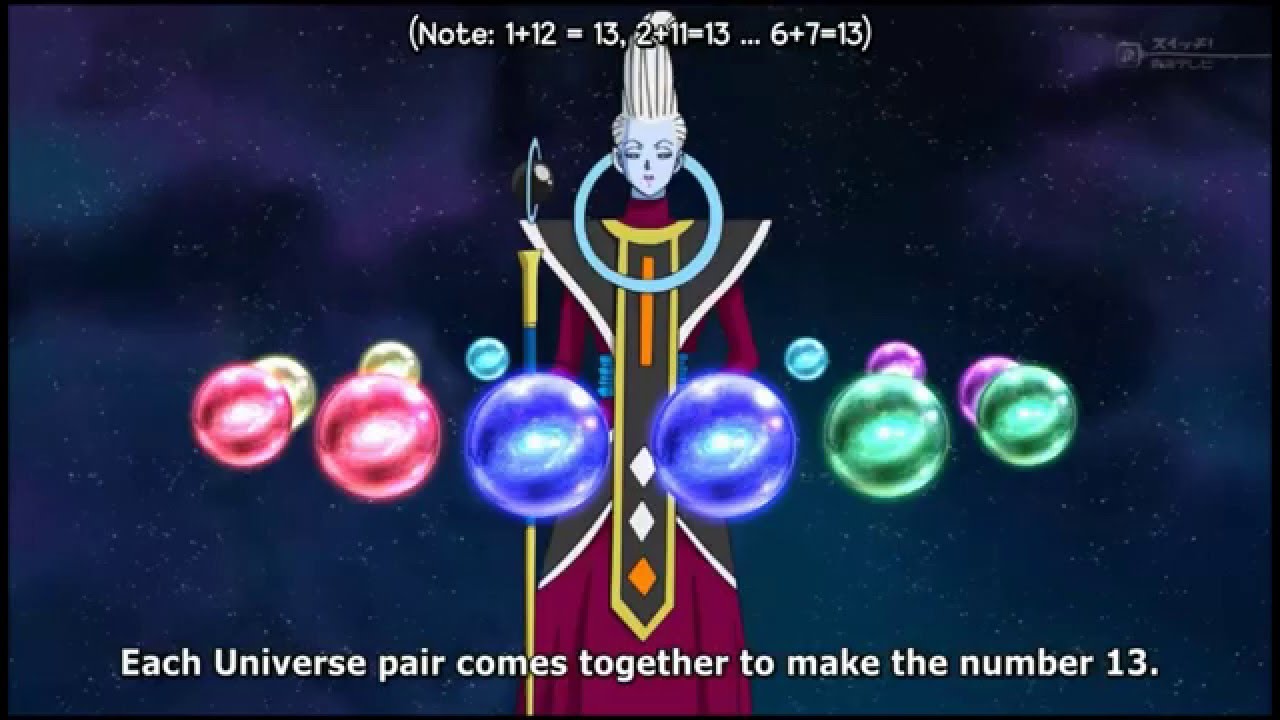
I am thinking about opening a thread specifically about Dragon Ball cosmology, arguing that the multiverse in Dragon Ball is Type 3, and that we have a very large amount of logical and solid evidence proving this, evidence that cannot be ignored by anyone.
I will begin by explaining the matter:
Explanation of the multiverse mechanism followed by Dragon Ball
Level III: The Many-Worlds Interpretation of Quantum Mechanics
The Many-Worlds Interpretation (MWI) of quantum mechanics, proposed by Hugh Everett III, is one of the well-known interpretations of quantum mechanics.
In short, one aspect of quantum mechanics is the impossibility of absolutely predicting certain observations; instead, there exists a set of possible observations, each with a different probability.
According to the Many-Worlds Interpretation, each possible observation represents a separate universe.
For example, suppose a six-sided die is rolled, and the outcome of the roll represents an observable quantum phenomenon. The six possible outcomes of the die correspond to six different universes
Tegmark argues that the Level III multiverse does not contain more possibilities within a Hubble volume than the Level I or Level II multiverse. In fact, all the different worlds produced by branching in a Level III multiverse can be found with the same physical constants within a Hubble volume of a Level I multiverse.
Tegmark writes that the only difference between Level I and Level III is where your copies reside: in Level I, they live elsewhere in three-dimensional space, while in Level III, they live in another quantum branch within an infinite-dimensional Hilbert space.
Similarly, all Level II bubble universes with different physical constants can be considered worlds produced by branching during moments of spontaneous symmetry breaking in a Level III multiverse.
According to Raphael Bousso and Leonard Susskind, and according to Yasunori Nomura, this is because the global spacetime of eternal inflation multiverses is a redundant concept. This means that multiverses of Levels I, II, and III are actually the same thing.
This hypothesis is known as the Quantum Multiverse.
Historical background
Richard Feynman’s many-worlds ideas are connected to the many-minds interpretation and to H. Dieter Zeh’s formulation of decoherence.
Explanation of key points of the Type (3) Many-Worlds Interpretation:
• Branching of the universe at every quantum event or decision, such as a quantum measurement. The universe splits into multiple new universes, each representing a different possible outcome.
• Reality for every possibility: If an event has two possible outcomes, the universe splits into two universes — one where outcome (A) occurs and another where outcome (B) occurs.
• Observed reality: We perceive only one outcome because we exist within one of these branched universes.
• Consistency with quantum mechanics: Everett’s interpretation avoids wave function collapse, a complex concept in quantum mechanics, by assuming that all possibilities occur in separate realities.
Getting to the core of the topic:
On the Dragon Ball website:
Professor Futamaze states:
The concept of parallel worlds arose from the study of quantum mechanics. It says that at this moment, there are countless universes in existence, and each of them contains “you.” So if there were, for example, ten universes, you would exist simultaneously in all of them.
Simply by perceiving “I am here,” the universe around you manifests. This is known as the Many-Worlds Interpretation.
Even decisions that are made from time to time create other worlds, because it is not limited to changing the past to create another timeline; rather, every decision that is made creates other possible worlds. Thus, every decision produces worlds.
Therefore, timelines — or what are called parallel worlds — originate from the study of quantum mechanics and quantum states as vectors that are orthogonal to one another within an infinite-dimensional Hilbert space. Anything in a new branch would be orthogonal to the previous branch.
In quantum mechanics, basis elements refer to states that form a complete set, meaning any state of a system can be expressed as a linear combination of these basis states.
In some cases, such as a particle in a one-dimensional box, the basis elements can be discrete and finite. However, in other cases, such as a particle in free space, the basis elements can be infinite.
To obtain an infinite number of basis elements in quantum mechanics, one usually uses the concept of momentum eigenstates or plane waves. These states are characterized by definite momentum values and are represented by the wave function Ψ(p), where p is momentum. The set of all possible momentum eigenstates forms an infinite basis for the system.
Even the relevant scan refers to “chou-kuu-kan”, which means hyper-space, and the way it works — absorbing all light — is literally within the context of super-gravity and hyperspace. The basis elements within it are infinite due to the previous scans we have regarding how Ψ(p) functions.
The red circle at the bottom left represents p.
To achieve an infinite number of basis elements in quantum mechanics, one usually uses momentum eigenstates or plane waves. These states have definite momentum values and are represented by the wave function Ψ(p).
Hyperspace is often considered infinite-dimensional because it contains an infinite number of degrees of freedom. In physics, degrees of freedom refer to the number of independent parameters or variables required to describe the state of a system.
In the context of hyperspace, these degrees of freedom correspond to the different possible values of hyperspatial coordinates, which include both bosonic and fermionic variables.
Bosonic variables obey commutation relations and can take continuous values, while fermionic variables obey anticommutation relations and can take discrete values.
Since there is no upper limit to the number of possible values these variables can take, hyperspace is considered infinite-dimensional. This infinite-dimensional nature allows for the rich and complex structure required to formulate supersymmetric theories in physics.
Image Screenshot ٢٠٢٦ ٠١ ٠٦ ٢٢ ٢٥ ٠٢ ٠٤ f598e1360c96b5a5aa16536c303cff92 hosted on ImgBB

ibb.co
Image Screenshot ٢٠٢٦ ٠١ ٠٦ ٢٢ ٢٥ ٣٢ ٠٢ f598e1360c96b5a5aa16536c303cff92 hosted on ImgBB
ibb.co
Image Screenshot ٢٠٢٦ ٠١ ٠٦ ٢٢ ٢٥ ٤٩ ٥١ f598e1360c96b5a5aa16536c303cff92 hosted on ImgBB
ibb.co
Image Screenshot ٢٠٢٦ ٠١ ٠٦ ٢٢ ٢٦ ٠١ ١٢ f598e1360c96b5a5aa16536c303cff92 hosted on ImgBB
ibb.co
Image Screenshot ٢٠٢٦ ٠١ ٠٦ ٢٢ ٢٦ ١٣ ٢٥ f598e1360c96b5a5aa16536c303cff92 hosted on ImgBB
ibb.co
Image Screenshot ٢٠٢٦ ٠١ ٠٦ ٢٢ ٢٦ ٢٥ ٠٥ f598e1360c96b5a5aa16536c303cff92 hosted on ImgBB
ibb.co
Image Screenshot ٢٠٢٦ ٠١ ٠٦ ٢٢ ٢٦ ٣٥ ٤٩ f598e1360c96b5a5aa16536c303cff92 hosted on ImgBB
ibb.co
Image Screenshot ٢٠٢٦ ٠١ ٠٦ ٢٢ ٢٨ ٣٥ ٨٨ 99c04817c0de5652397fc8b56c3b3817 hosted on ImgBB
ibb.co
Image Screenshot ٢٠٢٦ ٠١ ٠٦ ٢٢ ٢٩ ١٨ ٩٥ 99c04817c0de5652397fc8b56c3b3817 hosted on ImgBB
ibb.co
Image Screenshot ٢٠٢٦ ٠١ ٠٦ ٢٢ ٢٩ ٣٣ ٤٨ 99c04817c0de5652397fc8b56c3b3817 hosted on ImgBB
ibb.co
High 1-B.


 "Low Multiverse level, eventually Low Complex Multiverse level (As stated by both Gowasu and