• This forum is strictly intended to be used by members of the VS Battles wiki. Please only register if you have an autoconfirmed account there, as otherwise your registration will be rejected. If you have already registered once, do not do so again, and contact Antvasima if you encounter any problems.

    For instructions regarding the exact procedure to sign up to this forum, please click here.
  • We need Patreon donations for this forum to have all of its running costs financially secured.

    Community members who help us out will receive badges that give them several different benefits, including the removal of all advertisements in this forum, but donations from non-members are also extremely appreciated.

    Please click here for further information, or here to directly visit our Patreon donations page.
  • Please click here for information about a large petition to help children in need.

"Hypertimeline" standard revision for the Tiering System FAQ

Status
Not open for further replies.
Messages
470
Reaction score
307
As you all probably know, a verse can be upgraded by a "dimensional tier" if it can be demonstrated that the verse contains an additional temporal dimension. At the moment, our standards say that the existence of "special time travel" which can "go to prior versions of the timeline instead of the past" is sufficient proof of the existence of such a thing. Additionally, it is said that the "keyword" "time travel" "specifies that the action happens through movement through something like time" which would imply that there is an uncountably infinite continuum of "timeline snapshots" so to speak between the start and destination of this "special time travel." However, this reasoning is flawed.

To illustrate my point, suppose you start out in May 3, 2025 of Timeline A, which branched off another timeline which in turn branched off an original timeline in the past. Then you jump straight to Timeline B, a branching timeline that branched off earlier than Timeline A, and end up in April 19, 1589 of Timeline B.
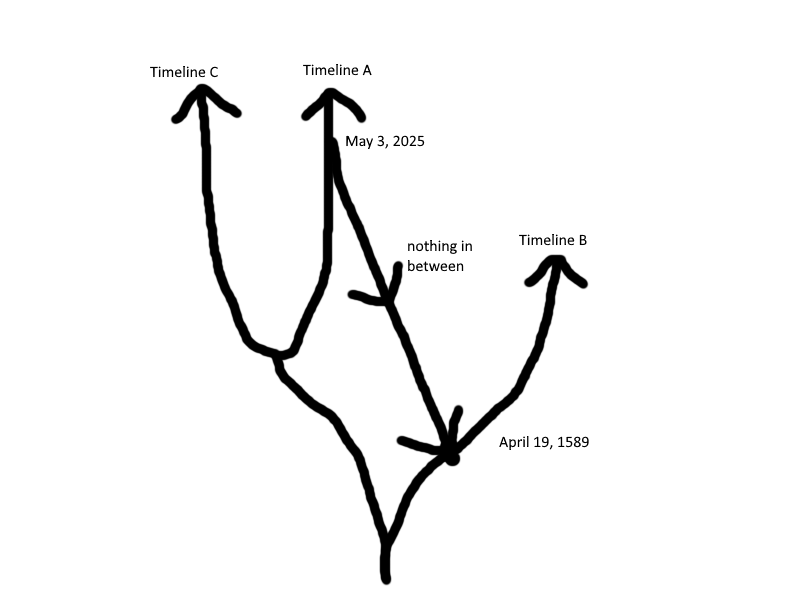
illus.png


It is evident that in this case, you would be "time traveling" since you are going from one point in time (May 3, 2025) to another (April 19, 1589). Additionally, you would be going from one version of a timeline to another, as timeline A is a version of the original timeline that has split twice, and timeline B is a version where the original timeline has only split once (there may be some other differences between the timelines as well).

EDIT: Revised example: To illustrate my point, suppose you start out in March 3, 2058 of "Time Tree 1" (branching timeline). Then you jump straight to "Time Tree 2", which is similar to Time Tree 1 except that it is missing one of its timeline branches, and end up in January 12, 1987 of Time Tree 2. Both "time trees" run parallel to the same axis of time by the way, and there are no "time tree snapshots" or anything of that sort in between them.
timetreetravel.png

It is evident that in this case, you would be "time traveling" since you are going from one point in time (March 3, 2058) to another (January 12, 1987). Additionally, you would be going from one version of the branched timeline/time tree to another, as Time Tree 2 is a version of Time Tree 1 that lacks one of its branches (there may be some other differences between the time trees as well). This meets the requirements for a "hypertimeline" under our current standards; yet there obviously isn't any sort of continuous flow of uncountably infinite "time tree snapshots" (there is nothing between the start and the destination of the "time travel") nor is there any sort of "extra time dimension" or "hypertimeline." In this counterexample, the term "time travel" does not refer to movement along a continuous flow of uncountably infinite "time tree" snapshots analogous to time, but to the fact that you are going from March 3, 2058 backwards along the shared time axis to Jan 12, 1987. Thus, as demonstrated, we should not assume that a verse has an additional dimension of time or a "hypertimeline" just because there is a "special time travel [that] can go to prior versions of the timelines instead of the past." It would simply be ridiculous to automatically assume that just because "time travel" can go to previous versions of branching timelines, this "time travel" must be along some uncountably infinite flow of entire "timeline versions" which has never been demonstrated.

Additionally, we shouldn't even treat "hypertimelines" as if they are some mystical thing that is separate from extra temporal dimensions at all. We should make it clear that "hypertimelines" are the exact same thing as a spacetime structure with extra dimensions of time. To reflect this fact, I also propose that we add a section to the Tiering System FAQ that explains that a hypertimeline is the exact same thing as a spacetime continuum with two time axes, instead of just one. Thus, demonstrating that a verse contains a "hypertimeline" should be held to the exact same standards as demonstrating that the verse contains an extra dimension of time.


All things considered, I propose that we remove the part of the Tiering System FAQ that says that there being "special time travel that can go to prior versions of the timelines instead of the past" proves the existence of an extra dimension of time, and that we should add that "hypertimelines" are simply spacetime continuums with two or more temporal dimensions rather than one and should thus be held to the same standards. Here is my sandbox, and here are the changes I am proposing:

CHANGE 1

["...Aside from direct statements, the easiest way to confirm that the line is comprised of uncountably infinitely many points/"snapshots" is to show that the development of the timelines is time-like. I.e. typically one would want a statement indicating that the alteration of the timelines is subject to its own flow of time, or that special time travel can go to prior versions of the timelines instead of the past. The keyword in the latter case is time travel, as that specifies that the action happens through movement through something like time. Note that such statements can be considered contradicted if the fiction specifies that new versions of the timeline, i.e. additional snapshots, are only created when the timeline is altered or similar..."

[I am obviously proposing that we delete the text instead of striking it through, the strikethrough is for the sake of showing the change]]

CHANGE 2

[At the end of the answer to "How do temporal dimensions impact tiering?" add this section to clarify what "hypertimelines" are:

Q: What is a "hypertimeline"?​


A: Further utilizing the terminology of “snapshots”, a “hypertimeline” is a “timeline” whose “snapshots” are themselves entire timelines. This would, in turn, entail that this "hypertimeline" contains uncountably many timelines within itself.

Note however that this precisely matches the description provided above of a “spacetime continuum with two time axes, instead of just one.” They are exactly the same thing. As such, to prove the existence of a hypertimeline in a particular verse’s cosmology, one must follow the exact same standards as one would to show that said cosmology has additional temporal dimension(s); that is, one must either cite a direct statement that the cosmology has additional temporal dimension(s) or otherwise demonstrate that the development of at least one timeline (it may not necessarily be a timeline; any collection of universal 3D "snapshots" that are uncountably infinite in number would qualify) is subject to its own continuous and persistent flow of time, meaning that, in the same way that each of the timeline's own "snapshots" is subject to the timeline's flow of time, the timeline itself exists as a "snapshot" on a continuous interval of "snapshots" coexisting (as opposed to a model resembling presentism where only one "snapshot" exists).]


Staff evaluation
Agree:
Disagree:
Neutral:
 
Last edited:
Btw, since this affects wiki standards, I’m pretty sure you need to make it a Staff Thread and get permission.
 
Really? How do I make it a staff thread? Do I just say "this is a staff thread" or something like that in the OP?
Just ask a thread mod or admin to move it for you and they'll see it done.

As for permission, I DM'd Agnaa about it and he said it seems fine. Is that enough?
Yes, that is fine. Long as you show proof that is.
 
Moved to staff thread, from now on, anyone who isn't staff need to ask for permission

@Telomera next time when you want to make a thread to revise standard, especially a controversial topic, ask admin for thread creation permission first
He said he got permission from Agnaa (IDK if you have to ask 3 admins or more for standard-revising threads).

BTW, thoughts on the proposals?
 
Just ask a thread mod or admin to move it for you and they'll see it done.


Yes, that is fine. Long as you show proof that is.
[EDIT: Deleted link to DM] I invited you and Vietthai96 to it btw.

And here are some screenshots of the conversation:
scre1.png

Scre2.png
 
Last edited by a moderator:
You should not link private DMs in any circumstances whatsoever (Uninvited members can't access it anyway), you should've only sent screenshots.

Also IDK what inviting me would've accomplished, I am a CGM, not a thread mod nor an admin - my vote means nothing here. It should've been sent to the admins individually instead of making group chats.
 
Oke, next time remember to put them in the OP

And also, asking perm via messege wall instead
 
You should not link private DMs in any circumstances whatsoever (Uninvited members can't access it anyway), you should've only sent screenshots.

Also IDK what inviting me would've accomplished, I am a CGM, not a thread mod nor an admin - my vote means nothing here. It should've been sent to the admins individually instead of making group chats.
OK my bad.
 
I am just going to point out that the example you explained in the OP doesn't count as evidence for the Hypertimeline. It was explained in the original thread (where the Hypertimeline standard was created) via this image.
Note: Change "static" to "vignette" to fix fandom images not displaying.

EDIT: Also yeah I remember there being stringent requirements for what qualifies and what doesn't for the whole "go back to a previous timeline".
 
To illustrate my point, suppose you start out in May 3, 2025 of Timeline A, which branched off another timeline which in turn branched off an original timeline in the past. Then you jump straight to Timeline B, a branching timeline that branched off earlier than Timeline A, and end up in April 19, 1589 of Timeline B.
I don't have much time right now but i from a glance, your illustration of the argument for hypertimeline is completely wrong, this isn't even proof or argument for hypertimeline. This illustration is just dimensional travelling to different timeline. The timeline B isn't even considered as previous version but another parallel timeline

I am just going to point out that the example you explained in the OP doesn't count as evidence for the Hypertimeline. It was explained in the original thread (where the Hypertimeline standard was created) via this image.
This is what hypertimeline is
 
I am just going to point out that the example you explained in the OP doesn't count as evidence for the Hypertimeline. It was explained in the original thread (where the Hypertimeline standard was created) via this image.
I see, thank you for the clarification. But even if we accept that example as valid, I still think it would be better to remove that part from the standards because it would imply that "time travel" between different "versions" of a timeline is enough. It does not specify the distinction between examples that the image you linked does. Most people aren't going to see all of the nuances that your image describes, so it's best to take off parts of the Tiering System FAQ that are potentially misleading.

But at the same time, I don't actually think your example is valid at all. There are only two "snapshots" in the "would count" example, and there's no indication that there is some uncountably infinite continuum of "snapshots" between the two of them.
snapshots.png


One of the major parts of my argument is that usage of the term "time travel" in reference to a scenario where you travel between "timeline snapshots" (or "time trees") doesn't necessarily imply that there is actually an additional flow of hypertime between the start and the destination. It could just mean that you are going from one point in "time" (whether it's the time within a timeline/"time tree" or "hypertime") to another without any reference to any "flow" in between. The same logic applies to the "would apply" example that you gave. If your example were called "time travel," it could simply refer to the fact that the destination is further into the past of the a shared time axis than the starting point. In this example, the term "time travel" would not refer to movement along a continuous flow of uncountably infinite "time tree" snapshots analogous to time, but to the fact that you're going from March 3, 2058 backwards along the shared time axis to Jan 12, 1987:
Revised example:

timetreetravel.png
 
Last edited:
Time travel to a past version of the entire timestream itself is evidence that a second temporal dimension exists, one that spans the whole timestream as snapshots. Per our standards, we default the size of a time dimension to infinite, making it obvious that there are uncountably infinite snapshots of the entire structure.

However, I will wait and see what other staff members think, since we might decide to treat the second temporal dimension differently than we treat a regular temporal dimension. And the thing that these kind of threads are famous to go out of my expectations.

But in very least, i would agree with linking that image or cleaner version of it in our FAQ explaination for better understanding.
 
Time travel to a past version of the entire timestream itself is evidence that a second temporal dimension exists, one that spans the whole timestream as snapshots.
Why would it be though? As I said, "time travel" could simply refer to travel along a shared time axis rather than the "time tree" your destination is in being in the "past" (or "future") of some separate dimension of time. What you're saying only works if the "timestream"/"time tree" is explicitly stated to be a "past" (or "future") version in the source material. Otherwise, you'd be imposing an additional sense of temporality onto a structure that has no indication of being there in the source material.

But even in that case, as you pointed out:
However, I will wait and see what other staff members think, since we might decide to treat the second temporal dimension differently than we treat a regular temporal dimension. And the thing that these kind of threads are famous to go out of my expectations.
And I would agree with doing so. It's quite a big assumption to make that "past" refers to "past" along an uncountably infinite flow of "time tree snapshots" analogous to time, especially if the verse doesn't make it clear that "past" is in reference to a time dimension that works similarly to ours.
But in very least, i would agree with linking that image or cleaner version of it in our FAQ explaination for better understanding.
That would definitely be better than what we have right now.
 
Time travel to a past version of the entire timestream itself is evidence that a second temporal dimension exists, one that spans the whole timestream as snapshots.
Technically, but I don't think we actually typically get evidence that strong.

It's usually just time travel being used, and ending up in a timeline with some different events. Which could be to another branch of a split timeline (as shown in the OP), or simply to a different timeline in the multiverse.
 
Technically, but I don't think we actually typically get evidence that strong.

It's usually just time travel being used, and ending up in a timeline with some different events. Which could be to another branch of a split timeline (as shown in the OP), or simply to a different timeline in the multiverse.
Afaik, we only determine if there is 2nd temporal dimension or not if and only if verse actually showcase that strong evidence

And OP shown illustration is not really what we follow to determine the 2nd temporal dimension. We follow this one:

I am just going to point out that the example you explained in the OP doesn't count as evidence for the Hypertimeline. It was explained in the original thread (where the Hypertimeline standard was created) via this image.

But if despite that some CRTs did pass on the case OP explained then we might have to elaborate further on the relevant section and include the visual illustration to clear any misconception.
 
Agnaa told me he won't be available for a while (sort of a long while actually). Do you think it'd be best to continue the evaluation of this thread without him or wait for him to come back?
It depends on whether or not other staffs are interested to participate in the thread or atleast when do they want to participate. I will tag some staffs incase they are not aware of this thread.

@Qawsedf234 @Elizhaa @DontTalkDT @Ultima_Reality @Planck69 @Executor_N0

Your input here will be appreciated.
 
there obviously isn't any sort of continuous flow of uncountably infinite "time tree snapshots" (there is nothing between the start and the destination of the "time travel") nor is there any sort of "extra time dimension" or "hypertimeline." In this counterexample, the term "time travel" does not refer to movement along a continuous flow of uncountably infinite "time tree" snapshots analogous to time, but to the fact that you are going from March 3, 2058 backwards along the shared time axis to Jan 12, 1987.
My main issue here: how can you time travel from 2058 to 1987 if there wasn't instances of things existing in-between those points.

Your implication here is that the act of time traveling would create a duplicate space in 1987 which is already covered within three temporal snapshot section:
However, caution is necessary. As explained above, we require that the additional time dimension is "a line comprised of uncountably infinitely many points." If new versions of timelines are only created if they are changed, due to time travel for example, then the number of "snapshots" of the timeline would be far more limited. The amount of snapshots would be one more than the times the timeline was changed. So, for example, if the timeline is rewritten 2 times, there would be 3 snapshots of the timeline: the original, the timeline after the first rewrite and the timeline after the second rewrite. That are far less than the required uncountably infinitely many.
The example in the OP that I made was referring to time travel just taking you to a different snapshots, rather than causing the splitting action or separating the snapshots.

If all time travel does is physically take you to a previous instance of the multiverse, that would imply a secondary axis in my mind.
 
My main issue here: how can you time travel from 2058 to 1987 if there wasn't instances of things existing in-between those points.
There would only be things in between 2058 and 1987 within each "time tree" along the shared temporal axis that they run parallel to. For example, you would have "2049 of Time tree 1" or "1999 of Time tree 2," but there would be nothing in between the two snapshots like "2000 of time tree 1.5." It's a discrete jump between the snapshots. Is there some issue with that? I don't know why you assume there has to be some continuous, uncountably infinite amount of snapshots in between the "time tree"/branching timeline snapshots. Like I said in my arguments above, the term "time travel" may refer to travel along a shared temporal axis that both "time trees"/branching timelines run parallel to rather than along an orthogonal temporal axis that runs between the snapshots. It's fallacious to assume that the term "time travel" automatically has to imply the latter.
Your implication here is that the act of time traveling would create a duplicate space in 1987 which is already covered within three temporal snapshot section:
Not really, no. My example works just fine even if both "time trees" have always existed. When you "time travel" you simply jump from one preexisting "time tree" to another. The act of time traveling doesn't "create" Time Tree 2.
timetreetravel.png

In my example, both the snapshot called time tree 1 and the snapshot called time tree 2 have both always existed and were not created by time travel.
The example in the OP that I made was referring to time travel just taking you to a different snapshots, rather than causing the splitting action or separating the snapshots.
Like I said above, my example works just fine even if both "time tree" snapshots have always existed.
If all time travel does is physically take you to a previous instance of the multiverse, that would imply a secondary axis in my mind.
I think the problem with your argument as well as our standards regarding hypertimelines is that both implicitly assume three things for no good reason:
1. That "time trees"/branching timelines are separated specifically by a spatiotemporal axis. If you have two "snapshots" of a time tree/branching timeline, it's possible that they could inhabit the same spatiotemporal region while still being separated from each other by quantum decoherence, something like DC's "vibrational frequency", some form of intangibility, or some other non-spatiotemporal mode of separation. But for some reason, we assume that the snapshots are separated by a spatiotemporal axis.

2. That, given the axis IS spatiotemporal, that the axis is temporal rather than spatial. As Agnaa pointed out,
Technically, but I don't think we actually typically get evidence that strong.

It's usually just time travel being used, and ending up in a timeline with some different events. Which could be to another branch of a split timeline (as shown in the OP), or simply to a different timeline in the multiverse.
In most cases, we don't actually have any evidence that the timelines are separated along a temporal rather than a spatial axis. It's possible that the axis separating the two snapshots is spatial rather than temporal (they're not "past" and "future" snapshots of the same branching timeline, they're just alternate versions with no form of temporal separation between each other), which means by extension that said axis is not necessarily "significant"/it could possibly be compactified. Yet for some reason, we automatically assume it to be a temporal axis, which, due to our standards, is automatically assumed to be "significant." Now of course, if we actually have evidence that one of the "snapshots" is explicitly considered a "past" snapshot within the verse, that's an entirely different scenario. But even then, you still have to assume...

3. That, given the axis is temporal, that it works the same as any other temporal dimension. Reiner pointed out that
However, I will wait and see what other staff members think, since we might decide to treat the second temporal dimension differently than we treat a regular temporal dimension.
Even if it's granted that both snapshots of the branching timeline are separated by an axis that is temporal in some way, I don't see why we should treat such an axis the exact same way we'd treat a temporal axis that's talked about as if it were analogous to the time dimension in normal 4D spacetime. If a text were to say that "this spacetime continuum has 2 dimensions of time instead of 1," that would clearly imply that the temporal dimensions are similar. But that's different from what we're talking about. If all we have to go off of is that there is some axis that separates two timelines along which axis "past," "present," and "future" exist, that doesn't really give us any context on how similar said axis really is to a normal, continuous temporal dimension encompassing uncountably many snapshots. Even the scenario you gave with a time machine creating 3 discrete timelines could technically be divided into "past" and "future" snapshots, yet we already accept that said scenario doesn't involve an uncountably infinite flow of snapshots like a typical temporal dimension would be.

I have to admit that 3. would be the most contentious thing for me to dispute though. If for some reason you think our assumption that all temporal axes are significant is way too important, I guess it would be OK to at least make the standards more strict and the FAQ more clear by at least requiring proof that the two snapshots are separated by a temporal axis rather than some other mode of separation as well as including the picture we've been citing so much.
 
There would only be things in between 2058 and 1987 within each "time tree" along the shared temporal axis that they run parallel to. For example, you would have "2049 of Time tree 1" or "1999 of Time tree 2," but there would be nothing in between the two snapshots like "2000 of time tree 1.5." It's a discrete jump between the snapshots. Is there some issue with that?
The main issue is that the wiki treats time as an infinite series of snapshots. The ability to travel to a singular snapshot requires movement between intermediate snapshots.

Unless it's actually created a timeline, it would require there to be in-between snapshots to time travel to.

Like I said in my arguments above, the term "time travel" may refer to travel along a shared temporal axis that both "time trees"/branching timelines run parallel to rather than along an orthogonal temporal axis that runs between the snapshots. It's fallacious to assume that the term "time travel" automatically has to imply the latter.
The example you're showing is previous iterations of the multiverse itself. The original multiverse is still there and you can time travel to a previous state of the multiverse with the original still being present. There's no branching present in my example and implying following a single axis wouldn't be able to take you to previous states of the multiverses existence.

My example works just fine even if both "time trees" have always existed
Your example (the crossed out one) wouldn't imply a second axis because it's traveling along the same "trunk" of the timeline, just in a different location. It's why multiple users pointed out that it's not how it works and why you needed to change it.

In my example, both the snapshot called time tree 1 and the snapshot called time tree 2 have both always existed and were not created by time travel.
Yes, which is why there's two temporal axis in that example. As there's an uncountable infinite number of multiverse iterations that exist parallel to one another.

That "time trees"/branching timelines are separated specifically by a spatiotemporal axis. If you have two "snapshots" of a time tree/branching timeline, it's possible that they could inhabit the same spatiotemporal region while still being separated from each other by quantum decoherence, something like DC's "vibrational frequency", some form of intangibility, or some other non-spatiotemporal mode of separation. But for some reason, we assume that the snapshots are separated by a spatiotemporal axis.
DC's hypertimeline is what we be based our timelines on, and them having a quantum vibrational difference would also give that space a Low 1-C rating for the same reasons mentioned.

The snapshots themselves are not seperated by a second axis as well. We're saying that there's an uncountable infinite number of temporal lines going in one direction, in order for that many lines to exist, a second temporal axis is required to contain them all. What seperates the universes to my understanding is the 5th Dimensional container they would all exist in.

Yet for some reason, we automatically assume it to be a temporal axis, which, due to our standards, is automatically assumed to be "significant."
We don't automatically assume that. Very few franchises use a hypertimeline and most do nlt meet the requirements. The default assumption is that the timeline branches from an origin point and time travel is taking you to a different section without that structure. The users have to prove it doesn't work lile that to qualify for a hypertimeline.
 
The main issue is that the wiki treats time as an infinite series of snapshots. The ability to travel to a singular snapshot requires movement between intermediate snapshots.
Alright fine, I guess I won't try to convince you to treat time dimensions differently in this scenario. But at the same time, our standards need to be more strict (or at least more clear) about how one must prove that two snapshots are separated by temporal axes rather than "insignificant" spatial axes or some other form of separation.
There's no branching present in my example and implying following a single axis wouldn't be able to take you to previous states of the multiverses existence.
Suppose we know that the multiverse snapshots are separated by an additional spatiotemporal axis rather than quantum decoherence or something. The problem here is that if all that we have to go off of is that you "time traveled" from "multiverse snapshot 1" to "multiverse snapshot 2" and that the two snapshots aren't just branching from a common origin, we still have no proof that the two snapshots are separated by a temporal axis specifically. In this scenario which matches the one cited earlier in this thread as valid, even if both "multiverse snapshots" have always existed and were not created by the time travel nor did they branch from an origin point, the multiverse snapshots could easily be separated by an insignificant spatial axis, which obviously wouldn't qualify for tier 1:
timetreetravel.png

If you want to object and say this doesn't count as time travel, that's not true. This would still be time travel because even if you're moving through space, you'd still also be moving along the two snapshots' shared, singular time axis.
Yes, which is why there's two temporal axis in that example. As there's an uncountable infinite number of multiverse iterations that exist parallel to one another.
The default assumption is that the timeline branches from an origin point and time travel is taking you to a different section without that structure. The users have to prove it doesn't work lile that to qualify for a hypertimeline.
The problem is that neither the preexistence of the branching timelines/time trees/multiverse snapshots nor the fact that they do not branch from an origin point prove that they are separated by a temporal axis rather than an insignificant spatial axis.

Overall, the most important part of proving a hypertimeline isn't through usage of the term "time travel," it's proving that two Tier 2 "snapshots" exist on an additional temporal axis. The usage of the term "time travel" doesn't help at all and the section in the Tiering System FAQ only serves to further confuse people, which is why I think it should be removed. And of course, hypertimelines are literally just additional temporal dimensions which is also something that we should clarify.
 
Received permission from @Antvasima in Direct Messages.
It is evident that in this case, you would be "time traveling" since you are going from one point in time (March 3, 2058) to another (January 12, 1987). Additionally, you would be going from one version of the branched timeline/time tree to another, as Time Tree 2 is a version of Time Tree 1 that lacks one of its branches (there may be some other differences between the time trees as well). This meets the requirements for a "hypertimeline" under our current standards; yet there obviously isn't any sort of continuous flow of uncountably infinite "time tree snapshots" (there is nothing between the start and the destination of the "time travel") nor is there any sort of "extra time dimension" or "hypertimeline." In this counterexample, the term "time travel" does not refer to movement along a continuous flow of uncountably infinite "time tree" snapshots analogous to time, but to the fact that you are going from March 3, 2058 backwards along the shared time axis to Jan 12, 1987. Thus, as demonstrated, we should not assume that a verse has an additional dimension of time or a "hypertimeline" just because there is a "special time travel [that] can go to prior versions of the timelines instead of the past." It would simply be ridiculous to automatically assume that just because "time travel" can go to previous versions of branching timelines, this "time travel" must be along some uncountably infinite flow of entire "timeline versions" which has never been demonstrated.
I think, based on this, your problem lies in two things:
  1. Special Time Travel does not show the existence of higher temporal dimensions.
  2. Even if it does, it doesn't mean that dimension is an uncountably infinite flow of time.
Qawsedf is already talking to you about the latter one, on how "Time" is treated as an unending flow unless shown otherwise, and therefore if the hypertimeline is portrayed as some "flow of Time", we would assume its significant in size (or so I understand). But I'll add some things to the first one:
What even is "Time Travel"
Time travel, by default, is considered movement along a Time Dimension, not necessarily in Space as well (although the latter is quite common, but its not a necessity). So Time Travel automatically means there is a "Time" dimension at play. Even if Spatial travel is involved too, it doesn't become a problem as long as we're moving in a Low 2-C Continuum and not a Hypertimeline, because the user is still moving in a time dimension that overarches the spatial ones.
What is "Special Time Travel"

Well, its not so special except for the fact that some user is using some form of "Time Travel" that allows him to not just move in a single timeline, but also to other timelines, through time travel.

Time, by itself, is infinite, and we assume that regular Time Travel can only travel to previous or future snapshots of the same timeline. Take, for example, the picture you made. Let's say a character exists on the main timeline (from which others branch). By regular time travel, which is only 4-D, they can only do as much as travel in that very timeline, not other timelines.

Even if their scenario branches into another timeline, they'd only be able to go to the past/future of that branched timeline, they can't simply "go to the main timeline before the branch happened". This is practically also the same as the limitation for immeasurable speed, where even though they can move in Time:
Immeasurable (Movement unbound from the flow of linear time, which cannot be measured. Given that S = D/T, if T is undefined, the speed formula cannot be applied. This is the same reason why multiple temporal dimensions also grant immeasurable speed. For further information, see the "Further Explanations"-section below)
They can't go outside their own timeline by time travel by default unless shown otherwise. Take this girl for example, in this matchup. She has immeasurable speed whereas Rimuru did not, at that time, yet Sailer Moon did not win. Why? Because her immeasurable speed (essentially time travel but via movement alone) doesn't encompass whatever is beyond her range/shown in-verse.

(I mean, sure that's a 3 year old thread, but I don't think our standards regarding this specific aspect changed over the course of the passing years)

Therefore, if a time travel DOES allow one to go to different timelines by itself, that means there's some sort of "Time" in which entire 4D Timelines are merely snapshots, that is, a hypertimeline/higher time dimension.

Note:
If, per say, the "special" time travel ability is not just time travel but also spatial movement (space-time travel), then of course there will be doubt whether it's the existence of a hypertimeline that allows for cross-timeline travel, or whether the timelines are simply parallel ones and the user uses the "space" aspect of the Space-Time travel, in which case sufficient proof would be needed (an example being that pausing/stopping the flow of Time the character is travelling in makes them unable to even to go different timelines at all, since if they were doing so via spatial travel earlier, time stop wouldn't effect their ability to go to a different continuum).

As to what's the default assumption (whether we require additional proof or if we assume it's still fine) under the case of "Space-Time Travel", I don't know about our standards regarding that (don't know if we even have one for this specific example), but I personally would lean to requiring additional proof.
 
If, per say, the "special" time travel ability is not just time travel but also spatial movement (space-time travel), then of course there will be doubt whether it's the existence of a hypertimeline that allows for cross-timeline travel, or whether the timelines are simply parallel ones and the user uses the "space" aspect of the Space-Time travel, in which case sufficient proof would be needed (an example being that pausing/stopping the flow of Time the character is travelling in makes them unable to even to go different timelines at all, since if they were doing so via spatial travel earlier, time stop wouldn't effect their ability to go to a different continuum).

As to what's the default assumption (whether we require additional proof or if we assume it's still fine) under the case of "Space-Time Travel", I don't know about our standards regarding that (don't know if we even have one for this specific example), but I personally would lean to requiring additional proof.
This is probably the most important part of the argument. I of course agree that we should require additional proof. But I would also add that in a case where special time travel as you define it is shown, we should not automatically assume by default that it's pure movement along temporal axes with no spatial movement (unless we have evidence that it is, of course).
timetreetravel.png

I really don't think that in a scenario like this^ (which would be valid under our current standards), we should automatically assume the existence of some hypertimeline on which the two "time tree snapshots" are simply two out of a continuous, uncountably infinite flow of "time tree snapshots." It's far more parsimonious and reasonable to interpret them as simply being two snapshots separated by an "insignificant" spatial axis (or, as I brought up earlier, they could even overlap in the same spatiotemporal location and be separated by some sort of quantum decoherence).

And what are the consequences of this on the Tiering System FAQ? As I have argued earlier in the thread, the "time travel" aspect doesn't actually play a big part here. The existence of "special time travel" on its own, even between two preexisting timelines that lack a shared branching origin, is not enough to prove the existence of a hypertimeline. Much more evidence is necessary, such as the "time stop" example you brought up in your post. But at that point, that necessary evidence would already be such strong evidence of an extra dimension of time that the "time travel" aspect is trivial, and the part of the FAQ that mentions "time travel" as if it were the "keyword" that proves the existence of a hypertimeline only serves to confuse readers. This isn't just my speculation either. As Agnaa mentioned, most cases of "special time travel" that users use to support a hypertimeline argument involve the timelines being separated by space rather than an extra dimension of time, which is clearly due to how misleading and imprecise FAQ currently is regarding hypertimelines:
Technically, but I don't think we actually typically get evidence that strong.

It's usually just time travel being used, and ending up in a timeline with some different events. Which could be to another branch of a split timeline (as shown in the OP), or simply to a different timeline in the multiverse.
That's why I want to remove the part of the FAQ that I proposed we remove, as well as explain that a "hypertimeline" is literally just a spacetime continuum with more than one dimension of time.
 
Therefore, if a time travel DOES allow one to go to different timelines by itself, that means there's some sort of "Time" in which entire 4D Timelines are merely snapshots, that is, a hypertimeline/higher time dimension.
This assumption isn't necessarily true. A temporal axis is what direction time flows while a timeline is the collection of temporal snapshots for a particular space. Traveling from one space to another would only imply a second time axis if its travel to different iterations of the same space or some form of orthogonal movement is implied to have taken place.
 
What is the staff consensus here so far? 🙏
 
What is the staff consensus here so far? 🙏
All the staff members who responded do not seem to agree with the thread's premise. However, I believe that the diagram @Qawsedf234 created to illustrate the type of time travel that proves the existence of a second temporal dimension should be added as elaboration to clear up any misconceptions in future.
 
Status
Not open for further replies.
Back
Top