Anti-scholastic Current: The Universal Possibilism, Dialetheism and Paraconsistent Logic
Despite having several advocates over the years, there is neither a principal representative of this point of view, nor so many advocates as scholasticism. The illogical view of omnipotence preaches that God could violate even the laws of classical logic, such as the law of noncontradiction the law of excluded middle, and the law of identity, and make mathematical absurdities like a triangle whose hypotenuse is greater than the sum of the legs.
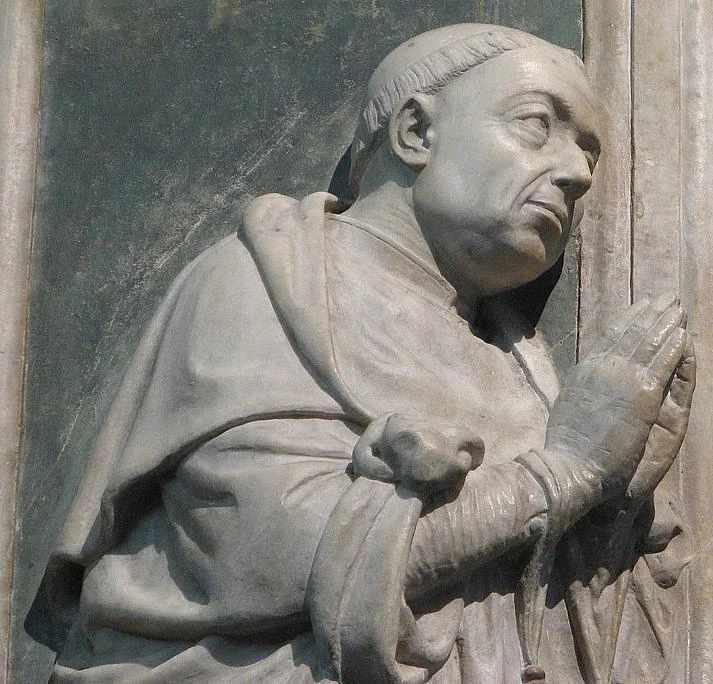
Nicholas of Cusa (1401-1464)
The main defense to universal possibilism probably comes from
René Descartes, expressed in his
Meditations on First Philosophy. Among them, it would include the very creation of logical and mathematical truths, like the classical laws of thought.
[5] In spite of his defense, Descartes' universal possibilism is considered absurd and unsustainable, as is the idea of absolute relativism, for he demands the negation of himself for his own affirmation, as W. L. Craig explains.
[4]
St. Pier Damiani in
De divina omnipotentia accused St. Girolamus of being blasphemous, for claiming that God could not undo what was done, i.e., accuse the past. For St. Pier Damiani, figures like St. Girolamus and Thomas Aquinas were blaspheming in trying to limitate God.
Cardinal
Nicholas of Cusa in
De douta ignorantia argued that God, being infinite, is
coincidentia oppositorum. I.e., should have all existing properties, and between these properties should have properties of both being and non-being, both positive and negative. This logically encompasses properties that contradict each other. In this way, it would be possible for God not only to be contradictory, but also to create contradictory objects.
Since I am going to discuss the maximum learning of ignorance, I must deal with the nature of Maximality. Now, I give the name “Maximum” to that than which there cannot be anything greater. But fullness befits what is one. Thus, oneness—which is also being—coincides with Maximality. But if such oneness is altogether free from all relation and contraction, obviously nothing is opposed to it, since it is Absolute Maximality. Thus, the Maximum is the Absolute One which is all things. And all things are in the Maximum (for it is the Maximum); and since nothing is opposed to it, the Minimum likewise coincides with it, and hence the Maximum is also in all things. And because it is absolute, it is, actually, every possible being; it contracts nothing from things, all of which [derive] from it. In the first book I shall strive to investigate incomprehensibly above human reason-this Maximum, which the faith of all nations indubitably believes to be God. [I shall investigate] with the guidance of Him “who alone dwells in inaccessible light.”
—De douta ignorantia, 1440[6] |
Think of omnipotence as the possibility of performing all acts that can be expressed by words that assume consistent meaning in potency, and to carry them out, it is enough for that power in act. This could explain some paradoxes such as the paradox of stone, so that God has in himself both the act of creating the stone and the act of lift it.
In addition, there are two current philosophical currents that can support the anti-scholastic view of omnipotence. These are paraconsistent logic and dialaletheism.
Paraconsistent logic is a non-classical logic that accepts and treats contradictions (DA SILVA FILHO, 1999),
a logic is paraconsistent if its logical consequence relation (⊨, either semantic or proof theoretic) is not explosive(PRIEST et al, 2016).
Dialetheism is the view that there are dialetheias. One can define a contradiction as a couple of sentences, one of which is the negation of the other, or as a conjunction of such sentences. (PRIEST 2017).
[7]
Recently, limitations were seen in classical logic and in Aristotelian principles such as non-contradiction, which encouraged mathematicians to base paraconsistent logic, which deals with the explosiveness of contradictions, and dialetheism, which accepts that there are real contradictions. An example of such applications are the paradoxes of self-reference, such as the
Liar paradox, which consists of the following:
Proposition
is false.
Or:
Proposition
is true.
Proposition
is false.
This paradox forces us to assume that an affirmation can be both true and false, which clearly violates the law of non-contradiction. This demonstrates a linguistic limitation on the principle of non-contradiction. An argument used is that if linguistics, which is a human faculty, can violate the non-contradiction law, why omnipotence, which is a transcendent quality, couldn't also violate this law?
Another example is
Russell's paradox, highlighting the
Barber's paradox, which derives from it.
Think of a situation where a city has only one barber, and men only have two ways to shave, 1) shaving alone or 2) going to the barber. This barber, however, does not shave anyone who shaves alone, and shaves all those who do not shave alone. If so, who shaves the barber? Because 1) if the barber shaves, it means he shaves himself, and therefore, he is not among the people he shaves; 2) if the barber doesn't shave alone, it means he's on the list of people he shaves.
Jean-Yves Beziau and
Newton da Costa spoke about this in the
1st World Congress on Logic and Religion. In their words: