• This forum is strictly intended to be used by members of the VS Battles wiki. Please only register if you have an autoconfirmed account there, as otherwise your registration will be rejected. If you have already registered once, do not do so again, and contact Antvasima if you encounter any problems.

    For instructions regarding the exact procedure to sign up to this forum, please click here.
  • We need Patreon donations for this forum to have all of its running costs financially secured.

    Community members who help us out will receive badges that give them several different benefits, including the removal of all advertisements in this forum, but donations from non-members are also extremely appreciated.

    Please click here for further information, or here to directly visit our Patreon donations page.
  • Please click here for information about a large petition to help children in need.

Progression in Hoyoverse Games: Duplicates, Gear, Weapons, Stats

Messages
1,718
Reaction score
599

Permission by Divine Edict (@Mr. Bambu)

Prologue

As HoYoverse titles have gradually become more represented on the wiki, a recurring methodology question has emerged regarding how their progression systems should be indexed. Unlike many traditional RPGs, these games make extensive use of permanent character progression and canonical equipment systems that are closely integrated into both gameplay and the setting itself. However, there does not appear to be a clear standard for how these mechanics should be reflected on profiles.

This thread is primarily concerned with Honkai: Star Rail, Genshin Impact, and Zenless Zone Zero, as these games share fundamentally similar progression systems. While similar mechanics exist in other RPGs and gacha titles, the purpose of this discussion is to establish a consistent methodology for HoYoverse games rather than making a universal rule for every gacha. However, other gacha games with analogous systems should be able to use whatever this thread decides and adapt it accordingly.

To briefly explain the systems in question:
  • Characters can permanently unlock additional abilities through duplicate-based progression systems, such as Eidolons, Constellations, and Mindscapes. These upgrades grant new passives, enhance existing abilities, or introduce entirely new mechanics, permanently expanding the character's capabilities.
  • Characters also utilize canonical equipment systems, including Relics, Artifacts, Drive Discs, Light Cones, Weapons, and W-Engines. These are not merely abstract gameplay mechanics but they exist within the worldbuilding of their respective games, possess lore and in-universe explanations, and are treated as genuine equipment used by characters.
The purpose of this thread is to discuss whether these canonical progression systems are currently being treated consistently with other RPG mechanics already accepted throughout the wiki.

The Issue: Should Monetization Influence Methodology?

I believe there is a methodological inconsistency in how HoYoverse character progression is evaluated compared to progression systems in many traditional RPGs.

Permanent progression systems such as Eidolons, Constellations, and Mindscapes are often omitted or not indexed despite representing permanent upgrades that expand a character's designed abilities. Likewise, canonical equipment systems such as Relics, Artifacts, Drive Discs, Light Cones, and similar mechanics are frequently excluded from profile indexing despite being acknowledged within the setting itself. Examples include: This Relic set is what the Trailblazer canonically used in the Amphoreus Arc. Additionally, characters acknowledge the use of this type of gear across those games and they join us in our activities. This means they should be eligible to use them.

By comparison, many RPG profiles already recognize optional progression when it represents a legitimate canonical state of the character. Optional weapons, hidden techniques, post-game abilities, final forms, late-game equipment, and optional upgrades are frequently documented or indexed when they meaningfully alter the character's capabilities. The determining factor has generally not been whether every player is guaranteed to obtain them, but whether they represent a legitimate form of character progression.

HoYoverse games appear to be treated differently primarily because progression is distributed through duplicate acquisition systems or equipment farming. This raises the question of whether the acquisition method - particularly one tied to the game's monetization model - is unintentionally becoming a determining factor in profile methodology.

Simply put, should a character's canonical progression be evaluated based on how the player unlocks it, or based on what the progression actually represents for the character?

The concern is not that every progression mechanic must automatically be accepted, but rather that the current methodology risks treating identical forms of RPG progression differently depending on whether they are obtained through a side quest, exploration, character progression, or a summoning interface.

Optional Content Has Never Been the Standard​

Across RPGs, players can obtain:

1) Optional weapons
2) Optional armor
3) Secret abilities
4) Hidden techniques
5) Sidequest rewards
6) Endgame equipment
7) Optional character upgrades

All of these are acquired through optional content, yet the fact that the player is not required to obtain them does not automatically make them non-canonical. The wiki generally evaluates whether they are legitimate forms of progression, not whether every player is guaranteed to possess them.

Some verses and profiles even have DLC "joke"/"arcade" weapons listed. So this raises this question:

Why should "optional" be treated differently when the progression happens to come from a gacha system?

The "Player Ownership" Argument​

An objection that has been brought up is that gacha characters or equipment are not inherently canonical because they are obtained through the player's account system. However, this confuses the method of acquisition with the identity of the character. It makes absolutely no sense at all to exclude any of those mechanics because some players do not have them. It would be the same as excluding a game's DLC because some people don't have it. That is very obviously, not a strong argument.


RNG Systems
Another possible objection is that some equipment systems contain randomized elements, such as gear substats or random upgrade rolls. However, randomness in acquisition should not be confused with a lack of canonicity. Many RPGs contain randomized equipment systems, including randomized weapons, enchantments, runes, gems, modifiers, and loot affixes, yet the existence of these systems is not dismissed simply because individual players may obtain different results.

The random element represents the player's method of obtaining or optimizing equipment, not necessarily whether the equipment system itself exists within the setting. A character obtaining a randomly generated weapon modifier in gameplay does not mean the underlying mechanic is fictional or non-canonical.

Therefore, the relevant question should not be whether every possible roll is assumed, but whether the equipment system and its effects are recognized as part of the character's available progression. Similar to other RPG mechanics, explicit abilities granted by equipment can be evaluated individually, while numerical values can be assumed to exist at any value since any sort of percentage would be normally indexed.

All in all, Randomness affects which item a player receives, not whether the equipment system itself exists within the setting.

Chance-Based Resistances (HSR-specific mostly) and Statistics (General)​

Another point is how chance-based resistances granted by canonical equipment should be indexed.

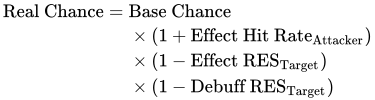
A common argument is that because mechanics such as Effect Res(istance) can never guarantee a 100% chance of resisting every incoming status effect, they should only qualify as "Limited Resistance" or not be indexed at all.

However, this conflates two fundamentally different concepts:
  • Activation rate (how often a resistance successfully activates).
  • Resistance potency (how much of the effect is resisted once it activates).
These are not the same thing.

When Effect Resistance successfully prevents a debuff, the status effect is resisted entirely. The character does not become "partially Frozen," "half Stunned", "half Imprisoned," or "somewhat Dominated." The effect either applies in full or fails to apply altogether. The numerical Effect RES value merely determines the likelihood of that complete negation occurring.

As such, it can be argued that the limitation lies in the frequency with which the resistance manifests, not in the strength of the resistance itself. So a Limited wording wouldn't work either as it usually means that the ability has a smaller scale or that it has certain drawbacks.

Unfortunately, I cannot think of ANY proposal other than simply listing it in characters' profiles as Resistances the way it has already been done so far. If some Disagree, I am kindly asking them to suggest another way that doesn't omit the characters' ability to defend against those effects. It's a probabilistic stat after all.

Other types of stats that are "rolled" will be addressed later in the thread.

Why Statistics Amplification Alone May Be Insufficient​

One possible approach would be to simply classify the majority of equipment systems as Statistics Amplification. As most of them are as of now. However, I do not believe this fully addresses the issue.

Many pieces of equipment grant a variety of effects with different applications. Status resistances, debuff application improvements, damage reduction, healing enhancements, energy regeneration, conditional buffs, shields, vulnerability and etc.

Reducing all of these mechanics to a generic Statistics Amplification entry risks obscuring abilities that are already recognized separately elsewhere on the wiki. For instance, an item that grants resistance to crowd-control effects is fundamentally different from one that simply increases Attack or Defense. Likewise, an item that improves healing or reduces incoming damage is describing a distinct gameplay effect rather than merely increasing the user's overall statistics.

Equipment, then, should be evaluated according to the nature of the effect it provides.

Treating every equipment effect as Statistics Amplification alone risks oversimplifying progression systems that are deliberately designed to grant far more than simple increases to combat parameters.

Consumables

The same discussion also extends to consumable items. While consumables are temporary by nature, temporary use has generally not been treated as sufficient grounds for excluding equipment from RPG profiles. Numerous RPG and MMORPG profiles already acknowledge consumable items, potions, scrolls, bombs, food, and other one-time-use equipment when they are part of the character's available arsenal or standard adventuring resources.

If HoYoverse characters are assumed to have access to canonical consumables that they can freely obtain and use, there appears to be little methodological reason to treat them differently solely because they originate from a gacha RPG. As with any other equipment, reasonable assumptions regarding availability and standard loadouts can be made explicit on the profile rather than excluding the category altogether.

End Thoughts
The current approach risks making the game's monetization model a determining factor in profile methodology rather than evaluating whether the progression itself is canonically part of the character. It seems odd that said monetization model has more influence over profile indexing than gameplay mechanics, narrative and so on. Canon shouldn't become less canonical because a publisher decided to lock progression behind a banner or a domain instead of a sidequest or some skill points.


Another point worth considering is that many gacha RPGs actually provide more explicit narrative support for their progression systems than numerous traditional RPGs. Artifacts, Relics, Drive Discs, Light Cones, and similar systems are often given in-universe explanations, lore entries, historical backgrounds, and are presented as genuine objects that exist within the setting rather than abstract gameplay mechanics. In contrast, many conventional RPGs feature equipment systems with little or no narrative justification, yet their existence as canonical items is rarely questioned.

Many existing profiles already include optional or late-game states when they represent a legitimate version of the character. Characters are often indexed with their strongest equipment, final forms, post-game abilities, DLC content, or optional upgrades. The question has never been whether something is mandatory, but whether it represents a valid canonical state of the character.

It therefore seems inconsistent to dismiss gacha progression solely because it originates from a summoning or equipment interface when the games themselves frequently provide stronger lore integration for those systems than many non-gacha titles.

Proposals​

Equipment should be treated the same way equipment is treated elsewhere on the wiki: it is to be reflected in the main profile. Highly customizable or situational loadouts can be handled through optional equipment sections, keys, or explanatory notes rather than being ignored outright. Rather than continuing to treat these systems on a case-by-case basis unless essential, I think it would be beneficial to establish a general methodology.

Proposal for Upgrades:
All games that use the duplicate character system such as Eidolons or Constellations when they significantly alter a character's abilities will be normally indexed.

Proposal for Equipment:
ANY sort of obtainable Weapon/Gear etc. can be listed under every character's profile as Equipment or anything akin to that and any benefits they provide will be listed in their profiles.

Alternative: All Equipment will be listed as "Optional" or "Conditional" and their bonuses will be listed as "Optional".

Alternative 2: Stats on Equipment parts that have only one variation (Only ATK exists for hands, HP% for head etc) will be listed as part of their Base abilities whereas any other will be listed under "Optiona"/"Conditional".


Statistics and "rolls" conversion into ability indexing


This part might be more controversial and I will not fight it too extensively but I do ask of everyone, again, if they disagree, to suggest ways for these stats and abilities to be indexed properly.

Plenty of those games have special stats that provide to the characters very specific abilities.

Game statVSBW ability analogueNotes
LevelingAccelerated DevelopmentObvious. Characters across ALL Hoyoverse games acknowledge you helping them level up (Examples here and here)
Eidolons/Constellations/MindscapesPower AwakeningNot too absurd of a suggestion. For example it also falls in line with Pathstriders walking down further into a Path and developing new powers.
ATK/HPStatistics AmplificationObvious.
Effect RESResistance to Status EffectsThe effect is fully negated when it succeeds.
Effect Hit RateProbability Manipulation [?]It improves the chance of landing debuffs against resistance.
DEF%Damage ReductionObvious.
Break EffectDurability Negation or Statistics Reduction + Paralysis Inducement + Power NullificationVerse exclusive gameplay mechanic. It increases damage taken and lowers resistances. It also incapacitates enemies and prevents them from using abilities. Charge ups are also interrupted.
Energy Regeneration RateEnergy Manipulation [?]Depends on what "energy" represents in each verse. For example, in Star Rail, Energy it's most likely Imaginary Energy which is already passively used by the cast.
Healing BonusEnhanced HealingObvious.
Elemental DMG BonusEnhanced Elemental Manipulation or Damage Boost or Greater Elemental ManipulationObvious.
Damage ReductionDamage ReductionIf it doesn't come from the DEF% stat.
Taunt / Aggro mechanicsEmpathic ManipulationObvious.
Anomaly Proficiency/MasteryStatistics Amplification or Damage BoostUnclear.
VulnerabilityDurability Negation or Statistics ReductionObvious.
 
Last edited:
ik this is a staff thread so ill only make this comment, but this shouldnt just affect hoyoverse games. all gacha games with a similar system should be affected such as wuthering waves, Neverness to everness, arknights, etcetc
This was my initial suggestion but @Mr. Bambu didn't seem very keen to this idea. I even had researched systems like FGO, Arknights, that goddess game thing, Blue Archives, Wuthering Waves and so on. But I compromised by reducing the net's width to Hoyoverse only. Which is why I added this:
However, other gacha games with analogous systems should be able to use whatever this thread decides and adapt it accordingly.
If however people, both supporters of their gacha verses and Staff, agree to apply this for other verses as well, I will be happy to. If not, then this could at the very least set a precedent.
 
And I forgot to use the Tag "Staff Thread" for this. Can it be salvaged or do I need to repost?

Nvm got it
 
We technically shouldn't be talking in this thread, but in light of the lack of Staff input...
The best thing to do is promote it in any relevant threads and, if you feel so inclined, respectfully and non-aggressively pester staff members in their walls to possibly take a look. Heavy emphasis on the non-aggression, don't recommend spamming their walls for example...
 
Should this even be a staff thread?
Well, it seemed to be a controversial subject. It could also affect all verses with similar systems so I thought it would be easier if it was discussed in this manner especially since they are pretty big changes in my opinion. It's also a methodology thing that could set a standard so future revisions don't pop up. Especially since gachas are gaining popularity.
 
Permission granted by → @TWILIGHT-OP

First of all, I agree with this thread.

I'm here as Genshin Impact's knowledgeable supporter to share these stuffs in case if anyone ask that if the game Mechanics and Kits for Genshin Impact's characters are canonical or not. So, I think these things will be useful and a supporting evidence for the OP's proposals too.

Characters' Gameplay Mechanics and Kits are Canon to the Story

In Genshin FES 2026 interview, said by Aquaria the Game's Combat-Designer, he reveal that the game kits that the Characters have are tied to their own Lore and Story, and Hoyoverse chosed Venti specifically as an example because he's related to recent Hexerei buff back in version 6.2/Luna 3.

The real reason behind the duration of his Elemental Burst and it's cooldown increases because he speak it out that Venti is overdrawing or crossing his authority over time by sacrificing his Future Time for temporary strength. Because of this, Venti will have to pay the price of doing it and that's why the real reason for his long period of slumber. Which is also why after he throw away the Mare Jivari out of the timeline, he then entered a long period of slumber. All of this are said in the official interview.


In conclusion, characters' kits, such as passive talents, utility passive, skills description are canon and tied to their own lore/story, as their kits basically represent the characters themselves, and therefore should be used for additional Powers and Abilities.

About Constellations

Constellations are a lore concept and gameplay mechanic in Genshin Impact. They control the fates (past, present, and future) of all humans in Teyvat, and as a result, every Character has their own unique star sign. In gameplay, they are sequential upgrades to playable Characters, which are similar to their Passive Talents and increase the effectiveness of the character or add new capabilities to existing abilities.

It should be noted that, Constellations are part of the characters in and of itself, and of course they're canon to the story, as the Constellations represent the characters' fate and power. So, there will be no reason to assume/claim that the things like increasing stats or such from the constellations are not canon and therefore cannot be used.

6cd40b036199.jpg

"The heavens control human fate like a puppeteer controls a marionette. So, the inauspicious stars themselves do not have free will. But, once I seal their power inside of a doll and bind it with animal bones, the residual thoughts within the bones allow them to develop awareness. I call these, uh, little creations, "Tzitzimimeh." You can think of them as manifestations of the inauspicious stars."

—Citlali's Voice-Over: Feelings About Ascension: Building Up

This should be clear to explain that these gameplay stuffs are canon, because there are many people thoughts that these are merely gameplay mechanics that cannot be used as Powers and Abilities in VSBW terms. Since nobody were trying to argue that they are actually canon, so I might just do it by myself.
 
Before presenting my arguments, I would first like to ask that posts unrelated to the purpose of this thread be removed so the discussion can remain focused.

With that said, I disagree with most of the conclusions reached here. More importantly, I believe this thread relies on several unsupported assumptions while providing very little direct evidence from the games themselves. Most of the arguments are presented as general principles, but without the scans or lore statements.
I believe there is a methodological inconsistency in how HoYoverse character progression is evaluated compared to progression systems in many traditional RPGs.
Permanent progression systems such as Eidolons, Constellations, and Mindscapes are often omitted or not indexed despite representing permanent upgrades that expand a character's designed abilities.
1- Duplicates (Constellations, Eidolons, etc.)
The first major issue is that the OP treats every HoYoverse game as though they all follow the exact same design philosophy regarding progression systems. However, there is no reason to assume that mechanics with similar gameplay functions must also share the same canonical status across different games.

Constellations, Eidolons, Mindscapes, and similar systems all originate from the gacha system, where players obtain duplicate copies of the same character. While these mechanics serve comparable gameplay purposes, each game explains them differently in its lore—if they are explained at all.

The wiki has always acknowledged that gameplay mechanics may or may not be canonical. Therefore, whether a progression mechanic should be considered part of the lore must be evaluated on a case-by-case basis.
Genshin Impact is a good example of this. Constellations receive lore explanations and are integrated into the setting. Honkai: Star Rail, on the other hand, does not provide comparable information regarding Eidolons. This distinction is important, yet the proposal largely ignores it.
The only official description we have regarding Eidolons is:
So what exactly can we conclude from this?
The most immediate problem is that this description explicitly portrays a process. The wording states that these possibilities eventually collapse, which clearly implies the passage of time. However, the story never explains when this process occurs or how far it has progressed for any given character.

Take Acheron as an example. At what point in the story are her possibilities supposed to have collapsed? Is she canonically E1? E2? E4? E6?
We simply do not know.

There is no canonical point in the narrative identifying when a character acquires specific Eidolons, nor is there any indication that every playable character should automatically be treated as having all six duplicates. The loading screen description is the only piece of lore regarding Eidolons in Honkai: Star Rail, making such assumptions entirely speculative.
Furthermore, it is worth noting that Eidolons have already been challenged in another CRT and currently have sufficient moderator support for removal, even though that thread has not yet been formally closed.

-

A second issue: gameplay values can change

Another major problem is that the numerical values associated with Constellations, Eidolons, and similar systems are not fixed narrative facts. They can be modified by the developers whenever necessary for gameplay balance.

A recent example is Genshin Impact's Stellar Conduct mechanic. After introducing this new reaction system, HoYoverse revisited older characters and added new effects to several Constellations in order to improve their performance within the current meta. Likewise, HoYoverse has repeatedly adjusted talents, and other gameplay values throughout the game's lifespan.

One could argue that the wiki can simply update the profiles whenever these values change. However, that is precisely why I consider these numerical values to be gameplay mechanics rather than evidence of a character's canonical state.
I will return to this point later, as it ties directly into the issue of optional equipment, etc.
RNG Systems
Another possible objection is that some equipment systems contain randomized elements, such as gear substats or random upgrade rolls. However, randomness in acquisition should not be confused with a lack of canonicity. Many RPGs contain randomized equipment systems, including randomized weapons, enchantments, runes, gems, modifiers, and loot affixes, yet the existence of these systems is not dismissed simply because individual players may obtain different results.

The random element represents the player's method of obtaining or optimizing equipment, not necessarily whether the equipment system itself exists within the setting. A character obtaining a randomly generated weapon modifier in gameplay does not mean the underlying mechanic is fictional or non-canonical.
RNG Equipment (Relics, Artifacts, etc.)

The second major issue concerns Relics, Artifacts, and similar equipment systems that rely on RNG-generated stats.
In my opinion, accepting RNG-generated values as canonical regardless of the verse would establish one of the most problematic precedents this wiki has ever adopted.

Let's consider a simple example.
Assume Character X obtains Relic Y.
That relic can randomly generate different substats such as ATK%, DEF%, HP%, CRIT Rate, CRIT DMG, Effect RES, Effect Hit Rate, and so on.
One copy of that relic may roll:
DEF% DEF HP% HP

Another copy of the exact same relic may instead roll:
ATK% DEF% ATK HP%

Both are equally valid outcomes generated by the game.
So why should we assume that Character X specifically possesses one exact version of that relic when the story never establishes it?

There is an important distinction between the following statements:

Relic Y exists in the world.
Relic Y can exist in the world.

Character X possesses Relic Y.
Character X might possess Relic Y.

Character X possesses Relic Y with substats A, B, and C.
Character X possesses Relic Y with substats D, E, and F.

Only the first statement is actually supported by the game's lore.
Everything beyond that is speculation.
The existence of a possible equipment configuration is not evidence that any character canonically possesses that configuration.
Should we grant characters abilities, resistances, or statistics simply because a particular item could exist and the character could equip it, despite the story never establishing either point?
There are countless possible combinations, and by definition there is no objective way to determine which combination a character possesses unless the lore explicitly identifies it.

One important thing though:
Relics and Artifacts generally possess fixed effects that do not change. Those fixed effects are quantifiable and could potentially be discussed if the story establishes that a character actually possesses the item.

RNG-generated substats, however, are an entirely different matter. They have no fixed canonical value and therefore cannot objectively be attributed to any character.
The next point, however, is even more problematic because it relies on an incomplete presentation of how these mechanics actually function.
Chance-Based Resistances (HSR-specific mostly) and Statistics (General)
Another point is how chance-based resistances granted by canonical equipment should be indexed.

A common argument is that because mechanics such as Effect Res(istance) can never guarantee a 100% chance of resisting every incoming status effect, they should only qualify as "Limited Resistance" or not be indexed at all.

However, this conflates two fundamentally different concepts:
  • Activation rate (how often a resistance successfully activates).
  • Resistance potency (how much of the effect is resisted once it activates).
These are not the same thing.
3. Effect RES

The next point concerns Effect RES in Honkai: Star Rail, which is a probability-based mechanic governing the application of debuffs.


Before addressing the argument itself, I would like to point out that this issue has already been discussed in a separate CRT. Although that thread has not yet been formally closed, it has already received sufficient moderator support in favor of removing Effect RES from the profiles in its current implementation.

Now, regarding the mechanic itself.
By default, playable characters in Honkai: Star Rail have 0% Effect RES. They can only increase this stat through sources such as Light Cones, Traces/Talents, or Relics.
However, the proposal ignores an important thing.

The only way for virtually every character to reach extremely high or even complete Effect RES values is through RNG-generated Relic substats, which, as explained previously, have no fixed canonical value.

In other words, the reasoning effectively becomes:
It is possible for a Relic with these substats to exist.
It is possible for the character to equip such a Relic.
Therefore, the character should be treated as possessing that Resistance.

I fundamentally disagree with this methodology.

Possibility is not evidence
.
The fact that a certain build can exist does not mean every character canonically possesses that build.

To make the argument even more questionable, you can simply look at build-ranking websites. Most players with some of the best builds in the game barely reach 30% Effect RES on many characters, and a significant number of top-ranked builds still have 0% Effect RES lol.

The proposal
also argues that Effect RES determines the probability of resisting a debuff rather than the degree to which the debuff affects the target once it succeeds.
That is precisely why I consider it Limited Resistance, not standard Resistance.
The mechanic does not state that a character inherently resists status effects. It only states that they have a certain probability of resisting them.
Furthermore, simply possessing resistance does not mean a character can resist an effect under every circumstance; otherwise, it would be immunity rather than resistance. That is exactly why the wiki distinguishes between different layers and varying degrees of resistance.

The wiki itself defines Resistance as:
Effect RES does not guarantee that a character withstands anything.
It merely provides a probability that they will.
Those are fundamentally different concepts.
As such, it can be argued that the limitation lies in the frequency with which the resistance manifests, not in the strength of the resistance itself. So a Limited wording wouldn't work either as it usually means that the ability has a smaller scale or that it has certain drawbacks.

Unfortunately, I cannot think of ANY proposal other than simply listing it in characters' profiles as Resistances the way it has already been done so far. If some Disagree, I am kindly asking them to suggest another way that doesn't omit the characters' ability to defend against those effects. It's a probabilistic stat after all.
The interpretation proposed in this thread also leads to an unreasonable conclusion.
Suppose a character possessed 0.0000000001% Effect RES.
Would they still qualify for standard Resistance simply because, on an astronomically rare occasion, they would completely resist a debuff?

Under that logic, every non-zero value would qualify equally, regardless of how insignificant it is.
That completely ignores the probabilistic nature of the mechanic itself.

Why Statistics Amplification Alone May Be Insufficient​

One possible approach would be to simply classify the majority of equipment systems as Statistics Amplification. As most of them are as of now. However, I do not believe this fully addresses the issue.

Many pieces of equipment grant a variety of effects with different applications. Status resistances, debuff application improvements, damage reduction, healing enhancements, energy regeneration, conditional buffs, shields, vulnerability and etc.
The final point of the proposal depends entirely on the previous assumptions being accepted.
Since I disagree with those assumptions for the reasons explained above, I do not believe there is much to discuss regarding that section.
Some verses and profiles even have DLC "joke"/"arcade" weapons listed. So this raises this question:

Why should "optional" be treated differently when the progression happens to come from a gacha system?
Finally, I would like to return to a point I mentioned earlier.
My argument is not that every progression mechanic in every gacha game is non-canonical. As I mentioned before, Genshin Impact's Constellations receive considerable lore explanations.

OK, Let's go: Why gacha progression should be treated cautiously?

The games discussed in this thread are all live-service titles.
Their gameplay systems are continuously updated over time through balance patches, new mechanics, new characters, and changes to the endgame.

Every gacha game revolves around progression systems and premium currency. One of the primary incentives for strengthening characters is clearing endgame content, which is periodically updated and designed around increasingly stronger character releases.

This naturally leads to powercreep, where newly released characters outperform older ones by receiving stronger multipliers, new mechanics, or more efficient kits.
As stronger characters are introduced, endgame enemies also become significantly stronger through HP inflation and other adjustments in order to maintain difficulty.
Eventually, older characters begin falling behind.
To address this, HoYoverse occasionally buffs older characters or introduces new mechanics that improve their performance so they remain attractive pulls.

The cycle is fairly straightforward:
Stronger characters → harder endgame → even stronger characters → stronger endgame → older characters become weaker → older characters receive gameplay buffs → the cycle repeats.

The important point here is that gameplay values—damage multipliers, talent percentages, constellation effects, stat modifiers, and similar numerical adjustments—primarily exist to maintain gameplay balance throughout the lifespan of a live-service game.

For that reason, I believe these mechanics should be treated with considerably more caution before being assumed to represent a character's canonical state.
 
This will be an equally long response.

First Point: Part 1

I don't think the conclusion follows from the premises presented.

I agree that Constellations, Eidolons, and Mindscapes have different in-universe explanations. However, a different lore explanation does not imply a different indexing methodology. The wiki already indexes many mechanics that differ completely in lore but serve an equivalent role within their respective progression systems.

The argument also seems to conflate two separate questions:
  1. Are duplicate progression systems canonically part of a character's progression?
  2. At what point in the story does a character possess each upgrade?
Even if the answer to the second question is unknown, that does not disbar the first.

We do not require a narrative scene showing a protagonist obtaining every optional weapon, accessory, skill, or upgrade before acknowledging that those forms of progression exist. The absence of a precise timeline has rarely been treated as sufficient reason to disregard a progression system altogether.

Likewise, asking "Is Acheron canonically E2 or E6?" assumes that profiles must correspond to a single moment in the main story. That is not generally how profiles are constructed either. Unless there's multiple titles or something. Profiles frequently represent a character's fully progressed or otherwise legitimate gameplay state without requiring every upgrade to be explicitly depicted during the narrative.

If the objection is that duplicate progression is optional, then I don't see how that principle differs from optional progression elsewhere in RPGs. If the objection is that it originates from a gacha system, then the methodology is being determined by the game's monetization model rather than by the nature of the progression itself. Which is problematic as hell.

I don't think the important question is when a character becomes E6. The important question is why duplicate-based permanent progression should be treated differently from other forms of permanent RPG progression. That distinction has not yet been established.

Part 2:
I don't think balance changes establish that duplicate progression lacks canonical standing.

The fact that devs occasionally adjusts numerical values demonstrates that the games are actively maintained, but it does not follow that the progression system itself is therefore non-canonical.

By that logic, any mechanic subject to balance changes (including base talents, character abilities, weapons, or even core combat statistics) would cease to represent the character's capabilities simply because the developers tuned them.

More importantly, this objection addresses the exact numerical implementation, whereas my proposal concerns the existence of the progression system itself.

If an Eidolon originally granted 20% Damage Reduction and was later changed to 25%, the relevant methodological question is not whether the number changed, but whether the Eidolon is a legitimate source of character progression.

Unless the argument is that all balance-adjusted mechanics should be considered non-canonical...

Point Two:

The fact that a relic can roll multiple different substat combinations does not necessarily mean that none of those values are canon. It only depends on how the verse treats the system.

The same logic would also invalidate many other game mechanics that are already accepted when they represent an abstraction of an in-universe phenomenon. A character having variable gameplay values does not automatically mean the mechanic itself has no canonical basis.

The important distinction is not "this exact relic can roll DEF% or ATK%" but rather "does the verse acknowledge that this equipment grants these types of properties?" If the lore establishes that Relics enhance attributes such as ATK, HP, resistance, speed, or other stats, then the existence of RNG only determines the magnitude of the enhancement, not whether the enhancement exists. Which is why those will be indexed purely as abilities without numbers similarly to other profiles using equipment.

If a Relic system canonically represents equipment that improves a character's physical capabilities, the argument that "this specific roll is not shown in the story" does not remove the entire mechanic. It js means we cannot assume the highest possible roll. Which is whatever anyway.

The reasonable approach would be to separate:
  • Fixed effects -> accepted if the character canonically possesses the item.
  • General stat categories -> accepted if the verse establishes the equipment grants those benefits.
  • Specific RNG values -> require justification that we likely won't be getting and won't need to index.
Otherwise, this standard would create the issue where an entire acknowledged progression system is dismissed simply because the gameplay implementation uses randomization.

Point Three:

This incorrectly assumes that resistance must be absolute or guaranteed in order to qualify as Resistance. That is not how resistance functions on the wiki afaik. Resistance is generally the ability to reduce, negate, or withstand an effect, not necessarily an unconditional immunity to it.

Effect RES does not represent "the character has no resistance unless they succeed." It represents an increased likelihood that the character will resist the application of a negative effect. The fact that this resistance is expressed probabilistically does not remove the defensive property.

A character with 30% Effect RES is not identical to a character with 0% Effect RES. The mechanic explicitly establishes that the former has a greater ability to avoid being affected by debuffs. The question is not whether every attempt succeeds, but whether the character possesses a trait that helps them resist the effect. Probability does not automatically disqualify a defensive ability.

If you want to distinguish those, a better way would be this:
  • Resistance: the ability increases the chance of resisting or preventing an effect.
  • Immunity: the effect cannot affect the character.
Effect RES does not grant immunity because we don't have a clear value, but that does not mean it cannot qualify as Resistance.

The 0.0000000001% example does not demonstrate that Effect RES is not Resistance. It only demonstrates that resistance can exist at different amounts. A negligible amount of resistance and a significant amount of resistance are not the same thing, but they still belong to the same category.

The existence of a lower bound for practical indexing is a separate issue from the nature of the mechanic itself. Many abilities can technically exist at extremely low values without meaning that the underlying ability is invalid. For example, a character with a very weak poison resistance is still possessing poison resistance while the question is whether that level is significant enough to be worth mentioning. Even if it would only stop rat poison.

Effect RES should therefore be evaluated based on whether it represents a character having a resistance to debuffs, not whether every possible percentage value is equally impressive.

Also, I am aware that you also have a thread discussing those. I created this thread because I feel that normal CRTs are becoming difficult to resolve properly due to recurring issues with how these mechanics are evaluated. I also felt like some very strong arguments were not being given sufficient attention.
 
Before presenting my arguments, I would first like to ask that posts unrelated to the purpose of this thread be removed so the discussion can remain focused.

With that said, I disagree with most of the conclusions reached here. More importantly, I believe this thread relies on several unsupported assumptions while providing very little direct evidence from the games themselves. Most of the arguments are presented as general principles, but without the scans or lore statements.

1- Duplicates (Constellations, Eidolons, etc.)
The first major issue is that the OP treats every HoYoverse game as though they all follow the exact same design philosophy regarding progression systems. However, there is no reason to assume that mechanics with similar gameplay functions must also share the same canonical status across different games.

Constellations, Eidolons, Mindscapes, and similar systems all originate from the gacha system, where players obtain duplicate copies of the same character. While these mechanics serve comparable gameplay purposes, each game explains them differently in its lore—if they are explained at all.

The wiki has always acknowledged that gameplay mechanics may or may not be canonical. Therefore, whether a progression mechanic should be considered part of the lore must be evaluated on a case-by-case basis.
Genshin Impact is a good example of this. Constellations receive lore explanations and are integrated into the setting. Honkai: Star Rail, on the other hand, does not provide comparable information regarding Eidolons. This distinction is important, yet the proposal largely ignores it.
The only official description we have regarding Eidolons is:

So what exactly can we conclude from this?
The most immediate problem is that this description explicitly portrays a process. The wording states that these possibilities eventually collapse, which clearly implies the passage of time. However, the story never explains when this process occurs or how far it has progressed for any given character.

Take Acheron as an example. At what point in the story are her possibilities supposed to have collapsed? Is she canonically E1? E2? E4? E6?
We simply do not know.

There is no canonical point in the narrative identifying when a character acquires specific Eidolons, nor is there any indication that every playable character should automatically be treated as having all six duplicates. The loading screen description is the only piece of lore regarding Eidolons in Honkai: Star Rail, making such assumptions entirely speculative.
Furthermore, it is worth noting that Eidolons have already been challenged in another CRT and currently have sufficient moderator support for removal, even though that thread has not yet been formally closed.
Your issue here seems to stem from the fact that its a process which is a fine concern however this is a normal thing in verses that involve MWI especially on as big of a scale as hoyoverse games

the eidolon description is just the process of different possibilities collapsing on eachother, this is a common occurance in verses with MWI and hoyo constantly mentions converging timelines in the narrative for example:


So its not an uncommon occurance for this to happen clearly, however, i think the issue actually stems from the character’s ability to cause these collapses. Eidolons arent an active thing the characters can aquire its just something the player can aquire for gameplay purposes. The only showing of a character collapsing possibilities is yao guang as seen above. So theres really 3 options we can go for here

1. Remove the ability entirely and only give it to yao guang

2. Make it unconventional and limited because it only happens 6 times

3. Assume all possibilities have already collapsed and give all eidolon abilities to the character’s base kit and removing the stats amps

im fine with any of these idrc i just think this gripe ignores the cosmology
-

A second issue: gameplay values can change

Another major problem is that the numerical values associated with Constellations, Eidolons, and similar systems are not fixed narrative facts. They can be modified by the developers whenever necessary for gameplay balance.

A recent example is Genshin Impact's Stellar Conduct mechanic. After introducing this new reaction system, HoYoverse revisited older characters and added new effects to several Constellations in order to improve their performance within the current meta. Likewise, HoYoverse has repeatedly adjusted talents, and other gameplay values throughout the game's lifespan.

One could argue that the wiki can simply update the profiles whenever these values change. However, that is precisely why I consider these numerical values to be gameplay mechanics rather than evidence of a character's canonical state.
I will return to this point later, as it ties directly into the issue of optional equipment, etc.
If this is just a numbers problem like stats amp i can agree with removing it
RNG Equipment (Relics, Artifacts, etc.)

The second major issue concerns Relics, Artifacts, and similar equipment systems that rely on RNG-generated stats.
In my opinion, accepting RNG-generated values as canonical regardless of the verse would establish one of the most problematic precedents this wiki has ever adopted.

Let's consider a simple example.
Assume Character X obtains Relic Y.
That relic can randomly generate different substats such as ATK%, DEF%, HP%, CRIT Rate, CRIT DMG, Effect RES, Effect Hit Rate, and so on.
One copy of that relic may roll:
DEF% DEF HP% HP

Another copy of the exact same relic may instead roll:
ATK% DEF% ATK HP%

Both are equally valid outcomes generated by the game.
So why should we assume that Character X specifically possesses one exact version of that relic when the story never establishes it?

There is an important distinction between the following statements:

Relic Y exists in the world.
Relic Y can exist in the world.

Character X possesses Relic Y.
Character X might possess Relic Y.

Character X possesses Relic Y with substats A, B, and C.
Character X possesses Relic Y with substats D, E, and F.

Only the first statement is actually supported by the game's lore.
Everything beyond that is speculation.
The existence of a possible equipment configuration is not evidence that any character canonically possesses that configuration.
Should we grant characters abilities, resistances, or statistics simply because a particular item could exist and the character could equip it, despite the story never establishing either point?
There are countless possible combinations, and by definition there is no objective way to determine which combination a character possesses unless the lore explicitly identifies it.

One important thing though:
Relics and Artifacts generally possess fixed effects that do not change. Those fixed effects are quantifiable and could potentially be discussed if the story establishes that a character actually possesses the item.

RNG-generated substats, however, are an entirely different matter. They have no fixed canonical value and therefore cannot objectively be attributed to any character.
The next point, however, is even more problematic because it relies on an incomplete presentation of how these mechanics actually function.
The relic artifact system can simply be optional equipment. Relics are actually achknowledged in the lore and are optional to farm so the mc and welt know these exist not to mention theres literally relics that are just character’s clothes like the duke inferno so i would assume he keeps his relic effects no? Im not sure why optional equipment wouldnt be fine here i mean other rpgs have indexed completely optional obtainables like in final fantasy or souls likes so the same thing should apply here.

Let's not forget light cones also run in an rng system would we disqualify those because getting them is completely optional and rng?
3. Effect RES

The next point concerns Effect RES in Honkai: Star Rail, which is a probability-based mechanic governing the application of debuffs.


Before addressing the argument itself, I would like to point out that this issue has already been discussed in a separate CRT. Although that thread has not yet been formally closed, it has already received sufficient moderator support in favor of removing Effect RES from the profiles in its current implementation.

Now, regarding the mechanic itself.
By default, playable characters in Honkai: Star Rail have 0% Effect RES. They can only increase this stat through sources such as Light Cones, Traces/Talents, or Relics.
However, the proposal ignores an important thing.

The only way for virtually every character to reach extremely high or even complete Effect RES values is through RNG-generated Relic substats, which, as explained previously, have no fixed canonical value.

In other words, the reasoning effectively becomes:
It is possible for a Relic with these substats to exist.
It is possible for the character to equip such a Relic.
Therefore, the character should be treated as possessing that Resistance.

I fundamentally disagree with this methodology.

Possibility is not evidence
.
The fact that a certain build can exist does not mean every character canonically possesses that build.

To make the argument even more questionable, you can simply look at build-ranking websites. Most players with some of the best builds in the game barely reach 30% Effect RES on many characters, and a significant number of top-ranked builds still have 0% Effect RES lol.

The proposal
also argues that Effect RES determines the probability of resisting a debuff rather than the degree to which the debuff affects the target once it succeeds.
That is precisely why I consider it Limited Resistance, not standard Resistance.
The mechanic does not state that a character inherently resists status effects. It only states that they have a certain probability of resisting them.
Furthermore, simply possessing resistance does not mean a character can resist an effect under every circumstance; otherwise, it would be immunity rather than resistance. That is exactly why the wiki distinguishes between different layers and varying degrees of resistance.

The wiki itself defines Resistance as:

Effect RES does not guarantee that a character withstands anything.
It merely provides a probability that they will.
Those are fundamentally different concepts.

The interpretation proposed in this thread also leads to an unreasonable conclusion.
Suppose a character possessed 0.0000000001% Effect RES.
Would they still qualify for standard Resistance simply because, on an astronomically rare occasion, they would completely resist a debuff?

Under that logic, every non-zero value would qualify equally, regardless of how insignificant it is.
That completely ignores the probabilistic nature of the mechanic itself.

The final point of the proposal depends entirely on the previous assumptions being accepted.
Since I disagree with those assumptions for the reasons explained above, I do not believe there is much to discuss regarding that section.

Finally, I would like to return to a point I mentioned earlier.
My argument is not that every progression mechanic in every gacha game is non-canonical. As I mentioned before, Genshin Impact's Constellations receive considerable lore explanations.

OK, Let's go: Why gacha progression should be treated cautiously?

The games discussed in this thread are all live-service titles.
Their gameplay systems are continuously updated over time through balance patches, new mechanics, new characters, and changes to the endgame.

Every gacha game revolves around progression systems and premium currency. One of the primary incentives for strengthening characters is clearing endgame content, which is periodically updated and designed around increasingly stronger character releases.

This naturally leads to powercreep, where newly released characters outperform older ones by receiving stronger multipliers, new mechanics, or more efficient kits.
As stronger characters are introduced, endgame enemies also become significantly stronger through HP inflation and other adjustments in order to maintain difficulty.
Eventually, older characters begin falling behind.
To address this, HoYoverse occasionally buffs older characters or introduces new mechanics that improve their performance so they remain attractive pulls.

The cycle is fairly straightforward:
Stronger characters → harder endgame → even stronger characters → stronger endgame → older characters become weaker → older characters receive gameplay buffs → the cycle repeats.

The important point here is that gameplay values—damage multipliers, talent percentages, constellation effects, stat modifiers, and similar numerical adjustments—primarily exist to maintain gameplay balance throughout the lifespan of a live-service game.

For that reason, I believe these mechanics should be treated with considerably more caution before being assumed to represent a character's canonical state.
Effect res just make it limited depending on what character ngl cause we usually assume that traces apply to the charavter so if a character has effect res traces they should have limited effect res
 
I agree that Constellations, Eidolons, and Mindscapes have different in-universe explanations. However, a different lore explanation does not imply a different indexing methodology. The wiki already indexes many mechanics that differ completely in lore but serve an equivalent role within their respective progression systems.
The wiki does not treat every gameplay mechanic as canonical, so you cannot simply apply the same indexing methodology across every case. That argument makes no sense. Different games can treat similar progression systems very differently, even if they serve comparable gameplay purposes. Furthermore, you're relying on the fact that Genshin's Constellations have substantial lore explanations and then attempting to extend that reasoning to Honkai: Star Rail's Eidolons, despite providing no evidence that the two should be treated the same.
Even if the answer to the second question is unknown, that does not disbar the first.
If the answer to that question is "unknown," then your entire resolution is ultimately based on speculation. If I claim that Character Y has three Eidolons at a certain point in the story while you claim they have six, both positions carry exactly the same evidential value until one of us provides additional evidence.

I think you still don’t understand what "eventually" means.
Likewise, asking "Is Acheron canonically E2 or E6?" assumes that profiles must correspond to a single moment in the main story. That is not generally how profiles are constructed either. Unless there's multiple titles or something. Profiles frequently represent a character's fully progressed or otherwise legitimate gameplay state without requiring every upgrade to be explicitly depicted during the narrative.
Again, I think you're missing the point. When we make a profile, we evaluate the character as they currently exist in the story. If the current point in the narrative never tells us how many Eidolons a character has, why should you get to decide? Not only do you need to demonstrate that Eidolons are actually canonical to the story (which you haven't), but you also need to demonstrate when each character canonically acquires them (which you also haven't).
By that logic, any mechanic subject to balance changes (including base talents, character abilities, weapons, or even core combat statistics) would cease to represent the character's capabilities simply because the developers tuned them.
That's exactly my point. Those numerical values are altered as the game evolves for balancing purposes. Therefore, the most straightforward conclusion is that they exist as gameplay balance rather than as fixed canonical attributes.
More importantly, this objection addresses the exact numerical implementation, whereas my proposal concerns the existence of the progression system itself.
These progression systems are represented primarily through numerical implementations. For example, an Eidolon may grant a 20% damage increase, 15% RES shred, additional multipliers, and so on.
If an Eidolon originally granted 20% Damage Reduction and was later changed to 25%, the relevant methodological question is not whether the number changed, but whether the Eidolon is a legitimate source of character progression.

Unless the argument is that all balance-adjusted mechanics should be considered non-canonical...
If those numbers are subject to change whenever balance adjustments are made, then the burden is on you to demonstrate that those values are canonical. Otherwise, the simplest explanation is exactly what they appear to be: gameplay balancing values.
The important distinction is not "this exact relic can roll DEF% or ATK%" but rather "does the verse acknowledge that this equipment grants these types of properties?" If the lore establishes that Relics enhance attributes such as ATK, HP, resistance, speed, or other stats, then the existence of RNG only determines the magnitude of the enhancement, not whether the enhancement exists. Which is why those will be indexed purely as abilities without numbers similarly to other profiles using equipment.
Relics may or may not grant a particular stat. You can't simply select the outcome that's convenient for your argument while ignoring the underlying RNG. Furthermore, you say that the profiles could simply index the abilities without the numbers, but the only way to obtain standard Resistance to Status Effect Inducement is by reaching 100% Effect RES in the first place.
If a Relic system canonically represents equipment that improves a character's physical capabilities, the argument that "this specific roll is not shown in the story" does not remove the entire mechanic. It js means we cannot assume the highest possible roll. Which is whatever anyway.
It's not merely that "this specific roll isn't shown in the story." That specific roll may not even exist on that particular Relic. You're implicitly treating a given substat as though it exists on every Relic, when in reality it may not exist on that Relic at all. You would first need to demonstrate that it does. More importantly, you can't even demonstrate which Relics each character canonically possesses, let alone which random substats those Relics have.
Effect RES does not represent "the character has no resistance unless they succeed." It represents an increased likelihood that the character will resist the application of a negative effect. The fact that this resistance is expressed probabilistically does not remove the defensive property.
You're simply repeating the same argument. The fact that a character only has a probabilistic chance to resist an effect is precisely why I classify it as Limited Resistance. Nobody is arguing that the character has no resistance.
A character with 30% Effect RES is not identical to a character with 0% Effect RES. The mechanic explicitly establishes that the former has a greater ability to avoid being affected by debuffs. The question is not whether every attempt succeeds, but whether the character possesses a trait that helps them resist the effect. Probability does not automatically disqualify a defensive ability.
Same point again...
The 0.0000000001% example does not demonstrate that Effect RES is not Resistance. It only demonstrates that resistance can exist at different amounts. A negligible amount of resistance and a significant amount of resistance are not the same thing, but they still belong to the same category.
Yes, 0% and 30% are different values, but both still fall under the same category: Limited Resistance, because the mechanic remains fundamentally probability-based.
The existence of a lower bound for practical indexing is a separate issue from the nature of the mechanic itself. Many abilities can technically exist at extremely low values without meaning that the underlying ability is invalid.
Nobody is denying the existence of these abilities. The disagreement is with classifying them as standard Resistance when the mechanic itself is explicitly probabilistic.

I had to repeat this point several times because you kept making the exact same argument over and over again.
the eidolon description is just the process of different possibilities collapsing on eachother, this is a common occurance in verses with MWI and hoyo constantly mentions converging timelines in the narrative for example:
None of the scans you provided actually mention Eidolons. You're simply inferring that this is what HoYoverse intended, but that's still an interpretation, not direct evidence.
The relic artifact system can simply be optional equipment. Relics are actually achknowledged in the lore and are optional to farm so the mc and welt know these exist not to mention theres literally relics that are just character’s clothes like the duke inferno so i would assume he keeps his relic effects no? Im not sure why optional equipment wouldnt be fine here i mean other rpgs have indexed completely optional obtainables like in final fantasy or souls likes so the same thing should apply here.
I've already addressed fixed Relic effects. If a character is actually shown to possess a particular Relic, then its fixed effects can reasonably be considered. However, the fact that Relics exist in the lore is completely irrelevant to the issue of RNG-generated substats.
Let's not forget light cones also run in an rng system would we disqualify those because getting them is completely optional and rng?
Light Cones are not RNG-based, and that's not what we're discussing. We're talking about numerical values. Nobody is arguing that pulling a Light Cone from the gacha is what makes it canonical or whatever. The "Player Ownership" point isn't my argument either. I've already explained what my actual position is.
 
None of the scans you provided actually mention Eidolons. You're simply inferring that this is what HoYoverse intended, but that's still an interpretation, not direct evidence.
they dont need to mention eidolons, the eidolon description matches whats consistantly shown in the verse. possibilities collapsing on a single entity. if its consistant with whats been shown then whats the issue?
I've already addressed fixed Relic effects. If a character is actually shown to possess a particular Relic, then its fixed effects can reasonably be considered. However, the fact that Relics exist in the lore is completely irrelevant to the issue of RNG-generated substats.
all of these effects are obtainable in relic sets so if anything its just optional equipment
Light Cones are not RNG-based, and that's not what we're discussing. We're talking about numerical values. Nobody is arguing that pulling a Light Cone from the gacha is what makes it canonical or whatever. The "Player Ownership" point isn't my argument either. I've already explained what my actual position is.
same as above its just optional equipment. its literally shown and achknowledged in canon so the effects of the relics should just be limited to the equipment
 
they dont need to mention eidolons, the eidolon description matches whats consistantly shown in the verse.
"They don't need to mention Eidolons."
Right... so why exactly should I accept that this is what HoYoverse meant when the game itself never says so?

Can you actually provide a scan that explicitly connects those statements to Eidolons, or not?
possibilities collapsing on a single entity. if its consistant with whats been shown then whats the issue?
OK, let's look at the scans you posted.
How does this relate to the Eidolon description at all?

That dialogue is about divining the future and actively influencing possible outcomes through observation. The Eidolon description, on the other hand, says that possibilities eventually collapse into a single entity. One describes an intentional act of interference, while the other appears to describe a natural process. Those are fundamentally different things, so you first need to demonstrate that they're referring to the same phenomenon instead of merely assuming they are.

Next one:
Again, the same issue.

This quote doesn't even mention collapse. Instead, it describes The Erudition deliberately choosing and anchoring a particular future while discarding others.

They simply discuss different examples involving possibilities or future outcomes, and you're assuming they're all describing the same underlying mechanic without explicit connection.
same as above its just optional equipment. its literally shown and achknowledged in canon so the effects of the relics should just be limited to the equipment
Indexing hypothetical builds based on hypothetical Relics with hypothetical RNG rolls that were never shown or established in the story.

Truly peak cinema.

Whatever, bro. As long as none of that gets indexed anywhere outside the Optional Equipment section, do whatever you want.
 
"They don't need to mention Eidolons."
Right... so why exactly should I accept that this is what HoYoverse meant when the game itself never says so?

Can you actually provide a scan that explicitly connects those statements to Eidolons, or not?
the eidolon statement is consistant with what is established in the cosmology so whats the issue? like genuienly what you're saying is that you need explicit statements for anything despite the statements already being consistant with the cosmology
OK, let's look at the scans you posted.

How does this relate to the Eidolon description at all?

That dialogue is about divining the future and actively influencing possible outcomes through observation. The Eidolon description, on the other hand, says that possibilities eventually collapse into a single entity. One describes an intentional act of interference, while the other appears to describe a natural process. Those are fundamentally different things, so you first need to demonstrate that they're referring to the same phenomenon instead of merely assuming they are.

Next one:

Again, the same issue.

This quote doesn't even mention collapse. Instead, it describes The Erudition deliberately choosing and anchoring a particular future while discarding others.

They simply discuss different examples involving possibilities or future outcomes, and you're assuming they're all describing the same underlying mechanic without explicit connection.
the point in showing these is to show that different possibilities converging is normal in the cosmology and the eidolon description matches with converging possibilities. if eidolons converge possibilities into one being then its consistant with the cosmology and can be indexed
Indexing hypothetical builds based on hypothetical Relics with hypothetical RNG rolls that were never shown or established in the story.
we literally index completely optional equipment thats never mentioned in the story all the time like the hunter's weapons in bloodborne or final fantasy's E skills. completely optional pick ups
Truly peak cinema.

Whatever, bro. As long as none of that gets indexed anywhere outside the Optional Equipment section, do whatever you want.
i mean yea thats fine by me
 
To avoid making this like a regular CRT, this will be shorter.

Initially, you repeatedly state that different games can treat similar mechanics differently. I don't disagree. However, saying that different lore explanations exist is not, by itself, a reason to adopt different indexing methodology. A different methodology requires a different methodological principle.

At the moment, the distinction appears to be:
"Constellations have more lore than Eidolons."
But that does not explain why one form of permanent progression should be considered fundamentally different from another. The amount of lore attached to a mechanic and whether it represents a permanent character upgrade are separate questions. Lore explanation behind indexing of abilities has never been an issue. It's the equivalent of a skill tree or a class leveling up. Eidolons are just that. Keep in mind, the "lore" explanation could just be a whistle to MWI as a cosmology thing. But anyway. They are still a gameplay mechanic.

Keep in mind, "game mechanics" being non canon (as the rules say) simply mean stuff like the characters dying to the belobog traffic light. Not their "upgrades" or "powerups" being nulled.

Also, plenty of profiles are actually composite versions of characters.

Again, most of these arguments are either: "The lore reason behind this isn't strong enough" or they are arguments based on the system being non-conventional. Either approach is a falsehood anyway since traveling with companions, empowering them and battling with them even to "farm" gear is a thing.

Moreover, let's see what the rules say.

Optional Equipment is defined as equipment a character has owned or used for an extended period, even if they don't normally carry it. It also specifically mentions player-customizable RPG protagonists as examples of characters whose equipment should often be listed as optional rather than ignored.

If we take a look at some other profiles such as the dragonborn, deltarune, persona profiles or even in the zelda series multiple abilities that stem from optional equipment are categorized overall as "Statistics Amplification" and such without further ado.


As for the "RNG", we don't really need to assume rolls. We just need to know "This equipment system can enhance the user's offensive and defensive statistics and grant these combat effects".


Regarding Effect RES specifically, I also disagree with the characterization of it as "Limited Resistance."

The wiki's standards define limitations in terms of scope, conditions, frequency, or other explicit restrictions on an ability. A probabilistic activation is not the same thing as a reduced or partial resistance.


Anyway, let's wait for Staff to come around so they can help us set a standard as this can possibly affect every Gacha in the wiki. And to completely deny them half of their mechanics is very unfair and raises a bit of an eyebrow to me.
 
Last edited:
the eidolon statement is consistant with what is established in the cosmology so whats the issue? like genuienly what you're saying is that you need explicit statements for anything despite the statements already being consistant with the cosmology
So what if those statements are consistent with the cosmology? Most of the scans you posted aren't even talking about the same phenomenon. I don't care whether something could fit the cosmology—that isn't concrete evidence. At best, you're presenting interpretations that might be true. And once again, none of that addresses the problem with the word "eventually."
the point in showing these is to show that different possibilities converging is normal in the cosmology and the eidolon description matches with converging possibilities. if eidolons converge possibilities into one being then its consistant with the cosmology and can be indexed
Yeah, but the scans you posted don't even refer to the same thing. Some of them arguably describe the opposite concept, such as The Erudition deliberately pruning possible futures rather than possibilities naturally collapsing into a single entity.
But that does not explain why one form of permanent progression should be considered fundamentally different from another
And what evidence have you actually presented to justify treating them the same way? That they're similar? Is that really the entire argument?
The amount of lore attached to a mechanic and whether it represents a permanent character upgrade are separate questions.
You say that Genshin's Constellations having lore while Eidolons don't is a separate issue, but that's precisely because you can't support your conclusion with actual lore. Instead, your argument is simply that they should be treated the same because they're similar.
It's the equivalent of a skill tree or a class leveling up
No, it isn't. The games themselves don't even classify them the same way.
Optional Equipment is defined as equipment a character has owned or used for an extended period, even if they don't normally carry it. It also specifically mentions player-customizable RPG protagonists as examples of characters whose equipment should often be listed as optional rather than ignored.

If we take a look at some other profiles such as the dragonborn, deltarune, persona profiles or even in the zelda series multiple abilities that stem from optional equipment are categorized overall as "Statistics Amplification" and such without further ado.
If you want to handle them as Optional Equipment, then go ahead. None of that should be indexed under the characters' standard Abilities or Resistances anyway, including Resistance to Status Effect Inducement.
Regarding Effect RES specifically, I also disagree with the characterization of it as "Limited Resistance."

The wiki's standards define limitations in terms of scope, conditions, frequency, or other explicit restrictions on an ability. A probabilistic activation is not the same thing as a reduced or partial resistance
...
Brother, you contradict yourself in your own response. Read what you wrote again, please🫩
Feel free to share it. I might be able to help your concerns.
As I've already stated, my criticism of RNG also applies to Genshin's Artifacts. Likewise, my concerns extend to numerical values that HoYoverse changes arbitrarily for balancing purposes.
 
So what if those statements are consistent with the cosmology? Most of the scans you posted aren't even talking about the same phenomenon. I don't care whether something could fit the cosmology—that isn't concrete evidence. At best, you're presenting interpretations that might be true. And once again, none of that addresses the problem with the word "eventually."
"so what if the statements are consistant" 😭 alright bro i guess we cant scale anything regardless if the statements match. all of the scans i posted are the exac same phenomenon, multiple possiblilities collapsing into one. that is consistant with the cosmology and eidolon description.

just kinda crazy how you are basically saying we cant use things despite them being consistant with the cosmology if we're being this stingy we can nuke 90% of the verses on the wiki lmao

the only problem with the word eventually is that theres no direct timeframe of this happening, collapses are just random except for what nous and yao guang do. doesnt make the eidolon description not consistant just means its unconventional baring the characters mentioned above
Yeah, but the scans you posted don't even refer to the same thing. Some of them arguably describe the opposite concept, such as The Erudition deliberately pruning possible futures rather than possibilities naturally collapsing into a single entity.
that is literally the same thing collapsing future possibilities into one is the same thing 😭
 
Brother, you contradict yourself in your own response. Read what you wrote again, please🫩
Frequency and probability are not the same.
You say that Genshin's Constellations having lore while Eidolons don't is a separate issue, but that's precisely because you can't support your conclusion with actual lore. Instead, your argument is simply that they should be treated the same because they're similar.
Because they are. They are part of a character's progression and part of their base kit that is meant to be unlocked with upgrades. The currency being duplicates is nothing different than skill points.
 
"so what if the statements are consistant" 😭 alright bro i guess we cant scale anything regardless if the statements match. all of the scans i posted are the exac same phenomenon, multiple possiblilities collapsing into one. that is consistant with the cosmology and eidolon description.

just kinda crazy how you are basically saying we cant use things despite them being consistant with the cosmology if we're being this stingy we can nuke 90% of the verses on the wiki lmao
...
breathe, Istaroth, breathe.

EIDOLONS:
"The possibility of the existence of observers. As people embark on a set path, those possibilities eventually collapse into a single entity."
Let's actually break this down.

The first part says that there are
"possibilities of the existence of observers"
(which is already quite vague).

Then:
"As people embark on a set path..."
This describes a NATURAL PROCESS that begins after a specific TRIGGER.
"those possibilities..."
This is referring back to the previously mentioned possibilities of observers (again, something left intentionally vague).
"eventually..."
This explicitly introduces the passage of TIME. The process does not happen instantaneously—it occurs after the trigger over an unspecified amount of time.
"collapse into a single entity."
Here, those previously mentioned possibilities converge into a single entity.

So the description is essentially:
Trigger → A NATURAL PROCESS begins → Over an unspecified amount of TIME, those possibilities converge/collapse into a single entity.

Now compare that to your scan:
"Divining the future is, in essence, a form of observation and calculation. It's an interference with the future. Each reading drives the murky future toward a definite outcome, a collapsed quantum state, even if that outcome isn't to one's liking."
Let's break that down too.
"Divining the future is, in essence, a form of observation and calculation."
Seeing the future through observation and calculation. Cool.
"It's an interference with the future."
That's already fundamentally different. This is ACTIVE EXTERNAL INTERFERENCE, not a natural phenomenon.
"Each reading drives the murky future toward a definite outcome..."
The observer influences the outcome through observation and calculation, exactly as described in the first sentence.

Now the second scan:
"The Erudition calculates how the 'future' will sprout. With so many possible outcomes, THEY choose to 'anchor' one path, CUTTING AWAY the crooked or fragile branches."
Again, the first part is about external influence, not a natural process.
"With so many possible outcomes, THEY choose to 'anchor' one path..."
Naturally, that's what you'd expect from someone who can calculate the future.

Then we get:
"CUTTING AWAY the crooked or fragile BRANCHES."
How is DISCARDING possible outcomes the same thing as those possibilities "UNIFYING" INTO A SINGLE ENTITY?

Frequency and probability are not the same.
breathe again.

Probability directly determines the expected frequency.

If Character X has a 10% chance to resist an effect and is hit by that effect 10 times, then on average they'll resist about 1 out of every 10 attempts. That's an expected frequency of roughly 1/10 over time.
Because they are. They are part of a character's progression and part of their base kit that is meant to be unlocked with upgrades. The currency being duplicates is nothing different than skill points.
Alright, bro. I'm not going to keep going in circles over the same point. I'll wait for the staff's input.
 
Endless walls of text

What’s the summary on both sides
 
Back
Top