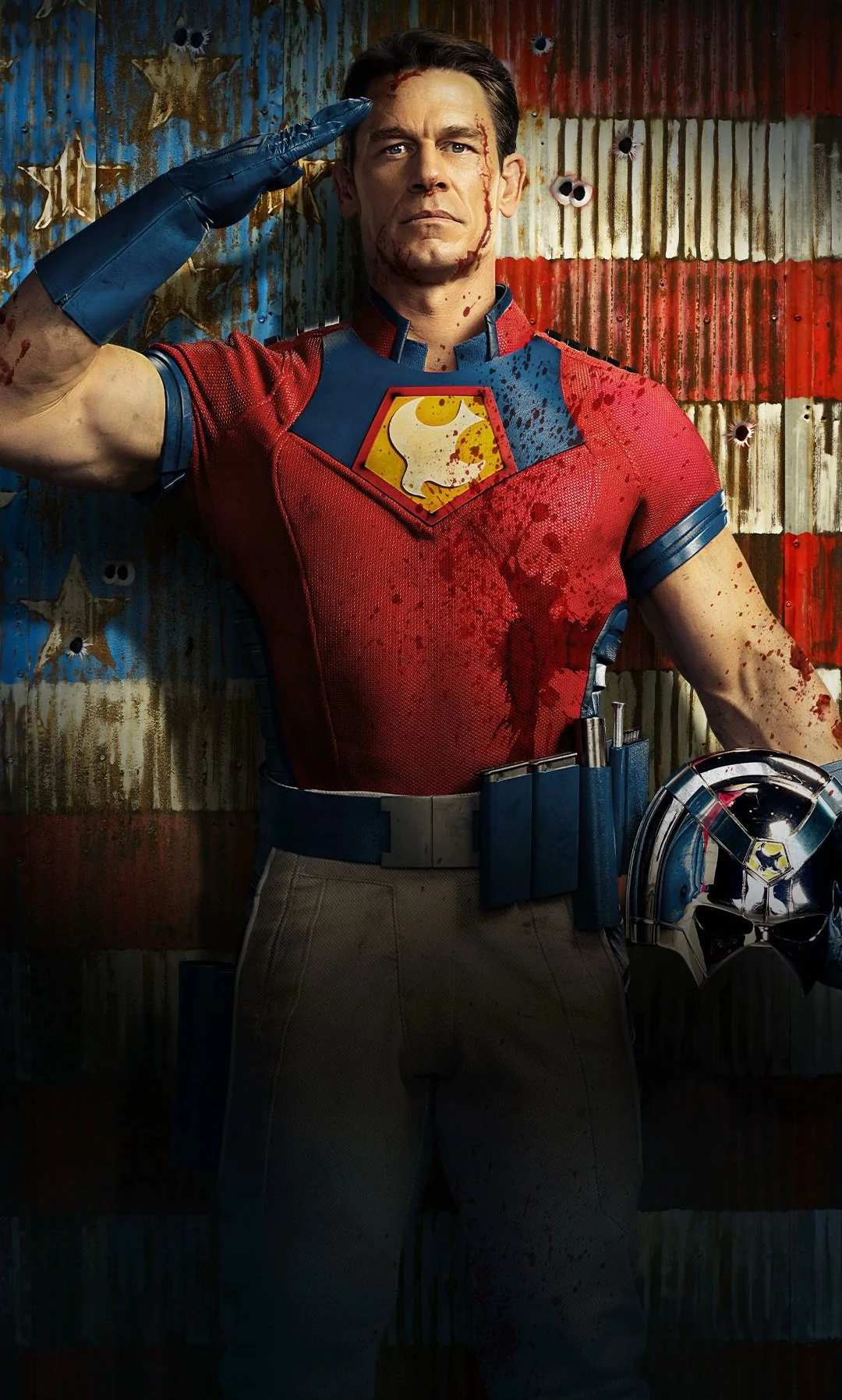
Host: The first season of Peacemaker ends with an alien invasion and a big battle. The second season ends with a more emotional confrontation. Why did you want to go that route for this season?
James Gunn: Well, I always thought the first season is about Peacemaker, and the second season is about Chris Smith. In the first season, Chris was dealing with the repercussions of his actions, but also the presence of his own trauma, a trauma that he had never seen, but was affecting all of his thoughts and decisions, and he just wasn’t aware of it. And by the end of season one, he becomes aware of this trauma.
In season two, he’s aware of his trauma and it actually makes his life a little bit harder. As anyone who’s done a bit of therapy knows, sometimes that can also make your life harder, at least temporarily. Because you’re dealing with all of this stuff in your life that you didn’t even know was there, and you’re doubting things about yourself that you never doubted. And this second season is about that internal journey of Christopher Smith. It was always about the way he relates to himself and the way he relates to the rest of the 11th Street kids from a perspective of the potential for healing.
Were there any other universes you dreamed up that you didn’t get a chance to include?
Yeah, I wanted them to open a door and see Deadpool in a room. And I talked to Ryan Reynolds about it [LAUGHS], but I think we would have had to go through some pretty big hoops to do that. [Ryan] wanted to do it!
Ah, that’s all anyone’s going to talk about now, is Deadpool. [Regretfully…] I should never have said it.
This episode includes two major reveals, can you talk about the decision to bring the planet of Salvation, and the Checkmate agency, into the DCU.
Yeah, those are the two things that were always a part of this season.
Even before I sat down with the writer’s room at DC [Studios], I had sort of mapped out what I thought the general story was. And two important aspects of that were Checkmate and especially Salvation.
Those were things that I had pitched to everybody when, even before we came into DC. I pitched it to Mike DeLuca and Pam Abdy (the co-heads of Warner Bros. Pictures), to Casey Bloys (the head of HBO Max) and to David Zaslav (the head of WBD). Then after we came into DC Studios and met with the writes room, we kind of worked things out a little bit more. So that was always pretty instrumental in the overarching story that I’m telling in the DCU.
The other shows, like Lanterns, is very connected to all of that. It may not seem like it, but it is all very connected.
What is it about the Salvation Run storyline that made you want to incorporate it your DCU storytelling?
It was really the concept. I like the concept of Rick Flag creating this prison that is absolutely inescapable, but it’s also a rash decision because ARGUS don’t realise from their initial tests that it’s a dangerous place. In the comics, and in our DCU, there are hints of it being dangerous.
But I also like the idea of being able to create this other environment where, people that are considered bad meta-humans are going to have to figure out a new way to create a society. That was what was always, interesting for me. I really liked the concept of it from the beginning when it first came out.
How much should the major DC comics fans be thinking about what actually happens in those books for what to expect in the DCU?
It really is about the concept. We’re taking elements like Salvation, but we’re not adapting that total story. For example, there’s a very distinct storyline in the comics that involves The Joker vs Lex Luthor, but we’re not doing that. The part that really spoke to me was the beginning of it where, in the comics Rick Flag Jr. and Amanda Waller were like, “meta-humans are a pain in the ass, they keep escaping, let’s just get rid of them permanently”. And they send them to the other place and of course there are a bunch of repercussions about sending a bunch of bad guys to another dimension. And in this case, the sole person there right now is a good guy who has to survive on this own [Peacemaker].
What do you envision Checkmate looking like in the DCU? Is it its own thing, or will it carry through Peacemaker and other projects?
You’ll definitely see Checkmate carrying through the DCU. They’re a thing now. They’re part of what’s going to happen. And I think they’re going to be really, really good at what they do. When we see them next, I think their circumstances will be a little bit different than the startup they are at now.
With Rick Flag implementing Luthor’s plans to imprison metahumans, things are going well for Lex Luthor right now. What sort of threat will get him to work with Superman in Man of Tomorrow?
Oh, a pretty pronounced one. I think that Lex Luthor is mostly concerned about Lex Luthor, so we’ll see what threatens Lex Luthor.
Rick Flag Sr. seems to be in a position of power, but once you enter into any kind of deal with Lex Luthor, doesn’t he tend to be the one holding all of the cards?
Yes. [LAUGHS]. Rick is dumb. I love the character of Rick Flag, but he thinks he is way smarter than he is. And we see it continuously. He thinks can compete with Lex, and there’s just no way he’s going to be able to. It’s not going to be great for him.
Is there anything now that you wish was different about Rick Flag Sr in Creature Commandos after what has happened in Peacemaker and in Superman?
No, I think that was all a part of what this is. We saw a guy in Creature Commandos, who seems at first like he’s a good guy but he’s absolutely not. He screws up everything, again, because he thinks smarter than Waller—which he isn’t. And he messes that up, and he falls for this woman, and is played by her from the beginning.
That to me, is the fun thing about Rick Flag. He’s totally imperfect.
Is redemption possible for Rick Flag Sr?
Yes, for sure. I certainly don’t think Rick Flag Sr is evil, I really don’t. Whenever Frank Grillo talks about the character he’s always like “I don’t see him as a villain, I see him as being a little obsessive about revenge, but I don’t know, someone kills my son, I’m not sure I wouldn’t feel the same way”.
I have compassion for Rick Flag, I don’t think he’s allowing himself to see the whole truth. The worst thing about Rick Flag is that he’s focused on the guy he can do something about more easily, rather than focusing on Amanda Waller who would be more difficult to confront. Because Amanda Waller was the one that gave the order to kill Rick Flag Jr.
Can you reveal when we might see Keith in the future?
I think we’ve born a villain, but I do think the sort of story is about Salvation. That story is more planned out than anything to do with Keith.
I have plans for Keith, but I just haven’t figured out exactly how it’s all going to work out so I have to make sure I can do it. It’s hard with the interdimensional hopping stuff to make these things come together in the way I’d like. I have what I would like to happen with Keith but I’m not sure, I have to make sure it will work.
Since this season ends on a cliffhanger, are you already planning a third season for Peacemaker?
No. This is about the wider DCU and other stories in which this will play out right now. That doesn’t mean there won’t be a third season, never say never, but right now, no.
This is about the future of the DCU. And Peacemaker’s still an important character.
Does the conclusion of Season 2 set up a broader role for Peacemaker in the DCU moving forward?
Yes. He’s important. He’s really important to me. Peacemaker is an important character. I said from the beginning when I took on this job. It’s about really maintaining and re-positioning the big diamond properties that DC has, like Batman, Wonder Woman, and Superman. And then, it’s about creating diamond properties out of the smaller characters, like Peacemaker.
Will John Cena or any other Peacemaker stars be returning in Supergirl or Man of Tomorrow?
Well, we’ll have to see [LAUGHS]. That’s a secret.
How much is what happens at the end of Peacemaker going to affect whatever you might do with Creature Commandos?
Oh, it’s in there. That’s being written now, and we’ve got the first couple of episodes. So that’s part of it, yeah.
What is the status of the Waller series, and might Checkmate be involved in that?
Yeah. It’s been… It’s just been a rough road [LAUGHS], there’s a lot to say. It’s like, so, yeah, you know, sometimes things just happen and it’s like butter and it’s so easy and you’re getting great scripts and it’s just, you know, straight of the bat, and other times it’s just a rockier road. And as I said from the beginning, we’ll never greenlight something where the scripts aren’t working, and we just haven’t had that yet with the Waller show.
What will dictate which DCU projects you choose to direct yourself?
Well with Man of Tomorrow, it hat was an idea I had for a long time. So, I already know the next few projects I’m directing. [LAUGHS].
How do you know? Is just because you are the one steering that particular part of the story?
Yeah, because it’s a part of the plan for the DCU. There is one big story. On the one hand, everything is going to be ok to watch by itself, but there is still a bigger story that is being told that involves, for example Salvation. And that story involves Rick Flag, it involves Lex and Superman, so those movies I’m going to be directing.
That’s the plan right now, at least. I may get so tired that I can’t do it because I’m pretty tired, so we’ll see. But there’s a plan that I’m going to do. It’s a couple more at least.
How do you balance wanting to tell a standalone season for Peacemaker, with also planting seeds for the DCU?
The balance, for me, is simply can people sit down and watch Peacemaker season two by itself, and be thoroughly entertained, and the answer is yes (maybe watching Peacemaker season one with it). So, that’s my only litmus test. Similarly, will people be able to go watch Man of Tomorrow without watching Peacemaker or even without watching Superman and be thoroughly entertained? That is the first thing that needs to exist. Then all the rest of it becomes gravy at that point.
How much will you integrate TV and movies in the DCU?
I want to make it so that you can watch anything by itself. I’m not expecting people to go into Man of Tomorrow and know what Salvation is. We will say it in the movie. You’ll find out anything you need to know about, such meta-human’s disappearing, through that movie.
It’s a very delicate balance when writing these things because I have to give the information to the audience. But simultaneous to that, it is not a mystery. We’re going to uncover stuff that we’ve already seen Peacemaker. So, you’ve got to be able to take the story in a way that people who already know the information are not going to be bored, and where people who don’t know the information will get the information in an easy and simple way.
But also, not to be burdened by stuff. You don’t want to make these things so complex, there needs to be an elegance to the storytelling that. Too many mumbo-jumbo things like magic stones that do this and that, there’s no emotional aspect to that. A prison in another dimension is easy for me to understand and say in one sentence.


 ️."
️."