• This forum is strictly intended to be used by members of the VS Battles wiki. Please only register if you have an autoconfirmed account there, as otherwise your registration will be rejected. If you have already registered once, do not do so again, and contact Antvasima if you encounter any problems.

    For instructions regarding the exact procedure to sign up to this forum, please click here.
  • We need Patreon donations for this forum to have all of its running costs financially secured.

    Community members who help us out will receive badges that give them several different benefits, including the removal of all advertisements in this forum, but donations from non-members are also extremely appreciated.

    Please click here for further information, or here to directly visit our Patreon donations page.
  • Please click here for information about a large petition to help children in need.

Is jumping lifting strength, a conversation

Vzearr

Vapour
He/Him
VS Battles
Retired
Messages
4,239
Reaction score
4,084
Last edited:
Of course jumping should be considered lifting strength. Ever heard of leg pressing which is using your legs to lift things (Including your own body when you jump with force)?
 
Thoughts (Psychomaster, read point 2 here)
  1. iirc we've typically treated jumping as lifting strength, which is backed up by how Large Size characters can get LS scaling to their weight if they're sufficiently acrobatic (including jumping high). I believe that for this to change, we may have to revise that.
  2. I think that there isn't a clean delineation between SS and LS, and that this gets particularly problematic for cases like the calc you're linking. For this specific case, it's using a character being able to "jump" in the space of 1 frame to anywhere on the map, and getting both velocity and acceleration from that. For the general case, and to highlight this as an issue, what separates a slap (striking strength) and a shove (lifting strength)? All that really does, imo, is the contact time; when contact times get this small, I think describing it as LS is really weird. If we take this with any degree of seriousness, all speedsters will have ludicrous LS for pushing themselves off the ground to run.
Overall, I don't know what the best solution is.
 
Jumping being considered LS isn't anything new to the wiki, I've done and accepted many such calcs for it, of course a feat that would be similar to striking strength like kicking yourself up would be different but jumping in and of itself should be valid for LS as you're literally using your legs to push off the ground some jumps even show the ground being ripped beneath their feet as they push up.

So yeah I'm in the camp that without a doubt jumping LS feats are valid
 
Jumping being considered LS isn't anything new to the wiki, I've done and accepted many such calcs for it, of course a feat that would be similar to striking strength like kicking yourself up would be different but jumping in and of itself should be valid for LS as you're literally using your legs to push off the ground some jumps even show the ground being ripped beneath their feet as they push up.

So yeah I'm in the camp that without a doubt jumping LS feats are valid
I consider jumping to be lifting strength, as it requires physically pushing against the ground, not unlike lifting something with your legs.
If someone kicks off a wall, gaining some distance from it in the process, would you consider that LS or SS (or would it be down to specific details of the feat)?
 
If someone kicks off a wall, gaining some distance from it in the process, would you consider that LS or SS (or would it be down to specific details of the feat)?
of course a feat that would be similar to striking strength like kicking yourself up would be different
Not LS that'd be striking strength if you're like quickly kicking off of something to propel yourself and gain momentum. I feel LS is more valid when there is contact with the base of the foot flat against a surface and your legs and/or body perform some kind of work as you push off such is bending down at the waist or knees to push off
 
Not LS that'd be striking strength if you're like quickly kicking off of something, I feel LS is more valid when there is contact with the base of the foot flat against a surface and you the legs and/or perform some kind of work as you push off sucu is bending down at the waist or knees to push off
I'd be down for using something along those lines, but I think it'd discount cases like the OP, where the evidence seems to be "They create a crater and move, so they jumped, so it's LS".

A more rigorous wording might be smth like "LS involves sustaining against a continuous force, such as by holding an object above oneself, or providing an opposing force against an object gradually decelerating as it hits them. LS can also involve exerting a force against an object, contacting the object in such a way that force is applied for an extended period of time, such as by bending relevant limbs." After some cleaned up wording I think I'd be good with that.
 
I'd be down for using something along those lines, but I think it'd discount cases like the OP, where the evidence seems to be "They create a crater and move, so they jumped, so it's LS
I honestly couldn't tell what was going on in the calc for the OPs video but yeah a crater by itself isn't indicative of it being LS just because it could have been done by kicking the ground to gain upwards momentum so I'm neutral on just because I can't tell for certain whats going on in the video.

A more rigorous wording might be smth like "LS involves sustaining against a continuous force, such as by holding an object above oneself, or providing an opposing force against an object gradually decelerating as it hits them. LS can also involve exerting a force against an object, contacting the object in such a way that force is applied for an extended period of time, such as by bending relevant limbs." After some cleaned up wording I think I'd be good with that
Yeah something along these lines is fine to me I'd say
 
Also, I would still kinda worry about speedsters getting absurd LS ratings, especially since afaik there's no hard limit on acceleration like there is for velocity, but I'm not sure about a great way to combat that.

My intuitive guess is smth like "LS feats largely granted due to acceleration rather than mass should be given a much lower priority than LS feats largely granted due to mass, when the two conflict." If a speedster gets Class M due to crouching down and jumping, reaching a speed of 1000 m/s in 0.001 seconds, even if they had multiple feats like that, I'd still take them struggling to lift a car to be more indicative.
 
IRL, jumping really high would generate extreme leg force that would translate to someone's pushing/pulling large objects. But I don't think it would quite scale to someone's bench pressing capability. As for deadlifting (The main method) would could still use their legs to assist; the saying "Lift with your legs not your back" rings a bell. I'm not really certain if we can use that since the latter requires parts of the arms and legs working together when done properly (Or just arms if done poorly) where as Jumping is just the legs. There's also situations where one could be running fast and just making use of momentum to U-turn the velocity and make use of that to jump high.

It is something that would be a sub category of lifting strength, but it shouldn't be the default to scale all forms of LS. And specifically, examples that lack momentum are probably fair game to list in a LS section, but using momentum would be striking strength rather than lifting strength.
 
Also, I would still kinda worry about speedsters getting absurd LS ratings, especially since afaik there's no hard limit on acceleration like there is for velocity, but I'm not sure about a great way to combat that
This is something I'm sure we've never accepted anyways though even if not like a written rule, its like something you know not to do and I don't think I've seen someone do that yet where they try and scale characters LS to X thing because they run at X speeds. If so we just let them know that's not valid usage of LS but otherwise I don't think that realistically poses any problem since like 90% of people im pretty sure know that's not really something you'd use for LS to begin with
 
Isn’t it that these calculations end up violating rules similar to the current use of KE rules? This is because, in the end, these calculations are based on speed to determine the force of various characters, a character being that fast doesn’t necessarily mean they have that much force. It’s similar to the KE rule where speed doesn’t correlate with energy, but in this case, it’s just replaced with force instead.
 
Isn’t it that these calculations end up violating rules similar to the current use of KE rules? This is because, in the end, these calculations are based on speed to determine the force of various characters, a character being that fast doesn’t necessarily mean they have that much force. It’s similar to the KE rule where speed doesn’t correlate with energy, but in this case, it’s just replaced with force instead.
Not really no? The force in this case is what's indicative of the height and speeds the characters are jumping to, if Hulk jumps 3000m in the air in like a second after some buildup then that height and speed he got from said jump is the equivalent force but most of the time anyways jumping isn't actually that wild on a KE scale anyways heck even with like High Hypersonic KE of a guy jumping you're still looking at 9-B ~ 9-A force with only like Class K~M jumping force which like isn't that bad and can be easily supported

Most of the time though you aren't having guys make jumps like that anyways and you'd probably be looking at something like Class 5~Class K with most jumping feats unless its specifcally extra destruction caused by said jump but in which case that's its own thing you can calculate without even needing to do the kinds KE part of it
 
Last edited:
Not really no? The force in this case is what's indicative of the height and speeds the characters are jumping to, if Hulk jumps 3000m in the air in like a second after some buildup then that height and speed he got from said jump is the equivalent force but most of the time anyways jumping isn't actually that wild on a KE scale anyways heck even with like High Hypersonic KE of a guy jumping you're still looking at 9-B ~ 9-A force with only like Class K~M jumping force which like isn't that bad and can be easily supported
I think it’s not much different from determining energy based on a character’s speed. I mean, if there’s a clear rule that energy cannot be derived from speed, then why is it acceptable to derive force from speed or acceleration? I’m looking for the distinction between these things, but I don’t see much of a difference, as the rules seem to stem from the inconsistency of energy and speed of character in fiction.
Kinetic Energy based on Movement Speed is case by case: Fiction often treats the speed with which a character can move himself as unrelated to their attack power. As such feats like just running or carrying a small object, like another character, should only be used if the fiction has made clear that the speed of the movement correlates to the character's power or if the character uses the fast moving object to attack. Calculating the energy necessary for moving large structures at great speeds, using the speed things move as a secondary effect of an attack, throwing objects at great speeds etc. are all acceptable methods of quantifying a characters power regardless
Asked whether jumping is considered LS, it might be or might not be—I’m still not sure. I think it’s more of a case-by-case basis. However, calculating force derived from speed and things like that, I think it violates the rules in a way similar to the KE rule. Unless it’s possible to find a distinction in the inconsistency between calculating force and energy, explaining how they differ.
 
I personally believe it depends on the jump itself.

A jump where someone bends down and launchings themselves up at high speed, has the same pushing/continuous motion needed for LS.

A jump that involves kicking the ground, is not applicable for LS as that's striking. The force generated does not come from bending down and rising up at high speed; it instead comes from the impact your leg makes from hitting something. In fiction, this could be the ground, wall, or even the air itself.

There are probably more example of bad jumps, but I'm focused more on what's acceptable right now.

Of course, there's also the issues of different body parts of LS. However, this wiki already ignores this completely for simplicity. That's why we accept constant crushing/tearing feats for LS as well. People who lift something with their legs is still regarded as LS, which is what I'm qualifying jumps as being.

What I'm seeing in the OP is not usable to me. I don't see anything suggesting this is an acceptable jump at all. The blog poster even says its theoretical.

I can also agree that straight lifting feats should have higher priority compared to other feats. If there is a contradiction between something like an acceptable jumping feats and an lifting/throwing/pushing feats, I'd be more inclined to believe the latter is more accurate.
 
This is something I'm sure we've never accepted anyways though even if not like a written rule, its like something you know not to do and I don't think I've seen someone do that yet where they try and scale characters LS to X thing because they run at X speeds. If so we just let them know that's not valid usage of LS but otherwise I don't think that realistically poses any problem since like 90% of people im pretty sure know that's not really something you'd use for LS to begin with
Not simply for running, but because they can launch off the ground with low timeframes. I think with the rules we've given so far, a sprinter's crouch start would qualify that first bit of acceleration for LS.
Not really no? The force in this case is what's indicative of the height and speeds the characters are jumping to, if Hulk jumps 3000m in the air in like a second after some buildup then that height and speed he got from said jump is the equivalent force but most of the time anyways jumping isn't actually that wild on a KE scale anyways heck even with like High Hypersonic KE of a guy jumping you're still looking at 9-B ~ 9-A force with only like Class K~M jumping force which like isn't that bad and can be easily supported

Most of the time though you aren't having guys make jumps like that anyways and you'd probably be looking at something like Class 5~Class K with most jumping feats unless its specifcally extra destruction caused by said jump but in which case that's its own thing you can calculate without even needing to do the kinds KE part of it
That may be most feats, but definitionally, LS feats will go out of control faster than KE feats, as they grow exponentially with speed, rather than linearly, and because they lack the light-speed barrier.
 
I think with the rules we've given so far, a sprinter's crouch start would qualify that first bit of acceleration for LS.
That's fair I hadn't considered that kind of start when running
That may be most feats, but definitionally, LS feats will go out of control faster than KE feats, as they grow exponentially with speed, rather than linearly, and because they lack the light-speed barrier.
I was under the impression we do indeed limit LS as well with the same limitations as KE, as far as im aware we've enforced this as such so not like SoL or FTL Lifting strength calcs same as KE. Regardless though we do have more than 1 way of doing jumping calculations that can be done without the regular speed portion

Lets just say we jumped 1000m into the air, We will assume 45% body height for the leg work of the force in the jump (this is just assuming legs are 45% of the total height)

62kg * 1000m * 9.81m/s = 608220 joules/ (1.71m*45%) = 790409.357N/9.81 = 8216.0370667kg (Class 10)

I'd imagine this is a fine work around for the concern in question
 
I was under the impression we do indeed limit LS as well with the same limitations as KE, as far as im aware we've enforced this as such so not like SoL or FTL Lifting strength calcs same as KE. Regardless though we do have more than 1 way of doing jumping calculations that can be done without the regular speed portion
For SoL and above velocities, sure, but timeframes can get arbitrarily short, rendering acceleration arbitrarily high.
Lets just say we jumped 1000m into the air, We will assume 45% body height for the leg work of the force in the jump (this is just assuming legs are 45% of the total height)

62kg * 1000m * 9.81m/s = 608220 joules/ (1.71m*45%) = 790409.357N/9.81 = 8216.0370667kg (Class 10)

I'd imagine this is a fine work around for the concern in question
That's a bit of an underestimate for jumping, actually.

Ignoring air friction, the time needed for gravity to move you a certain vertical height is sqrt((2*h)/g), since the height is 1000 meters, and it's in Earth's gravity, that gives a time of ~14.28 seconds. Since jumping is functionally falling from a height in reverse, you would need a speed that reaches 0 velocity after 14.28 seconds to jump 1000 meters high, which means a velocity of ~140 m/s.

One would need to reach that velocity by the time their feet leave the ground. Assuming a leg length of 0.8 m, and halving that due to human fallibility with jumping technique and due to shins not being bendable, means one needs to accelerate to that speed before moving 0.4 m

Assuming linear acceleration, their average speed over that time will be half of their final speed, so 70 m/s, which means that they accelerated to that velocity in 1/175th of a second. Giving an acceleration of 24,500 m/s^2.

Multiplied by the weight of 62 kg, that gives a force exerted of 1,519,000 Newtons, or ~155,000 kgf, Class K.

Yours ended up so much lower since you divided by 9.81^2 in the last step, which is not the correct conversion between Newtons and kilogram force (unless one of those 9.81 divisions was part of the method, in which case that method is just a substantial underestimate).

EDIT: We could even collapse this all into one thing to hide the use of velocity; F = (((sqrt(2*h/g))*g)^2)*m/(2*L), where F is force, h is final height, g is the gravitational constant, m is the mass, and L is the length the force was done over (typically, the difference in height between initiating the jump, and losing contact with the ground).
 
Last edited:
For SoL and above velocities, sure, but timeframes can get arbitrarily short, rendering acceleration arbitrarily high.

That's a bit of an underestimate for jumping, actually.

Ignoring air friction, the time needed for gravity to move you a certain vertical height is sqrt((2*h)/g), since the height is 1000 meters, and it's in Earth's gravity, that gives a time of ~14.28 seconds. Since jumping is functionally falling from a height in reverse, you would need a speed that reaches 0 velocity after 14.28 seconds to jump 1000 meters high, which means a velocity of ~140 m/s.

One would need to reach that velocity by the time their feet leave the ground. Assuming a leg length of 0.8 m, and halving that due to human fallibility with jumping technique and due to shins not being bendable, means one needs to accelerate to that speed before moving 0.4 m

Assuming linear acceleration, their average speed over that time will be half of their final speed, so 70 m/s, which means that they accelerated to that velocity in 1/175th of a second. Giving an acceleration of 24,500 m/s^2.

Multiplied by the weight of 62 kg, that gives a force exerted of 1,519,000 Newtons, or ~155,000 kgf, Class K.

Yours ended up so much lower since you divided by 9.81^2 in the last step, which is not the correct conversion between Newtons and kilogram force (unless one of those 9.81 divisions was part of the method, in which case that method is just a substantial underestimate).
Yeah that was just how the method there I saw was structured honestly but yeah if we want to take what you did and list that as a method for completing said feats I'd personally say thats fine
 
Of course jumping should be considered lifting strength. Ever heard of leg pressing which is using your legs to lift things (Including your own body when you jump with force)?
By this logic punches should be considered lifting strength, because haven't you heard of Bench press where you use your arms to lift things. In IRL terms I'd agree with the logic, but we have to remember why LS is split from AP in the first place, being that fiction isn't really consistent with it and even in IRL it can be a little uneven based on what a specific person uses their body for all the time. That's the issue, not whether or not an amount of muscles are used.
iirc we've typically treated jumping as lifting strength, which is backed up by how Large Size characters can get LS scaling to their weight if they're sufficiently acrobatic (including jumping high). I believe that for this to change, we may have to revise that.
Isn't the case with that more a matter of us needing proof that a large sized character can handle weight comparable to their own mass, and being able to maneuver efficiently would give a proper demonstration of that? It's not really something innate to any particular maneuver, as far as I can tell (And in my personal opinion, naturally)
I personally believe it depends on the jump itself.

A jump where someone bends down and launchings themselves up at high speed, has the same pushing/continuous motion needed for LS.

A jump that involves kicking the ground, is not applicable for LS as that's striking. The force generated does not come from bending down and rising up at high speed; it instead comes from the impact your leg makes from hitting something. In fiction, this could be the ground, wall, or even the air itself.

There are probably more example of bad jumps, but I'm focused more on what's acceptable right now.

Of course, there's also the issues of different body parts of LS. However, this wiki already ignores this completely for simplicity. That's why we accept constant crushing/tearing feats for LS as well. People who lift something with their legs is still regarded as LS, which is what I'm qualifying jumps as being.

What I'm seeing in the OP is not usable to me. I don't see anything suggesting this is an acceptable jump at all. The blog poster even says its theoretical.

I can also agree that straight lifting feats should have higher priority compared to other feats. If there is a contradiction between something like an acceptable jumping feats and an lifting/throwing/pushing feats, I'd be more inclined to believe the latter is more accurate.
While I disagree with the general principle, I do at least see the logic here and think if nothing else, a proper windup like what you'd see with a squat is what this should be limited to. I'm fine with compromising to this extent (and especially the aspect of consistency, which is another really big issue I have with this stuff)
 
Last edited:
Comparing this to real life (I know real life scenarios aren't always analogous to what goes in fiction, but it's the general principle I'm choosing to espouse), jump height can be a decent indicator of the explosive contractibility of a person's muscles.

However, strength training alone probably isn't going to impact your vertical jump performance much. It's a very specific kind of training that's used to increase jump perfomance, and it doesn't have direct correlation with static strength, what we would typically consider lifting.

I can speak from experience that squatting more (I'm using the squat here as it's the closest static strength exercise to pure jumping) has not impacted my personal jump height. I can also point to the best jumpers in the world not being even close to the best squatters, and vice-versa.

Overall, put me as disagree.
 
I'm on the same camp as Psycho, Dale and Rusty so on the 'Agree' side of things.

In fiction there often isn't a big distinction and jumping may correlate with a character's lifting/pushing strength (probably following the "lift with your legs" saying which is pretty universal).
 
Comparing this to real life (I know real life scenarios aren't always analogous to what goes in fiction, but it's the general principle I'm choosing to espouse), jump height can be a decent indicator of the explosive contractibility of a person's muscles.

However, strength training alone probably isn't going to impact your vertical jump performance much. It's a very specific kind of training that's used to increase jump perfomance, and it doesn't have direct correlation with static strength, what we would typically consider lifting.

I can speak from experience that squatting more (I'm using the squat here as it's the closest static strength exercise to pure jumping) has not impacted my personal jump height. I can also point to the best jumpers in the world not being even close to the best squatters, and vice-versa.

Overall, put me as disagree.
I don't like this argument. There's shitloads of muscle groups that have little effect on each other when trained in isolation, I don't think LS is meant to only include one of those.
 
I'm not talking about them in isolation? And the muscle groups involved in squatting/jumping are absolutely not small. They include a complex system of interworking tissue that comprises a large chunk of the body's skeletal muscle mass.

For the squat: https://fitnessprogramer.com/exercise/squat/

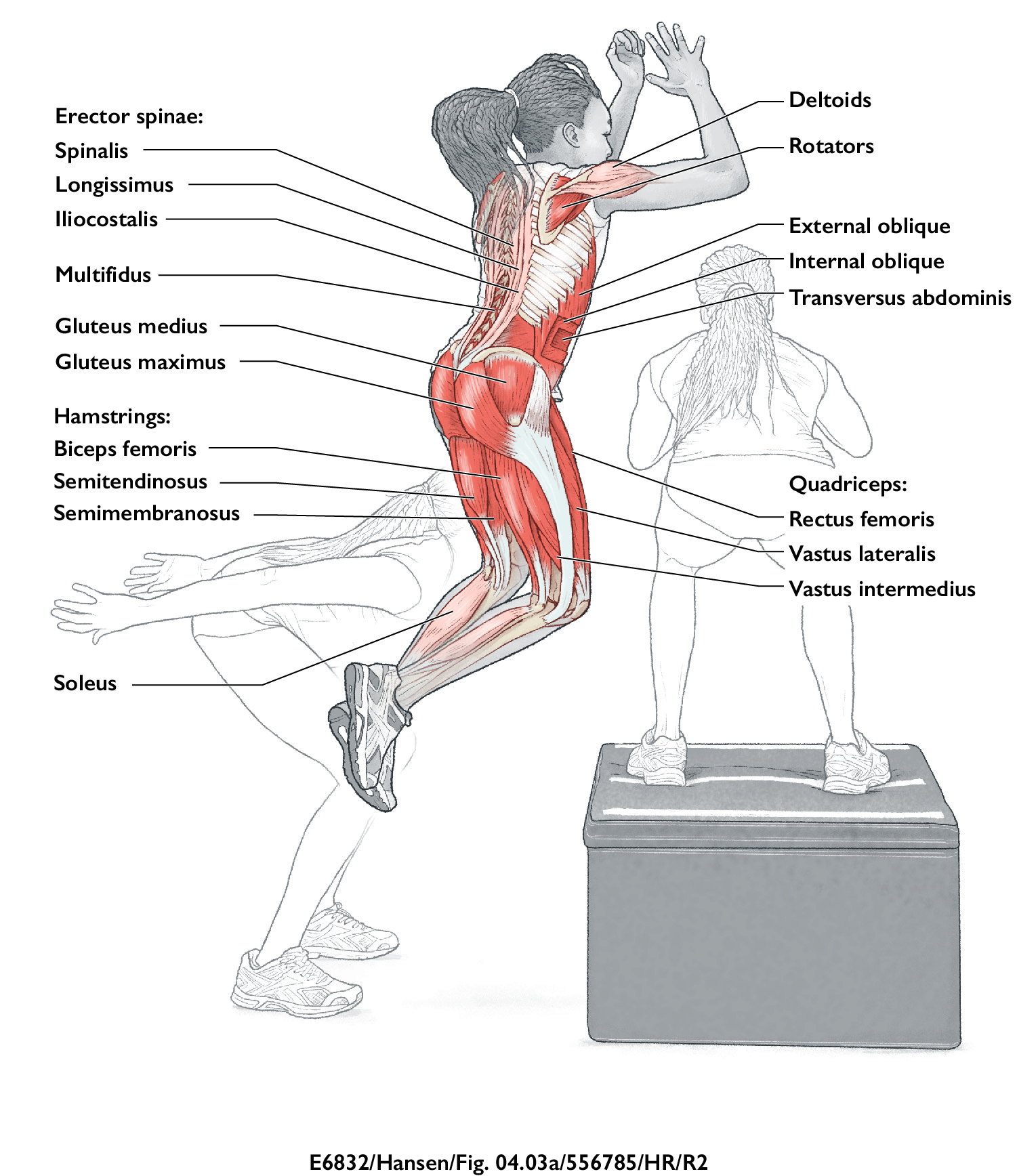
For the jump (this is a box jump, not a vertical jump, but it get's the point across):
E6832_556785.jpg
 
In theory, it should be. Essentially when you're jumping, you're throwing yourself up with your own body movements, which requires force. When jumping, the net force is essentially higher than the force of gravity acting upon you, that is your weight. Thing is jumping isn't lifting in the conventional sense of the term, that is lifting an object up. In other words, it isn't in practice.

Bill me in for neutral on this one.
 
Comparing this to real life (I know real life scenarios aren't always analogous to what goes in fiction, but it's the general principle I'm choosing to espouse), jump height can be a decent indicator of the explosive contractibility of a person's muscles.

However, strength training alone probably isn't going to impact your vertical jump performance much. It's a very specific kind of training that's used to increase jump perfomance, and it doesn't have direct correlation with static strength, what we would typically consider lifting.

I can speak from experience that squatting more (I'm using the squat here as it's the closest static strength exercise to pure jumping) has not impacted my personal jump height. I can also point to the best jumpers in the world not being even close to the best squatters, and vice-versa.

Overall, put me as disagree.
The issue is that calcs finding LS through jumping use acceleration as a direct metric rather than something like jump height.
 
The issue is that calcs finding LS through jumping use acceleration as a direct metric rather than something like jump height.
We actually have used both, it really just depends on who is doing the calc I suppose
For SoL and above velocities, sure, but timeframes can get arbitrarily short, rendering acceleration arbitrarily high.

That's a bit of an underestimate for jumping, actually.

Ignoring air friction, the time needed for gravity to move you a certain vertical height is sqrt((2*h)/g), since the height is 1000 meters, and it's in Earth's gravity, that gives a time of ~14.28 seconds. Since jumping is functionally falling from a height in reverse, you would need a speed that reaches 0 velocity after 14.28 seconds to jump 1000 meters high, which means a velocity of ~140 m/s.

One would need to reach that velocity by the time their feet leave the ground. Assuming a leg length of 0.8 m, and halving that due to human fallibility with jumping technique and due to shins not being bendable, means one needs to accelerate to that speed before moving 0.4 m

Assuming linear acceleration, their average speed over that time will be half of their final speed, so 70 m/s, which means that they accelerated to that velocity in 1/175th of a second. Giving an acceleration of 24,500 m/s^2.

Multiplied by the weight of 62 kg, that gives a force exerted of 1,519,000 Newtons, or ~155,000 kgf, Class K.

Yours ended up so much lower since you divided by 9.81^2 in the last step, which is not the correct conversion between Newtons and kilogram force (unless one of those 9.81 divisions was part of the method, in which case that method is just a substantial underestimate).

EDIT: We could even collapse this all into one thing to hide the use of velocity; F = (((sqrt(2*h/g))*g)^2)*m/(2*L), where F is force, h is final height, g is the gravitational constant, m is the mass, and L is the length the force was done over (typically, the difference in height between initiating the jump, and losing contact with the ground).
This was a good fix of the example I tried to use for using height
 
That's fair I hadn't considered that kind of start when running

I was under the impression we do indeed limit LS as well with the same limitations as KE, as far as im aware we've enforced this as such so not like SoL or FTL Lifting strength calcs same as KE. Regardless though we do have more than 1 way of doing jumping calculations that can be done without the regular speed portion
I had come across this sort of thing before. The thing about acceleration is, unlike speed which is hard-capped at the speed of light (299792458 m/s) under almost all circumstances, acceleration can be whatever the heck we want it to be: https://en.wikipedia.org/wiki/Orders_of_magnitude_(acceleration)

We managed to make a railgun with an acceleration of 1,000,000,000 m/s² before. The calculated force from the 2 gram projectile used as a reference is 2 meganewtons, and the work based on the reference distance of 1 cm is 20,000 newtons.

A neutron star, which has an escape velocity of around 0.54c, has an acceleration of anywhere from 1*10^12 to 1*10^13 m/s².

I had to look into these because one calc I did was something I knew for sure needed to be calculated using relativistic acceleration, and it was an Asterix calc. Granted it had nothing to do with jumping, but it had very much to do with relativistic acceleration, which was something hardly touched by the wiki. I asked SpaceBattles (and those guys do NOT mess around when it comes to calculations) and was given this as an easy way to go about relativistic acceleration, with the instructions on how to set it up to boot: https://www.omnicalculator.com/physics/space-travel
 
I had come across this sort of thing before. The thing about acceleration is, unlike speed which is hard-capped at the speed of light (299792458 m/s) under almost all circumstances, acceleration can be whatever the heck we want it to be: https://en.wikipedia.org/wiki/Orders_of_magnitude_(acceleration)

We managed to make a railgun with an acceleration of 1,000,000,000 m/s² before. The calculated force from the 2 gram projectile used as a reference is 2 meganewtons, and the work based on the reference distance of 1 cm is 20,000 newtons.

A neutron star, which has an escape velocity of around 0.54c, has an acceleration of anywhere from 1*10^12 to 1*10^13 m/s².

I had to look into these because one calc I did was something I knew for sure needed to be calculated using relativistic acceleration, and it was an Asterix calc. Granted it had nothing to do with jumping, but it had very much to do with relativistic acceleration, which was something hardly touched by the wiki. I asked SpaceBattles (and those guys do NOT mess around when it comes to calculations) and was given this as an easy way to go about relativistic acceleration, with the instructions on how to set it up to boot: https://www.omnicalculator.com/physics/space-travel
Acceleration isn’t limited like speed, but using FTL speeds in force calculations doesn’t work. According to relativity, as an object gets closer to light speed, its mass increases, and reaching or exceeding light speed would require infinite energy something impossible in reality.

Normal force equations like F = ma don’t apply here. At high speeds, it need relativistic formulas, and once it go past light speed, the numbers break down, becoming meaningless or outright contradicting physics.

In short, no matter how high acceleration gets, if speed exceeds light, force calculations still won’t work and give invalid results.

Finally, force calculation still needs to consider whether KE is at light speed or not. It‘s not like there are no limitations at all.

I’m not sure if this thread is the right place to discuss this. If not, I’d appreciate a warning. Since this topic may or may not be directly related to jumping as LS, there might be a new thread for these kinds of discussions.
 
Acceleration isn’t limited like speed, but using FTL speeds in force calculations doesn’t work. According to relativity, as an object gets closer to light speed, its mass increases, and reaching or exceeding light speed would require infinite energy something impossible in reality.

Normal force equations like F = ma don’t apply here. At high speeds, it need relativistic formulas, and once it go past light speed, the numbers break down, becoming meaningless or outright contradicting physics.

In short, no matter how high acceleration gets, if speed exceeds light, force calculations still won’t work and give invalid results.
Yeah, this was already brought up. I already said that I was talking about timeframes getting arbitrarily short, not velocities exceeding SoL.
Finally, force calculation still needs to consider whether KE is at light speed or not. It‘s not like there are no limitations at all.
We can consider that, but there are still concerning cases where it isn't.
I’m not sure if this thread is the right place to discuss this. If not, I’d appreciate a warning. Since this topic may or may not be directly related to jumping as LS, there might be a new thread for these kinds of discussions.
It is the right place for this, but I don't think you're really bringing out anything new.
 
Yeah, this was already brought up. I already said that I was talking about timeframes getting arbitrarily short, not velocities exceeding SoL.

We can consider that, but there are still concerning cases where it isn't.

It is the right place for this, but I don't think you're really bringing out anything new.
Apologize, I didn’t see it. I might have skimmed over it, so I’m not sure how much this topic has been expanded on or discussed.
 
Bumping this since it was never applied.

And since it came up in this thread, I think we might want to discuss deriving LS from destruction.

I don't think this should be done, in the same way that we explicitly disallow deriving speed or mass from destruction for Kinetic Energy Feats.


EDIT: Gonna take that to another thread since people disagree.
 
Last edited:
IRL, jumping really high would generate extreme leg force that would translate to someone's pushing/pulling large objects. But I don't think it would quite scale to someone's bench pressing capability. As for deadlifting (The main method) would could still use their legs to assist; the saying "Lift with your legs not your back" rings a bell. I'm not really certain if we can use that since the latter requires parts of the arms and legs working together when done properly (Or just arms if done poorly) where as Jumping is just the legs. There's also situations where one could be running fast and just making use of momentum to U-turn the velocity and make use of that to jump high.

It is something that would be a sub category of lifting strength, but it shouldn't be the default to scale all forms of LS. And specifically, examples that lack momentum are probably fair game to list in a LS section, but using momentum would be striking strength rather than lifting strength.
I still think I have the same thoughts; I think jumps could be LS for ones that didn't have momentum, but not so much for ones that follow running fast since momentum tends to make it feel more affiliated with SS rather than LS.
 
Both sides make good points, pin me for neutral, leaning to agree to keep it as LS.
 
Bumping this since it was never applied.
There was never a decision reached DDM, Myself and Vzearr all said under correct circumstances it could be valid, you yourself said you'd be alright with it under certain circumstance

And since it came up in this thread, I think we might want to discuss deriving LS from destruction.

I don't think this should be done, in the same way that we explicitly disallow deriving speed or mass from destruction for Kinetic Energy Feats.
Otherwise for this point here, we've always allowed this depending on the feat in question.
 
Back
Top