• This forum is strictly intended to be used by members of the VS Battles wiki. Please only register if you have an autoconfirmed account there, as otherwise your registration will be rejected. If you have already registered once, do not do so again, and contact Antvasima if you encounter any problems.

    For instructions regarding the exact procedure to sign up to this forum, please click here.
  • We need Patreon donations for this forum to have all of its running costs financially secured.

    Community members who help us out will receive badges that give them several different benefits, including the removal of all advertisements in this forum, but donations from non-members are also extremely appreciated.

    Please click here for further information, or here to directly visit our Patreon donations page.
  • Please click here for information about a large petition to help children in need.

One Piece: Problem with earthquake calcs

Floxy178

He/Him
VS Battles
Calculation Group
Messages
1,024
Reaction score
1,092
So recently I was looking through these two calcs and noticed something strange.
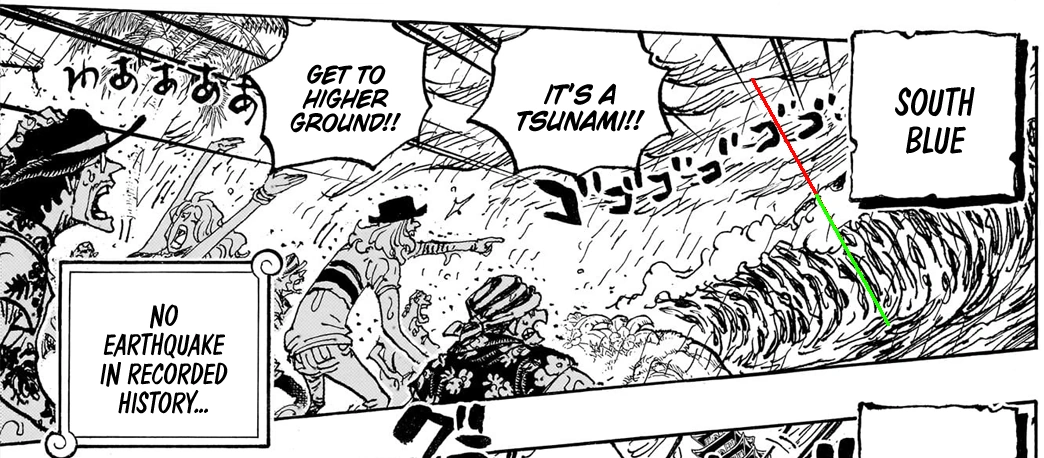
Both calcs after converting Moment Magnitude to Richter Magnitude, use this formula:
(Magnitude at distance) + 6.399 + 1.66*log10((r/110)((2π)/360)) = Richter Magnitude of Earthquake
However blog that's linked for reference doesn't include such a step. Additionally I looked at blog that @Migue79 did after method got accepted, see update part, this one doesn't include it either. It calculates 10^(1.5*Me + 4.8) directly from 1.5667 ∗ Log(H)+ 7.0781 + (-4.9 + 4.7)/1.5

Corrected results will be 2.139329e+22 joules for Mother Flame calc (method 1 should still be usable tho as OP planet is bigger than Earth method 1 isn't correct either) and 8.007211e+21 joules for BB one.

Agree: @Damage3245 @DontTalkDT
Disagree:
Neutral:
 
Last edited:
@KingTempest @Migue79 Could you both check out this thread please?
Yeah I can

My formula is just Migue's formula but it implements the formula of earthquake at a distance
  1. r ≥ 700 km: In this case the formula is (Magnitude at distance) + 6.399 + 1.66*log10((r/110)((2π)/360)) = Richter Magnitude of Earthquake

That's all

For example

Tsunami formula is 1.5667 * Log(700.14309942296) + 7.0781
Moment to Richter is ABOVE + (-4.9 + 4.7)/1.5
Richter from a distance is 6.399 + 1.66*log10((r/110)((2π)/360))

So it just compresses it all into one. Same for the other one.

If you want to fact check them to make sure the math is right then be my guest. But the actual calculation is just migue's formula but at a distance.
 
Yeah I can

My formula is just Migue's formula but it implements the formula of earthquake at a distance
  1. r ≥ 700 km: In this case the formula is (Magnitude at distance) + 6.399 + 1.66*log10((r/110)((2π)/360)) = Richter Magnitude of Earthquake

That's all

For example

Tsunami formula is 1.5667 * Log(700.14309942296) + 7.0781
Moment to Richter is ABOVE + (-4.9 + 4.7)/1.5
Richter from a distance is 6.399 + 1.66*log10((r/110)((2π)/360))

So it just compresses it all into one. Same for the other one.

If you want to fact check them to make sure the math is right then be my guest. But the actual calculation is just migue's formula but at a distance.
That's only in case if formula gives magnitude at distance.
 
...Which these formulas calculate?
Ehh not necessarily? Not an earthquake expert but I don't think found moment magnitude is a local thing, it's just referred as "earthquake magnitude". If derivation relies on values of magnitudes at epicenter, then calculated value won't be magnitude at distance? That'd just be Richter Magnitude of earthquake.
 
Isn't that something that can only be used for an Earth-like planet? The 110 km to one degree of the Earth's circumference?
Sorry to jump in but if that's the case how would earthquake feats of this scale work on planets larger than Earth?
 
For this part:


Isn't that something that can only be used for an Earth-like planet? The 110 km to one degree of the Earth's circumference?
Yeah 110 should be changed to circumference of OP planet / 360.

Also r there should be arc length, not diamater or distance with straight line. (so blog did it correct at first, before change)

Btw even if we adjust logΔ part of formula according to OP planet, rest of formula(constants) is only for Earth. I'll send DT saying that formula doesn't work if planet isn't Earth-like or Earth size if I find it.

Edit:
 
Last edited:
Yeah 110 should be changed to circumference of OP planet / 360.

Also r there should be arc length, not diamater or distance with straight line. (so blog did it correct at first, before change)

Btw even if we adjust logΔ part of formula according to OP planet, rest of formula(constants) is only for Earth. I'll send DT saying that formula doesn't work if planet isn't Earth-like or Earth size if I find it.

Edit:
I see. That does seem to call both calcs into question.

Unless there's a solution it seems to me that both calcs should be removed.
 
Don't we just need a version of the earthquake formula that replaces the Earth based constants with those of Blue Planet's to fix the calcs?
 
I see. That does seem to call both calcs into question.

Unless there's a solution it seems to me that both calcs should be removed.
Yeah it seems method 1 one doesn't work either as I mentioned in OP.
Don't we just need a version of the earthquake formula that replaces the Earth based constants with those of Blue Planet's to fix the calcs?
Yeah. Though that seems quite unrealistic.
 
Why is that?
Because those are empirical values based on Earth data. They assume Earth’s radius, its attenuation, crustal thickness, seismic wave behaviors specific to Earth, etc. etc. There's no way for us to prove how it'll be on a non Earth-like planet. (unless someone has idea to do so)
 
Because those are empirical values based on Earth data. They assume Earth’s radius, its attenuation, crustal thickness, seismic wave behaviors specific to Earth, etc. etc. There's no way for us to prove how it'll be on a non Earth-like planet. (unless someone has idea to do so)
Wouldn't be fair to throw away a feat for factors that are literally impossible for us to figure out due to being a fictional world, that's why we make assumptions in calcs to begin with. The current planet size calc already uses the assumptions of it having similar aspect to Earth via using Earth's density

The only problem there would be trying to figure out crustal thickness. The most accurate formula uses Sr/Y, the ratio of strontium to yttrium in igneous rocks to determine crustal thickness, which is impossible for us to figure out for a fictional planet. From my own research I have yet to find a formula that doesn't use factors that are impossible for us to measure for a fictional world, but I am still looking
 
Last edited:
Wouldn't be fair to throw away a feat for factors that are literally unquantifiable, that's why we make assumptions in calcs to begin with. The current planet size calc already uses the assumptions of it having similar aspect to Earth via using Earth's density

The only problem there would be trying to figure out crustal thickness. The most accurate formula uses Sr/Y, the ratio of strontium to yttrium in igneous rocks to determine crustal thickness, which is impossible for us to figure out for a fictional planet. From my own research I have yet to find a formula that doesn't use factors that are impossible for us to measure for a fictional world, but I am still looking
Obviously you can make such assumptions. But I'm pretty sure even if you take planet as physically proportional to Earth, formula won't apply still. Geometry isn't only factor after all. Take gravity for example. If gravity, and thus, overburden pressures change, how that will affect wave speeds or attenuation? I just don't think we will be able to quantify all that without empirical data that we simply don't have for fictional scenario.
 
Obviously you can make such assumptions. But I'm pretty sure even if you take planet as physically proportional to Earth, formula won't apply still. Geometry isn't only factor after all. Take gravity for example. If gravity, and thus, overburden pressures change, how that will affect wave speeds or attenuation? I just don't think we will be able to quantify all that without empirical data that we simply don't have for fictional scenario.
The planet size calc already gives us surface gravity which would let us figure out those factors if needed, though I don't think that's necessary.
Both the Kilo Kilo and Ton Ton fruits show us that gravity can't be much higher than Earth's as they would weigh much higher than the stated weights of their moves, so just using Earth's gravity is fine.
 
The planet size calc already gives us surface gravity which would let us figure out those factors if needed, though I don't think that's necessary.
Well, then as I already said above, if someone somehow comes up with completely adjusting formula for such factors, it should be fine.
Both the Kilo Kilo and Ton Ton fruits show us that gravity can't be much higher than Earth's as they would weigh much higher than the stated weights of their moves, so just using Earth's gravity is fine.
? How are we taking Earth density for planet mass, assuming planet being Earth-like/proportional to Earth but at the same time having normal gravity despite planet being bigger than Earth in size? These don't hold up together.
 
? How are we taking Earth density for planet mass, assuming planet being Earth-like/proportional to Earth but at the same time having normal gravity despite planet being bigger than Earth in size? These don't hold up together.
well there's a bunch of anti-feats for the planet's surface gravity being like 79.5x stronger than Earth's, I thought this was already how it was treated? (Otherwise wouldn't most speed feats be increased via gravity like how Metriod's speed feats involving Zebe used to be before the gravity was debunked). If using Earth's density is causing this problem then it would prob be better to recalculate to find mass via Earth gravity instead

Edit:
Went to check out the math
mass = (9.8*505766859.762^2)/6.6743e-11= 3.7559611e28kg
that's 6285.0754685 earth masses and is 79.5582813677x less massive than the current calc; exactly the gravity difference
the planet density from that mass would be
3.7559611e28/5.42e26= 69.2981752768 kg/m3
that is quite a low planet density
 
Last edited:
Well, then as I already said above, if someone somehow comes up with completely adjusting formula for such factors, it should be fine.
I'd be down to do it if told what parts of the formula needs to be adjusted
 
well there's a bunch of anti-feats for the planet's surface gravity being like 79.5x stronger than Earth's, I thought this was already how it was treated? (Otherwise wouldn't most speed feats be increased via gravity like how Metriod's speed feats involving Zebe used to be before the gravity was debunked). If using Earth's density is causing this problem then it would prob be better to recalculate to find mass via Earth gravity instead
Maybe, but discussing mass of Planet isn't purpose of this thread, I'm just going with whatever is accepted.
I'd be down to do it if told what parts of the formula needs to be adjusted
Basically you'd need to replace those 1.66, 6.399 and requirement of 700 km. However from what I understand you'll actually need values such as magnitude at distance and Richter magnitude to make a formula. As for how to do it without that (like through comparison with current formula) I don't know.

For example 1.66 scales how strongly magnitude decreases with logΔ, but a bigger planet may have different decay slope. Asking these to DT will be better imo.

If you want the source to analyze better here it is.(page 11) But there Richter C. F. 1958. Elementary seismology. San Francisco: W. H. Freeman seems to be cited (page 342). Unfortunately on the table only distances up to 600 km are shown.

But logic is that (not sure but someone can correct me if needed), at some point (700 km in this case) graph becomes more linear and likely matches linear function a * logΔ + b.

So if you fit a good line that'll relatively represent those data points, its slope will be approximately ≈1.66. This means that amplitude attenuation follows 1 / Δ^1.66. So 1.66 here is average that fits best the observed data and it accounts for all factors that reduce wave energy.

Other than that we need to take a value for b, here 6.399 is calibration constant, to match result of formula to values we have. Shortly, we figure slope of line and additive constant that'd match equation to the needed result.

So to make one, you'll prob need a whole dataset of how magnitude decreases with distance in OP planet, and figure out at what distance magnitude change becomes likely linear with log of Δ. Then based on that make constants yourself.
 
So recently I was looking through these two calcs and noticed something strange.

Both calcs after converting Moment Magnitude to Richter Magnitude, use this formula:

However blog that's linked for reference doesn't include such a step. Additionally I looked at blog that @Migue79 did after method got accepted, see update part, this one doesn't include it either. It calculates 10^(1.5*Me + 4.8) directly from 1.5667 ∗ Log(H)+ 7.0781 + (-4.9 + 4.7)/1.5

Corrected results will be 2.139329e+22 joules for Mother Flame calc (method 1 should still be usable tho as OP planet is bigger than Earth method 1 isn't correct either) and 8.007211e+21 joules for BB one.

Agree: @Damage3245
Disagree:
Neutral:
How much would the new calculations for the two feat discussed in this thread now bring us to?
 
Already edited my post but yeah it also works.
This is for total seismic, not radiated waves. Radiated waves isn't dependent on the planet's size. The calculation isn't calculating the total seismic energy for anything
Ehh not necessarily? Not an earthquake expert but I don't think found moment magnitude is a local thing, it's just referred as "earthquake magnitude". If derivation relies on values of magnitudes at epicenter, then calculated value won't be magnitude at distance? That'd just be Richter Magnitude of earthquake.
The earthquakes magnitude aren't being calculated from the epicenter they're being calculated from effects thousands of kilometers away
 
Were did moment magnitude to Richter Magnitude conversion get accepted? Was there a thread? I don't remember.
 
The earthquakes magnitude aren't being calculated from the epicenter they're being calculated from effects thousands of kilometers away
What it changes if in the end magnitude of epicenter is what's found?
This is for total seismic, not radiated waves. Radiated waves isn't dependent on the planet's size. The calculation isn't calculating the total seismic energy for anything
Kinda confused how that's independent. Formula (Magnitude at distance) + 6.399 + 1.66*log10((r/110)((2π)/360)) = Richter Magnitude of Earthquake won't work for planet different from Earth.
 
Were did moment magnitude to Richter Magnitude conversion get accepted? Was there a thread? I don't remember.
I'll send the thread in a minute.

It should be this if I'm not mistaken:
 
I'll send the thread in a minute.

It should be this if I'm not mistaken:
Ah, thanks. That seems like the right thread.
Differing by a constant seems suspicious.... well, I will take a closer look at a later time.

But yeah, magnitude at distance formula has Earth radius baked in and (to some extent) should depend on composition of the planet as well, I believe.
 
Ah, thanks. That seems like the right thread.
Differing by a constant seems suspicious.... well, I will take a closer look at a later time.
Yeah there's also thing like formula being very sensitive to local effects such as topography. I myself was planning on making a thread in the future about its validity in general.
But yeah, magnitude at distance formula has Earth radius baked in and (to some extent) should depend on composition of the planet as well, I believe.
Should I mark you as agree then?
 
What it changes if in the end magnitude of epicenter is what's found?

Kinda confused how that's independent. Formula (Magnitude at distance) + 6.399 + 1.66*log10((r/110)((2π)/360)) = Richter Magnitude of Earthquake won't work for planet different from Earth.
Ah, thanks. That seems like the right thread.
Differing by a constant seems suspicious.... well, I will take a closer look at a later time.

But yeah, magnitude at distance formula has Earth radius baked in and (to some extent) should depend on composition of the planet as well, I believe.
Is there a way to account for the different planet then?
 
Is there a way to account for the different planet then?
I don't really know sorry. It seems you already need a bunch of data with known values and results to begin with to adjust a formula.

But @Lilybitdun seemed to be eager to make one. Maybe she finds something.
 
KE. Peak ground acceleration.

Good luck finding the mass of the tectonic plates tho.
I don't really know sorry. It seems you already need a bunch of data with known values and results to begin with to adjust a formula.

But @Lilybitdun seemed to be eager to make one. Maybe she finds something.
So TLDR if your planet isn't earth you literally can't calc anything
Can't calc earthquakes, can't calc cloud calcs, can't calc escape velocity calcs, can barely do PE
This is the dumbest thing ever
 
So TLDR if your planet isn't earth you literally can't calc anything
Can't calc earthquakes, can't calc cloud calcs, can't calc escape velocity calcs, can barely do PE
This is the dumbest thing ever
you could probably still do cloud calcs by using normal density values it just wont be super high
 
Back
Top