• This forum is strictly intended to be used by members of the VS Battles wiki. Please only register if you have an autoconfirmed account there, as otherwise your registration will be rejected. If you have already registered once, do not do so again, and contact Antvasima if you encounter any problems.

    For instructions regarding the exact procedure to sign up to this forum, please click here.
  • We need Patreon donations for this forum to have all of its running costs financially secured.

    Community members who help us out will receive badges that give them several different benefits, including the removal of all advertisements in this forum, but donations from non-members are also extremely appreciated.

    Please click here for further information, or here to directly visit our Patreon donations page.
  • Please click here for information about a large petition to help children in need.

One Piece: Dressrosa Meteor Kinetic Energy Rules

Status
Not open for further replies.

KingTempest

He/Him
VS Battles
Thread Moderator
Messages
24,281
Reaction score
37,682
A thread passed stating that the meteors break Kinetic Energy rules due to the calculation of the meteors flying from the atmosphere not equaling the damage.
This is flawed.

The thread deduced that because the strings effectively took 0.011545454% of the energy due to surface area, the speed and KE wouldn't change much, so the full continental KE rating would still stand.
However I find reason to doubt that due to the showing in the manga and the anime.
In the manga, nobody notices how fast they fall until they approach quickly, even from outside of the exosphere nobody notices them due to the speed, consistent with Issho's other meteors.
Yet here, we see that it stopped for so long that even the average marine could note its arrival.

In the anime, we see how fast it falls to the ground, yet the moment it hits the strings, the movement is semi-halted. It turns from a freefall to a struggle, like cutting butter with a hot butterknife vs cutting a steak with a spoon.

If calcs are disagreed on based on the logic of the meteors not following KE rules, then this shouldn't be a disqualifier, due to the strings mitigating a vast majority of the yield.
The strings having 0.011545454% of the surface area shouldn't mean that it only withstood 0.011545454% of the yield when we see it takes more than 90%.
 
Currently, I think this is fine. But I know Damage will comment on this when he can, and I want to hear his thoughts on this before concretely saying I agree.
 
Totally agree with everything here. And honestly, if meteors stop being valid for kinetic energy calcs this site might as well shut down. That’s how fundamental this is.

The surface area thing was never a real counterargument. Saying the strings only cover 0.011% of the surface area doesn’t mean they only took 0.011% of the energy, that’s just not how physics works. A knife has way less surface area than a steak but it still transfers the full force you put into it.

And the visual evidence makes it pretty obvious too. If the strings were doing basically nothing you wouldn’t see the meteor go from a full freefall to what’s basically a stalemate. That’s not 0.011% resistance, that’s the strings eating the vast majority of the kinetic energy. Regular marines noticed it slowing down, that alone tells you something massive was being mitigated.

The whole “meteors don’t follow KE rules” argument is also just a precedent nobody actually wants to set. As someone already pointed out in the Dabura thread, the consistency rule exists to stop stuff like “9-A character throws a rock at 0.5c and barely cracks a wall, rate the verse as 7-C”. It’s not there to disqualify feats where KE is actually working correctly. A meteor visibly decelerating under load and straining the thing holding it is exactly the kind of portrayal the rule is meant to protect, not invalidate. Every projectile in fiction deals with drag, friction, whatever. If we start throwing out feats because they don’t match a frictionless vacuum scenario we’re trashing half the site’s best calcs. The mitigation is shown on screen, you account for it and move on.
 
I mean yeah, 0.011545454% is lower bound if anything, there's no reason to say it has such upper bound.
 
In the manga, nobody notices how fast they fall until they approach quickly, even from outside of the exosphere nobody notices them due to the speed, consistent with Issho's other meteors.
Yet here, we see that it stopped for so long that even the average marine could note its arrival.
I think there's a slight mistake in your reasoning. It's already been shown that "fodder Marines" have reacted to Issho's meteors in the past and were able to run away from them before they landed, and nothing had been done to "slow down" this particular meteor before they reacted.

So that doesn't support that the meteors he later dropped over Dressrosa had to have been slown down in order for them to react in time.

In the anime, we see how fast it falls to the ground, yet the moment it hits the strings, the movement is semi-halted. It turns from a freefall to a struggle, like cutting butter with a hot butterknife vs cutting a steak with a spoon.
I agree that in the anime it does appear to be noticeably slowed down by the strings, but the anime adaptation of it is markedly different from the manga in it only showing a single meteor dropping down and interacting with the Birdcage, compared to the 4 - 6 meteors that Issho drops in the manga. The anime isn't really a reliable indicator of the meteors interacting with the Birdcage because it cuts out an important part of the scene.

Looking at that panel in the manga, with the meteors falling so quickly behind each other (just a gap of a few kilometers at most between them by current Dressrosa size), if the lead meteor had slammed into the Birdcage and lost at least 90% of its speed, then it's easy to figure out that it would still be passing through the Birdcage's strings by the time the next meteor arrived.

Going off of the latest calc values for it, if the first meteor had a diameter of 2,627 meters like the second one, and slammed into the Birdcage at 4,711,933.33 m/s which caused it to reduce its speed to 471,193.333 m/s then it would take 5.58 milliseconds for the meteor to cross the 2,627 meter distance to fully be on the other side of the Birdcage's strings.

Meanwhile the second meteor, 5 kilometers behind it, travelling at 4,711,933.33 m/s would've slammed into the Birdcage in 1.18 milliseconds.

Before the first meteor gets halfway through the strings, the second meteor would've already impacted the Birdcage. Yet we can see that the first meteor has not only cleared the strings before fallen at least several hundred meteors beyond them before the second meteor has reached the Birdcage.

And this is assuming that it really was a 90% reduction; in the anime clip the meteor almost comes to a standstill. If the meteors were really temporarily halted completely for a moment then a barrage of consecutive meteors travelling at 4,711,933.33 m/s would've definitely stacked up on the Birdcage's surface before falling through, which we don't see happening.

If calcs are disagreed on based on the logic of the meteors not following KE rules, then this shouldn't be a disqualifier, due to the strings mitigating a vast majority of the yield.
The strings having 0.011545454% of the surface area shouldn't mean that it only withstood 0.011545454% of the yield when we see it takes more than 90%.
I agree that the strings probably didn't take only 0.01154% of the yield, but the manga definitely doesn't support a 90+% speed reduction of the meteors and I think that the Marines reacting the meteor is not strong evidence for that.

The 90% in the OP seems to like an estimate; how much exactly are you proposing that the meteors were actually slowed down by the Birdcage?
 
Last edited:
Regardless of the disagreements with the specifics of the feat itself, it seems like everyone agrees the value derived from the thread is probably incorrect, and that it shouldn't be used as a defeater of the calculation, at least in its current iteration. So, we shouldn't have to worry about deliberating on that specific value anymore.
 
I think there's a slight mistake in your reasoning. It's already been shown that "fodder Marines" have reacted to Issho's meteors in the past and were able to run away from them before they landed, and nothing had been done to "slow down" this particular meteor before they reacted.

So that doesn't support that the meteors he later dropped over Dressrosa had to have been slown down in order for them to react in time.
Fair
I agree that in the anime it does appear to be noticeably slowed down by the strings, but the anime adaptation of it is markedly different from the manga in it only showing a single meteor dropping down and interacting with the Birdcage, compared to the 4 - 6 meteors that Issho drops in the manga. The anime isn't really a reliable indicator of the meteors interacting with the Birdcage because it cuts out an important part of the scene.

Looking at that panel in the manga, with the meteors falling so quickly behind each other (just a gap of a few kilometers at most between them by current Dressrosa size), if the lead meteor had slammed into the Birdcage and lost at least 90% of its speed, then it's easy to figure out that it would still be passing through the Birdcage's strings by the time the next meteor arrived.

Going off of the latest calc values for it, if the first meteor had a diameter of 2,627 meters like the second one, and slammed into the Birdcage at 4,711,933.33 m/s which caused it to reduce its speed to 471,193.333 m/s then it would take 5.58 milliseconds for the meteor to cross the 2,627 meter distance to fully be on the other side of the Birdcage's strings.

Meanwhile the second meteor, 5 kilometers behind it, travelling at 4,711,933.33 m/s would've slammed into the Birdcage in 1.18 milliseconds.

Before the first meteor gets halfway through the strings, the second meteor would've already impacted the Birdcage. Yet we can see that the first meteor has not only cleared the strings before fallen at least several hundred meteors beyond them before the second meteor has reached the Birdcage.

And this is assuming that it really was a 90% reduction; in the anime clip the meteor almost comes to a standstill. If the meteors were really temporarily halted completely for a moment then a barrage of consecutive meteors travelling at 4,711,933.33 m/s would've definitely stacked up on the Birdcage's surface before falling through, which we don't see happening.
We don't get shots of the multiple meteors after we see them in the atmosphere above the birdcage so we can't talk about what it would and wouldn't have done.
On top of that, we know that they didn't land in the same place, or else they would've piled themselves on top of the first one that hit.

So for all we know they could've all collided with the birdcage at relative times in varying places and it wouldn't be a contradiction.

The meteors had to have been there for long periods of time because we see that after its cut the pieces now fall at different speeds (same link). We know that because when it cuts through, there's still chunks of the missing pieces of the sphere in the air.

If it was to retain its speed, and if the birdcage had minimal influence, although they would've been cut, they would've still fallen in sync, but instead they did not due to one thing or another.
I agree that the strings probably didn't take only 0.01154% of the yield, but the manga definitely doesn't support a 90+% speed reduction of the meteors and I think that the Marines reacting the meteor is not strong evidence for that.

The 90% in the OP seems to like an estimate; how much exactly are you proposing that the meteors were actually slowed down by the Birdcage?
I have no idea to be very honest, I'm just saying however much it truly was can't be minimized strictly because the presence of the birdcage knocks it
 
We don't get shots of the multiple meteors after we see them in the atmosphere above the birdcage so we can't talk about what it would and wouldn't have done.
We can make inferences of what we can't see based on what we can see, and the values that we use for calcing them. If what ended up happening doesn't line up with what we expect to happen, then our calc values could be wrong.

On top of that, we know that they didn't land in the same place, or else they would've piled themselves on top of the first one that hit.
So for all we know they could've all collided with the birdcage at relative times in varying places and it wouldn't be a contradiction.
They don't have to be directly right on top of each other on the ground for it to be an issue when their path to the Birdcage is all coming in at the same angle. The meteors are large enough that just being in the same vicinity will mean there'd be a collision at the top of the Birdcage when the lead meteors slow down. I don't really see how they could miss each other at the top when they're all heading the same direction.

The meteors had to have been there for long periods of time because we see that after its cut the pieces now fall at different speeds (same link). We know that because when it cuts through, there's still chunks of the missing pieces of the sphere in the air.

If it was to retain its speed, and if the birdcage had minimal influence, although they would've been cut, they would've still fallen in sync, but instead they did not due to one thing or another.
I'm not sure about them falling in sync. It would probably be confusing for the reader if the pieces did fall together simultaneously because it would look like the Birdcage didn't slice it at all given how small the gaps would be between each chunk. Showing the meteors split apart so drastically visually conveys better that they were sliced. But I know this isn't a strong argument; I don't want to assume Oda's intentions.


Even aside from that though, I think we have to consider that the meteors just aren't as powerful as a pure kinetic energy calculation would suggest. When the meteors, having been split apart, land in the town, Issho claims that he "didn't mean to be so widespread" with the destruction that ensued. These are supposedly Multi-Continental meteors that Issho is dropping and Issho is dropped 4 - 6 of them. Based on his words, Issho didn't know for certain that the strings were going to cut his meteors. It is likely that he expected the meteors to punch straight through the Birdcage and yet the destruction we see in the double-page spread above is more than Issho expected his own meteors to cause. Massive chunks of rock several kilometers across, slamming down at over 1.5% the speed of light, and Issho was intending to cause destruction concentrated in a smaller area?

It just seems to me that the energy results from a purely K.E. perspective yield a far higher result than the actual destruction inflicted, which is why I think that this rule is valid:

There is a destruction/AP calculation contradicting a kinetic energy calculation. The destruction/AP calculation would take priority over the kinetic energy calculation in this case as the AP calculation would be a better proof in regards to how much damage he/she is capable of in an attack.

Even if the Birdcage had never been there or had any effect on the meteor's speed, the actual destruction wasn't expected to be so drastically high, unless Fujitora was planning on wiping Dressrosa from the map, which he wasn't.
 
We can make inferences of what we can't see based on what we can see, and the values that we use for calcing them. If what ended up happening doesn't line up with what we expect to happen, then our calc values could be wrong.

They don't have to be directly right on top of each other on the ground for it to be an issue when their path to the Birdcage is all coming in at the same angle. The meteors are large enough that just being in the same vicinity will mean there'd be a collision at the top of the Birdcage when the lead meteors slow down. I don't really see how they could miss each other at the top when they're all heading the same direction.
It's falling onto strings. They could come from the same angle but regardless if they were spread out enough then they wouldn't hit each other or cause any noticeable collision. This is supported by the fact that we see the lead meteor land, and we don't see any other meteors around it
I'm not sure about them falling in sync. It would probably be confusing for the reader if the pieces did fall together simultaneously because it would look like the Birdcage didn't slice it at all given how small the gaps would be between each chunk. Showing the meteors split apart so drastically visually conveys better that they were sliced. But I know this isn't a strong argument; I don't want to assume Oda's intentions.
In the case where they all fast fell through the strings and were all cut at the same time, they would fall in sync if they kept a certain threshold of energy due to the fact that the strings wouldn't utilize enough energy to actually push them apart so they would've landed at the same time, regardless of visually being connected or not.
Same way things get cut and get sent flying due to the KE of whatever's cutting them, something stagnant isn't going to divide and repel chunks of a multi KM meteor.

Retroactively, if it slowed down and got cut from there, then what would happen is that due to the birdcage's curve, it'd hold certain pieces towards the peak and other pieces would drop first due to size and whatnot.

The only way the meteor could be split like that is if
A. The birdcage moved to cut it to exert KE on it (wrong)
B. The birdcage stopped the meteor and it cut slowly like a slow cheese grater which would've dropped different pieces at different times.
Even aside from that though, I think we have to consider that the meteors just aren't as powerful as a pure kinetic energy calculation would suggest. When the meteors, having been split apart, land in the town, Issho claims that he "didn't mean to be so widespread" with the destruction that ensued. These are supposedly Multi-Continental meteors that Issho is dropping and Issho is dropped 4 - 6 of them. Based on his words, Issho didn't know for certain that the strings were going to cut his meteors. It is likely that he expected the meteors to punch straight through the Birdcage and yet the destruction we see in the double-page spread above is more than Issho expected his own meteors to cause. Massive chunks of rock several kilometers across, slamming down at over 1.5% the speed of light, and Issho was intending to cause destruction concentrated in a smaller area?

It just seems to me that the energy results from a purely K.E. perspective yield a far higher result than the actual destruction inflicted, which is why I think that this rule is valid:

Even if the Birdcage had never been there or had any effect on the meteor's speed, the actual destruction wasn't expected to be so drastically high, unless Fujitora was planning on wiping Dressrosa from the map, which he wasn't.
Issho is an idiot.

He was tasked to not cause widespread destruction to Marijoa and he was going to summon a meteor thinking it was tame even though it would've, and verbatim stated in the same scan, "wiped the map clean between them".
He summoned a meteor in a 2v1 that made a crater in the beach of green bit as a test and Doflamingo was crashing out because it wasn't needed.
Like look. He's a dummy. The mitigated damage was more than what he intended.

No disrespect to you, but the worst thing you can do is use Fujitora as an accurate measurement of destruction.
 
Last edited:
Well, since it is never specified what Fujitora intended his meteorites to accomplish, outside of it breaking through the Birdcage, I believe speculation is warrant but must be left to a minimum. It could be the case that this is a contradiction to the calculated value, but in the same vein, it could also be explained away by, for example: Fujitora believing the meteorites would've broken through, but with difficulty, and with a resulting loss of velocity, which is why he was aghast when that didn't occur, and instead the meteorites were cleanly sliced into parts. It would address why there wasn't quite that level of destruction after they impacted the ground, it would be because their initial velocity was greatly reduced. Now, I agree this is speculative, but either assertion is speculative at the end of the day. We can only compare the assumptions made with the evidence provided and see which one is more likely the case.

In light of this, it seems like Fujitora's meteorites aren't the most consistently portrayed, admittedly. I believe Damage is correct in bringing up the mathematical values seemingly contradicting the visual portrayal of the feat. If there are several meteorites falling around similar, but variably different speeds: at varying, but visually close distances. Them not impacting each other after the initial loss of velocity of the first meteorite, is an issue. It can be addressed, as KT explicated. But, to me, it shows how speculative the entire feat is. If both interpretations can be proposed, and both have similar explanatory power, I can't say for certainty either is true--it is dependent on the assumptions made.

I don't know which claim is more correct, given the circumstances, but I will say if we can't appeal to the calculation itself, and the assumptions made around it, it might be more effective to see the problem in a different way. Say we did assume the calculation is correct, is the calculation consistent with other values from characters around the same strength as Fujitora? If so, it increases the probability of the calculation being valid, at least value-wise. If it doesn't, then it decreases the probability likewise. Either way, it provides us a different perspective to go about weighing our options. Now, even this has its issues, but it is an example of what could be done.

But that is merely by perspective of the situation.
 
An inconsistency with the amount of meteors causes nothing outside of "how many meteors are being calced?" cause at that point we could just calc one and go along our day.

It causes this fake need to say it's inconsistent because... they didn't blow up or spread out or something? Them not hitting each other due to not being behind each other is clearly explained by "they're not on the same plane" and they're further out and closer than the camera needs it to be, which is why they didn't hit each other even after they landed.

Issho is just another of many who thought they could stop the birdcage, and failed. Nothing more nothing less. His ignorance of his capabilities of destruction shouldn't minimize that.
 
Issho is an idiot.
Pretty sure in those circumstances Issho was simply pretending to be dumb.

Like he didn't care of their wellbeings of scum like Doflamingo or the Celestial Dragons and he wouldn't have mind to troll the former and turn the latters into just collateral damage.

While with the Birdcage he didn't want to stop Doflamingo (as realistically he could have done it) and prefered to leave it to Luffy (as he wanted to use the events on Dressrosa as rightful justification to dissolve the Warlord System), so he only did the bare minimum to trick everyone into believing he actually trying his best.

Still i also think it doesn't trully disprove the calc's validity, as the widespread destruction was in part due of the Birdcage slicing the meteors a part and make them fall all over the Dressrosa.
 
Last edited:
I'll bump this by saying I agree with KingTempest on this. The visuals, especially in the anime, makes it very obvious to me that the meteors are slowed down by the strings by a good margin. Much larger than the % that the last thread had accepted as such.
 
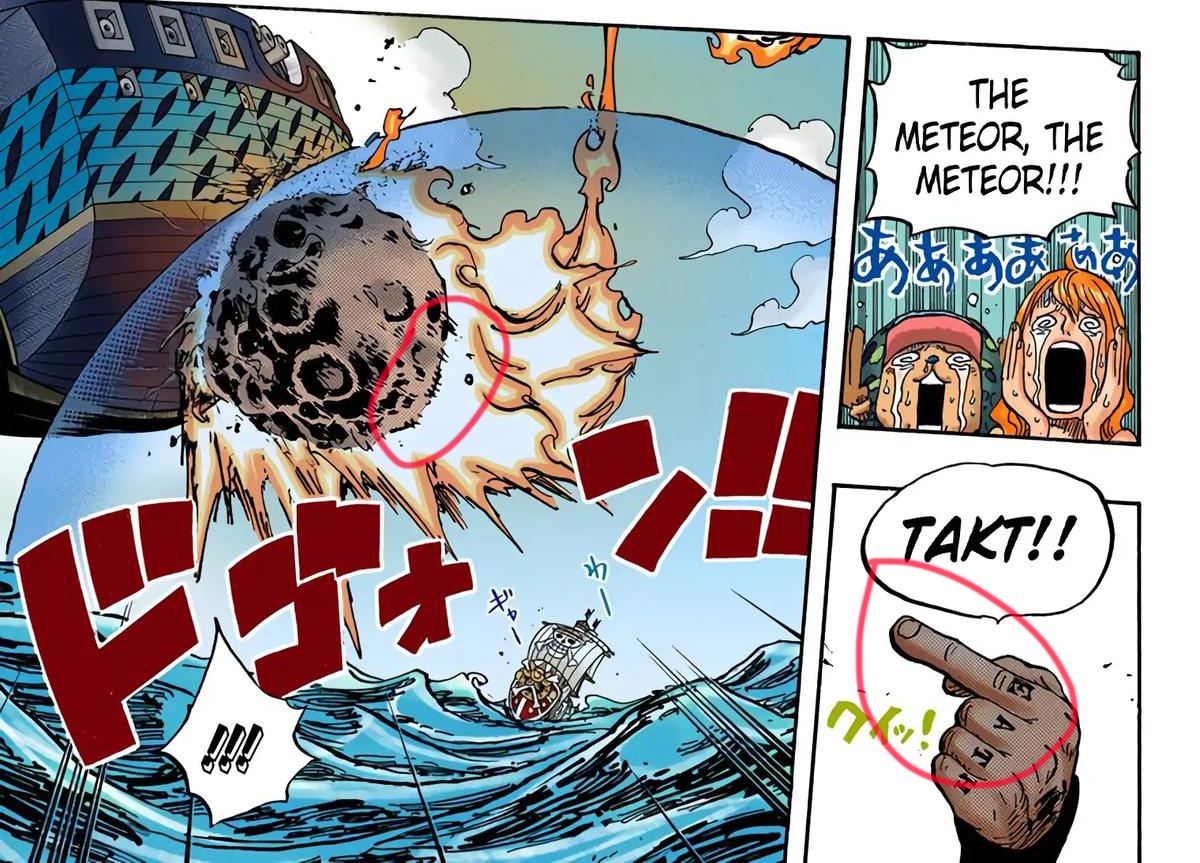
Out of curiosity, how do we currently treat the meteor that Law redirected to a navy battleship? Do we assume that it maintained or lost its kinetic energy after Law's Takt when it impacted the ship?
Seems likely that it lost KE? To me, it seems that Law pushed the meteor away in an upwards direction towards the ship instead of just at like a 90° angle. Which would cancel out a good chunk of momentum.
 
The manga literally shows where the meteors would have to stop, at the edge of the borders of ROOM (Hence the movement didn't continue)
Where do you see the meteors stopping at the edge of the ROOM on that panel?

And also, it is telekinetically moved and then stopped in the air... Until Law himself removes his ROOM, meaning the full KE movement of the meteors would've been fully operated and negated by Law's Takt
Law ever telekinetically lifted objects within his ROOM before, but I don't recall him completely negating an object's speed with it. To me it looks like Law just redirected the meteor, not that he immobilized it and then sent it moving on his own power.

Let it be known that the hull of the battleships are extraordinarily tough, so much so that even Prime Garp and Kuzan struggle to damage them.
Garp and Aokiji with no Haki involved though. Not a lot of destructive physical feats for them without Haki.
 
Law ever telekinetically lifted objects within his ROOM before, but I don't recall him completely negating an object's speed with it. To me it looks like Law just redirected the meteor, not that he immobilized it and then sent it moving on his own power.

Garp and Aokiji with no Haki involved though. Not a lot of destructive physical feats for them without Haki.
Garp pulverized several mountains without using Haki as using it wouldn't count as training according to him.
 

Thanks, appears to be an anime-only scene but does show him stopping someone falling at least. In the anime for the meteors however, Law isn't shown to stop them moving.

As for Garp pulverizing mountains (with an unknown amount of punches), it isn't directly stated that he used Haki or not but you could reasonably infer that he didn't based on his other statement.
 
Where do you see the meteors stopping at the edge of the ROOM on that panel?
Because Law can only move it within his ROOM, and we literally see it at the edge inside ROOM?
Law ever telekinetically lifted objects within his ROOM before, but I don't recall him completely negating an object's speed with it. To me it looks like Law just redirected the meteor, not that he immobilized it and then sent it moving on his own power.
the objects that are lifted are always floating in space even when he makes no movement for it, so you can't say that it didn't immobilize

Redirecting it is just not how the ability works at all, everything connected to the object itself has to be controlled and manipulated entirely
0518-04-Ope-Ope-No-Mi-Vol-1.jpg

“ROOM” allows you to freely move the positions of various objects within the space. With just a single finger, you can control even massive objects—like battleships—exactly as you wish!!

Also btw, the meteor went to the left and up, so there's no redirecting without fully stopping the original KE of it going down, even if he didn't control the full object
 
Last edited:
Because Law can only move it within his ROOM, and we literally see it at the edge inside ROOM?
What I mean is that Law could've only changed the direction that the meteor was heading; the speed isn't necessarily affected. And also if the meteor did fall completely under Law's control then why would he want to slow it down? Wouldn't it be more effective for him if he slammed it into Fujitora's ship at the full speed it had as it entered his ROOM?

And it can't have been drastically slowed down because we see meteors close outside of the ROOM too; if the first meteor had slowed down drastically than the second meteor would've long caught up to it before it hit Fujitora's ship.
 
No disrespect

Why are we talking about this?
 
What I mean is that Law could've only changed the direction that the meteor was heading; the speed isn't necessarily affected. And also if the meteor did fall completely under Law's control then why would he want to slow it down? Wouldn't it be more effective for him if he slammed it into Fujitora's ship at the full speed it had as it entered his ROOM?
1. The speed has to be affected, as it's the speed of Law moving it

2. Want to slow it down or not doesn't matter, he just stopped the meteors from falling into the Sunny... His aim is to escape not destroy the ship (if he did, however, Fujitora would've counter attacked (both for his men and himself), which wouldn't be wise)

3. More effective in what way..? Your making assumption based on character choices that has nothing to do with the facts of the ability or feat.
And it can't have been drastically slowed down because we see meteors close outside of the ROOM too; if the first meteor had slowed down drastically than the second meteor would've long caught up to it before it hit Fujitora's ship.
they seem way closer than the positions they were at in the beginning (seen with how close the flames are)
0724-014.png


Also KE would still need to be countered even if it was "redirected"
Also btw, the meteor went to the left and up, so there's no redirecting without fully stopping the original KE of it going down, even if we assume didn't control the full object
Gnaw-h.png
 
We have enough approval, so unless we want to turn the discussion on evaluate calcs and which to use, then this thread has done this purpose and can be closed.
We should probably sort out of the planet size revision before we evaluate any calcs that require the size of the planet.
 
Status
Not open for further replies.
Back
Top