• This forum is strictly intended to be used by members of the VS Battles wiki. Please only register if you have an autoconfirmed account there, as otherwise your registration will be rejected. If you have already registered once, do not do so again, and contact Antvasima if you encounter any problems.

    For instructions regarding the exact procedure to sign up to this forum, please click here.
  • We need Patreon donations for this forum to have all of its running costs financially secured.

    Community members who help us out will receive badges that give them several different benefits, including the removal of all advertisements in this forum, but donations from non-members are also extremely appreciated.

    Please click here for further information, or here to directly visit our Patreon donations page.
  • Please click here for information about a large petition to help children in need.

What kind of range would it be?

Messages
550
Reaction score
126
An universe that encompasses another universe that encompasses a 2-C/2-B structure, and a character can destroy/affect all these structures (by either AP/Haxs and all of these structures are universal in size). What kind of range would this be?

Would the range change if the universes were infinite in size, and would it change if the universe were infinitely larger/bigger than the universe encompassed?
 
if they are provable seperate space-time thats being encapsulated by a larger universe structure then clearly its just 2-C/2-B depending on how many universes there are.
 
if they are provable seperate space-time thats being encapsulated by a larger universe structure then clearly its just 2-C/2-B depending on how many universes there are.
So uhh, destroying a normal 2-C structure AND destroying a 2-C structure encompassed by 2 infinitly larger/bigger structures are the same range?
 
So uhh, destroying a normal 2-C structure AND destroying a 2-C structure encompassed by 2 infinitly larger/bigger structures are the same range?
unless they are higher dimensional, they will just be +1 universe size. like how some character destroy 12 universes and other would do 27 universes, but still 2-C, aka Low Multiversal Range.
 
unless they are higher dimensional, they will just be +1 universe size. like how some character destroy 12 universes and other would do 27 universes, but still 2-C
Not necessary a higher dimensional but I found it weird that the structure doesn't matter in the wiki.

If character 1 can destroy 2 normal universes that are finite in size and character 2 who can destroy an infinite sized universe and another universe encompassed by it that's infinitly bigger/larger shouldn't have the same range since 2 simply outrange 1, unless I misunderstand something...
 
If character 1 can destroy 2 normal universes that are finite in size and character 2 who can destroy an infinite sized universe and another universe encompassed by it that's infinitly bigger/larger shouldn't have the same range since 2 simply outrange 1, unless I misunderstand something...
things to note here is 2 normal finite universe destruction would be 3-A if time isnt in equation, otherwise if time is included, and if the character 1 destroyed 2 universe at the same time then only it is 2-C (the range of 2 universe which is incalculable due to the distance between the two universe isnt known or standardized so both needs to be destroyed in one move) Range = Universal to Low Multiversal

About Character 2, if the destruction is a nested/embeded infinite universe, it is High 3-A baremin and scales up with how many seperate space-times are embaded in the "bulk of the larger infinite universe" which you said 2-B structure, so countable finite number of embeded universal structure. Range = High Universal to Multiversal

also maybe look into this as well, might give you more insight to what you are asking and more.
 
Last edited:
I think you've misread what I said (but it's fine). To start with, all universes and structures have space-time, and the example there
If character 1 can destroy 2 normal universes that are finite in size and character 2 who can destroy an infinite sized universe and another universe encompassed by it that's infinitly bigger/larger shouldn't have the same range since 2 simply outrange 1, unless I misunderstand something...
only include 2 universes for both (2-C), it just the scale/size that's not the same : character 1 is 2 finite sized universes on the same scale and character 2 is 1 infinite sized universe within an infinitly bigger sized universe.
 
only include 2 universes for both (2-C), it just the scale/size that's not the same : character 1 is 2 finite sized universes on the same scale and character 2 is 1 infinite sized universe within an infinitly bigger sized universe.
ah yea both will be same range here, even if space is finite, time is inherently assume to be uncountable infinite, unless specifically stated in the verse that "infinity" as a concept can't be implemented in physical reality and or Time functions in intervals (like ever second, nano, pico second, very weird for a series to point that out but smth to throw it out there as a scenario) a 3-A universe with time axis would become low 2-C, a high 3-A universe with time axis will also become low 2-C. So be it nested universe structure (2-infinite Universe embeded) or just 2 seperate finite universe, both will give same range here.

if you find it weird to understand, remember vsbw has something called reality equalization. so in the end when a standard compariosn of structure, is being made, there are multiple ways to have same size structure.

your example just uses two different ways to scale to same thing.
 
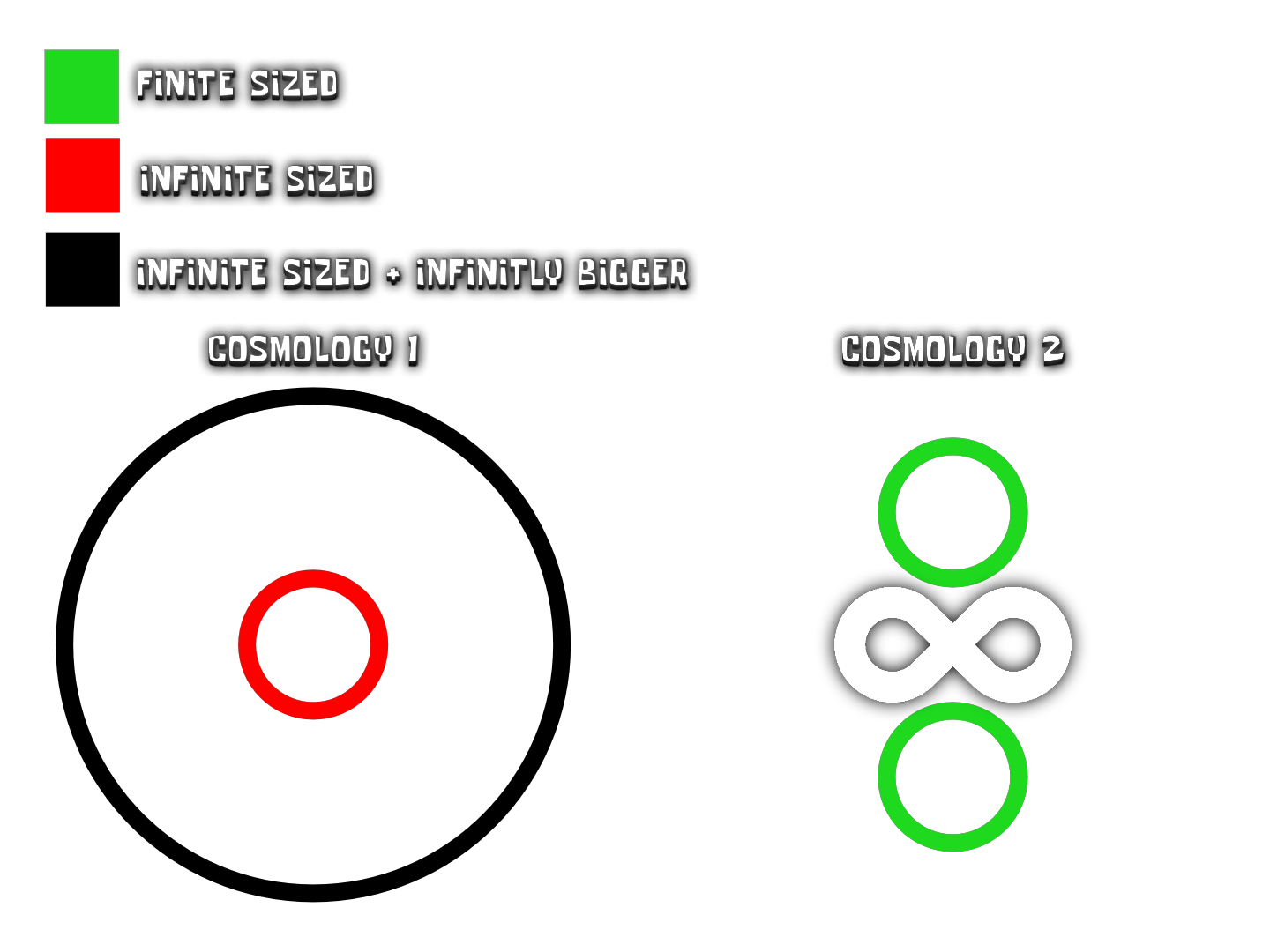
1751471542-nouveau-projet-121-12f75a7.png

I made an example for a better visual and understanding, does the range stay the same? The infinite logo stand for infinite distance between both universes. Also what does reality equalization have to do here since it doesn't go beyond tier 3 and would anything change if the distance were finite asw?
 
it will be same range of low multiversal. unless you can argue bigger infinity is actually higher dimension which i have ittierated before. or you have supporting statements infinity bigger "box" which contains infinte universe. also it could be argued that your first infinite example might be smaller range as well. check Note 6
 
I made an example for a better visual and understanding, does the range stay the same?
It would be same if they are seperate space-time
Also what does reality equalization have to do here since it doesn't go beyond tier 3 and would anything change if the distance were finite asw?
universe with finite space and time is whatever, the distance between two universes by default regardless of whatever stated in incalculable. so two seperate space times will always be 2-C be it infinite-finite, finite-finite, infinite-infinite pair of cosmology. hence when equalization for tier happens, you are not arguing for the series but how it will be treated in the wiki with all the type of pairs can happen for universes. and the reason for that is Time. i asked you before if universe here is space-time which you said it is. then think of it this way. Time is uncountable infinite, then if you destroy segements of time of a finite universe, that is still infinite many universes being destroyed as snapshots. so a 3-A finite universe can still have scales of High 3-A easily if time and in this wiki a universe is treated Low 2-C is the univerze is is atleast universal and has a time axis.
 
it will be same range of low multiversal. unless you can argue bigger infinity is actually higher dimension which i have ittierated before. or you have supporting statements infinity bigger "box" which contains infinte universe. also it could be argued that your first infinite example might be smaller range as well. check Note 6
Yeah it's both 2-C, but can't a range be bigger/more important than another one regardless? Like AP, being higher into a specific tier.
 
Yeah it's both 2-C, but can't a range be bigger/more important than another one regardless? Like AP, being higher into a specific tier.
you can do that as footnote on scale, look at sonic page with all its infinite multipliers. if you are savy enough to how thesr types of calculation would happen. personally in your case, i dont think its warented as when lets say character is traveling 2 universes on both your cosmology, if the attack is traveling the entire space time continuum of the cosmology, then it will be 2-C for both. but in your infinite universe and bigger infinite universe that is encompassing it, if the entire timeline isnt being traveled here, maybe you can do Extradimensional range, its bellow low complex but above multiversal+ (Attacks and abilities that can reach outside the conventional space-time of a single universe in a way that isn't covered by any other range ratings. Typically by being able to reach into parts of, but not the entirety of, different realms that lie outside of a standard multiverse)
 
But in your infinite universe and bigger infinite universe that is encompassing it, if the entire timeline isnt being traveled here, maybe you can do Extradimensional range, its below* low complex but above multiversal+
Wait, you can have extradimensional range with a 2-C cosmology? (Like seriously)
1751492780-nouveau-projet-122-ad9351f.png
 
Bump, I also realized that (unless I'm wrong) it's possible because if it was a 2-A structure, it would simply be Low-1C range. (Am I right?)
 
Bump, also if my message above was right : if 5 sized universes (with space-time) is within a timeless universe who's far bigger and universal in size, who's within another timeless primordial universe who's massively bigger again than the previous universe but none of them are infinite in size. Would affecting/destroying all of those places grant extradimensional range or 2-C range? If it's 2-C range, does it require infinite size for all to be extradimensional?
 
Bump, also if my message above was right : if 5 sized universes (with space-time) is within a timeless universe who's far bigger and universal in size, who's within another timeless primordial universe who's massively bigger again than the previous universe but none of them are infinite in size. Would affecting/destroying all of those places grant extradimensional range or 2-C range? If it's 2-C range, does it require infinite size for all to be extradimensional?
Isn't affecting the 5 Universes alone 2-C already
 
1751471542-nouveau-projet-121-12f75a7.png

I made an example for a better visual and understanding, does the range stay the same? The infinite logo stand for infinite distance between both universes. Also what does reality equalization have to do here since it doesn't go beyond tier 3 and would anything change if the distance were finite asw?
Where did you get this Spongebob font?
 
An universe that encompasses another universe that encompasses a 2-C/2-B structure, and a character can destroy/affect all these structures (by either AP/Haxs and all of these structures are universal in size). What kind of range would this be?

Would the range change if the universes were infinite in size, and would it change if the universe were infinitely larger/bigger than the universe encompassed?
Extradimensional: Attacks and abilities that can reach outside the conventional space-time of a single universe in a way that isn't covered by any other range ratings. Typically by being able to reach into parts of, but not the entirety of, different realms that lie outside of a standard multiverse, or by being able to reach into multiple timelines simultaneously without covering a universal distance.

And if these outer universes are straight up superior/5D it can just be Low Complex Multiversal.
 
Extradimensional: Attacks and abilities that can reach outside the conventional space-time of a single universe in a way that isn't covered by any other range ratings. Typically by being able to reach into parts of, but not the entirety of, different realms that lie outside of a standard multiverse, or by being able to reach into multiple timelines simultaneously without covering a universal distance.

And if these outer universes are straight up superior/5D it can just be Low Complex Multiversal.
I mean, it would still be extradimensional even if none of the structure is infinite in size but universal right? Also same if the universe encompassing it doesn't have time? (Like I said here)
Bump, also if my message above was right : if 5 sized universes (with space-time) is within a timeless universe who's far bigger and universal in size, who's within another timeless primordial universe who's massively bigger again than the previous universe but none of them are infinite in size. Would affecting/destroying all of those places grant extradimensional range or 2-C range? If it's 2-C range, does it require infinite size for all to be extradimensional?
And how can it be Low-1C if it doesn't have infinite 4D structures? I thought it was either having infinite 4D structures within a bigger universe to be 5D or having hypertimeline (and I'm using a 2-C structure within an universe, within another universe, like my example just above).
 
I mean, it would still be extradimensional even if none of the structure is infinite in size but universal right? Also same if the universe encompassing it doesn't have time? (Like I said here)
I think so. The contents themselves shouldn't really matter if we're talking about range as opposed to AP.
 
Back
Top