• This forum is strictly intended to be used by members of the VS Battles wiki. Please only register if you have an autoconfirmed account there, as otherwise your registration will be rejected. If you have already registered once, do not do so again, and contact Antvasima if you encounter any problems.

    For instructions regarding the exact procedure to sign up to this forum, please click here.
  • We need Patreon donations for this forum to have all of its running costs financially secured.

    Community members who help us out will receive badges that give them several different benefits, including the removal of all advertisements in this forum, but donations from non-members are also extremely appreciated.

    Please click here for further information, or here to directly visit our Patreon donations page.
  • Please click here for information about a large petition to help children in need.

Expanding the Lifting Strength page

Damage3245

He/Him
VS Battles
Administrator
Calculation Group
Messages
34,542
Reaction score
34,966
This is the current content of the Lifting Strength page:
Lifting Strength is defined as the mass that an individual can lift on Earth. In other words, it measures the amount of upward force a character can produce. As such, pushing and pulling feats are also considered part of this statistic as long as they have proper calculations to account for the difference from lifting. The weight of something pulled across a horizontal surface often needs to account for the appropriate friction coefficient after finding the mass of the object. Telekinesis or other similar abilities must be separated from physical strength when used in a lifting feat. Tearing also falls within this category, but it is unreliable for calculating overall lifting ability most of the time, as the force used in a tearing motion is much lower than a lift, as a tearing motion uses much fewer muscle groups and is an awkward application of force compared to other movements. Likewise, throwing an object a certain height upwards can be used as a lifting feat, as doing so would require greater strength than merely lifting the object.

While Striking Strength measures the energy of a character's physical attacks, Lifting Strength measures the amount of mass they can lift, which derives from the amount of force a character can produce. As such, they measure two different physical quantities. Furthermore, fiction commonly features characters capable of striking with vastly greater energy than needed to lift weights they struggle with. As such, to accommodate for fictional portrayals, our indexes don't assume that a character that can physically produce the amount of energy used in lifting an object by a certain height can also lift it if said character didn't explicitly display such lifting feats. Thus, Lifting Strength and Striking Strength are generally not comparable and should be evaluated separately.

Essentially it defines the "Lifting Strength" feats that can be rated as:
  • Lifting an object / mass with upwards force.
  • Pushing or pulling an object, with the friction of an object being accounted for when pushed/pulled across a surface.
  • Tearing an object (though this is considered less reliable than straight up lifting an object)
  • Throwing an object, which requires greater strength than merely lifting an object.
We also note that if the "Lifting Strength" feat is accomplished with means other than physical strength such as Telekinesis then it must be rated separately, and that we differentiate between Striking Strenth and Lifting Strength as they're two different physical qualities. So just because a character can punch another highly durable character and injure them doesn't mean we assume their Lifting Strength from that feat.


However there's two points of clarification that I want to raise for expanding the page if they're deemed acceptable. Where methods for Lifting Strength are used which aren't explicitly spelled out in the page.

The first is the case of a character jumping at a certain speed to get their Lifting Strength:

In the case of the character Star and Stripe from the manga My Hero Academia, it has been calculated here that she was able to dodge out of the way of an attack by jumping at 186668889.063 m/s,or 62% the speed of light, which with her official weight nets her a force of 3.6153647e+18 Newtons (Class P)

My understanding is that a character's jumping force has been considered acceptable for their lifting strength for a while though I don't think it's explicitly listed as a viable method on the page.


The second point, is in the case of a character interacting with a small amount of mass at Relativistic speeds.

Sasuke Uchiha from the manga Naruto, has been calculated here swinging his sword here to block a lightspeed attack from Mifune, with Sasuke's swing being at a speed of roughly 86% the speed of light which grants him 1.2586845e+17 Newtons (Class P).

This is being proposed as a lifting strength for Sasuke for him being able to swing a certain mass with incredible acceleration in order to block Mifune's strike. Naturally at calculated Relativistic+ speeds, any mass moving in such a quick timeframe is going to require an incredible amount of force. But does translate to Sasuke being able to lift significantly larger masses just as easily as he can swing this very light sword?


Personally, both of these examples being "Lifting Strength" under the current definition is odd to me. The reason being is that both Sasuke drawing his sword to clash with another character and Star and Stripe leaping are both quick, instantaneous actions involved very small amounts of mass. It comes across as potentially misleading to see someone has a Lifting Strength rating on par with the weight of small Moons or asteroids, when their only actual feat is jumping quickly or swinging a 3 pound sword quickly.

To me, in order for Lifting Strength to be fully separated from Striking Strength, it has to be a sustained action.

A character lifting a weight above their head, or pushing an object physically shouldn't be something done momentarily otherwise I'm pretty sure we could rate all characters with Rel+ combat speed to have Class P Lifting Strength by default just for swinging their fists.

Furthermore, fiction commonly features characters capable of striking with vastly greater energy than needed to lift weights they struggle with.

This is best exemplified in the two examples that I've given. Star and Stripe's jump is the highest "Lifting Strength" feat in the verse, and Sasuke's sword swing will be the highest Lifting Strength feat in the verse outside of the gravity-based Chibaku Tensei feats. The actual "lifting" that they or other similar characters do isn't shown to be this high.


If however these are totally fine to be rated as the sole feats for a character's Lifting Strength values, then I think our page needs updating to mention these methods alongside the other current methods.
 
I've seen similar feats to Sasuke's used to measure AP and Striking Strength. Admittedly the sword being used for that was actually very heavy.
 
Why would them being fast discredit them from being sustained action? If character is shown applying force from a state of negligible or no prior velocity at the moment of contact with the object, that'd imply sustained force application. If character shows any acceleration/significant speed before contacting object, that'll be disqualifying I think.

Edit: I do think including these examples is a good idea if we reach consensus though.
 
Last edited:
Why would them being fast discredit them from being sustained action? If character is shown applying force from a state of negligible or no prior velocity at the moment of contact with the object, that'd imply sustained force application. If character shows any acceleration/significant speed before contacting object, that'll be disqualifying I think.
This currently makes better sense to me. Thank you. 🙏
 
Yeah I agree. I'm pretty sure jumping scaling to LS requires like, a squat or a lunge showcasing your weight being acted on, and swinging needs to be actually weighty objects. Just moving fast just leads to outlierish results throughout the fandom
 
Last edited:
I was given permission to comment by Damage. (sorry I couldn't shorten it more, ig I'm a natural born yapper 💔)

I have 3 main things I'd like to say.
First, I think the idea of looking at this with "oh X can lift a mountain just because he can do this" is extremely misleading. We already know moving an object can scale massively above the objects namesake tier or GBE. And LS is no different as 99.9% of the time a feat that includes throwing or generally moving an object it is going to require force immensely above said objects mass alone. So as long as the feat is biomechanically a feat of lifting it shouldn't be ignored just because we think it seems crazy.
To put it simply, it's like making a rule against KE just because we don't like how it gives results bigger than an objects namesake tier.

Second of all, the issue of having to lift the object "over a period of time" has been addressed in a very recent staff thread, which basically ended up with the general consensus being that you can't really apply such rule. It's pretty obvious throwing a giant boulder or swinging a sword the size of a building are blatantly feats of lifting strength and are intended as such, and them being performed over a short period should make them more impressive, not less, as that means higher velocity.
Would you say me bicep curling a 30kg dumbbell is not a lifting strength feat because I'm so strong I did it in half a second, but it is a feat for someone weaker than me struggling to slowly curl it over the period of 10 seconds? That doesn't really make sense neither from a perspective of physics nor biology, and it's not something that only powerscalers would understand. It's a fact all humans experience on daily basis.

And lastly, while it may be tempting to create a rule that requires the feat to be performed on an object with "high mass", that will inevitably end up creating caps that draw a completely arbitrary line with no actual logic behind it. It'd create a situation where character A could throw an object at relativistic speeds and it wouldn't scale anywhere, but character B would throw an object 10x bigger at subsonic speeds and somehow end up scaling millions of times higher. Even tho from the perspective of actual physics, character A is actually the one performing a feat millions of times stronger. To give an example that's pretty common, throwing a human on to the surface of the moon would be somehow several times less impressive than what an average irl bodybuilder can bench.

I agree the idea that any rel+ character should be class T/P is a little silly and I don't really even care about the Sasuke calc (I originally thought of it for a joke), but I think it's much better and more logical to approach this on a case by case basis rather than trying to make a rule that covers such a wide range of different feats and risk the consequences of getting it wrong.
 
Well yeah I don't think anyone agrees with adding a timeframe or anything like that to LS feats I said as much in the thread you linked so that part of this thread I don't agree with but if we're just talking about the specifc two feats mentioned I gave my thought above
 
So has this thread been rejected, or can we make any constructive revisions based on it? 🙏
 
So has this thread been rejected, or can we make any constructive revisions based on it? 🙏
Most staff that have commented so far appear to think that the issues I mentioned in the OP are proper issues. Namely Dalesean's comment that jumping should only count as lifting strength under specific conditions, and the sword swing being an issue, with KT and ElJoaki5 agreeing with that.
 
Okay. I apologise for misremembering your intended points then. 🙏
 
Namely Dalesean's comment that jumping should only count as lifting strength under specific conditions
Speaking of this, I did go back and look at the S&S jump feat and she does do a kind of squat leaning into the lunge of her jump which actually make it fine under our standards, had she jumped just like kicking up with no real form showing there's skme level of force being applied or prepared to make the jump then it wouldn't count so right now my issued just lies with the sasuke calc
 
Speaking of this, I did go back and look at the S&S jump feat and she does do a kind of squat leaning into the lunge of her jump which actually make it fine under our standards, had she jumped just like kicking up with no real form showing there's skme level of force being applied or prepared to make the jump then it wouldn't count so right now my issued just lies with the sasuke calc
Just a thought but wouldn't there be an equal and opposite reaction for her jump applied to the jet that she leaped off of?

If she, with her 93.1 kg of mass were leaping upwards at 62% the speed of light, the fighter jet (if it massed for example 20,000 kg) should be launched downward at the same time at roughly Mach 3207, or approximately 1,100 kilometers per second.

Which doesn't seem to be what happens in the actual scene.
 
Just a thought but wouldn't there be an equal and opposite reaction for her jump applied to the jet that she leaped off of?

If she, with her 93.1 kg of mass were leaping upwards at 62% the speed of light, the fighter jet (if it massed for example 20,000 kg) should be launched downward at the same time at roughly Mach 3207, or approximately 1,100 kilometers per second.

Which doesn't seem to be what happens in the actual scene.

This is true, its a weird one but yeah its better to fit all criteria or stuff for LS than just form alone
 
I do have a ginormous gripe with using certain feats for lifting strength because people can move at hypersonic speeds and shit but they can't even bench press a car. It doesn't make logical sense.

But I'll play along if it works with the wiki.

Shit like swinging light objects super fast based on calcs in order to produce yields strong enough to bench press the earth's atmosphere, I disagree there. Hell no.
 
I do have a ginormous gripe with using certain feats for lifting strength because people can move at hypersonic speeds and shit but they can't even bench press a car. It doesn't make logical sense.

But I'll play along if it works with the wiki.

Shit like swinging light objects super fast based on calcs in order to produce yields strong enough to bench press the earth's atmosphere, I disagree there. Hell no.
Those don't meet out standards anyways, just swinging a sword fast doesn't equate to LS unless its some super large sword
 
Speaking of this, I did go back and look at the S&S jump feat and she does do a kind of squat leaning into the lunge of her jump which actually make it fine under our standards, had she jumped just like kicking up with no real form showing there's skme level of force being applied or prepared to make the jump then it wouldn't count so right now my issued just lies with the sasuke calc
my bad, question

is it possible to jump without a squat???
 
Those don't meet out standards anyways, just swinging a sword fast doesn't equate to LS unless its some super large sword
I don't think it's mentioned anywhere? This thread is literally to decide one if I'm not misunderstanding anything. Closest thing I can think of is a rule for KE/AP, not LS. Even if we don't assume that carried object has destructive power corresponding to movement speed, we still assume it moves at that speed, which should be enough for the use of LS. We're just bothered with acceleration that is being able to applied to object, regardless of if we assume said object has such AP or not.

Honestly, I currently disagree with proposal. For example let's say 2 characters perform same movement, same force on objects with same mass. First one keeps carrying it until the end to swing while second one uses same thing for throwing. I find it weird how we won't count first feat while counting second feat. Only difference is that one releases the object in the end while the other stops it.

I also don't find "moving fists as LS" argument convincing either because we simply don't index LS like that, character's own body isn't included, we're just accounting for objects. Obviously we won't assign different LS values for 2 people that lift same weight just because they themselves weight different for example, despite character with more mass needing to move same parts of the body but with greater mass. (probably a weird example but anyway)

I mean evaluating it case by case is better imo. Like sure if it's outlier or has any anti feats you'll just treat it as any other outlier. But generally saying you can't use LS without some minimal mass seems just as arbitrary as any minimum timeframe to me.

So it's more like saying "if character can accelerate 10 kg at 98.1 m/s^2 then it doesn't mean he can accelerate 100 kg at 9.81 m/s^2 (so basically being able to lift 100kg)" while he literally should as that's what force he's literally applying to the object unless there's any counter evidence of inconsistencies as I mentioned earlier.

This thread will prob get accepted anyway but I just wanted to share my thoughts on this.

As for other arguments for specific calcs in the OP (jumping from jet, lack of supporting feats, etc.) I think that they make sense.
 
I don't think it's mentioned anywhere? This thread is literally to decide one if I'm not misunderstanding anything. Closest thing I can think of is a rule for KE/AP, not LS. Even if we don't assume that carried object has destructive power corresponding to movement speed, we still assume it moves at that speed, which should be enough for the use of LS. We're just bothered with acceleration that is being able to applied to object, regardless of if we assume said object has such AP or not.

Honestly, I currently disagree with proposal. For example let's say 2 characters perform same movement, same force on objects with same mass. First one keeps carrying it until the end to swing while second one uses same thing for throwing. I find it weird how we won't count first feat while counting second feat. Only difference is that one releases the object in the end while the other stops it.

I also don't find "moving fists as LS" argument convincing either because we simply don't index LS like that, character's own body isn't included, we're just accounting for objects. Obviously we won't assign different LS values for 2 people that lift same weight just because they themselves weight different for example, despite character with more mass needing to move same parts of the body but with greater mass. (probably a weird example but anyway)

I mean evaluating it case by case is better imo. Like sure if it's outlier or has any anti feats you'll just treat it as any other outlier. But generally saying you can't use LS without some minimal mass seems just as arbitrary as any minimum timeframe to me.

So it's more like saying "if character can accelerate 10 kg at 98.1 m/s^2 then it doesn't mean he can accelerate 100 kg at 9.81 m/s^2 (so basically being able to lift 100kg)" while he literally should as that's what force he's literally applying to the object unless there's any counter evidence of inconsistencies as I mentioned earlier.

This thread will prob get accepted anyway but I just wanted to share my thoughts on this.

As for other arguments for specific calcs in the OP (jumping from jet, lack of supporting feats, etc.) I think that they make sense.
This is almost never the case and like the exact opposite of our standards?

Kinetic Energy based on Movement Speed is case by case: Fiction often treats the speed with which a character can move himself as unrelated to their attack power. As such feats like just running or carrying a small object, like another character, should only be used if the fiction has made clear that the speed of the movement correlates to the character's power or if the character uses the fast moving object to attack. Calculating the energy necessary for moving large structures at great speeds, using the speed things move as a secondary effect of an attack, throwing objects at great speeds etc. are all acceptable methods of quantifying a characters power regardless

Just moving around or fighting while holding something like a knife or sword or bat doesn't qualify to be used as LS in calcs as per our standards as it falls undee the same umbrella as the KE standards for this kind of thing as well unless there some specifc circumstance or narrative to support something like that in the specifc work
 
This is almost never the case and like the exact opposite of our standards?

Kinetic Energy based on Movement Speed is case by case: Fiction often treats the speed with which a character can move himself as unrelated to their attack power. As such feats like just running or carrying a small object, like another character, should only be used if the fiction has made clear that the speed of the movement correlates to the character's power or if the character uses the fast moving object to attack. Calculating the energy necessary for moving large structures at great speeds, using the speed things move as a secondary effect of an attack, throwing objects at great speeds etc. are all acceptable methods of quantifying a characters power regardless

Just moving around or fighting while holding something like a knife or sword or bat doesn't qualify to be used as LS in calcs as per our standards as it falls undee the same umbrella as the KE standards for this kind of thing as well unless there some specifc circumstance or narrative to support something like that in the specifc work
Excuse me, what? You're saying it shouldn't be LS and quote page saying we shouldn't use it for KE. The page doesn't say anything like that for LS.
Even if we don't assume that carried object has destructive power corresponding to movement speed, we still assume it moves at that speed, which should be enough for the use of LS. We're just bothered with acceleration that is being able to applied to object, regardless of if we assume said object has such AP or not.
 
But the Lifting Strength is derived from the K.E., isn't it?
Not for this case at least. You're just:
-finding LS from speed&mass
-finding KE from speed&mass

If using KE is considered invalid, I don't see how it makes using LS invalid.
We follow the same standards of that page regarding our LS policies as well
That doesn't change the fact that we don't have a clearly defined rule for that (at least I haven't been provided by one).
 
That doesn't change the fact that we don't have a clearly defined rule for that (at least I haven't been provided by one).
they'll need to officially write it out I suppose but this is something that has always been the case and treated as such so apologies if ya didn't know but yeah ig by our non verbal standards this is something that we have for a good time now have always had against our standards

Its why ya don't have your random rel characters like swordmen like Class P just because they have swords and can fight fast. we have rules against that kinda thing but ig they weren't formally written in full
 
I mean yeah not being formally written is quite unreliable long-term. Though my stance still remains the same.
I'm mech less inclined for that and say we should hold the same standards as there's lots of ways to get LS in much more valid ways, you also have to be careful with it and only do what isn't contraidicted or what is actually intended to be a feat of strength in the first place so something like just having good combat speeds shouldn't really qualify to all of a sudden make someone have busted LS, heck even if they had LS feats in that range I'd still be weary of that method of doing things that way personally but that's just how I see it🤷‍♂️


Edit: reminder to all reading we have to still update our pages regardless of the thread's conclusions since we have unwritten verbal standards that haven't made their way to pages
 
Last edited:
Not for this case at least. You're just:
-finding LS from speed&mass
-finding KE from speed&mass

If using KE is considered invalid, I don't see how it makes using LS invalid.
Got permission from damage

But isnt that what the calc did? Finding the constant force to be applied based on the "relativistic kinetic energy corresponding to average speed" (talking about the 2nd calc, where you attack with an object)

- which again, doesn't work either because what we know are the distance moved and time taken, not "the final speed"; its actual Relativistic KE and corresponding lifting strength would be well beyond whatever was calculated above.

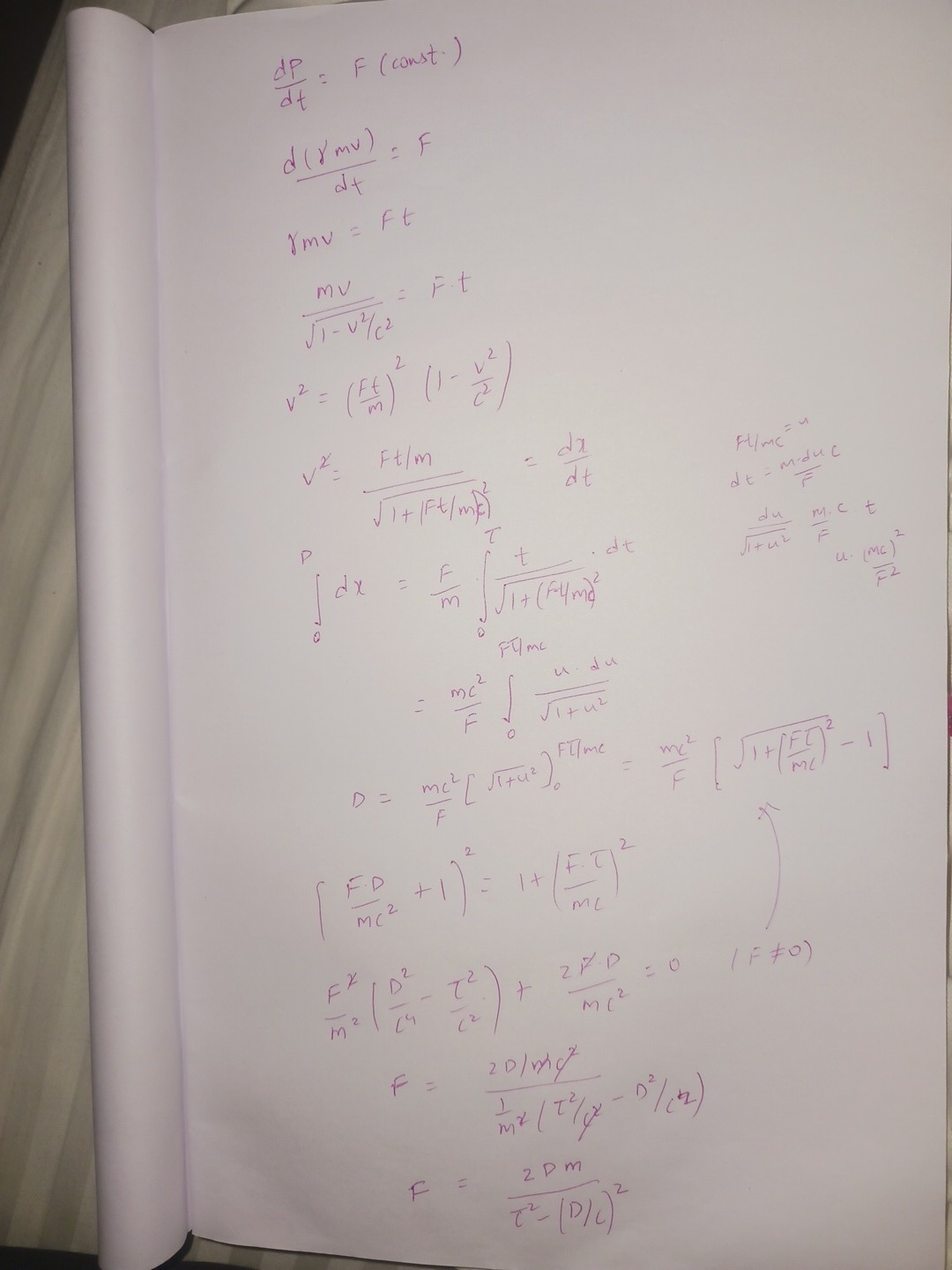
Well, the exact relation is F=2Dmc^2/((cT)^2-D^2) for distance D moved in time T in 1-D by constant force, and V_max=2TDc^2/((cT)^2+D^2)
9ddbb3eacec7395b2d99c1c63ba3bfa0.jpg

(TAU IS NOT PROPER TIME ITS JUST T, BAD LABELING)
(substituting F in V.
F=2Dmc^2/((cT)^2-D^2), v=2TDc^2/((cT)^2-D^2)/sqrt(1+(2DTc/((cT)^2-D^2)))^2), v=2TDc^2/sqrt(((cT)^2-D^2)^2+(2DTc)^2), v=2TDc^2/((cT)^2+D^2))

And honestly you'd once again, observe the same relation between RKE and LS once you rearrange. Find gamma from V_max and then (Gamma-1)*mc^2 you should end up with F*D (since F is constant)

If KE doesn't work LS shouldn't work due to the relation between these two under our set of assumptions. Basically, we aren't calculating each of them independently known "V" and "M" (we should be doing it with known "D", "T", "M"); and even if we calculate independently the relation remains due to constant force assumption

Or you can also write F=dP/dt, P=gamma*m*v and dP/dv = m*gamma + (gamma^3)m(v/c)^2 = m*gamma*(1+gamma^2*(v/c)^2) and (v/c)^2 = 1-(1/gamma)^2, so = m*gamma*(1+gamma^2-1) =m*gamma^3; let's just write F=dP/dv*dv/dt, F=m*gamma^3*dv/dt and that's F=m*gamma^3*v*dv/dx;

while KE = (gamma-1)*mc^2, with dK/dx=mc^2*d(gamma)/dx =mc^2*d(gamma)/dv*dv/dx = mc^2*gamma^3*v/c^2*dv/dx = M*gamma^3*v*dv/dx = F (self-evident)

Edit: thanks for letting me comment, I'll go sleep

Edit-2: basically, if you are are acknowledging lifting strength, you are acknowledging the Force acting over the said distance D, and subsequently you should be acknowledging the Work done by this force and thus the KE
 
Last edited:
Got permission from damage

But isnt that what the calc did? Finding the constant force to be applied based on the "relativistic kinetic energy corresponding to average speed" (talking about the 2nd calc, where you attack with an object)

- which again, doesn't work either because what we know are the distance moved and time taken, not "the final speed"; its actual Relativistic KE and corresponding lifting strength would be well beyond whatever was calculated above.

Well, the exact relation is F=2Dmc^2/((cT)^2-D^2) for distance D moved in time T in 1-D by constant force, and V_max=2TDc^2/((cT)^2+D^2)
9ddbb3eacec7395b2d99c1c63ba3bfa0.jpg

(TAU IS NOT PROPER TIME ITS JUST T, BAD LABELING)
(substituting F in V.
F=2Dmc^2/((cT)^2-D^2), v=2TDc^2/((cT)^2-D^2)/sqrt(1+(2DTc/((cT)^2-D^2)))^2), v=2TDc^2/sqrt(((cT)^2-D^2)^2+(2DTc)^2), v=2TDc^2/((cT)^2+D^2))

And honestly you'd once again, observe the same relation between RKE and LS once you rearrange. Find gamma from V_max and then (Gamma-1)*mc^2 you should end up with F*D (since F is constant)

If KE doesn't work LS shouldn't work due to the relation between these two under our set of assumptions. Basically, we aren't calculating each of them independently known "V" and "M" (we should be doing it with known "D", "T", "M"); and even if we calculate independently the relation remains due to constant force assumption

Or you can also write F=dP/dt, P=gamma*m*v and dP/dv = m*gamma + (gamma^3)m(v/c)^2 = m*gamma*(1+gamma^2*(v/c)^2) and (v/c)^2 = 1-(1/gamma)^2, so = m*gamma*(1+gamma^2-1) =m*gamma^3; let's just write F=dP/dv*dv/dt, F=m*gamma^3*dv/dt and that's F=m*gamma^3*v*dv/dx;

while KE = (gamma-1)*mc^2, with dK/dx=mc^2*d(gamma)/dx =mc^2*d(gamma)/dv*dv/dx = mc^2*gamma^3*v/c^2*dv/dx = M*gamma^3*v*dv/dx = F (self-evident)

Edit: thanks for letting me comment, I'll go sleep

Edit-2: basically, if you are are acknowledging lifting strength, you are acknowledging the Force acting over the said distance D, and subsequently you should be acknowledging the Work done by this force and thus the KE
You're right that calc uses average speed, it's a lowball. If we're going to be more accurate we'll get around 7.5e17 N and 0.99c and if we solve for known distance, time and mass we'll get same result as work/distance anyway so I don't get argument of LS depending on solely KE just because we calculated it that way. Obviously relation exists but it doesn't matter as we simply seperate LS from AP. Otherwise you'll as well argue with speed value that feat isn't relativistic because we deny KE corresponding to that speed.
As such, to accommodate for fictional portrayals, our indexes don't assume that a character that can physically produce the amount of energy used in lifting an object by a certain height can also lift it if said character didn't explicitly display such lifting feats. Thus, Lifting Strength and Striking Strength are generally not comparable and should be evaluated separately.
 
You're right that calc uses average speed, it's a lowball. If we're going to be more accurate we'll get around 7.5e17 N and 0.99c and if we solve for known distance, time and mass we'll get same result as work/distance anyway so I don't get argument of LS depending on solely KE just because we calculated it that way. Obviously relation exists but it doesn't matter as we simply seperate LS from AP. Otherwise you'll as well argue with speed value that feat isn't relativistic because we deny KE corresponding to that speed.
How I look at it is, we think of speed as a "given" (of sorts), and judge whether or not we accept associated kinetic energy from it, which we don't in this kind of feat (due to how super common in fiction merely the act of reacting to and blocking "light" is, despite the impossibility, and doesn't translate to the portrayed power and narrative consistency most of the times)

Similarly idt force feats are that distinct at all from kinetic energy feats when it comes to the reasons why these are judged with scrutiny

Whenever kinetic energy for moving object like this is acceptable, lets say due to the explicit description of implications of moving it at the said speed, l would also tend to agree that it should be applicable for lifting strength

But otherwise I think we are ignoring the reason why KE for feats like this is rejected when we accept lifting

(Edit: As for the values you mentioned yeah you're right, I too mentioned almost exact same ones before in the other thread as well, just that I don't think it should be indexed)
 
Last edited:
I'll update the OP for this tomorrow with some new thoughts I've had on other Lifting Strength feats currently in use, and some proposals for what we could do.


EDIT: A bit delayed on this, but working on it.
 
Last edited:
Back
Top