- 1,048
- 1,121
As far as I know, we don't have a method for calculating omnidirectional feats when speed is relativistic. I've seen it being calculated as being same fraction as classical KE formula (like calculating relativistic KE and dividing it by 2 or 6), but it isn't correct, as KE isn't quadratic with speed here, so distribution will be different from how those derived 1/4 or 1/12 treat it.
Difference becomes larger as speed is closer to c (method mentioned above gets higher results than actual), as for these omnidirectional feats, rise of KE isn't that big with speed approaching c compared to normal rel KE because most of its speed is significantly lower than c.
I'll also add versions for sphere shape (omnidirectional 3D wise). Almost the same, just for taking parts that have same speed we use 4πr²ρ instead of 2πrHρ. Even if not clouds I'm sure there'll be some feats like that with air.
Alternatively, I hope maybe someone could make calculator for these.
Edit:
Accounting for length contraction was proposed by DT so I'll write here new versions. All of them have just additional γ(r) in formula. Everything else is the same as above.
Case 1:
2πϱHc² ∫₀ᴿ (1/(1 - V² r²/(R² c²)) - 1/√(1 - V² r²/(R² c²))) r dr
Case 2:
2πρHc² ∫₀ᴿ (1/(1 - (V²/c²)(1 - r/R)²) - 1/√(1 - (V²/c²)(1 - r/R)²)) r dr
Case 1 for sphere:
4πρc² ∫₀ᴿ (1/(1 - V² r²/(c² R²)) - 1/√(1 - V² r²/(c² R²))) r² dr
Case 2 for sphere:
4πρc² ∫₀ᴿ (1/(1 - (V²/c²)(1 - r/R)²) - 1/√(1 - (V²/c²)(1 - r/R)²)) r² dr
Agree: @DontTalkDT (new version) @Dalesean027 (new version)
Disagree:
Neutral:
Difference becomes larger as speed is closer to c (method mentioned above gets higher results than actual), as for these omnidirectional feats, rise of KE isn't that big with speed approaching c compared to normal rel KE because most of its speed is significantly lower than c.
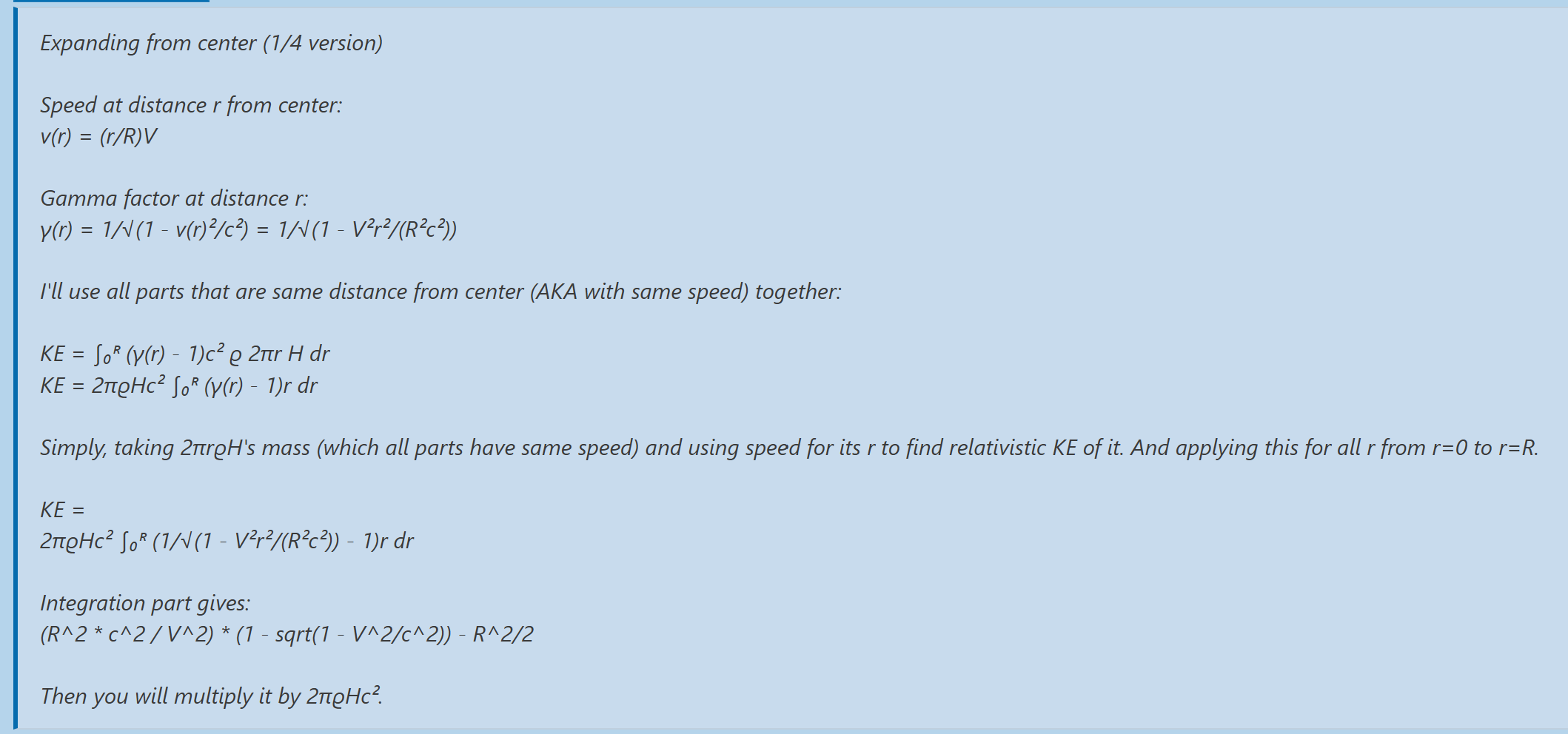
Expanding from center (1/4 version)
Speed at distance r from center:
v(r) = (r/R)V
Gamma factor at distance r:
γ(r) = 1/√(1 - v(r)²/c²) = 1/√(1 - V²r²/(R²c²))
I'll use all parts that are same distance from center (AKA with same speed) together:
KE = ∫₀ᴿ (γ(r) - 1)c² ϱ 2πr H dr
KE = 2πϱHc² ∫₀ᴿ (γ(r) - 1)r dr
Simply, taking 2πrϱH's mass (which all parts have same speed) and using speed for its r to find relativistic KE of it. And applying this for all r from r=0 to r=R.
KE =
2πϱHc² ∫₀ᴿ (1/√(1 - V²r²/(R²c²)) - 1)r dr
Integration part gives:
(R^2 * c^2 / V^2) * (1 - sqrt(1 - V^2/c^2)) - R^2/2
Then you will multiply it by 2πϱHc².
Speed at distance r from center:
v(r) = (r/R)V
Gamma factor at distance r:
γ(r) = 1/√(1 - v(r)²/c²) = 1/√(1 - V²r²/(R²c²))
I'll use all parts that are same distance from center (AKA with same speed) together:
KE = ∫₀ᴿ (γ(r) - 1)c² ϱ 2πr H dr
KE = 2πϱHc² ∫₀ᴿ (γ(r) - 1)r dr
Simply, taking 2πrϱH's mass (which all parts have same speed) and using speed for its r to find relativistic KE of it. And applying this for all r from r=0 to r=R.
KE =
2πϱHc² ∫₀ᴿ (1/√(1 - V²r²/(R²c²)) - 1)r dr
Integration part gives:
(R^2 * c^2 / V^2) * (1 - sqrt(1 - V^2/c^2)) - R^2/2
Then you will multiply it by 2πϱHc².
Dispersing them from center (1/12 version)
Same as Case 1, just here:
v(r) = V(1-r/R)
So formula becomes:
KE =
2πρHc² ∫₀ᴿ (1/√(1 - (V²/c²)(1 - r/R)²) - 1) r dr
Integration gives:
R^2 * ((c * arcsin(V/c)) / V + (c^2 * (1 - sqrt(1 - V^2/c^2))) / V^2 - 1/2 )
Then you will multiply by 2πϱHc².
Same as Case 1, just here:
v(r) = V(1-r/R)
So formula becomes:
KE =
2πρHc² ∫₀ᴿ (1/√(1 - (V²/c²)(1 - r/R)²) - 1) r dr
Integration gives:
R^2 * ((c * arcsin(V/c)) / V + (c^2 * (1 - sqrt(1 - V^2/c^2))) / V^2 - 1/2 )
Then you will multiply by 2πϱHc².
I'll also add versions for sphere shape (omnidirectional 3D wise). Almost the same, just for taking parts that have same speed we use 4πr²ρ instead of 2πrHρ. Even if not clouds I'm sure there'll be some feats like that with air.
Expanding case
if v<<c use:
Newtonian = ∫₀ᴿ 0.5 * 4 * π * r^2 * ρ * (v * r / R)^2 dr = 2 * π * ρ * v^2 / R^2 * ∫₀ᴿ r^4 dr = 2 * π * ρ * v^2 / R^2 * R^5/5 = 3/10 mv^2
(since ρ = 3m/4πR^3)
Relativistic KE =
4πρc² ∫₀ᴿ (1/√(1 - V²r²/(c²R²)) - 1) r² dr
Integration part:
(R^3 * c^3 / V^3) * [ (1/2)arcsin(V/c) - (V/(2c))√(1 - V^2/c^2) - (V^3)/(3c^3) ]
Then multiply by 4πρc².
if v<<c use:
Newtonian = ∫₀ᴿ 0.5 * 4 * π * r^2 * ρ * (v * r / R)^2 dr = 2 * π * ρ * v^2 / R^2 * ∫₀ᴿ r^4 dr = 2 * π * ρ * v^2 / R^2 * R^5/5 = 3/10 mv^2
(since ρ = 3m/4πR^3)
Relativistic KE =
4πρc² ∫₀ᴿ (1/√(1 - V²r²/(c²R²)) - 1) r² dr
Integration part:
(R^3 * c^3 / V^3) * [ (1/2)arcsin(V/c) - (V/(2c))√(1 - V^2/c^2) - (V^3)/(3c^3) ]
Then multiply by 4πρc².
Dispersing from center case
if v<<c use:
Newtonian = ∫₀ᴿ 0.5 * 4 * π * r^2 * ρ * (v * (1 - r / R))^2 dr = 2 * π * ρ * v^2 * ∫₀ᴿ r^2(1 - r / R)^2 dr = 2 * π * ρ * v^2 * R^3/30 = 1/20 mv^2
Relativistic KE =
4πρc² ∫₀ᴿ (1/√(1 - (V²/c²)(1 - r/R)²) - 1) r² dr
Integration part:
R^3 * ( (c / V) * [ arcsin(V / c) - 2 * (c / V) * (1 - sqrt(1 - V^2 / c^2)) + (c^2 / V^2) * (0.5 * arcsin(V / c) - (V / (2 * c)) * sqrt(1 - V^2 / c^2)) ] - 1/3)
Then multiply by 4πρc².
if v<<c use:
Newtonian = ∫₀ᴿ 0.5 * 4 * π * r^2 * ρ * (v * (1 - r / R))^2 dr = 2 * π * ρ * v^2 * ∫₀ᴿ r^2(1 - r / R)^2 dr = 2 * π * ρ * v^2 * R^3/30 = 1/20 mv^2
Relativistic KE =
4πρc² ∫₀ᴿ (1/√(1 - (V²/c²)(1 - r/R)²) - 1) r² dr
Integration part:
R^3 * ( (c / V) * [ arcsin(V / c) - 2 * (c / V) * (1 - sqrt(1 - V^2 / c^2)) + (c^2 / V^2) * (0.5 * arcsin(V / c) - (V / (2 * c)) * sqrt(1 - V^2 / c^2)) ] - 1/3)
Then multiply by 4πρc².
Edit:
Accounting for length contraction was proposed by DT so I'll write here new versions. All of them have just additional γ(r) in formula. Everything else is the same as above.
Case 1:
2πϱHc² ∫₀ᴿ (1/(1 - V² r²/(R² c²)) - 1/√(1 - V² r²/(R² c²))) r dr
Case 2:
2πρHc² ∫₀ᴿ (1/(1 - (V²/c²)(1 - r/R)²) - 1/√(1 - (V²/c²)(1 - r/R)²)) r dr
Case 1 for sphere:
4πρc² ∫₀ᴿ (1/(1 - V² r²/(c² R²)) - 1/√(1 - V² r²/(c² R²))) r² dr
Case 2 for sphere:
4πρc² ∫₀ᴿ (1/(1 - (V²/c²)(1 - r/R)²) - 1/√(1 - (V²/c²)(1 - r/R)²)) r² dr
Agree: @DontTalkDT (new version) @Dalesean027 (new version)
Disagree:
Neutral:
Last edited: