1.) A 3 dimensional sphere is composed of an uncountable infinity of 2D circles. T/F?
True.
Are higher-dimensional beings infinitely larger than lower-dimensional equivalents?
In a way, yes, though not how most would think when using this word. Basically, an arbitrary object of dimension n is essentially comprised by the total sum of uncountably infinite objects of one dimension less, which may be described as lower-dimensional "slices", each corresponding to one of the infinite points of a line. For instance, a square is made of infinitely many line segments (Lined up on the y-axis), a cube of infinitely many squares (Lined up on the z-axis), and so on.
One may think of it as a multiplication between sets: For instance, the unit square [0,1]² may be expressed as the product of two unit intervals [0,1] x [0,1], which itself can be visualized as taking "copies" of the first interval and lining them up along each point of the second interval, of which there are uncountably infinitely-many, thus forming a square out of infinite line segments.
2.) The space that separates universes is called a "bulk space", and has 4 spacial dimensions because the space-times within it do not intersect or interact. T/F?
True.
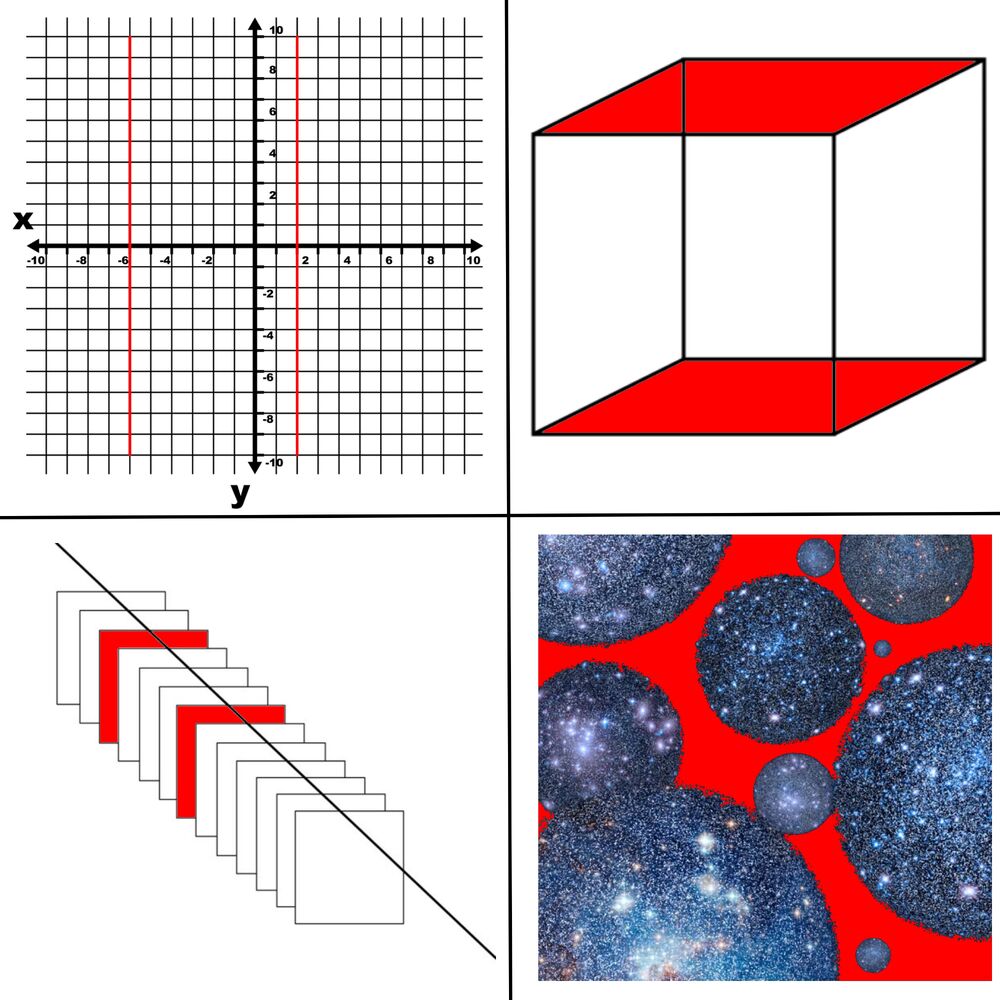
In geometry, Euclid's 5th postulate declares: "Given a line and a point not on that line, there is exactly one line parallel to the given line that passes through the given point." Parallelism is a characteristic of dimensional objects on a single plane where they can extend in all directions endlessly without ever intersecting. Lines are 1-dimensional objects, yet they require 2-dimensional space to exist in parallel. In a 1-dimensional space, there is no concept of parallel lines. In such a constrained coordinate space, every line is destined to overlap or coincide with any other line it encounters. By introducing a second dimension and extra direction of freedom, any points outside a single line can be extended in equidistance with no intersection. This idea can be generalized to describe the consistency of parallelism between all similarly dimensioned entities on a single plane. Let's visualize it.
As explained before, the two 1-dimensional objects (lines) require 2-dimensional space to exist in parallel. By extrapolating that reasoning, 2-dimensional objects (planes) require 3-dimensional space to exist in parallel. In the third diagram, we have a space-time continuum depicted as a line composed of endless static representations of 3-dimensional space extending to encompass past, present, and future states of a universe. Under this model, 3-dimensional spaces could exist in parallel, non-intersecting states when displaced across different time periods. This logic would work even under a space-like 4th dimension. And finally, 4-dimensional space-times would have to be displaced across a 5th dimension to maintain their non-intersectionality. Space-time is a model used in general relativity to define objects in 3 dimensions of space and 1 of time. When space-times exist in parallel, any object defined in the space of past/present/future must be confined to a single 4-dimensional plane, even if a universe is infinite in time and space.
3.) In a set of real numbers, 1, and 2 contain an uncountable infinity of decimals between them. T/F?
True.
A real number is a quantity that can represent any position along a continuous number line. It includes both rational numbers, which can be expressed as fractions, and irrational numbers, which cannot be expressed as fractions and have non-repeating, non-terminating decimal expansions. The distance between one and two can indeed represent a continuous number line comprising rational and irrational numbers, making it a set of real numbers. The cardinality (number of elements) of the set of real numbers is uncountably infinite.
4.) I remember seeing people type out (R^5) or (R^R^R^R^R) for things. What does that mean?
ℝ is a symbol denoting a set of real numbers. Those expressions are cartesian products. In set theory, the Cartesian product is a mathematical operation that combines the elements of two sets to create a new set. For example, if A={1,2} and B={x,y}, then A*B={(1,x), (1,y), (2,x), (2,y)}.
Constructing higher dimensional objects that qualify as "higher levels of infinity" requires cartesian products between continuous sets with uncountably infinitely many elements. For instance, Rx(RxRxR) could represent Time*Space; a
Low 2-C space-time continuum. [1,2,3,4,...,12]x(RxRxR)xR could represent a multiverse with 12 space-time continuums; 12 five-dimensional positions occupied by space-time continuums. The aforementioned cartesian product is not tier 1 because the 5th set is countable and not continuous. R^9 could represent a
High 1-C object.
5.) So let's say a character is able to destroy an object/structure that was explicitly stated to be higher dimensional, but of finite size. What tier would the character be? Would it be any different if this higher dimensional thing were stated to be infinite in size instead?
You don't need hyper-specific terminology like "higher dimensions are uncountably infinitely larger than lower ones," higher dimensions can be finite but still qualify as higher levels of infinity as long as they view lower dimensions as quantitatively inferior. For instance, if we were told that from the perspective of a space containing 12 universes, that said timelines are
infinitesimal in size or view space-time as having
zero mass/size/volume, such a space would be Low 1-C. Higher dimensions having
infinite extent along distinct axes would also qualify higher dimensions for higher levels of infinity. You need to be careful about instances where a hyperspace containing a multiverse is described as infinite though; time is infinite by default, so you'd need proof that such a hyperspace is infinite on a higher dimensional level (rather than infinite on a 4-D level).
Space being infinite in itself doesn't matter, as space at that level is infinite in some sense anyway. You would need to be told that either specifically its 5 dimensional volume is infinite or that specifically the 5th dimensional axis (the one you add to the standard timelines) is infinite (or very large) for that to work. But I figure if you have information that specific then you wouldn't need this thread. In general, infinite could mean infinite by 3D or 4D standards, or in the sense of countably infinite times larger than a spacetime continuum, so that is just not enough.