If you have anymore evidence and arguments, then you'll have to post them all here, I'm not sure linking to other boards is the best way to this.
And you'll probably need more concrete evidence to indicate that Supreme and Invincible are the same continuity.
However, I will post everything I have now.
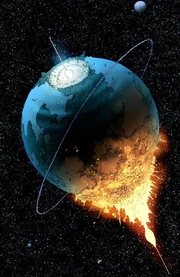 Viltrum is atleast 11x the size of earth, judging from the 4 moons and ring of solid mass around the planet next to the Roche limit. To estimate the force required to destroy a planet 11 times the size, density, and gravity of Earth
 , we need to determine the
gravitational binding energy (GBE) of the planet. This is the energy needed to overcome the gravitational attraction holding it together.
The formula for gravitational binding energy is:
U=5R3GM2
where:
- U = gravitational binding energy (Joules),
- G = gravitational constant (6.674×10⁻¹¹m3kg−1s−2),
- M = mass of the planet,
- R = radius of the planet.
Step 1: Scaling the Properties of the Planet
Since the planet is
11 times Earth's
size, density, and gravity, we assume:
- Radius: R′=11R⊕
- Density: ρ′=11ρ⊕
- Gravity: g′=11g⊕
Mass is related to density and volume:M=34πR3ρIf density is
11 times Earth's density, then mass scales as:M′=11×(113M⊕)=114M⊕Since R′=11R⊕, the binding energy scales as:U′=5×11R⊕3G(114M⊕)2 =117×U⊕Earth’s
gravitational binding energy is approximately
2.24 × 10³² J, so:U′=117×(2.24×1032) =1.95×1040J
Step 2: Converting to Force
If we assume an impactor or weapon delivers energy over some time and distance, we can estimate the force needed. If the destruction occurs over d=R′=11R⊕, and assuming an instantaneous explosion:F=dU=11×6.37×1061.95×1040 F≈2.79×1032 NTo convert
energy (Joules) to megatons of TNT, we use the conversion factor:
1 megaton (MT) of TNT=4.184×10¹⁵ J
We calculated the gravitational binding energy needed to destroy the planet as:
1.95×1040 J
Now, converting to megatons:
4.184×10151.95×1040 ≈4.66×1024 MT
Final Answer:
You would need approximately
4.66×1024 megatons of TNT to destroy the planet.
Conclusion:
To destroy a planet 11 times the size, density, and gravity of Earth, you'd need approximately
2.8×1032 Newtons of force applied over a planetary-scale distance. Nolan had grown strong enough to survive beat down from Thragg and even land a few blows on him, meaning that Post-Viltrumite War Nolan can scale to the full blast yield needed to destroy the planet.
Space Racer's gun is also a negligible factor as it only acted as a temporary destabilization of the core. It is not said what effects the destabilization caused, but it can be assumed that it reduced the heat of the planet's core. Many characters throughout the story attribute the destruction of viltrum to the 3 Viltrumites.
Additionally, Space Racer's gun has been stated to be able to destroy anything in its wake, from planets to stars. Yet when shot at Viltrum it only destablizes the core temporarily. Therefore it could be argued that Viltrum is much, much denser.
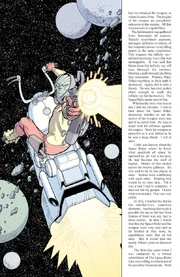
Nolan speaks of the Space Racer.
The Rognarr's planet has gravity so dense that the Rognarr evolved to be extra tough just so they could move. They are strong enough to easily kill Viltrumites, so one can assume their planet has the same properties as Viltrum at the very least. To estimate the force needed to
destroy the disk, we need to consider:
- The disk’s size and mass – It must be large and strong enough to withstand the gravitational pull of a planet 11 times Earth's gravity.
- The material strength – It must block all the heat from the star, meaning it has to be massive and durable enough to withstand immense radiation pressure.
- The force required to shatter it – The energy needed depends on whether we want to break it apart (structural failure) or completely vaporize it (full destruction).
Step 1: Estimate the Disk’s Mass
- The disk must be at least the diameter of the planet (11× Earth's diameter = 140,000 km).
- It also must be thick enough to stay intact, so we assume a thickness of 100 km (a rough guess for something truly indestructible).
- If made of something super-strong like neutron star material, the density could be 1017 kg/m³.
- The volume of the disk(assuming a circular shape): V=πR2×thickness
- Using R=70,000 km (converted to meters): V=π(7×10⁷)2×(105) =1.54×10²¹ m3
- Mass of the disk: M=ρ×V =(1017)×(1.54×1021) =1.54×1038 kg
Step 2: Energy Needed to Destroy the Disk
Since the disk is
huge and dense, breaking it apart requires overcoming its
gravitational binding energy (similar to a planet’s destruction). Using the same formula:
U=5R3GM2
- Gravitational constant G=6.674×10⁻¹¹.
- Using M=1.54×1038 kg and R=7×10⁷ m:
U=5(7×10⁷)3(6.674×10⁻¹¹)(1.54×1038)2 =1.01×1054 J
Step 3: Convert Joules to Megatons
Using
1 megaton of TNT = 4.184×10¹⁵ J:
4.184×10151.01×1054 =2.42×1038 megatons
Thaddeus stated that the Coalition of Planets does not possess a weapon capable of harming Viltrumites. Later on, Conquest even destroys the ship that holds this canon that destroyed the Sun Disk. The ship would need to be durable enough to withstand the recoil energy of the cannon, making this feat consistent. Furthermore, a massive plot point in the arc was trying to find a weapon capable of harming Viltrumites. It could be argued that the Viltrumites could dodge the ray from the cannon, hence why Thaddeus said the ship's cannon could not hurt them, but that would be untrue, as the Coalition of Planets has shown to have knowledge of where the Viltrumites reside, so the Coalition could've always orchestrated a sneak attack against them if the cannon could truly harm them. (Thaddeus is not above using sneak attacks, as he has used the Scourge Virus against Viltrumites in the past.)

I picked neutron star material in that example because:
- The disk would need to withstand the gravitational pull of a planet 11× Earth’s gravity.
- It would need to completely block the heat from reaching the planet—which implies it can’t bend, warp, or disintegrate under immense radiation pressure, gravitational stress, or temperature differentials.
- Neutron star matter is basically the strongest naturally occurring matter we know of: it has insane density and tensile strength, making it the toughest known natural material.
- As stated, Conquest destroyed the Coalition spaceship, which destroyed the Sun Disk, meaning that he scales to the energy needed to destroy said Sun Disk. Some arguments are made that the spaceship had a wide surface area, so the force was distributed across the ship in a less concentrated manner. But that is irrelevant, as Conquest destroys the ship in its entirety. Another argument is often made using tanks as an example. The argument goes that the Coalition spaceship could not actually withstand its own force because tanks can destroy other tanks with their cannons. But all that means is that Conquest can exert an equal or greater force than the Coalition spaceship's cannon. Here's why:
Yes, tanks are engineered to withstand the recoil forces generated by their main guns. This capability is achieved through the integration of sophisticated recoil management systems that absorb and dissipate the energy produced during firing, thereby preserving the structural integrity and stability of the vehicle.
One notable example is the M1 Abrams tank, which employs advanced hydraulic recoil mechanisms and torsion bar suspensions to mitigate recoil impact. These systems function collectively to stabilize the tank during firing operations, enhancing both accuracy and crew safety. https://militarysphere.com/recoil-management-5/
Additionally, research has been conducted to further reduce recoil forces in armored vehicles. For instance, a study explored the implementation of a soft recoil system using a mass-spring-damper model. The findings indicated that such a system could effectively decrease recoil impact, leading to reduced displacement during firing and shorter firing intervals.https://www.academia.edu/32058437/F...ance_rejection_control_to_reject_recoil_force, https://www.researchgate.net/public...for_Soft_Recoil_System_using_Dynamic_Behavior
Moreover, advancements in recoil mechanism design have been documented, such as the development of concentric hydro-spring recoil systems. These modern systems offer compactness and high performance, contributing to improved recoil management in contemporary high-power tank guns.
In summary, through the integration of specialized recoil management systems and ongoing research into innovative technologies, tanks are effectively designed to withstand and manage the forces generated by their own weaponry.https://militarysphere.com/recoil-management-5/
Yes, both tanks and firearms can experience structural failures due to recoil forces if they are not adequately designed or maintained. Such failures often result from material fatigue, inadequate design, or manufacturing defects, leading to compromised durability and potential destruction of the equipment.https://www.researchgate.net/publication/388235221_GENERAL_THEORETICAL_AND_PRACTICAL_SIMILARITIES_in_Three_Notable_US_and_German_World_War_II_Armour_Penetration_Studies?utm_
Firearms:
Firearms are susceptible to structural failures if critical components cannot withstand the stresses imposed by repeated firing. For example, the Winchester Model 1911 shotgun experienced issues where the buffer rings, designed to reduce recoil, often failed. This failure led to increased recoil, causing stocks to split and rendering the firearm unsafe to operate. https://en.wikipedia.org/wiki/Winchester_Model_1911
Additionally, a study on machine gun bolts revealed that premature failures occurred due to fatigue fractures. These fractures often initiated at locations with stress risers, such as sharp corners or holes, leading to cracks and eventual failure of the bolt during firing. https://www.researchgate.net/public...d_modelling_of_highly_stressed_firearms_parts, https://www.americanrifleman.org/content/metal-fatigue-failures-is-your-gun-at-risk/
Tanks:
Tanks can also suffer from structural failures related to recoil mechanisms. A failure analysis of high-strength steel bolts used in an army tank's recoil mechanism revealed that pre-existing quench cracks, which should have been detected during manufacturing inspections, led to bolt failures during installation. These compromised bolts could potentially fail under the stress of recoil during firing, jeopardizing the tank's operational integrity. https://www.astm.org/stp13524s.html
In summary, inadequate design, material defects, or insufficient maintenance can lead to structural failures in both firearms and tanks due to recoil forces. Ensuring rigorous design standards, quality manufacturing processes, and regular maintenance is essential to prevent such failures and maintain the safety and effectiveness of these weapons.
Tanks are engineered to withstand the recoil forces generated by their own cannons through specialized recoil management systems. These systems, including hydraulic cylinders and springs, absorb and dissipate the energy produced during firing, ensuring the structural integrity and stability of the tank. For instance, a study on the movement of 125 mm tank cannon recoiling parts highlights the effectiveness of these mechanisms in controlling recoil forces. https://www.researchgate.net/publication/353698092_Study_of_movement_of_125_mm_tank_cannon_recoiling_parts?utm_source
In contrast, when a tank is struck by an enemy's armor-piercing shell, the situation differs significantly. These projectiles are designed to concentrate immense kinetic energy onto a small impact area to penetrate armor. Research into armor penetration during World War II revealed that highly kinetic armor-piercing shells were capable of breaching adversaries' armor due to their focused energy delivery. https://www.researchgate.net/publication/388235221_GENERAL_THEORETICAL_AND_PRACTICAL_SIMILARITIES_in_Three_Notable_US_and_German_World_War_II_Armour_Penetration_Studies?utm_source
Moreover, advancements in ammunition, such as the use of depleted uranium (DU) in anti-tank projectiles, have enhanced penetration capabilities. DU's high density and self-sharpening properties make it more effective than alternatives like tungsten, enabling it to breach modern tank armor more efficiently. https://www.wired.com/2009/12/army-...anium-for-new-weaponry?utm_source=chatgpt.com
In summary, tanks can manage the predictable and internally generated recoil forces of their own cannons through dedicated recoil systems. However, they remain vulnerable to the concentrated and externally applied forces of enemy projectiles specifically engineered to penetrate armor


