There's nothing for it to pull towards that we see in panel so moot point
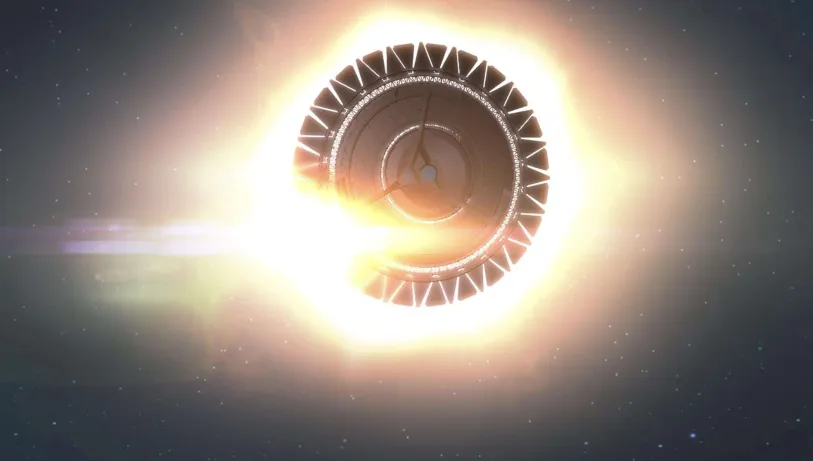
The literal star VERY CLOSE TO IT.
if none of the disk was damaged at all then there is no "chain reaction",
That is literally incorrect, energy phases through material without shattering it and can still damage the inside, the fact the missiles didn't destroy any material makes it questionable that you're attributing the larger explosion to the missiles themselves.
No, there is no chain reaction that blows up the planet with anything to do with Earth's core. The Earth doesn't have 60 Zettatons of Energy just sitting around in the core waiting for a spark to make it go boom, planet's aren't bombs. Mechanical components also don't mean anything on their own.
The thermal energy alone is already at 10-20% of the Earth's GBE, that's just in the core. The gravity that holds the planet together is also energy. You could absolutely cause a chain reaction by releasing the thermal energy which would essentially destroy the planet.
Your interpretation is also subjective that's the point I was trying to make
Mine is supported by visuals, yours is supported by vibes.
I don't think you understand what GBE is. Gravitational binding energy has nothing to do with the gravitational force of the disk or the star pulling on each other. It is the internal gravitational energy holding the disk together. Also literally everything in the universe with mass applies a force of gravity on each other so the disk is literally pulling the star yes.
I admit my mistake.
What I meant to say is, the mass and overall proportions and distance the Disk is from the star doesn't make sense, thus, the GBE calculated using these statistics don't make sense as well. A Disk that massive, that close to the star, would inevitably be pulled in by it, and vice versa. Which is why the GBE isn't valid, because the stats used to calculate it aren't valid.
The Disk doesn't appear to move while on screen. It is a literal metal disk in front of the star, placed to block the star's light from reaching a planet, which implies the angular momentum of the Disk is equal to the planet's year-round trip around it.
I will calculate it's gravitational pull, and show how it doesn't make sense for it to be so close, or so massive.
Given:
- Distance r ≈ 1.35 × 10^9 m
- Disk mass M_d ≈ 2.94 × 10^28 kg
- Star radius ≈ 5.94 × 10^8 m
- Star mass M_s ≈ 2 × 10^30 kg
- r_com = r × (M_d / (M_s + M_d))≈ 1.35e9 × (2.94e28 / 2.03e30)≈ 1.35e9 × 0.0145≈ 1.96 × 10^7 m
- That is ~19,600 km from the star’s center.
- The star’s radius is ~5.94 × 10^8 m.
Orbital speed required to not fall in:
v = sqrt(G M_s / r)
v ≈ sqrt(6.67e-11 × 2e30 / 1.35e9)
≈ sqrt(9.88e10)
≈ 3.14 × 10^5 m/s
So the disk needs ~314 km/s sideways speed to stay in orbit. That would make for a
7.5 hour orbit. This doesn't make any sense, the Disk is supposed to follow the planet's orbit so it constantly blocks it,
it needs to orbit the star in a year, but it couldn't at that distance. So either the distance is incorrect, or the mass is incorrect. The disk has ~15 Jupiter masses, it would also collapse under its own weight.
At that proximity, it would suffer strong tidal forces from the star. It should absolutely fall in.
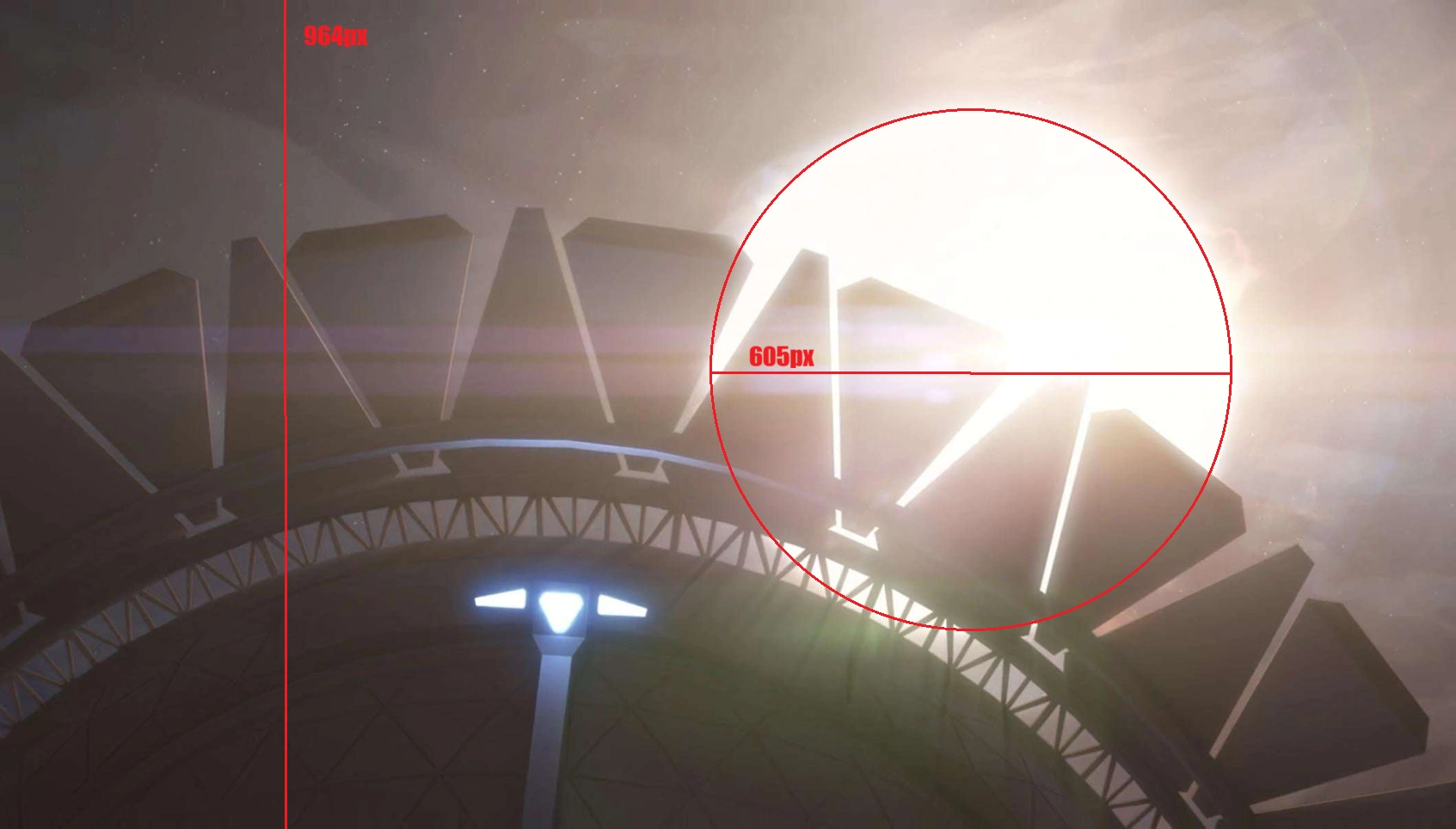
The reason why using the star's apparent radius on the screen might've led to the deflated distance is because of this effect:
The sun should be way smaller than it appears.