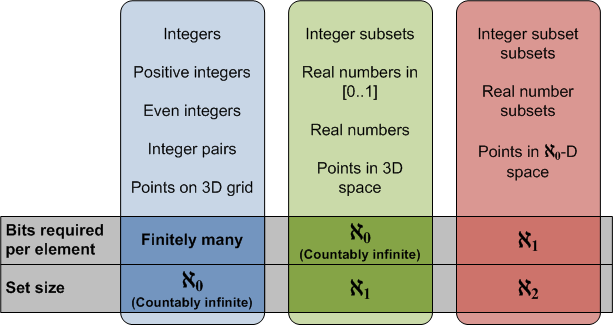
He thinks exponentiation of infinite sets is the same as finite sets. so he thinks infinity * infinity = infinity ^ 2 , thats what hes trying to argue.
I’m not sure why, but this is one of the most persistent questions about mathematics. I understand that infinity is fascinating or confusing, but it’s useful to understand that we have great freedom in math to define things however we wish, and we choose to do so when it’s useful, or beautiful, or interesting.
Yes, there are various contexts where
∞
=
∞
+
1
is a valid, formal, precise assertion. There are other contexts in which this would be a meaningless expression, and yet others in which it would be false. The symbol
∞
is used in many different ways across math.
Here is Rudin, Real and Complex Analysis, a standard graduate-level textbook on measure theory and integration, p. 18:
Arithmetic in
[
0
,
∞
]
1.22 Throughout integration theory, one inevitably encounters
∞
. One reason is that one wants to be able to integrate over sets of infinite measure […] much of the elegance of theorems like 1.26 and 1.27 would be lost if one had to make some special provisions whenever this occurs.
Let us define
a
+
∞
=
∞
+
a
=
∞
if
0
≤
a
≤
∞
[…]
It’s nothing profound or philosophically deep; it’s just a convenient shorthand which makes certain statements about sums and integrals easier to write down.
In cardinal arithmetic,
κ
+
1
=
1
+
κ
=
κ
whenever
κ
is an infinite cardinal (which is one common mathematical concept corresponding to “infinity”). On the other hand, in ordinal arithmetic,
1
+
ω
=
ω
while
ω
+
1
≠
ω
. So here is a case where “infinity + 1” is not the same as “infinity”.
Does this work this site ?