• This forum is strictly intended to be used by members of the VS Battles wiki. Please only register if you have an autoconfirmed account there, as otherwise your registration will be rejected. If you have already registered once, do not do so again, and contact Antvasima if you encounter any problems.

    For instructions regarding the exact procedure to sign up to this forum, please click here.
  • We need Patreon donations for this forum to have all of its running costs financially secured.

    Community members who help us out will receive badges that give them several different benefits, including the removal of all advertisements in this forum, but donations from non-members are also extremely appreciated.

    Please click here for further information, or here to directly visit our Patreon donations page.
  • Please click here for information about a large petition to help children in need.

VS Battles Wiki Forum

NikHelton
NikHelton
What value did you get?
Actually I don't know if it can be used because it's not certain that it was done with 1 attack.
NikHelton
NikHelton
I also updated Orochi's feat using the frame that we decided to use. Is the math ok?
Therefir
Therefir
I got around 11 gigatons for SG, which is why I didn't make a calc since rising the mountain got better results.

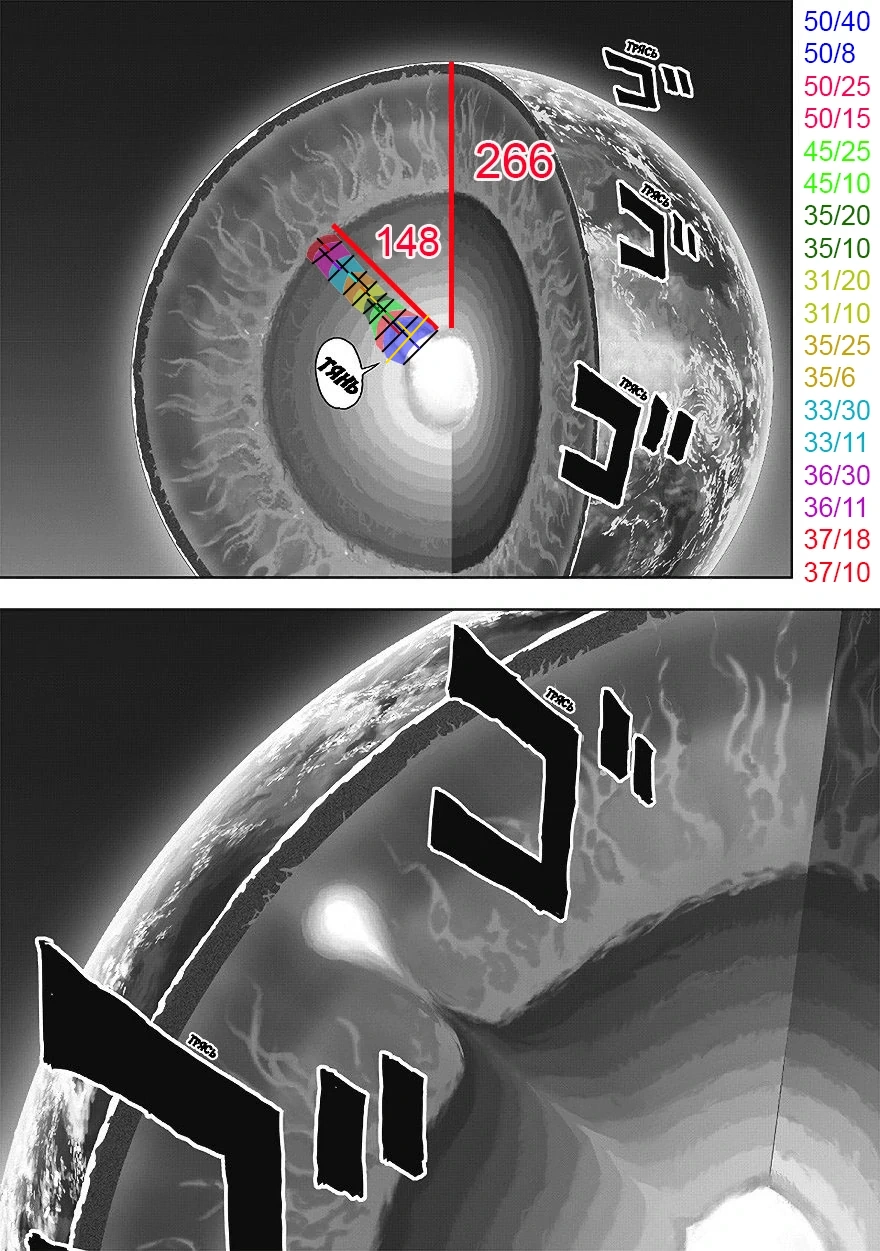
The portion of the outer core that was affected is only this small. You are using the whole energy ball once again, and applying those values to the rest of the outer core, and I also imagine you didn't use the 4.3 m/s^2 of acceleration in the outer core.

And the calculator that you linked doesn't show anything.

Actually I don't know if it can be used because it's not certain that it was done with 1 attack
It's funny you said that but fail to notice you are making a similar mistake with Orochi's calc :/
NikHelton
NikHelton
Yes, I really should correct the gravitational force.

But wait, what? You yourself threw off the photo in the comments and admitted that all the layers of the outer core were involved on the frame at a time.
And if you are talking about the point where the inner and outer core touch, then look at how low the boundary of the outer core is relative to the bunch. When the clot moves the inner core, it already begins to distort the outer one.
_vhz8xGSw48.jpg
Therefir
Therefir
That's the energy sphere, the inner core is made out of pure, solid iron, it's impossible for it to be stretched like that.

And going by your calc, the energy sphere would have drilled a massive hole between the layers. That never happened.
NikHelton
NikHelton
Look at the second frame. The inner core is destabilized and distorted. It was definitely stretched out.
I calculated not making a hole in the core, but lifting the entire mass that was affected.
But if you want I can calculate the PE of each layer and add up the results.
Therefir
Therefir
I already calculated the mass of each layer, except the one above the inner core.
Look at the second frame. The inner core is destabilized and distorted. It was definitely stretched out.
That's just energy being left behind. As I said the core is made of iron, it would break into pieces if it was stretched like that, the core is not in a liquid state or molten, it's completely solid:
"However, unlike the outer core, the inner core is not liquid or even molten. The inner core's intense pressure—the entire rest of the planet and its atmosphere—prevents the iron from melting. The pressure and density are simply too great for the iron atoms to move into a liquid state."
NikHelton
NikHelton
But you will not deny that the inner core is deformed on the second frame, will you?
I mean it really happened and it is unlikely that Murata thought about the malleability of the core.


But even so. It looks like the lower layers use more mass. The width of the base is clearly larger. I think it would increase the result a little.

I will make a more accurate version later.
Therefir
Therefir
That layer I need to measure separately, for the other layers the one I used as the average should be fine.
NikHelton
NikHelton
The lower layers are also an order of magnitude larger than those above. However, it will still be High 6-A I think.

By the way, it looks like KE Sage has been accepted. You seem to really like time frames. But I think that 3 seconds is too long for one frame when Sage is literally spinning so fast that it loses its shape.

I think you can use 1.5 and 2 seconds as the middle and low end.
Therefir
Therefir
I think you can use 1.5 and 2 seconds as the middle and low end.
At the very least this would be preferable over just having a 1 second end.

Notice me when you finish adding those timeframes so I can check the results.
NikHelton
NikHelton
I will be able to get to the computer only in a day, but with such time ends the result will be 2.25 and 4 times less, respectively.

This is 149 Teratons for the Low end and 265 Teratons for the Mid end. All results are still High 6-B.
NikHelton
NikHelton
I have added temporary ends for the Sage feat. Could you look again?
NikHelton
NikHelton
And could you tell me what this figure is called and how to find its volume?

The only thing that comes to my mind is to make one spherical cap and subtract the smaller volume from it by cutting


S0XolBgonfM.jpg
Therefir
Therefir
The closest thing I could find was a spherical dome and it's really complicated to find the values of it.

So I'm fine with your idea of using a spherical cap to then substract the smaller part (maybe by subtracting a 30% of it? Like if the spherical cap was hollow).
NikHelton
NikHelton
Well, I'll calculate it tomorrow.
What do you think about the temporary ends of Sage's feat? I have added the results
Therefir
Therefir
I like how you put two low-ends.

By the way, I recommend you to delete the part about the 500 meters, so the blog is easier to read.
NikHelton
NikHelton
I will do it tomorrow.

Could you leave a comment under the blog so this can be used?
Therefir
Therefir
I went with the 2 seconds end.
NikHelton
NikHelton
Back
Top
